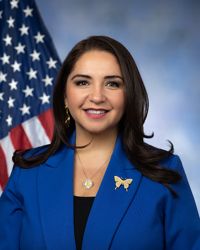
Delia C. Ramirez
DDemocratIL-3 · Representative
53
/ 100
Average
Attendance95
Avg: 96
Independence5
Avg: 4
Bipartisan Tone8
Avg: 15
Ethics Record100
Avg: 99
Transparency42
Avg: 53
Accountability Score — composite of attendance, independence, bipartisan tone, ethics record & transparency.
Methodology22
Bills Sponsored
0
Enacted into Law
0
Passed a Chamber
22
In Committee
All Sponsored Bills
HRES1627In Committee
Reaffirming the commitment of the House of Representatives to preserve and expand pathways to citizenship.
HR10803In Committee
To abolish the Department of Homeland Security and establish a Department of Community Safety, and for other purposes.
HRES1409In Committee
Recognizing the upcoming 250th anniversary of the United States of America and reaffirming the commitment of the House of Representatives to the Nation's founding ideals of liberty, equality, and opportunity for all immigrant communities in the United States.
This resolution marks the upcoming 250th anniversary of the United States and expresses the House's commitment to the founding principles of liberty, equality, and opportunity, with a specific focus on immigrant communities. The measure is largely symbolic and does not create new laws or programs, but rather serves as an official statement of support for these ideals as they apply to immigrants living in the country. It has been sent to the House Committee on Oversight and Government Reform for consideration.
HR1391In Committee
Student Veteran Benefit Restoration Act of 2025
This bill would restore or expand education benefits for military veterans who are pursuing college degrees or vocational training. The changes would likely make it easier for former service members to use their GI Bill benefits or access additional financial support for education without losing other military-related benefits they've earned. Veterans and their families would be the primary beneficiaries of these restored or improved education programs.
HRES1277In Committee
Recognizing, from Chicago to Palestine to the Democratic Republic of the Congo to Puerto Rico, that the pain, violence, and oppression the global majority experiences are interconnected, acknowledges that the future must be self-determined, and affirms our humanity and dignity through a renewed mandate for human rights.
This resolution expresses support for connecting human rights issues across different regions and communities, arguing that violence and oppression in places like Chicago, Palestine, the Democratic Republic of the Congo, and Puerto Rico are related problems requiring coordinated solutions. It calls for greater emphasis on self-determination and human rights protections for affected populations worldwide. The measure has been referred to multiple House committees for review, including those handling foreign affairs, defense, and financial matters.
HR8555In Committee
Living Wage For All Act
This bill would gradually raise the federal minimum wage over time with the goal of eventually matching the national median wage, ensuring workers earn what's considered a living wage. Large, highly profitable corporations would be required to reach higher wage standards first, and the bill would eliminate special lower wage rates currently allowed for certain workers like tipped employees and people with disabilities. The changes would affect millions of low-wage workers across the country and increase labor costs for businesses, particularly large corporations.
HRES1198In Committee
Recognizing that stable housing keeps families together.
This resolution expresses support for policies that help families maintain stable housing, recognizing that having a secure home is important for keeping families together. The measure has been sent to the House Financial Services Committee, which handles housing and banking issues, though it does not appear to propose specific new laws or programs at this stage.
HR7948In Committee
To deem certain individuals as parents of Department of Veterans Affairs employees for purposes of determining entitlement to certain family and medical leave for such employees.
This bill would expand the definition of "parent" for VA employees seeking family and medical leave, allowing them to take time off to care for individuals who aren't their biological or adoptive parents but have served a parental role in their lives. The change would let VA workers use federal family leave benefits for people like stepparents, grandparents, or other family members who raised them, making the leave policy more flexible for employees with non-traditional family structures.
HR7709In Committee
Full-Body Restraint Prohibition Act
This bill would ban the use of full-body restraints on immigrants in custody, such as shackles or chains that restrict movement across the entire body. The prohibition would apply to immigration enforcement agencies and detention facilities that hold people awaiting deportation hearings or processing. The measure aims to prevent physical injuries and improve conditions for immigrants in government custody.
HR7556In Committee
Pensions for All Act
This bill would require employers to automatically enroll their workers in retirement savings plans, making it easier for employees to save for retirement without having to set up accounts on their own. It aims to expand access to pension-like benefits to workers who currently lack employer-sponsored retirement plans, particularly those at smaller companies or in certain industries. The proposal would affect both employers and workers across the labor market.
HR7190In Committee
To end detention and electronic monitoring, and redirect funding to community-based wrap-around services.
The bill would eliminate immigration detention facilities and electronic monitoring programs that track immigrants, instead using that money to fund community support services like housing, job training, and counseling for immigrants in the United States. This would affect immigration enforcement practices and how the government handles people in the immigration system, shifting from incarceration-based approaches to community-based alternatives.
HR7231In Committee
Lobbyist Loophole Closure Act
This bill would close legal gaps that allow certain people who influence government policy to avoid registering as lobbyists, making it harder for them to operate behind the scenes without public disclosure. The changes would likely require more people who are paid to persuade lawmakers to officially register and report who they work for and how much they spend, giving voters and watchdog groups better visibility into who is trying to influence Congress. The bill affects lobbying firms, their clients, and anyone paid to advocate for specific policies in Washington.
HR7119In Committee
DHS Use of Force Oversight Act
This bill would establish new oversight rules for how the Department of Homeland Security uses force during immigration enforcement operations, likely requiring better documentation, training, and accountability when agents use physical force against immigrants or during border enforcement activities. The legislation aims to ensure that DHS agents follow consistent standards and that there are clearer consequences when force is used improperly, affecting both immigration enforcement officers and the people they encounter during enforcement actions.
HR6015In Committee
VA Care and Benefits Accountability Act
The legislation would require the Department of Veterans Affairs to improve how it tracks and reports on the quality of care and benefits it provides to veterans, making information about wait times, treatment outcomes, and benefit processing more transparent and accessible to the public. It would also establish new accountability measures to ensure the VA is meeting performance standards and would create mechanisms for veterans and Congress to better monitor the agency's effectiveness. Veterans, VA employees, and taxpayers would be affected by these changes, as they would lead to greater oversight of how the VA spends resources and delivers services.
HR6014In Committee
Right to Representation for Department of Veterans Affairs Workers Act of 2025
This bill would give Department of Veterans Affairs employees the right to be represented by a union or labor representative when dealing with workplace matters like discipline or grievances. The change would apply specifically to VA workers and could affect how the agency handles personnel decisions and employee disputes. Veterans Affairs employees would gain protections similar to those available to many other federal workers.
HCONRES57In Committee
Honoring Wadee Alfayoumi, a 6-year-old Palestinian-American boy, murdered as a victim of a hate crime for his Palestinian-Muslim identity, in the State of Illinois.
HR5336In Committee
Equal Tax Act
Without more specific details about what tax changes this bill proposes, it likely aims to adjust how taxes are calculated or applied to make the tax system fairer across different groups of people or income levels. The bill has been sent to the House Committee on Ways and Means, which handles all federal tax legislation, but its exact impact on workers, businesses, or different income groups cannot be determined until the specific provisions are revealed.
HR5238In Committee
Stop Super PAC-Candidate Coordination Act
Stop Super PAC-Candidate Coordination Act This bill treats certain payments for coordinated expenditures as campaign contributions for purposes of disclosure and reporting requirements. The bill generally defines a coordinated expenditure as a payment made by any person in cooperation with a candidate, an authorized committee of a candidate, a political committee of a political party, or an agent of a candidate or committee. Further, the bill sets forth penalties for willfully violating limits related to making contributions to a candidate for coordinated expenditures. The bill also prohibits a candidate or an individual holding federal office from soliciting, receiving, directing, or transferring funds to or on behalf of certain types of political committees.
HR3565In Committee
To provide for a limitation on the transfer of defense articles and defense services to Israel.
This bill prohibits the President from selling, transferring, or exporting certain defense articles or services to Israel, except in specified circumstances. Defense articles covered by the prohibition include BLU-109 bunker busting bombs, Joint Direct Attack Munition (JDAM) assemblies, and 155mm artillery ammunition. Defense services directly related to such articles are also covered. The President may sell, transfer, or export such defense articles or services to Israel if (1) a law is enacted specifying the purposes for which such articles or services may be used, and (2) Israel provides written assurances that the defense articles or services will be used for those specific statutory purposes and in a manner consistent with certain other laws, including international human rights laws.
HR3368In Committee
Born in the USA Act of 2025
This bill would change citizenship rules for children born in the United States to non-citizen parents, likely by restricting automatic citizenship at birth or creating new requirements for babies to become citizens. The change would affect millions of children born to immigrant parents and could alter long-standing immigration and citizenship policy. The bill has been sent to the House Judiciary Committee for review.
HR3013In Committee
To amend title 38, United States Code, to increase the authorization of appropriations for comprehensive service programs for homeless veterans.
The federal government would increase funding for programs that help homeless veterans find housing, get job training, and access mental health and substance abuse services. This would allow the Department of Veterans Affairs to expand and improve these support services across the country for veterans experiencing homelessness. The change affects homeless veterans and the organizations that provide them assistance.
HR3049In Committee
Tenants’ Right to Organize Act
This legislation would protect renters' legal right to form unions or tenant associations to collectively bargain with landlords over issues like rent, maintenance, and living conditions. The bill would prevent landlords from punishing tenants for organizing activities, similar to protections that exist for workers in other industries. Renters across the country would gain stronger tools to negotiate better housing conditions and advocate for their rights as a group.