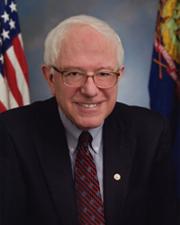
Bernard Sanders
IIndependentVT · Senator
71
/ 100
Above Average
Attendance93
Avg: 97
Independence100
Avg: 23
Bipartisan Tone14
Avg: 14
Ethics Record100
Avg: 100
Transparency31
Avg: 47
Accountability Score — composite of attendance, independence, bipartisan tone, ethics record & transparency.
Methodology45
Bills Sponsored
0
Enacted into Law
0
Passed a Chamber
43
In Committee
All Sponsored Bills
S5493In Committee
Ban Artificial Superintelligence Act of 2026
S5456In Committee
Stop Social Security Garnishment Act of 2026
S5384In Committee
Thirty-Two Hour Workweek Act
S5280In Committee
Guaranteed Paid Vacation Act
S5284In Committee
Green New Deal for Public Housing Act
S5185In Committee
Audit the Pentagon Act
Audit the Pentagon Act This bill requires the Department of Defense (DOD) to reduce spending for any department, agency, or other DOD element that DOD determines has not achieved an unqualified opinion on its full financial statements for the calendar year ending during that fiscal year. (An unqualified opinio n or clean audit means an auditor has determined the financial statements are presented fairly and provide a true view of an entity’s financial position.) Specifically, the amount available to such department, agency, or element for the fiscal year when the determination is made must be reduced by 2%. Amounts unavailable to such department, agency, or element must be applied on a pro rata basis against each program, project, and activity. DOD must deposit such unavailable amounts in the general fund of the Department of the Treasury for purposes of deficit reduction.
S5026Reported
Childhood Diabetes Reduction Act of 2026
Childhood Diabetes Reduction Act of 2026 This bill requires health warnings on labels and in advertisements for food and beverages that are sweetened, processed, or contain a high level of certain nutrients of concern, and it prohibits specifically advertising such products to children. It also expands research and outreach on proper nutrition. The bill requires various Food and Drug Administration (FDA) warnings on labels for (1) sugar-sweetened beverages, (2) food and beverages with non-sugar sweeteners, and (3) ultra-processed food and beverages. These warnings must contain specified information regarding the risks of developing certain health conditions (e.g., diabetes); warnings for sweetened food and beverages must specifically say that these products are not recommended for children. If a food or beverage contains a nutrient of concern (e.g., added sugar, saturated fat, or sodium) at a level that poses health risks, its label must indicate that the product is high in the relevant nutrient. Additionally, the bill prohibits marketing or advertising these products to children under the Federal Food, Drug, and Cosmetic Act, which is primarily enforced by the FDA. Further, marketing or advertising these products to children, or without including the required warnings, is considered an unfair or deceptive trade practice that is subject to action by the Federal Trade Commission (FTC). The bill specifically restores the FTC's statutory authority to regulate advertising targeting children. (This authority was limited in 1980.) Finally, the bill expands research on nutrition science and requires a public education campaign about nutrition and exercise.
S4825In Committee
American A.I. Sovereign Wealth Fund Act
The bill would create a new tax on artificial intelligence systems that are considered systemically important—meaning they're so large or widely used that problems with them could harm the broader economy. Companies developing or operating these major AI systems would have to pay this excise tax, which could affect tech companies, AI developers, and potentially increase costs for AI services. The proposal is currently under review by the Senate Finance Committee.
S4602In Committee
Abolish Super PACs Act
The proposal would cap how much money individuals and groups can donate to super PACs, which are organizations that spend unlimited funds on political advertisements and campaigns independent of candidates. Currently, super PACs can accept unlimited donations, but this bill would set reasonable contribution limits to reduce the influence of large donors in elections. The change would affect wealthy individuals, corporations, and other groups that fund these political organizations.
S4551In Committee
Restoring Overtime Pay Act of 2026
The bill would set a minimum salary level that salaried workers must earn to be classified as executives, administrators, or professionals who don't qualify for overtime pay, and would automatically increase that threshold each year to keep up with inflation. Currently, employers can classify many salaried workers as exempt from overtime rules even if they earn relatively low salaries, but this change would require them to pay overtime to salaried workers below the new threshold. The automatic annual updates would mean the salary requirement would grow over time without Congress having to pass new laws each year.
S4518In Committee
Universal School Meals Program Act of 2026
The proposal would provide free breakfast and lunch to every student in American schools, regardless of their family's income level. Currently, only students from lower-income families qualify for free or reduced-price meals, while others pay full price. This change would affect millions of schoolchildren and require schools to adjust their food service budgets and operations.
S4413In Committee
Protecting America’s Workers Act
The proposal would strengthen workplace safety rules by extending protections to more workers, making it harder for employers to punish employees who report unsafe conditions, and increasing fines for serious safety violations. It would also adjust penalties to account for inflation and give workers or their families greater rights when injuries occur. The changes aim to make workplaces safer and give workers more power to speak up about dangerous conditions without fear of retaliation.
SJRES138In Committee
A joint resolution providing for congressional disapproval of the proposed foreign military sale to the Government of Israel of certain defense articles and services.
This joint resolution prohibits a proposed foreign military sale of certain defense articles and services to Israel.
SJRES32In Committee
A joint resolution providing for congressional disapproval of the proposed foreign military sale to the Government of Israel of certain defense articles and services.
This joint resolution prohibits a proposed foreign military sale of certain defense articles and services to Israel.
S4272In Committee
Home Team Act of 2026
Without specific subjects listed, this bill likely addresses policies related to sports, local teams, or community athletic programs, though the exact focus cannot be determined from the title alone. The referral to the Commerce, Science, and Transportation Committee suggests it may involve interstate commerce, broadcasting rights, or federal regulation of sports leagues and their operations. More information about the bill's specific provisions would be needed to explain what it would actually do for fans, teams, or communities.
S4214In Committee
Artificial Intelligence Data Center Moratorium Act
Artificial Intelligence Data Center Moratorium Act This bill prohibits building or upgrading artificial intelligence (AI) data centers until laws regulating AI and AI data centers are enacted. It also restricts the export of AI-related computing hardware to countries without similar laws in effect. Specifically, no AI data center may be constructed or upgraded until laws are enacted (1) subjecting AI products to prerelease federal review and approval for safety and effectiveness, and (2) ensuring that AI-related economic gains benefit workers and the people of the United States (including by preventing AI-related job loss). Further, with respect to AI data centers built or upgraded after the moratorium ends, these laws must ensure such centers do not increase consumers’ utility bills and do not harm the environment; affected communities are empowered to approve or reject construction or upgrades; such centers create union jobs subject to labor standards; and no government subsidy is provided for the construction, upgrade, or operation of such centers. Under the bill, the term AI data center includes collocated structures and equipment under common ownership or control used for AI development or operation that meet certain power and design specifications. Additionally, the Department of Commerce must prohibit the export, reexport, or in-country transfer of specified computing hardware for AI-related use to any country that does not have comparable laws or regulations in effect. Finally, the Department of Energy must periodically report on AI data centers’ funding sources, energy and water use, and labor.
SJRES137In Committee
A joint resolution providing for congressional disapproval of the proposed foreign military sale to the Government of Israel of certain defense articles and services.
Congress is considering blocking a planned sale of military equipment and services to Israel that the executive branch had proposed. If passed, this resolution would prevent that specific arms sale from moving forward, giving lawmakers a chance to reject a foreign military transaction they believe shouldn't happen. The measure is currently under review by the Senate Foreign Relations Committee.
SJRES136In Committee
A joint resolution providing for congressional disapproval of the proposed licensing of certain defense articles and services to Israel.
This resolution would block the federal government from approving the sale of certain military equipment and services to Israel. If passed, it would prevent a specific weapons deal that the administration had proposed, giving Congress the power to reject the sale even though the president wanted to move forward with it. The measure affects defense contractors who would have supplied the equipment and the U.S.-Israel military relationship.
S3956In Committee
Make Billionaires Pay Their Fair Share Act
This bill would impose a new annual tax on the wealth of extremely wealthy individuals, likely those with net worth above a certain threshold like $50 million or $1 billion. The tax would apply to their total assets rather than just their income, and the revenue collected would go toward federal spending. Supporters argue it would reduce wealth inequality and fund government programs, while critics worry it could be difficult to implement and might discourage investment.
S3869In Committee
Healthy Families Act
This bill would require employers to provide paid sick leave to their workers, allowing employees to take time off for their own illness or to care for sick family members without losing pay. The law would apply to most private employers and would give workers a set number of paid sick days each year that they could use for medical appointments, preventive care, or caring for relatives. This would help workers avoid financial hardship when they or their loved ones get sick while also reducing the spread of illness in workplaces.
S3622In Committee
SERVE Act
Without access to the specific legislative text, this bill likely addresses government operations or service-related policies, possibly involving federal employees, veterans' benefits, or public service programs based on its referral to the Homeland Security and Governmental Affairs Committee. The exact impact on workers, agencies, or the public would depend on the bill's specific provisions, which would be clarified once the committee reviews it.
S2954In Committee
Health Care Workforce Expansion Act of 2025
Health Care Workforce Expansion Act of 2025 This bill establishes grants to (1) cover the tuition of certain students at health professions schools, (2) expand enrollment at health professions schools, and (3) assist health care practitioners with relocating their practices to rural areas. The Department of Education must provide grants to students at schools of medicine, dentistry, and nursing to fully pay their tuition and required fees. Medical students must agree to practice primary care for 10 years after graduation, and dentistry students must agree to practice in a rural area for 10 years after graduation. If recipients fail to complete such service, the grants become loans requiring repayment of up to $50,000. Additionally, the bill increases the number of residency positions eligible for graduate medical education payments under Medicare for qualifying hospitals, with a focus on psychiatry and primary care residencies. It also reauthorizes through FY2035 the Teaching Health Center Graduate Medical Education Program, which supports education and training of medical students in primary care residency programs in community-based ambulatory patient care centers. The Health Resources and Services Administration (HRSA) must provide 10-year grants to schools of medicine, dentistry, and nursing to expand student enrollment, such as through educational partnerships and modernizing programs. HRSA must also provide grants to physicians, dentists, and nurses to assist with relocating their practices to rural areas. Grant recipients must agree to practice in the new location for at least three years.
S2819In Committee
Head Start for America's Children Act
This bill would likely expand or modify the Head Start program, which provides early childhood education and development services to low-income preschool-age children and their families. The changes could involve increased funding, improved program standards, or expanded access to help more disadvantaged children prepare for kindergarten and elementary school. Families with young children in lower-income households would be the primary beneficiaries of any program improvements or expansions.
SJRES41In Committee
A joint resolution providing for congressional disapproval of the proposed export of certain defense articles to Israel.
This joint resolution prohibits a proposed export of certain firearms, parts, and components to Israel.
SJRES70In Committee
A joint resolution providing for congressional disapproval of the proposed export of certain defense articles to Israel.
This joint resolution prohibits a proposed export of certain firearms, parts, and components to Israel.
S2444In Committee
End Polluter Welfare Act of 2025
This bill would eliminate or reduce tax breaks and subsidies that currently benefit oil, gas, coal, and other fossil fuel companies. The changes would affect energy companies' bottom lines by making them pay more in taxes, potentially leading to higher costs for consumers and workers in those industries. The goal is to redirect government support away from polluting energy sources and toward cleaner alternatives.
S2335In Committee
Pensions for All Act
This bill would require employers to automatically enroll their workers in retirement savings accounts, similar to how 401(k) plans work, making it easier for employees to save for retirement without having to set up accounts on their own. The goal is to help more American workers, especially those at smaller companies that don't currently offer pension plans, build retirement savings over time. Workers would still be able to opt out if they choose not to participate.
S1832In Committee
College for All Act of 2025
This bill would make college tuition free or significantly more affordable for students by having the federal government cover costs at public colleges and universities. It would likely affect millions of students and families by reducing or eliminating the need to take out student loans, while also potentially increasing funding for community colleges and trade schools. The proposal aims to make higher education more accessible regardless of family income.
S1818In Committee
Prescription Drug Price Relief Act of 2025
Prescription Drug Price Relief Act of 2025 This bill requires the Department of Health and Human Services (HHS) to review brand-name drugs annually for excessive pricing and, if a drug is found to be priced excessively, to void any exclusivity granted to its sponsor. Specifically, HHS must review all brand-name drug prices at least annually and upon petition. If any such drugs are found to be excessively priced, HHS must (1) void any government-granted exclusivity; (2) issue open, nonexclusive licenses for the drugs; and (3) expedite the review of corresponding applications for generic drugs and biosimilar biological products. HHS must also create a public database with its determinations for each drug. An entity accepting an open, nonexclusive license under these provisions must pay a reasonable royalty to the holder of the relevant patent or approved new drug application, and must price the generic drug or biosimilar below the excessive rate. Under the bill, a price is considered excessive if the domestic average manufacturing price exceeds the median price for the drug in Canada, the United Kingdom, Germany, France, and Japan. If a price does not meet this criteria, or if pricing information is unavailable in at least three of these countries, the price is still considered excessive if it is higher than reasonable in light of specified factors, including development cost, revenue, and the size of the affected patient population. The bill also requires drug manufacturers to report specified financial information for brand-name drugs, including research and advertising expenditures.
S1730In Committee
Water Affordability, Transparency, Equity, and Reliability Act of 2025
S1506In Committee
Medicare for All Act
Medicare for All Act This bill establishes a national health insurance program that is administered by the Department of Health and Human Services (HHS). Among other requirements, the program must (1) cover all U.S. residents; (2) provide for automatic enrollment of individuals upon birth or residency in the United States; and (3) cover items and services that are medically necessary or appropriate to maintain health or to diagnose, treat, or rehabilitate a health condition, including hospital services, prescription drugs, mental health and substance abuse treatment, dental and vision services, home- and community-based long-term care, gender affirming care, and reproductive care, including contraception and abortions. The bill prohibits cost-sharing (e.g., deductibles, coinsurance, and copayments) and other charges for covered services, with the exception of prescription drugs. Additionally, private health insurers and employers may only offer coverage that is supplemental to, and not duplicative of, benefits provided under the program. Health insurance exchanges and specified federal health programs terminate upon program implementation. However, the program does not affect coverage provided through the Department of Veterans Affairs, TRICARE, or the Indian Health Service. Additionally, state Medicaid programs must cover certain institutional long-term care services. The bill also establishes a series of implementing provisions relating to (1) health care provider participation; (2) HHS administration; and (3) payments and costs, including the requirement that HHS negotiate prices for prescription drugs and establish a formulary. Individuals who are age 18 or younger may enroll in the program starting one year after enactment of this bill; other individuals may buy into a transitional plan or an expanded Medicare program at this time, depending on age. The bill's program must be fully implemented four years after enactment.
S1332In Committee
Raise the Wage Act of 2025
This bill would increase the federal minimum wage, which is the lowest hourly rate employers are legally required to pay workers, making it higher than the current $7.25 per hour that has been in place since 2009. The change would affect millions of low-wage workers across the country, particularly in retail, food service, and other service industries, while potentially increasing costs for small and large businesses. The bill is currently under review by the Senate committee responsible for labor and employment issues.
S939In Committee
Medicare Dental, Hearing, and Vision Expansion Act of 2025
Medicare Dental, Hearing, and Vision Expansion Act of 2025 This bill provides for coverage of dental, hearing, and vision care under Medicare. Specifically, the bill provides for coverage of dental and oral health services, including cleanings, treatments, and dentures; hearing aids and related services, including aural rehabilitation services; and vision services, including routine eye exams and eyeglasses. The Centers for Medicare & Medicaid Services (CMS) must set a fee schedule for dental and oral health services based on the national median fees for similar services, and it must phase in adjustments to premiums for Medicare medical services to account for coverage of dental and oral health services over a three-year period beginning in 2028. Payment to providers of hearing aid services must be made on an assignment-related basis; payment to providers of vision services must be made under the physician fee schedule. The bill provides funds for FY2025 for the CMS to implement the bill's changes.
SRES109In Committee
A resolution expressing the sense of the Senate that Russian President Vladimir Putin should immediately withdraw Russian forces from Ukraine.
This resolution expresses the sense that Russian forces must immediately cease attacks on Ukraine and withdraw unconditionally.
S770In Committee
Social Security Expansion Act
Social Security Expansion Act This bill increases Social Security benefits, expands Social Security payroll taxes, and makes other changes to the Social Security program. Specifically, the bill changes the way Social Security benefits are calculated by increasing the primary insurance amount applicable to average monthly earnings that fall below a specified amount, and increasing bend points for individuals who become eligible for Social Security after 2025. (Bend points are dollar amounts at which earnings are segmented for the purpose of calculating an individual’s primary insurance amount. The share of an individual’s earnings that are replaced by Social Security decreases at each escalating bend point.) The bill also revises the method of calculating cost-of-living adjustments to account for the spending of individuals over the age of 62 and establishes a new minimum benefit for certain low earners. Further, the bill permits full-time students who are the children of deceased or disabled workers to collect Social Security or railroad retirement child’s benefits until they reach age 22. With respect to taxes, the bill extends payroll taxes on wages, salaries, and self-employment earnings to income above $250,000. (In 2025, the maximum amount subject to Social Security payroll tax is $176,100.) The bill also increases the net investment income tax and subjects active trade or business income to this tax. Finally, the bill combines the existing Federal Old-Age and Survivors Insurance Trust Fund and the Federal Disability Insurance Trust Fund into a single Social Security Trust Fund.
SJRES21In Committee
A joint resolution providing for congressional disapproval of the proposed foreign military sale to Israel of certain defense articles and services.
This joint resolution prohibits the proposed foreign military sale of certain defense articles and services to Israel.
S381In Committee
10 Percent Credit Card Interest Rate Cap Act
10 Percent Credit Card Interest Rate Cap Act This bill temporarily caps credit card interest rates at 10%. Creditors that knowingly violate this bill forfeit the entire interest of the debt. The bill also provides a private right of action for debtors to recover interest, finance charges, or fees. The action must be brought within two years of the violation. In addition, violations of this bill are subject to civil liability under the Truth in Lending Act, which is enforced by the Consumer Financial Protection Bureau and the Federal Trade Commission. These changes sunset on January 1, 2031.
S3923In Committee
Let the States Innovate on Sustainable Energy Act of 2010
Let the States Innovate on Sustainable Energy Act of 2010 - Amends the Public Utility Regulatory Policies Act of 1978 (PURPA) to allow a state legislature or regulatory authority to set the rates for a sale of electric energy by a facility generating electric energy from renewable energy sources pursuant to a state-approved production incentive program under which the facility voluntarily sells electric energy and an electric utility is required to purchase such energy at a specified rate.
S3612In Committee
Marsh-Billings-Rockefeller National Historical Park Establishment Amendments Act of 2010
Marsh-Billings-Rockefeller National Historical Park Establishment Amendments Act of 2010 - Amends the Marsh-Billings-Rockefeller National Historical Park Establishment Act to expand the boundary of the Marsh-Billings-Rockefeller National Historical Park in Vermont to include the King Farm in Woodstock, Vermont. Requires King Farm to be added to, and administered as part of, the Park and to be used for agricultural, forestry, conservation, and educational purposes.
S3460Reported
10 Million Solar Roofs Act of 2010
10 Million Solar Roofs Act of 2010 - Directs the Secretary of Energy (DOE) to establish a program under which the Secretary shall provide competitive grants to states, Indian tribes, and local governments to provide rebates, loans, or other incentives to eligible participants for the purchase and installation of solar energy systems for properties located in the United States. Requires the Secretary to implement criteria for awarding such grants that: (1) provides the maximum leverage of federal funds; (2) provides for the maximum deployment of solar energy; (3) ensures that grants are awarded to a diversity of geographic locations and recipients with different population sizes; (4) provides no less than 2% of the funds available to Indian tribes and consortia of Indian tribes; and (5) provides a preference for grant recipients that have established and maintained, or that agree to commit to establish and maintain, standards and policies to overcome barriers to distributed generation (including interconnection and net metering). Authorizes the use of funds received to expand or establish a solar rebate program, a solar loan program, a solar performance-based incentive program, or another solar incentive program, solar deployment program or project, or innovative solar financing program as determined by the Secretary. Requires a grant recipient to: (1) certify that funds will be used to supplement, expand, or create new programs and to deploy an increased quantity of solar energy systems; and (2) submit to the Secretary an implementation plan that contains projections for solar energy systems deployment, data regarding the number of eligible participants that are assisted under existing applicable state and local programs, and projections for additional solar energy system deployment and the number of additional eligible participants covered. Authorizes the Secretary to specify the type and capacity of solar energy system and type of deployment or incentive program for which the grant funds are made available. Makes each eligible entity receiving funds responsible for 20% of the amount of the provided funds. Provides that a participant who receives a rebate under this Act shall not be eligible for a rebate for expenditures for installation of a renewable energy system in connection with a dwelling unit or small business under the Energy Policy Act of 2005. Limits the aggregate value of the grants, rebates, and tax credits provided to an eligible participant to 50% of the cost to the purchaser of the purchase and installation. Sets a goal of installing distributed solar energy systems on not fewer than 10 million properties located in the United States by December 31, 2021. Requires the Secretary to report to Congress on recommendations in achieving such goal. Authorizes appropriations for FY2012-FY2021.
S3433In Committee
Clean Coasts and Efficient Cars Act of 2010
Clean Coasts and Efficient Cars Act of 2010 - Amends the Outer Continental Shelf Lands Act to prohibit the Secretary of the Interior from issuing a lease or permit for the exploration, development, or production of oil or natural gas in: (1) the Pacific and Atlantic Regions of the outer Continental Shelf; or (2) certain areas in the Gulf of Mexico. Replaces current fuel economy standards for automobiles for model years 2021 through 2030 with new standards for model years 2017 through 2030. Requires the Secretary of Transportation to prescribe an average fuel economy standard for passenger and non-passenger automobiles for each model year beginning with model year 2017 to achieve a combined fuel economy average for model year 2030 of at least 55 miles per gallon for the total fleet of passenger and non-passenger automobiles manufactured for sale in the United States for that model year (excluding light-duty vehicles that draw motive power from a battery with a capacity larger than 4 kilowatt-hours). Directs the Administrator of the Environmental Protection Agency (EPA), in collaboration with the Administrator of the National Highway Transportation Safety Administration (NHTSA), to ensure continued progress in significantly improving motor vehicle fuel efficiency and reducing greenhouse gas emissions by setting motor vehicle emission and fuel economy standards for model year 2017 and subsequent model years that reflect the greatest emission reductions and fuel efficiency improvement achievable through the application of technology that will be available for the model year to which the standards apply, considering the costs associated with the application of technology and other appropriate factors.
S2993In Committee
10 Million Solar Roofs and 10 Million Gallons of Solar Water Heating Act of 2010
10 Million Solar Roofs and 10 Million Gallons of Solar Water Heating Act of 2010 - Requires the Secretary of Energy to establish a program to provide rebates for the purchase and installation of solar photovoltaic systems and solar water heating systems for residential and commercial properties in order to install over 10 years at least : (1) an additional 10 million solar systems with a cumulative capacity of at least 30,000 megawatts; and (2) an additional 200,000 solar water heating systems with a cumulative capacity of 10 million gallons. Establishes rebate eligibility criteria and the amount of rebates.
S1721In Committee
Transportation Low Emissions Energy Plan 2020 Act
Transportation Low Emissions Energy Plan 2020 Act - Directs the Secretary of Transportation (DOT), in coordination with the Secretary of Energy (DOE) and the Administrator of the Environmental Protection Agency (EPA), to establish a stakeholder-driven process to develop a national transportation low emissions energy plan. Requires such plan to: (1) project the near- and long-term need for and location of electric drive vehicle refueling infrastructure at strategic locations across all major national highways, roads, and corridors; (2) identify infrastructure and standardization needs for electricity providers, infrastructure providers, vehicle manufacturers, and electricity purchasers; (3) establish a goal of achieving strategic deployment of electric vehicle infrastructure by 2020; (4) prioritize the development of standardized public charge access ports with wireless or smart card billing capability and level I and level II charge port systems (that charge an electric vehicle over a period of 8 to 14 hours and 4 to 8 hours, respectively) that will meet the energy requirements of the majority of plug-in hybrid and battery electric vehicles; (5) examine the feasibility of level III charge port systems that can charge over a period of 10 to 20 minutes; and (6) focus on infrastructure that provides consumers with the lowest cost while providing convenient charge system access. Authorizes the Secretary to: (1) designate within DOT a LEEP coordinator to oversee Plan development and the implementation of regional pilot projects; and (2) establish four pilot projects to demonstrate electric drive vehicles and infrastructure in rural locations and in commercial use.
S1621In Committee
Thermal Energy Efficiency Act of 2009
Thermal Energy Efficiency Act of 2009 - Establishes in the Treasury a Thermal Energy Efficiency Fund. Requires the Administrator of the Environmental Protection Agency (EPA) to: (1) allocate to the Fund 2% of the quantity of emission allowances established for any of calendar years 2012-2050 under any program for the regulation of greenhouse gas emissions that is established by federal law; (2) auction all of the emission allowances allocated to the Fund for a calendar year; and (3) deposit all proceeds of such auctions into the Fund. Directs the Secretary of Energy (DOE), for each calendar year during which such a program is in effect, to use amounts in the Fund to make competitive grants to eligible entities (including state and local governments, commercial or industrial entities, and federal agencies) to carry out qualifying district energy, combined heat and power, or recoverable waste energy projects. Establishes as a goal of the United States to meet 20% or more of total U.S. electrical power capacity through combined heat and power by calendar year 2030.
S1246In Committee
Home Energy Retrofit Finance Program Act
Home Energy Retrofit Finance Program Act - Directs the Secretary to Energy (DOE) to: (1) provide Home Energy Retrofit Finance Program grants to states to establish or expand revolving finance funds to support financing for energy efficiency measures and renewable energy improvements to existing homes and residential buildings; and (2) conduct and report to Congress on an evaluation of such Program.