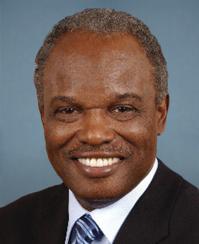
David Scott
DDemocratGA-13 · Representative
50
/ 100
Average
Attendance99
Avg: 96
Independence2
Avg: 4
Bipartisan Tone10
Avg: 15
Ethics Record100
Avg: 99
Transparency17
Avg: 53
Accountability Score — composite of attendance, independence, bipartisan tone, ethics record & transparency.
Methodology7
Bills Sponsored
0
Enacted into Law
0
Passed a Chamber
7
In Committee
All Sponsored Bills
HR6819In Committee
Bridge to Summer Nutrition Act of 2025
The bill would extend nutrition assistance to children during summer months when school meal programs aren't available, helping low-income families afford food when kids are out of school. It likely expands or creates summer food benefits similar to existing school lunch programs to prevent hunger gaps during the break. The measure affects families with school-age children and involves both agriculture and education agencies in its implementation.
HRES1200In Committee
Supporting the designation of March 2026 as Endometriosis Awareness Month.
This resolution would officially designate March 2026 as Endometriosis Awareness Month to increase public understanding of a painful condition affecting millions of women and people with female reproductive systems. The designation would encourage healthcare providers, organizations, and the public to raise awareness about endometriosis symptoms, treatment options, and the impact it has on patients' quality of life. While symbolic rather than creating new programs or funding, the designation aims to shine a spotlight on a condition that is often underdiagnosed and misunderstood.
HR6726In Committee
To amend the Housing and Urban Development Act of 1968 to provide reforms to housing counseling and financial literacy programs.
The proposal would update federal housing counseling and financial literacy programs to help people better understand mortgages, budgeting, and homeownership responsibilities. It affects prospective homebuyers, renters, and families seeking to improve their financial knowledge through government-supported counseling services. The changes aim to modernize these programs to be more effective at preparing people for major housing decisions.
HRES579In Committee
Supporting the designation of July as Uterine Fibroids Awareness Month.
This resolution supports the goals and ideals of Uterine Fibroids Awareness Month.
HRES256In Committee
Supporting the designation of March 2025 as Endometriosis Awareness Month.
This resolution expresses support for the goals and ideals of Endometriosis Awareness Month. Endometriosis is a painful condition in which the tissue that normally lines the inside of the uterus grows outside the uterus.
HRES175In Committee
Recognizing the seriousness of polycystic ovary syndrome (PCOS) and expressing support for the designation of the month of September as "PCOS Awareness Month".
This resolution expresses support for the goals and ideals of PCOS Awareness Month. Polycystic ovary syndrome (PCOS) is caused by a hormone imbalance and can cause symptoms such as infertility, weight gain, excess hair growth, and acne.
HR812In Committee
MAKERS Act
Making Advances Kinetic Education, Research, and Skills Act or the MAKERS Act This bill requires the National Science Foundation (NSF) to award competitive grants to institutions of higher education to support research and development related to makerspaces. Under the bill, makerspaces are defined as community spaces that provide learners and entrepreneurs with tools, technology, and knowledge, and support educational opportunities for personal growth, workforce training, and early-stage business ventures. Grant funds may be used to support research on the effectiveness of makerspaces in engaging students and communities in science, technology, engineering, and math (STEM), among other functions. In awarding grants, the NSF must prioritize certain applicants, including (1) community colleges and minority-serving institutions; and (2) institutions that apply in partnership with workforce development entities, high-need local educational agencies, or independent nonprofit or academic makerspaces.