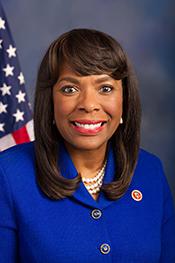
Terri A. Sewell
DDemocratAL-7 · Representative
63
/ 100
Average
Attendance98
Avg: 96
Independence4
Avg: 4
Bipartisan Tone15
Avg: 15
Ethics Record100
Avg: 99
Transparency95
Avg: 53
Accountability Score — composite of attendance, independence, bipartisan tone, ethics record & transparency.
Methodology12
Bills Sponsored
0
Enacted into Law
0
Passed a Chamber
12
In Committee
All Sponsored Bills
HR10374In Committee
Affordable Premiums for Seniors Act of 2026
HR10236In Committee
Protecting Student Athletes from Unexpected Tax Liability Act
HR8864In Committee
LIFT Act
I don't have enough information to write an accurate summary. The bill title "LIFT Act" and referral to the Ways and Means Committee suggest it likely deals with taxes or economic policy, but without knowing the specific subjects or provisions, I cannot reliably explain what the bill would actually do or who it affects. Could you provide the bill's subjects or a brief description of its contents?
HR7921In Committee
To amend the Consolidated Farm and Rural Development Act to modify provisions relating to rural decentralized water systems grants.
This bill revises and reauthorizes through FY2031 a program that provides financial assistance for rural water systems under the Consolidated Farm and Rural Development Act. Under the existing program, the Department of Agriculture may provide grants to nonprofit organizations that in turn must provide subgrants and loans to individuals for household water well systems or individually owned household decentralized wastewater systems in rural areas. This bill modifies the eligibility requirements for subgrants. To be eligible for a subgrant, an individual must be a member of a household with an annual combined income that is no more than 60% of the median nonmetropolitan household income for the area served by the nonprofit (currently, the state or territory in which the individual resides). The bill also allows a subgrant for a household decentralized wastewater system to include sufficient additional funding to cover the cost of a performance warranty with a duration of at least five years. In addition, the bill allows loans to be awarded to an individual who is a member of a household with an annual combined income that is 60% or more of the median nonmetropolitan household income for the area.
HR8153In Committee
Maternal Vaccination Act
This bill would likely establish or expand programs to encourage pregnant women and new mothers to receive vaccinations that protect both them and their babies from serious diseases. The measure would probably affect pregnant women, new mothers, healthcare providers, and potentially insurance coverage or public health initiatives related to maternal vaccination. The bill aims to improve health outcomes for mothers and infants by increasing vaccination rates during pregnancy and the postpartum period.
HR8024In Committee
Maternal Vaccination Act
This bill would likely establish or expand programs to encourage pregnant women and new mothers to receive vaccinations that protect both them and their babies from serious diseases. The measure would probably affect pregnant women, new mothers, healthcare providers, and potentially insurance coverage or public health initiatives related to maternal vaccination. The goal would be to increase vaccination rates among mothers to prevent disease transmission to infants who are too young to be vaccinated themselves.
HR4731In Committee
Resident Physician Shortage Reduction Act of 2025
Resident Physician Shortage Reduction Act of 2025 This bill increases the number of residency positions eligible for graduate medical education payments under Medicare for qualifying hospitals, including hospitals in rural areas and health professional shortage areas. The bill provides for an additional increase of 2,000 positions per fiscal year from FY2026-FY2032; during this period, each hospital may receive up to 75 additional positions in total under the bill and current law. Additionally, one-third of the positions that are made available under the bill must be allocated to hospitals that are already operating above applicable resident limits. The bill also requires the Government Accountability Office to report on strategies to increase the diversity of the health professional workforce, including with respect to representation from rural, low-income, and minority communities.
HR4381In Committee
To direct the Secretary of Defense to establish a pilot program regarding treating pregnancy as a qualifying event for enrollment in TRICARE Select.
The proposal would allow military spouses and dependents to enroll in TRICARE Select (the military's health insurance plan) when they become pregnant, treating pregnancy as a major life event that qualifies someone for coverage. Currently, people can only sign up for TRICARE Select during limited enrollment periods or after certain qualifying events like marriage or birth, so this would give pregnant women earlier access to military health benefits. The Defense Department would test this approach through a pilot program to see if it works before potentially expanding it more widely.
HR3890In Committee
Resident Physician Shortage Reduction Act of 2025
This bill would address the shortage of resident physicians—doctors in training—by likely increasing the number of training positions available through Medicare funding or other federal support. The change would help hospitals train more doctors and could improve access to medical care in underserved areas by expanding the pipeline of physicians entering the workforce. Residents, hospitals, and patients seeking medical care would be the primary groups affected by this legislation.
HR14In Committee
John R. Lewis Voting Rights Advancement Act of 2025
John R. Lewis Voting Rights Advancement Act of 2025 This bill establishes new criteria for determining which states and political subdivisions must obtain preclearance before changes to voting practices may take effect. Preclearance is the process of receiving preapproval from the Department of Justice (DOJ) or the U.S. District Court for the District of Columbia before making legal changes that would affect voting rights. A state and all of its political subdivisions shall be subject to preclearance of voting practice changes for a 10-year period if, during the previous 25 years: 15 or more voting rights violations occurred in the state; 10 or more violations occurred, at least 1 of which was committed by the state itself; or 3 or more violations occurred and the state administers the elections. A political subdivision as a separate unit shall also be subject to preclearance for a 10-year period if three or more voting rights violations occurred there during the previous 25 years. States and political subdivisions that meet certain thresholds regarding minority groups must preclear covered practices before implementation, such as redistricting. States and political subdivisions must notify the public of changes to voting practices. The bill authorizes DOJ to require states or political subdivisions to provide certain documents or answers to questions for enforcing voting rights. The bill outlines factors courts must consider when hearing challenges to voting practices, such as the extent of any history of official voting discrimination in the state or political subdivision.
HR964In Committee
Rosa Parks Day Act
Rosa Parks Day Act This bill designates Rosa Parks Day as a federal holiday.
HRES88In Committee
Supporting the designation of January 31, 2025, as "Earned Income Tax Credit Awareness Day".
This resolution expresses support for the designation of Earned Income Tax Credit Awareness Day. The resolution also calls for increasing awareness of (1) the earned income tax credit, which is refundable; (2) other refundable federal tax credits; and (3) free tax filing assistance.