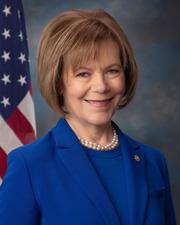
Tina Smith
DDemocratMN · Senator
56
/ 100
Average
Attendance95
Avg: 97
Independence13
Avg: 23
Bipartisan Tone28
Avg: 14
Ethics Record100
Avg: 100
Transparency26
Avg: 47
Accountability Score — composite of attendance, independence, bipartisan tone, ethics record & transparency.
Methodology37
Bills Sponsored
0
Enacted into Law
3
Passed a Chamber
32
In Committee
All Sponsored Bills
S5605In Committee
Employee and Retiree Access to Justice Act
S5580In Committee
Public Housing Fire Safety Act
S5579In Committee
Mapping Housing Discrimination Act
S5534In Committee
Building and Maintaining Homeless Shelters Act
S5411In Committee
Emergency Grant Aid for College Students Act
Emergency Grant Aid for College Students Act This bill establishes a grant program for emergency student financial aid. It also prohibits the Department of Education (ED) from transferring functions related to this program to other federal agencies. Specifically, the bill directs ED to establish a grant program for institutions of higher education to provide emergency financial aid grants to students. The bill also prohibits ED from entering into or carrying out interagency agreements related to this program. This prohibition applies to the transfer of functions such as administering or operating programs, making grants, carrying out technical assistance, enforcing rights and requirements (e.g., data collection requirements), conducting administrative and oversight functions, and monitoring grantees.
S5232In Committee
Rural Residency Planning and Development Act of 2026
S5004In Committee
Cancer Drug Parity Act of 2026
The bill would require employer health insurance plans to charge patients the same out-of-pocket costs for cancer drugs taken by mouth as they do for cancer drugs given by injection or infusion at a doctor's office. This change would help cancer patients afford oral medications, which are increasingly common treatments but are sometimes more expensive for patients to pay for than traditional IV treatments. The bill affects workers and their families who get health insurance through their employers.
SRES789In Committee
A resolution recognizing June 2026, as "LGBTQ Pride Month".
This resolution would officially recognize June 2026 as LGBTQ Pride Month at the federal level, expressing congressional support for celebrating the history and contributions of LGBTQ Americans. The measure is largely symbolic and does not create new laws or programs, but serves as a formal acknowledgment of the month's significance to the LGBTQ community and their allies. It affects no specific groups through policy changes but represents a statement of values from Congress.
S4871In Committee
Improving Personal Risk Assessments to Prevent Suicide Act
The Department of Defense and Veterans Affairs would be required to study and report on how military sexual trauma and domestic violence contribute to suicide and suicidal thoughts among active-duty service members and veterans. The agencies would then brief Congress on their findings to help identify ways to better support and protect those affected by these traumatic experiences. This affects military personnel, veterans, and the agencies responsible for their mental health and safety.
S4848In Committee
Farming Opportunities Training and Outreach Grant Program Reauthorization Act of 2026
The bill would expand and improve federal assistance programs for farmers and ranchers who face discrimination or economic disadvantages, as well as for veterans who want to start or continue farming operations. These programs would provide better access to loans, training, land, and other resources to help these groups succeed in agriculture. The changes aim to make it easier for socially disadvantaged and veteran farmers to compete and build sustainable farming businesses.
S4832In Committee
SNAP Tribal Food Sovereignty Act of 2026
This bill would allow the U.S. Department of Agriculture to sign contracts directly with Native American tribes and tribal organizations to run food assistance programs in their communities, rather than having the federal government manage these programs. Currently, tribes have limited ability to operate their own nutrition assistance programs, so this change would give them more control over how food aid is delivered to their members. The bill affects Native American tribes, tribal governments, and low-income Native Americans who rely on food assistance programs.
S4785In Committee
FDPIR Tribal Food Sovereignty Act of 2026
FDPIR Tribal Food Sovereignty Act of 2026 This bill expands and makes permanent a pilot program through which the Department of Agriculture must enter into self-determination contracts with tribal organizations, upon the request of an Indian tribe, to carry out the Food Distribution Program on Indian Reservations (FDPIR). (FDPIR provides, in lieu of benefits under the Supplemental Nutrition Assistance Program, food commodities to low-income households on Indian reservations and to Native American families residing in Oklahoma or in designated areas near Oklahoma.)
S1157Passed Senate
Women and Lung Cancer Research and Preventive Services Act of 2025
This bill would increase funding and support for research into lung cancer in women and expand access to preventive screening services like CT scans for women at risk. It aims to address the fact that lung cancer affects women differently than men and that many women develop it without smoking histories. The legislation would help doctors better understand, detect, and prevent lung cancer in female patients.
S4672In Committee
Postal Delivery Accountability Act
The Postal Service would be required to follow recommendations from its internal watchdog office to better track and report on mail routes that aren't being fully delivered to customers. This would help identify problem areas where mail is going undelivered or only partially delivered, and ensure customers and postal leadership are notified when service issues occur. The change aims to improve mail delivery reliability and transparency across the country.
S4483In Committee
Promoting Access to Local Agriculture Act of 2026
Promoting Access to Local Agriculture Act of 2026 This bill directs the Department of Agriculture (USDA) to establish a streamlined process for farmers and ranchers to provide benefits under certain federal nutrition programs. These programs include the Supplemental Nutrition Assistance Program (SNAP); the Senior Farmers Market Nutrition Program (SFMNP); the Special Supplemental Nutrition Program for Women, Infants, and Children (WIC); and the Gus Schumacher Nutrition Incentive Program (GusNIP). Specifically, USDA must establish a streamlined application process for farmers and ranchers to apply to be vendors under the nutrition programs, including by developing a single application for the programs or an information sharing system. USDA must also develop a streamlined process for these vendors to use standardized technology to process program benefits (such as a single piece of equipment or a mobile application). Further, USDA must ensure that the program benefit processing equipment and systems made available by a state agency are appropriate for the entity. For example, this includes ensuring wireless or mobile processing equipment and technology systems are appropriate for farmers markets and other direct-to-consumer markets.
S4389In Committee
HELP Separated Children Act
The legislation would establish protections for children whose parents or guardians are detained or deported due to immigration enforcement actions, such as ensuring they have access to legal representation, notification of their parent's whereabouts, and plans for their care and custody. The bill aims to prevent children from being separated from their families or left without supervision during immigration raids and deportations. It would affect immigrant families, child welfare agencies, and immigration enforcement officials.
S4385In Committee
Community Connect Grant Program Act of 2026
The bill would extend and reauthorize a federal grant program that helps bring high-speed internet access to rural communities that lack reliable broadband service. This program provides funding to rural electric cooperatives and other organizations to build the infrastructure needed to connect underserved areas to the internet. The measure affects rural residents and businesses that currently have limited or no access to broadband, as well as the utility companies and nonprofits that would receive grants to expand internet service.
S4187In Committee
Data to Save Moms Act
This bill would require the federal government to collect and analyze data on maternal health outcomes, pregnancy-related deaths, and complications to identify patterns and improve care for pregnant women and new mothers. By tracking this information across different states and populations, the legislation aims to help doctors and public health officials spot problems early and develop better strategies to reduce maternal mortality and serious health risks. The bill would primarily affect pregnant women, healthcare providers, hospitals, and state health departments working to improve maternal health outcomes.
S4168In Committee
Livestock Consolidation Research Act of 2026
Livestock Consolidation Research Act of 2026 This bill requires the Department of Agriculture's (USDA's) Economic Research Service (ERS) to publish a report on consolidation and concentration in the livestock industry (i.e., beef, dairy, pork, and poultry production, including broilers, eggs, and turkeys). ERS must publish the report within one year of the Census of Agriculture being made publicly available. As background, USDA's National Agricultural Statistics Service (NASS) conducts the census every five years. NASS released the 2022 census in 2024. The ERS report must include (1) information on changes in the size and location of ranches, farms, processing facilities, and packers throughout the United States; and (2) the impact of these changes on farmers, ranchers, and downstream consumers.
S4025In Committee
Addressing Teacher Shortages Act of 2026
Addressing Teacher Shortages Act of 2026 This bill directs the Department of Education (ED) to establish an Addressing Teacher Shortages Program. Through this program, ED shall award grants for local educational agencies to address teacher shortage challenges. Specifically, grant funds may be used to establish or expand teaching residency programs, teacher mentor programs, specified recruitment and training programs, and other evidence-based strategies to increase teacher retention and support teachers.
S3990In Committee
PrEP Access and Coverage Act of 2026
This bill would require health insurance plans to cover HIV prevention medication (PrEP) without requiring patients to pay out-of-pocket costs like copays or deductibles. The legislation aims to make preventive HIV drugs more accessible and affordable for people at risk of infection, removing financial barriers that might otherwise prevent them from using these medications.
S3978In Committee
Investments in Rural Transit Act
This bill would provide federal funding and support to improve public transportation systems in rural areas, which currently have limited bus and transit options compared to cities. The money would help rural communities build new transit routes, purchase vehicles, and maintain existing services so that residents without cars can travel for work, medical appointments, and other needs. The legislation aims to address transportation gaps that make it harder for rural Americans to access jobs and services.
S3711In Committee
Addressing Climate Financial Risk Act of 2026
This bill would require banks, insurance companies, and other financial institutions to assess and disclose how climate change could affect their investments and business operations, similar to how they already report other financial risks. The goal is to help investors and regulators understand which financial companies might face losses from climate-related events like floods or droughts, and to encourage these institutions to reduce their exposure to climate risks. This affects anyone with bank accounts, insurance policies, or retirement investments, since it could influence how financial companies manage money and price their services.
SRES570In Committee
A resolution designating November 2025 as "National Lung Cancer Awareness Month" and expressing support for early detection and treatment of lung cancer.
This resolution designates November 2025 as National Lung Cancer Awareness Month.
S622Passed Senate
Leech Lake Reservation Restoration Amendments Act of 2025
Leech Lake Reservation Restoration Amendments Act of 2025 This bill transfers certain federal land located in the Chippewa National Forest in Cass County, Minnesota, to the Department of the Interior for the benefit of the Leech Lake Band of Ojibwe. Specifically, the bill requires the Department of Agriculture (USDA) to transfer for the benefit of the tribe land in the Chippewa National Forest that records maintained by the Bureau of Indian Affairs show was sold without the unanimous consent of the rightful landowners. Upon agreement between USDA and the tribe, USDA shall substitute alternative National Forest System land located in Cass County, Minnesota, on an acre-for-acre basis for those parcels of federal land to be transferred in a manner that avoids inholdings and provides a preference for land adjacent to or near existing Leech Lake trust lands and lands of cultural importance to the tribe, to the maximum extent practicable. USDA may transfer land to Interior on a rolling basis as that land is identified and surveys are completed. USDA, acting through the U.S. Forest Service, must provide for public engagement and comment to implement this bill.
S621Passed Senate
A bill to accept the request to revoke the charter of incorporation of the Lower Sioux Indian Community in the State of Minnesota at the request of that Community, and for other purposes.
This bill accepts the request of the Lower Sioux Indian Community (a federally recognized Indian tribe in Minnesota) to revoke the community's charter of incorporation.
SRES528Introduced
A resolution supporting after-school programs and Lights On Afterschool, a national celebration of after-school programs held on October 23, 2025.
This resolution expresses support for Lights On Afterschool, a national celebration of after-school programs held on October 23, 2025.
SRES518In Committee
A resolution designating October 2025 as "National Principals Month".
S3137In Committee
Housing for All Veterans Act of 2025
The legislation would establish new federal programs and funding to help homeless and at-risk veterans find stable housing, including rental assistance, supportive housing services, and partnerships with local communities. It aims to address the housing crisis affecting veterans by providing resources for mental health services, job training, and other support alongside housing placement. Veterans, homeless service providers, and housing organizations would be the primary beneficiaries of these new programs and funding.
S638Reported
A bill to amend the Act of June 22, 1948.
This bill prevents decreases in annual payments provided to Cook, Lake, and Saint Louis Counties in Minnesota for national forest lands in the Boundary Waters Canoe Area Wilderness. Specifically, the bill modifies the formula created under the Thye-Blatnik Act that the Department of the Treasury uses to determine the amount of the payments. Treasury must base the payments on the highest fair appraised value, including historical fair appraised values, rather than on the fair appraised value of the land.
S2727In Committee
A bill to amend the Food, Agriculture, Conservation, and Trade Act of 1990 to authorize grants for eligible institutions to carry out agriculture workforce training programs, and for other purposes.
This bill directs the National Institute of Food and Agriculture to establish a grant program within its Beginning Farmer and Rancher Development Program for eligible educational institutions to develop and carry out agriculture workforce training programs. Eligible institutions include U.S. land-grant universities, non-land-grant colleges of agriculture, junior or community colleges with agriculture programs, and area career and technical education schools with agriculture programs. The grants must be used to develop and carry out agriculture workforce training programs to (1) promote the growth of the agriculture industry, (2) foster competitiveness within the industry, and (3) improve the training and retention of workers in the industry. An agriculture workforce training program is a program developed by an eligible institution in collaboration with a targeted industry partner through which the industry partner provides training to enrolled students. This may include training through internships, apprenticeships, experience-based curricula, and educational programs and workshops. The program must be implemented by January 31, 2026.
SRES312In Committee
A resolution recognizing June 2025, as "LGBTQ Pride Month".
This resolution expresses support for the rights, freedoms, and equal treatment of lesbian, gay, bisexual, transgender, and queer (LGBTQ) individuals. The resolution r ecognizes that LGBTQ rights are human rights and protected by the laws of the United States and international treaties. Additionally, the resolution encourages the celebration of LGBTQ Pride Month in June.
S2028In Committee
Supporting Apprenticeship Colleges Act of 2025
Supporting Apprenticeship Colleges Act of 2025 This bill directs the Department of Education to award grants to institutions of higher education that sponsor construction and manufacturing-oriented registered apprenticeship programs for (1) expanding or supporting outreach to high schools, local businesses, local workforce development boards, and apprenticeship intermediaries; and (2) providing advising and support services to students who are enrolled in these apprenticeship programs.
S1880In Committee
CDFI Bond Guarantee Program Improvement Act of 2025
CDFI Bond Guarantee Program Improvement Act of 2025 This bill reauthorizes the Community Development Financial Institutions (CDFI) Bond Guarantee Program for four years and revises it to allow for a greater number of participants. CDFIs are financial institutions serving low-income communities. Designation as a CDFI allows an institution to participate in programs such as the CDFI Bond Guarantee Program. The program provides CDFIs with financing for community and economic development projects through federal credit subsidies that allow CDFIs to issue bonds. The bill (1) reduces the program’s minimum loan amount from $100 million to $25 million, (2) eliminates the cap on the annual number of guarantees, and (3) revises the maximum amount that may be held in a CDFI's relending account for secondary loans.
S1260In Committee
Rural Housing Service Reform Act of 2025
This bill would make changes to how the federal government provides housing loans and assistance to people in rural areas through the U.S. Department of Agriculture's Rural Housing Service program. The reforms likely aim to make it easier for rural residents and farmers to access affordable housing financing and improve the quality of housing programs in communities outside cities and suburbs.
S1237In Committee
New Producer Economic Security Act
New Producer Economic Security Act This bill establishes the New Producer Economic Security Program within the Farm Service Agency (FSA) to provide funding and grants to help new farmers, ranchers, and forest owners. Specifically, the FSA must make competitive grants to, enter into cooperative agreements with, or provide other capital support to eligible entities (e.g., state or local governments, Indian tribes, nonprofit organizations, and institutions of higher education). These entities must provide direct assistance to qualified farmers, ranchers, and forest owners (e.g., those who have not operated a farm or ranch for more than 10 consecutive years or are economically disadvantaged). The bill specifically excludes from assistance any foreign-based or foreign-owned corporation. The direct assistance may include payments to qualified beneficiaries to acquire real property (including air rights and water rights), secure clear title on heirs' property, and improve or remediate land, water, and soil. Eligible entities may also use grants (1) to provide direct assistance to qualified beneficiaries in assessing, purchasing, acquiring, or retaining eligible land; (2) for activities designed to support farm establishment and long-term viability; and (3) to provide technical assistance. The FSA must establish a stakeholder committee, and in collaboration with the committee, develop a process for evaluating and selecting applications submitted by eligible entities. The stakeholder committee must include perspectives reflecting the complexity of the rural and urban U.S. agricultural landscapes and the wide variety of agricultural production models.
S951In Committee
Stop Comstock Act