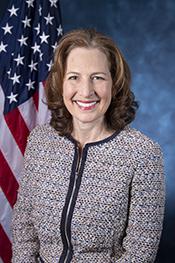
Kim Schrier
DDemocratWA-8 · Representative
54
/ 100
Average
Attendance99
Avg: 96
Independence6
Avg: 4
Bipartisan Tone29
Avg: 15
Ethics Record100
Avg: 99
Transparency15
Avg: 53
Accountability Score — composite of attendance, independence, bipartisan tone, ethics record & transparency.
Methodology19
Bills Sponsored
1
Enacted into Law
0
Passed a Chamber
17
In Committee
Bills That Became Law
All Sponsored Bills
HR3657Enacted
Hydropower Licensing Transparency Act
Hydropower Relicensing Transparency Act This bill directs the Federal Energy Regulatory Commission to report annually to Congress on the status of the relicensing process for each application for a renewed hydropower dam license.
HR10604In Committee
Zeus 95 Memorial Act
HR10287In Committee
9-8-8 Crisis Response Act
HR9445In Committee
Let Doctors Provide Reproductive Health Care Act
This bill would protect healthcare providers' ability to offer reproductive health services, including abortion and contraception, without facing legal penalties or restrictions. It would affect doctors, nurses, and other medical professionals who provide these services, as well as patients seeking reproductive care. The bill has been sent to two House committees for review and consideration.
HR9000In Committee
SCREEN for Type 1 Diabetes Act of 2026
The government would fund and run a public awareness campaign to educate Americans about screening for type 1 diabetes, a condition where the body's immune system attacks cells that produce insulin. This campaign would help people understand the signs of type 1 diabetes and the importance of early detection, potentially affecting patients, families, and healthcare providers who work with diabetic patients. The bill is currently under review by the House Committee on Energy and Commerce.
HR8425In Committee
Strengthening the Vaccines for Children Program Act of 2026
Strengthening the Vaccines for Children Program Act of 2026 This bill expands vaccination programs and coverage for children under Medicaid and the Children's Health Insurance Program (CHIP). Specifically, the bill expands and otherwise modifies the Vaccines for Children Program, which provides free vaccinations to individuals 18 years of age or younger who are uninsured or underinsured (i.e., with limited or no insurance for vaccines), are eligible for Medicaid, or are American Indians or Alaskan Natives. The bill expands the program to include children enrolled in CHIP. The Government Accountability Office must report on the related effects of the bill's changes. The bill also temporarily requires payments under Medicaid and CHIP for vaccine administration and counseling services for children to be made at a rate that is no less than the rate under Medicare for equivalent services. It also increases the Federal Medical Assistance Percentage (i.e., federal matching rate) for states that conduct culturally appropriate outreach regarding the benefits of vaccinations for children.
HR7712In Committee
RNGR Support Act of 2026
The bill would provide financial support and resources to rangeland managers and agricultural operations that depend on grazing lands, likely through grants, loans, or technical assistance programs. It aims to help farmers and ranchers maintain sustainable grazing practices while dealing with challenges like drought, land management costs, or conservation requirements. The measure would primarily benefit livestock producers and rural communities that rely on rangelands for their operations.
HR8127In Committee
Permanent Housing Affordability Act
This bill would encourage and support alternative homeownership models where multiple people or organizations share ownership and equity in a home, rather than one person owning it outright. The legislation aims to make homeownership more accessible and affordable by allowing people to build ownership stakes gradually or collectively, which could help lower-income families and first-time homebuyers enter the housing market. The bill has been sent to committees that handle financial services and government oversight to determine what changes to federal law or programs might be needed to make these shared ownership arrangements easier.
HR7377Reported
Know Before You Drive Act
This bill would require used car dealers to disclose a vehicle's complete history and condition to buyers before purchase, including information about past accidents, repairs, and title problems. The requirement aims to help consumers make informed decisions and protect them from unknowingly buying damaged or unsafe vehicles. Used car buyers and dealers would be the main groups affected by these new transparency rules.
HR7164In Committee
Capping Costs for Consumers Act of 2026
This bill would limit how much patients have to pay out of their own pockets for health care services and medications. It likely aims to reduce the financial burden on consumers by capping costs like deductibles, copayments, and coinsurance that people pay when they visit doctors or buy prescriptions. The proposal affects patients, insurance companies, and healthcare providers by potentially changing how much individuals must contribute to their own medical care.
HR6697In Committee
EAT Healthy Foods from Local Farmers Act
Expanding Access To Healthy Foods from Local Farmers Act or the EAT Healthy Foods from Local Farmers Act This bill amends The Emergency Food Assistance Program to authorize the Food and Nutrition Service (FNS) to provide funds for states to purchase priority agricultural products (e.g., fruits, vegetables, meats, and grains) from eligible small businesses and distribute them to needy persons through emergency feeding organizations. Eligible small businesses under this FNS program include growers, packers, processors, distributors, food-hubs, or cooperatives that are (1) underserved (e.g., women-owned or veteran owned); or (2) composed of or source agricultural products from beginning farmers or small or mid-sized farms that are structured as family farms. The Department of Agriculture (USDA) must also create a cross-agency working group to review and reconsider how USDA's procurement of priority agricultural products can be directed to support a wider range of agricultural producers and product distributors in a manner that meets goals such as nutrition security, resilient local and regional food systems, and rural job creation.
HR6341In Committee
Partnerships for Agricultural Climate Action Act
The legislation would create partnerships between the federal government and farmers to help reduce greenhouse gas emissions and improve soil health on agricultural land. Farmers participating in these programs would receive financial support and technical assistance for adopting climate-friendly practices like cover cropping, reduced tillage, and rotational grazing. The bill aims to help agriculture become more sustainable while supporting rural communities and landowners in addressing climate change.
HR5365In Committee
ENABLE Conservation Act of 2025
Eliminating Needless Administrative Barriers Lessening Efficiency for Conservation Act of 2025 or the ENABLE Conservation Act of 2025 This bill amends the continuous enrollment procedure for the Conservation Reserve Program (CRP) of the Farm Service Agency to permanently allow the continous enrollment of land under the State Acres for Wildlife Enhancement (SAFE) initiative and allow an acreage cap to be waived. CRP is a land conservation program that provides an annual rental payment to farmers in exchange for removing environmentally sensitive land from agricultural production and planting species that will improve environmental health and quality. The bill permanently allows producers to use the continuous enrollment procedure for land that will be enrolled under the SAFE initiative. (The SAFE initiative restores habitats to meet high-priority state wildlife conservation goals.) The bill also allows the Department of Agriculture to grant a waiver to exclude acreage enrolled under the continuous enrollment procedure from a cap that limits the amount of cropland in a county that is permitted to be enrolled in CRP. The government of the county involved must concur with the waiver for it to be granted.
HR6229In Committee
Water Infrastructure Finance and Innovation Act Amendments of 2025
This bill would modify how the federal government finances water infrastructure projects, likely making it easier or cheaper for states and cities to borrow money for drinking water systems, wastewater treatment plants, and flood control projects. The changes could affect communities across the country that need to upgrade aging water pipes and treatment facilities, as well as the companies that build and maintain this infrastructure. The bill is still in early stages and has been sent to a congressional subcommittee for review.
HR3889In Committee
National Prescribed Fire Act of 2025
National Prescribed Fire Act of 2025 This bill directs the Department of Agriculture (USDA) and the Department of the Interior to increase the number and size of prescribed fires conducted on federal lands. For 10 years, Interior and USDA must annually conduct prescribed fires on federal land so that the total acreage where prescribed fires are conducted is 10% greater than the previous fiscal year. Interior and USDA must establish a collaborative prescribed fire program to provide financial assistance to eligible entities to conduct prescribed fires in priority landscapes. Interior and USDA may enter into cooperative agreements or contracts with states, Indian tribes, counties, municipal governments, fire districts, nongovernmental organizations, or private entities to coordinate prescribed fires on federal land. Interior and USDA must expand employment opportunities for prescribed fire practitioners, including by expanding hazard pay, supporting underrepresented groups, and establishing additional training centers. To address the public health and safety risk of the expanded use of prescribed fire, the Environmental Protection Agency must coordinate with state, tribal, and local air quality agencies to support the environmental review of wildland fires.
HR3826In Committee
Expanding Access to Diabetes Self-Management Training Act of 2025
Expanding Access to Diabetes Self-Management Training Act of 2025 This bill expands Medicare coverage of diabetes outpatient self-management training. Specifically, the bill specifies that in addition to physicians, other health care practitioners may also provide such services. It also specifies that coverage includes an initial 10 hours of training until used, as well as an additional 2 hours of training per year. The bill also prohibits the Centers for Medicare & Medicaid Services from limiting training that is deemed medically necessary. Additionally, the Center for Medicare and Medicaid Innovation must test a model in which such training is provided virtually and evaluate any effects on costs, services, and health outcomes.
HR3656In Committee
To amend the Agricultural Research, Extension, and Education Reform Act of 1998 to authorize the Secretary of Agriculture to waive the matching funds requirement under the specialty crop research initiative, and for other purposes.
This bill authorizes the Department of Agriculture to waive the matching funds requirement for grants under the Specialty Crop Research Initiative. Currently, entities that receive grants under the initiative must provide nonfederal matching funds (including funds from an agricultural promotion, research, and information program) equal to not less than the amount of the grant.
HR1433In Committee
Kids’ Access to Primary Care Act of 2025
Kids' Access to Primary Care Act of 2025 This bill modifies payments for Medicaid primary care services. Specifically, the bill applies a Medicare payment rate floor to Medicaid primary care services that are provided after the date of enactment of the bill and extends the payment rate to additional types of practitioners (e.g., obstetricians). The Centers for Medicare & Medicaid Services must conduct a study on the number of children enrolled in Medicaid, the number of providers receiving payment for primary care services, and associated payment rates before and after the bill's implementation.
HR1213In Committee
Forest Data Modernization Act of 2025
Forest Data Modernization Act of 2025 This bill directs the Forest Service to expand and update its Forest Inventory and Analysis (FIA) program. Under the existing program, the Forest Service collects, analyzes, and reports on information about the condition of forest resources in the United States, such as data concerning wildfires or other forest management issues. The bill directs FIA to include forest carbon in its inventory. The bill also requires FIA's strategic plan to include a detailed description of the organization and procedures necessary to (1) understand and report on changes in land cover and use, and (2) evaluate carbon-related data variables. FIA must update the strategic plan within six months and every five years thereafter. Among other items, the first update must include (1) a plan to implement nationally consistent data collection protocols and procedures; and (2) a plan to expand current data collection, further integrate remote sensing technology, or both. FIA must also prepare and publish a compilation of certain forest statistics every two years. Additionally, the bill requires FIA to continue (1) the Timber Products Output survey, and (2) the National Woodland Owner Survey. To provide data consistency, FIA must include a clear definition of forest when reporting data. Finally, FIA (1) must also establish an office, a data platform, or both to process and respond to complex data requests submitted by external organizations; and (2) may impose fees on the organizations submitting the requests.