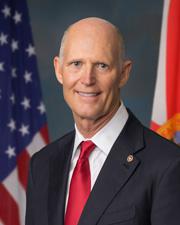
Rick Scott
RRepublicanFL · Senator
62
/ 100
Average
Attendance100
Avg: 97
Independence26
Avg: 23
Bipartisan Tone16
Avg: 14
Ethics Record100
Avg: 100
Transparency59
Avg: 47
Accountability Score — composite of attendance, independence, bipartisan tone, ethics record & transparency.
Methodology130
Bills Sponsored
0
Enacted into Law
0
Passed a Chamber
115
In Committee
All Sponsored Bills
S5684In Committee
No Cash for Incompetent and Malicious Contractors Act
S5682In Committee
A bill to amend the Foreign Agents Registration Act of 1938, as amended to clarify that foreign government-owned media operating in the United States must register as a foreign agent.
S5654In Committee
Protecting Florida's Offshore Military Readiness Act
SRES938Introduced
A resolution to honor the Americans killed by Hamas terrorists and their affiliates on and after October 7, 2023, to reaffirm the commitment of the United States to seek legal justice on behalf of their families, and for other purposes.
S5642In Committee
Know Your Sanctioned Securities Act
S5643In Committee
Protecting U.S. Investors From Chinese Military Companies Act
S5547In Committee
SCREEN Act of 2026
S5442In Committee
Cost Estimates Improvement Act
Cost Estimates Improvement Act This bill requires cost estimates prepared by the Congressional Budget Office or the Joint Committee on Taxation to include the costs of servicing the public debt.
S5427In Committee
Subterranean Border Defense Act
S5377In Committee
A bill to amend the Congressional Budget and Impoundment Control Act of 1974 to establish certain procedures for consideration of appropriation bills, and for other purposes.
S5315In Committee
Trade Deficit Elimination Act of 2026
S1735In Committee
Permitting Transparency and Accountability Act
S5230In Committee
Make SWAPs Efficient Act of 2026
S5178In Committee
Small Business Regulatory Flexibility Improvements Act
The federal government would be required to conduct more thorough studies of how new regulations affect small businesses, nonprofits, and other small organizations before putting those rules into effect. This would give small entities a better chance to understand and prepare for regulatory changes that could impact their operations. The change aims to make sure that regulators carefully consider the burden their rules place on smaller organizations, not just large corporations.
S5155In Committee
American Hiring Transparency Act
Companies that want to hire foreign workers through the permanent labor certification process would have to pay a fee of at least $10,000 per worker, with the goal of encouraging employers to hire American workers instead. The money collected from these fees could potentially be used to support job training or other workforce programs. This would affect businesses across various industries that rely on hiring skilled workers from outside the United States.
S3788Reported
CLEAR LABELS Act
Consumer Labeling for Enhanced API Reporting and Legitimate Accountability for Base Entity Listings Act or the CLEAR LABELS Act This bill requires drugs and active pharmaceutical ingredients made available in the U.S. market to be labeled with the names and locations of their manufacturers. Specifically, a finished, packaged drug product must be labeled with the name and place of business of (1) the original manufacturer (or manufacturers) of each active pharmaceutical ingredient; (2) the original manufacturer of the finished drug product; and (3) the packer or distributor, if any. This information must be printed on the product label or made available electronically. Active pharmaceutical ingredients (which are generally sold to manufacturers and researchers, not consumers) must also be labeled with the name and place of business of their original manufacturers. Under the bill, the original manufacturer is the establishment that conducts the majority of the significant phases of manufacturing to produce the ingredient or product. The Food and Drug Administration (FDA) has discretion to determine whether a violation of these requirements constitutes misbranding and to assess a civil fine. The FDA must consider certain factors in determining whether to assess a fine, including whether the violator was notified of their noncompliance and was provided an opportunity to correct the violation. Finally, the FDA must coordinate with U.S. Customs and Border Protection to address any overlap between these requirements and existing requirements for imported drugs. These provisions take effect five years after the bill is enacted.
S5069In Committee
Coast Guard Leadership Modernization Act
The proposal would create a new Cabinet-level position called Secretary of the Coast Guard, making the head of the Coast Guard a direct advisor to the President with the same status as other department secretaries like the Secretary of Defense or Secretary of State. Currently, the Coast Guard operates under the Department of Homeland Security, but this change would give it independent status similar to the Navy or Army. This would affect Coast Guard personnel, maritime security operations, and how the federal government organizes its military and civilian leadership.
S5068In Committee
Service Academy Parity Act
The proposal would change how cadets are selected and appointed to the Coast Guard Academy, the military training school that prepares officers for the Coast Guard. The changes would affect the nomination process that determines which qualified applicants get admitted to the academy. This impacts prospective cadets seeking admission and the Coast Guard's ability to recruit and train its future officers.
S5044In Committee
Honoring the Victims of Communist China’s Tyranny Act
The federal government would be required to create a memorial in Washington, D.C. to honor people who died or suffered persecution under Chinese Communist Party rule, including victims of genocide and crimes against humanity. The State Department would oversee the design and construction of this memorial to remember those affected by these historical events.
S5016In Committee
Clean Water Allotment Modernization Act of 2026
The proposal would change how the federal government distributes money and authority for water pollution control programs to states and tribes. These modifications could affect how states manage their water quality standards, pollution permits, and cleanup efforts for rivers, lakes, and coastal areas. The specific changes would impact state environmental agencies, water utilities, industries that discharge into waterways, and communities relying on clean water.
S4958In Committee
Safeguard Kids Act
Schools would be able to teach students in elementary and secondary grades about how artificial intelligence works, what risks it poses, and how to use it responsibly. The bill aims to help young people understand both the benefits and dangers of AI technologies they're increasingly encountering in their daily lives. This would give educators resources and support to include AI literacy in their curriculum alongside traditional subjects.
SRES800In Committee
A resolution commending the courage, bravery, and resolve of the fathers, mothers, sons, and daughters of Cuba, whom 5 years ago, stood in the face of brutal harassment, beatings, and torture to protest against the Communist Cuban regime, demanding access to their fundamental rights to life, dignity, and freedom.
This resolution honors Cuban citizens who protested against the government five years ago and faced violence and abuse for demanding basic freedoms and human rights. The resolution recognizes their courage in standing up to what it describes as a repressive regime despite the serious risks they took. It has been sent to the Senate Foreign Relations Committee for consideration.
S4898In Committee
Medicaid RAC Improvement Act of 2026
Medicaid RAC Improvement Act of 2026 This bill establishes additional requirements for and expands the scope of Medicaid Recovery Audit Contractors (RACs). RACs identify improper Medicaid payments to providers, collect overpayments, and reimburse underpayments. Current law requires state Medicaid programs to establish a RAC program; however, states may apply to the Centers for Medicare & Medicaid Services (CMS) for an exception. The bill prohibits the CMS from granting exceptions after December 31, 2028. The CMS must inform states that have an approved RAC exception that the exception will not be renewed after this date, and it must also inform these states of the current expiration date of their excepted status. The bill also expands the scope of RACs to include a review of payments to Medicaid managed care organizations, prepaid inpatient health plans, and prepaid ambulatory health plans. In addition, the bill expands the period of review for RACs to include the four-year period prior to the fiscal year at issue. Finally, the bill establishes reporting requirements relating to the effectiveness of RACs, including annual reports with state-specific data on collected overpayments. The CMS must also conduct a study and establish a related demonstration program to increase the number of states with a RAC program.
SRES788In Committee
A resolution commemorating the passage of 5 years since the tragic building collapse in Surfside, Florida, on June 24, 2021.
This resolution honors the five-year anniversary of the Surfside condominium collapse in Florida that killed 98 people, recognizing the tragedy and its impact on the families and community affected. The resolution serves as a formal acknowledgment by Congress of this disaster and the lives lost, though it does not create new laws or programs.
S4834In Committee
Prioritizing American Talent Act
The legislation would restrict how much money the government can spend on processing and issuing work permits for foreign students studying in the United States. This would affect international students who want to work while in school or after graduation, as well as colleges and universities that rely on foreign student enrollment and the companies that hire them for internships or jobs.
SRES444In Committee
A resolution condemning the dictator of the People's Republic of China, Xi Jinping, for deceit, undermining prospects for peace and security, and orchestrating crimes against humanity.
This resolution condemns China's President, Xi Jinping, for deceit, undermining prospects for peace and security, and orchestrating crimes against humanity. The resolution also expresses solidarity with the people of China, and people worldwide, who have endured the consequences of rule by the Chinese Communist Party (CCP) and encourages the application of all applicable sanctions authorities against CCP officials.
SRES770Introduced
A resolution designating June 6, 2026, as National Naloxone Awareness Day.
The Senate has approved a resolution to officially recognize June 6, 2026, as National Naloxone Awareness Day, a day dedicated to raising public awareness about naloxone—a medication that can reverse opioid overdoses and save lives. This designation aims to educate Americans about the importance of naloxone access and its role in combating the opioid crisis. The resolution passed unanimously without any changes.
SRES769In Committee
A resolution honoring the memory of the victims of the heinous attack at the Pulse nightclub on June 12, 2016.
This resolution honors the 49 people killed and many others wounded in the mass shooting at the Pulse nightclub in Orlando, Florida on June 12, 2016. The measure expresses the Congress's respect for the victims and survivors of this tragedy. It has been sent to the Judiciary Committee for consideration.
S4762In Committee
Generative AI Terrorism Risk Assessment Act
The government would be required to study and report each year on how terrorists might use artificial intelligence tools to carry out attacks against the United States. This affects national security officials and policymakers who need to understand emerging threats and prepare defenses accordingly. The bill aims to help the Department of Homeland Security stay ahead of potential dangers posed by advanced AI technology in the hands of bad actors.
S4769In Committee
Illegal Immigration Cost Recovery Act
The bill would increase financial penalties for people who illegally enter the United States or stay after being ordered to leave, as well as for employers who knowingly hire workers without legal authorization to work. These penalties would be doubled from their current amounts, making the fines significantly more expensive for those who violate immigration laws. The changes would affect undocumented immigrants, people subject to deportation orders, and businesses that employ unauthorized workers.
S4771In Committee
Protecting Asylum Integrity Act
The federal government would charge people a fee when they request a credible fear interview, which is a process where asylum seekers demonstrate they face danger if returned to their home country. This would affect immigrants and asylum applicants who are trying to establish that they qualify for protection in the United States. The Department of Homeland Security would collect these fees to help cover the costs of conducting these interviews.
S4716In Committee
SNAP Fraud Reporting Act of 2026
States would be required to collect and report data on fraud cases in the food stamp program (SNAP) to help the federal government track misuse of benefits. This would affect state welfare agencies and potentially impact how the program is monitored for abuse. The measure aims to give policymakers better information about where fraud is occurring so they can address problems more effectively.
S4687In Committee
Tiananmen Square Memorial Act of 2026
The bill would create a new street or public space in Washington, D.C. called Tiananmen Square Memorial Boulevard, likely to commemorate the 1989 pro-democracy protests in Beijing. This designation would primarily affect residents and visitors to the nation's capital by adding a named location that serves as a memorial to those historical events.
S4674In Committee
DUMP Red Tape Act
The Small Business Administration would set up a hotline where small business owners can report government rules and regulations they believe are unnecessarily burdensome or complicated. The hotline would collect these complaints and help identify which regulations might be causing the most problems for small companies trying to operate. This would give small business owners a direct way to voice concerns about red tape to a federal agency that advocates for their interests.
S4663In Committee
Florida Freeze Disaster Assistance Act
Florida Freeze Disaster Assistance Act This bill provides $3.5 billion in emergency funding for the Department of Agriculture (USDA) to provide block grants to certain states for losses of revenue, quality, or production of crops (including crops prevented from planting), trees, bushes, and vines as a consequence of a freeze or cold weather conditions. The bill specifies that the funding may only be made available for losses occurring in counties that received a disaster designation for freeze and related cold weather conditions issued by USDA on March 4, 2026. (This includes certain counties in Alabama, Florida, and Georgia.) The bill requires the assistance provided by the bill to include compensation to producers for losses of multi-year crops. The funds provided by this bill must be made available upon the request of a state department of agriculture or other appropriate state agency.
SRES749Introduced
A resolution designating May 2026 as "Older Americans Month".
The Senate has officially designated May 2026 as "Older Americans Month" to recognize and celebrate the contributions and achievements of seniors in American society. This symbolic designation encourages communities, organizations, and individuals to honor older adults through events, programs, and awareness activities throughout that month. The resolution passed unanimously without any changes.
S4586In Committee
Blocking CCP Spy Tech Act of 2026
The government would be required to review whether communications equipment and services from certain companies pose national security risks, particularly examining foreign-made technology that could potentially be used for spying or sabotage. This review would help determine if the U.S. should restrict or ban certain communications products and services to protect sensitive government and civilian networks. The measure affects telecommunications companies, equipment manufacturers, and government agencies responsible for national security.
S4581In Committee
CCP Sanctions Shot Clock Act
The bill would expand a government list that identifies Chinese companies with military connections, requiring certain foreign individuals and entities associated with these companies to be included on the Non-SDN Chinese Military-Industrial Complex Companies List. This list is used to restrict U.S. investment and business dealings with these organizations as a national security measure. The change would affect American investors, companies doing business with China, and financial institutions that need to comply with these restrictions.
S4601In Committee
Chinese CBDC Prohibition Act of 2026
Money services businesses like payment processors and money transfer companies would be banned from handling transactions involving China's digital currency, which is a government-controlled electronic form of money. The law aims to prevent U.S. financial companies from facilitating the use of this Chinese digital currency within American commerce. This would affect banks, payment apps, and other financial service providers that currently process international transactions.
S4564In Committee
Maritime Cybersecurity Act
The Coast Guard would be required to evaluate the cybersecurity risks of software and hardware used at important maritime facilities like ports and shipping terminals to identify potential vulnerabilities that hackers could exploit. This assessment would help protect critical infrastructure that millions of Americans depend on for trade, transportation, and national security. The bill is currently under review by the Senate Commerce Committee.
SRES738Introduced
A resolution recognizing the significance of Jewish American Heritage Month and calling on elected officials and civil society leaders to counter antisemitism.
The Senate formally recognized Jewish American Heritage Month and called on government officials and community leaders to actively work against antisemitism and discrimination. The resolution passed unanimously, affirming support for Jewish Americans and their contributions to the country while emphasizing the need to combat hate and prejudice.
S4565In Committee
Strengthening Cyber Resilience Against State-Sponsored Threats Act
The government would create a task force to investigate and report on cyberattacks against America's critical infrastructure—like power grids, water systems, and communications networks—that are carried out by Chinese state-sponsored hackers. This effort would help federal agencies understand the scope and methods of these attacks so they can better protect essential services that millions of Americans depend on daily. The task force would need to deliver detailed findings to Congress about what's happening and how to defend against future threats.
S4524In Committee
BLAST Act
Former members of Congress and other elected federal officers would be permanently banned from working as lobbyists trying to influence Congress after they leave office. The ban would apply to anyone who previously served in Congress or held an elected federal position, preventing them from using their insider connections and relationships to advocate for clients' interests on Capitol Hill. This would affect former politicians who might otherwise transition to lobbying careers after their time in elected office ends.
S4508In Committee
BLUE Act
The legislation would restrict the public release of personal information about federal law enforcement officers, such as their home addresses, phone numbers, and family details, to protect their safety and privacy. This would apply to officers working for agencies like the FBI, DEA, and other federal law enforcement bodies. The bill aims to prevent potential harassment or threats against these officers and their families by limiting access to their personal data.
SRES717In Committee
A resolution honoring the memory of Jereima "Jeri" Bustamante on the eighth anniversary of her passing.
This resolution honors the life and memory of Jereima "Jeri" Bustamante and encourages the recipients of the Jereima Bustamante Memorial Scholarship to carry on her legacy.
S4432In Committee
Tibet Atrocities Determination Act
The bill would require the U.S. government to formally investigate and determine whether serious human rights violations or crimes against humanity have occurred in Tibet, and to report its findings to Congress. This would affect U.S. foreign policy decisions and could influence how the government responds to China regarding treatment of Tibetan people. The measure is currently under review by the Senate Foreign Relations Committee.
SRES696Introduced
A resolution expressing support for the designation of the month of April 2026 as "Parkinson's Awareness Month".
Congress is officially recognizing April 2026 as "Parkinson's Awareness Month" to draw attention to Parkinson's disease, a neurological condition that affects movement and causes symptoms like tremors and stiffness. This designation encourages people, organizations, and government agencies to raise awareness about the disease, support research efforts, and help patients and their families understand available resources and treatments. The resolution passed unanimously in the Senate without any changes.
S4424In Committee
A bill to amend the National Defense Authorization Act for Fiscal Year 2021 to prohibit certain institutions of higher education from receiving research and development awards, and for other purposes.
The proposal would prevent certain colleges and universities from receiving federal research and development funding from the Department of Defense and other government agencies. The bill targets institutions that meet specific criteria, though the exact conditions would be determined through the legislative process. This would affect academic researchers and institutions that rely on government contracts to fund scientific and engineering projects.
S4423In Committee
A bill to amend the Research and Development, Competition, and Innovation Act to require each institution of higher education to certify as part of an application for a research and development award that such institution does not operate certain branch campuses, and for other purposes.
Colleges and universities seeking federal research and development funding would need to certify that they don't operate certain types of branch campuses in order to receive the money. The bill aims to restrict which educational institutions can access these federal research grants based on their campus structure. This would affect universities and research institutions that rely on federal funding for scientific and academic research projects.
SRES682In Committee
A resolution expressing the sense of the Senate by condemning the handling of the 2019 Ukraine Whistleblower Complaint, calling for the Department of Justice to initiate an investigation and prosecution of the matter, and declaring the impeachment of President Donald J. Trump by the House of Representatives lacks legitimacy.
This resolution expresses the Senate's view that the handling of a 2019 whistleblower complaint about Ukraine was improper and calls on the Department of Justice to investigate and prosecute those involved. It also declares that the House's impeachment of President Trump related to this matter was not legitimate. The resolution is a statement of Senate opinion rather than a law that would change government policy or actions.
SRES627In Committee
A resolution designating March 5, 2026, as "National Slam the Scam Day" to raise awareness about pervasive scams and to prevent government imposter scams and other types of scams by promoting education about such scams.
The resolution establishes March 5, 2026, as a national awareness day dedicated to educating the public about common scams, particularly those where criminals impersonate government agencies to defraud people. The day aims to help consumers, seniors, and other vulnerable groups recognize and avoid falling victim to scams by promoting information about how these schemes work. This is a symbolic measure with no direct legal requirements, but it encourages government agencies and organizations to use the day for public education campaigns.
S4295In Committee
Stop Support for UNRWA Act of 2026
This bill would prevent U.S. foreign aid from going to Hamas or organizations controlled by it, and would cut funding to United Nations agencies if they are led by countries that the U.S. considers to support terrorism. The restrictions aim to ensure American taxpayer money doesn't indirectly support terrorist organizations or countries designated as state sponsors of terrorism through international institutions. The bill affects how the U.S. government distributes aid abroad and which international organizations receive American funding.
S4296In Committee
IGO Anti-Boycott Act
IGO Anti-Boycott Act This bill penalizes U.S. persons (individuals or entities) that participate in certain boycotts imposed by international governmental organizations (IGOs). The bill expands an existing law that prohibits various actions by U.S. persons in relation to boycotts imposed by foreign governments on a country that is friendly to the United States and not itself the object of a U.S. boycott. This bill applies those prohibitions to similar boycotts imposed by IGOs. Prohibited actions include (1) refusing to do business with companies organized under the laws of the boycotted country, if the refusal is pursuant to an agreement with or request from the country or IGO imposing the boycott; (2) furnishing information about whether any person has a business relationship with or in the boycotted country; and (3) furnishing information about whether someone is associated with charitable or fraternal organizations that support the boycotted country. Criminal penalties for willful violations of this law include fines of up to $1 million. In addition to such fines, individuals may be imprisoned for up to 20 years. Civil penalties may include fines and revocations of export licenses for certain national security-related items. The bill also requires the President to annually submit to Congress and make available to the public a report describing these boycotts and listing the foreign countries and international governmental organizations involved in fostering or imposing them.
SRES647In Committee
A resolution designating March 21, 2026, as "National Osceola Turkey Day".
This resolution designates March 21, 2026, as National Osceola Turkey Day.
S4229In Committee
SCHEDULES Act of 2026
Scheduling for Community Health and Easy Data to Understand for Legislators to Evaluate Services Act of 2026 or the SCHEDULES Act of 2026 This bill requires the Department of Veterans Affairs (VA) to establish a standard for timing between the date on which a referral for VA care is entered into the VA's system and the date on which an appointment for care occurs, whether at a VA facility or through care in the community. The VA must publish the standard in the Federal Register and on a publicly accessible VA website. Additionally, the VA must submit a report at least quarterly on the number and percentage of referrals that meet the new timing standard.
S4231In Committee
A bill to amend title 38, United States Code, to increase flexibility in the transferability of Post-9/11 Educational Assistance, and for other purposes.
This bill would make it easier for military members to transfer their Post-9/11 GI Bill education benefits to their family members, giving them more options for who can use these college tuition benefits and when. The change would affect active-duty service members and veterans who want to help pay for their spouse's or children's education. The bill is currently under review by the Senate Veterans' Affairs Committee.
S1383Introduced
Veterans Accessibility Advisory Committee Act of 2025
Safeguard American Voter Eligibility Act or the SAVE America Act This bill requires individuals to provide documentary proof of U.S. citizenship when registering to vote, and requires photo identification to vote, in federal elections. Specifically, the bill prohibits states from accepting and processing an application to register to vote in a federal election unless the applicant presents documentary proof of U.S. citizenship. The bill specifies what documents are considered acceptable proof of U.S. citizenship, such as identification that complies with the REAL ID Act of 2005 that indicates U.S. citizenship, a valid U.S. passport, or a valid government-issued photo identification card that shows the applicant's place of birth was in the United States. Further, the bill (1) requires states to accept and process a voter registration application in the event of a name discrepancy in the applicant's documentation, as long as the applicant provides additional documentation; and (2) requires states to establish an alternative process to demonstrate U.S. citizenship. Within 30 days of the bill's enactment, each state must take affirmative steps on an ongoing basis to ensure that only U.S. citizens are registered to vote, which shall include establishing a program to identify individuals who are not U.S. citizens using information supplied by certain sources. Further, each state must submit its complete official list of eligible voters to the Department of Homeland Security for comparison with the Systematic Alien Verification for Entitlements system, which is used to verify immigration status. Individuals who are identified as noncitizens must be given the opportunity to provide documentary proof of U.S. citizenship. Additionally, states must remove noncitizens from their official lists of eligible voters. The bill (1) provides for a private right of action for certain violations, and (2) establishes criminal penalties for certain offenses. The bill prohibits a state or local election official from providing a ballot for a federal election to an individual who does not present valid physical photo identification. An individual who does not present the required identification must be permitted to cast a provisional ballot. However, an election official may not determine that the individual is eligible under state law to vote in the election unless, not later than three days after casting the provisional ballot, the individual presents (1) the identification required, or (2) an affidavit attesting that the individual does not possess the identification because of a religious objection to being photographed. Further, an election official may not allow for voting methods other than in-person voting unless the individual submits the ballot with (1) a copy of their photo identification, or (2) the last four digits of their Social Security number with an affidavit attesting that the individual is unable to obtain a copy of a valid photo identification after making reasonable efforts to obtain a copy. This prohibition shall not apply to overseas military voters or individuals provided the right to vote other than in person under the Voting Accessibility for the Elderly and Handicapped Act. State and local government officials must provide, to the extent practicable, public access to a digital imaging device for the purpose of allowing individuals to use the device at no cost to make a copy of their valid photo identification.
SCONRES30In Committee
A concurrent resolution expressing the sense of Congress that the Ratepayer Protection Pledge announced on March 4, 2026, reflects sound national policy to protect ratepayers in the United States, promote electricity affordability, and ensure that all people of the United States, including households, small businesses, schools, hospitals, and farms, have access to reliable and affordable energy as artificial intelligence and data center infrastructure expands across the United States.
Congress is expressing support for a pledge to protect electricity customers from rate increases as artificial intelligence and data centers expand across the country, with the goal of keeping energy affordable for households, small businesses, schools, hospitals, and farms. The resolution reflects lawmakers' concern that the growing power demands of AI and data centers could drive up electricity costs for everyday consumers. This is a non-binding statement of congressional intent rather than a law that would directly regulate rates or companies.
S4184In Committee
Senior Citizens’ Freedom to Work Act of 2026
This bill would allow people over a certain age to earn more money from work without losing their Social Security benefits, or it might eliminate the earnings limit entirely so seniors can work as much as they want without penalty. Currently, Social Security reduces benefits for retirees who earn above a certain threshold, which discourages some older Americans from continuing to work. The change would affect millions of seniors who want or need to keep working while collecting the retirement benefits they've already paid into.
S4150In Committee
District of Columbia Home Rule Improvement Act of 2026
This bill would give Washington, D.C. residents more control over their local government by reducing Congress's power to override decisions made by D.C.'s elected leaders. Currently, Congress can reject or change laws that D.C. passes, even though D.C. residents pay federal taxes and follow federal laws like everyone else. The changes would let D.C. govern itself more like a state does, though Congress would likely keep some oversight authority.
S4026In Committee
American Dream Accounts Act of 2026
This bill would create a new type of savings account that allows individuals to set aside money for major life goals like buying a home, paying for education, or starting a business, with special tax breaks to help the savings grow faster. The accounts would let people contribute money that either reduces their taxes now or grows tax-free, depending on the account type, making it easier for working families and young adults to save for big expenses without losing money to taxes. The bill is currently being reviewed by the Senate Finance Committee to determine whether it should move forward.
S4024In Committee
Federal Taxpayer Funds Protection and Clawback Act
This bill would allow the federal government to recover taxpayer money that was improperly spent or awarded due to fraud, waste, or mismanagement by federal agencies and their contractors. It would establish procedures for the government to "claw back" or reclaim funds from individuals and companies that received money they weren't entitled to, similar to how banks can reverse fraudulent transactions. The measure aims to protect taxpayers by making it easier for the government to track down and recover misspent federal dollars.
S2314Reported
SHARKED Act of 2025
Supporting the Health of Aquatic systems through Research Knowledge and Enhanced Dialogue Act of 2025 or the SHARKED Act of 2025 This bill requires the Department of Commerce to establish a task force to address and report to Congress about critical needs with respect to shark depredation. (Shark depredation is the partial or complete removal of a hooked fish by a shark directly from a fishing line before the line is retrieved.) The duties of the task force are, among other responsibilities, to (1) develop ways to improve coordination and communication across the fisheries management and shark research communities; (2) identify research priorities and funding opportunities; (3) develop recommended management strategies to address shark depredation; and (4) coordinate the development and distribution of educational materials. The bill specifies that the task force must include representatives of each Regional Fishery Management Council, each Marine Fisheries Commission, the fish and wildlife agencies of coastal states, and the National Marine Fisheries Service. The task force must also include researchers and others with relevant expertise. The task force must report its findings to Congress within two years after the bill's enactment and every two years thereafter until the task force is terminated. The task force sunsets within seven years after the date of its establishment.
S3951In Committee
Balanced Budget Responsibility Act of 2026
This bill would likely require the federal government to balance its budget, meaning it cannot spend more money than it takes in through taxes and other revenue. The measure would affect how Congress allocates money for programs like Social Security, Medicare, defense, and infrastructure, potentially requiring cuts to some services or increases in taxes to avoid deficits. It would constrain lawmakers' ability to borrow money to fund government operations, which could significantly impact both government workers and the public services Americans rely on.
S3920In Committee
UASI Act
The title "UASI Act" is too vague to determine the specific policy without additional context. Based on the immigration subject matter and referral to the Homeland Security committee, this bill likely addresses some aspect of immigration policy or enforcement, but the exact provisions—whether it expands legal immigration pathways, changes enforcement procedures, affects border security, or modifies visa programs—cannot be determined from the information provided.
S3921In Committee
Sanctuary Jurisdiction Event Security Enhancement Act
This bill would require local law enforcement in cities and counties that have "sanctuary" policies (which limit cooperation with federal immigration authorities) to provide security assistance during major public events and to notify federal immigration officials about individuals with criminal histories who are in the country illegally. The legislation aims to give federal authorities better access to information about undocumented immigrants in sanctuary jurisdictions, particularly those with criminal records, during large gatherings where security is a concern.
S3857In Committee
One Nation, One Visa Policy Act
This bill would establish a single, unified visa system across the United States instead of the current multiple visa categories and programs. The change would likely simplify how people apply for permission to live and work in the country, affecting immigrants, employers who hire foreign workers, and immigration agencies that process applications.
SRES607In Committee
A resolution honoring the memories of the victims of the senseless attack at Marjory Stoneman Douglas High School on February 14, 2018.
This resolution honors the memories of the victims killed in the attack on February 14, 2018, at Marjory Stoneman Douglas High School in Parkland, Florida, and offers condolences to the families, loved ones, and friends of the victims. The resolution (1) honors the survivors and pledges continued support for their recovery, (2) recognizes the strength and resilience of the Marjory Stoneman Douglas High School community, and (3) expresses gratitude to the emergency medical and health care professionals of the Parkland community for their efforts in responding to the attack and caring for the victims and survivors.
S3856In Committee
SNAP Data Transparency and Oversight Act of 2026
This bill would require the government to publicly share more detailed information about how the SNAP food assistance program (formerly known as food stamps) is being used and managed across different states. The legislation aims to increase transparency and oversight of the program by making data about participation, spending, and program effectiveness more accessible to Congress and the public. This could help lawmakers and citizens better understand how federal food assistance dollars are being spent and identify areas where the program might be improved.
S446In Committee
A bill to prohibit Big Cypress National Preserve from being designated as wilderness or as a component of the National Wilderness Preservation System, and for other purposes.
This bill prohibits the Big Cypress National Preserve in Florida from being designated as wilderness or as a component of the National Wilderness Preservation System. The National Park Service currently manages Big Cypress National Preserve, which is a freshwater swamp ecosystem of 729,000 acres. In general, development activities, commercial activities, permanent structures, and roads are prohibited in wilderness areas. In contrast, natural preserves typically allow some development activities, such as hunting or oil and gas exploration.
SJRES102Reported
A joint resolution disapproving the action of the District of Columbia Council in approving the D.C. Income and Franchise Tax Conformity and Revision Temporary Amendment Act of 2025.
Congress is attempting to block a Washington D.C. tax law that would change how the district taxes business income and individual earnings to match federal tax rules. If approved, this resolution would prevent the D.C. Council's tax changes from taking effect, keeping the district's current tax system in place instead. This affects D.C. residents and businesses that would otherwise see changes to their tax obligations.
S3681In Committee
Keep Our Border Agents Paid Act
This bill would ensure that U.S. Border Patrol agents and other immigration enforcement officers continue receiving their paychecks during government shutdowns, when normal funding lapses. The measure affects thousands of federal workers who patrol borders and enforce immigration laws, guaranteeing they stay on the job and get paid even when Congress fails to pass a budget.
S3640In Committee
Divesting from Communist China’s Military Act of 2026
The legislation would require the federal government and certain pension funds to stop investing in Chinese companies that support the country's military or defense sector. This would affect retirement savings for federal employees, military personnel, and potentially state pension funds by restricting where their money can be invested. The goal is to prevent American retirement savings from financially supporting Chinese military development.
S3641In Committee
No Relief for Allies of Dictators Act of 2026
SRES571Introduced
A resolution remembering the December 6, 2019, terrorist attack at Naval Air Station Pensacola and commemorating those who lost their lives, and those who were injured, in the line of duty.
This resolution condemns the December 6, 2019, terrorist attack at Naval Air Station Pensacola and commemorates the service members and civilians who lost their lives or were injured in the attack. Additionally, the resolution remembers Ensign Joshua Kaleb Watson, Petty Officer Third Class Mohammed Sameh Haitham, and Petty Officer Third Class Cameron Scott Walters, who were killed in the attack. Finally, the resolution commends (1) the decision to give medals and awards to the law enforcement officers, uniformed service members, and civilians who responded to the attack; and (2) the efforts undertaken by the Department of Defense to enhance security at military installations.
S3453In Committee
No Bounties on Badges Act
S2270In Committee
Myakka Wild and Scenic River Act of 2025
This bill would protect a section of Florida's Myakka River from development by designating it as a Wild and Scenic River, a federal status that restricts dam construction and requires careful management of the surrounding land. The designation would preserve the river's natural character and recreational value for fishing, boating, and wildlife viewing while affecting how property owners and local governments can use land along the river corridor. The change would primarily impact Florida residents, outdoor enthusiasts, and conservation groups interested in protecting the river ecosystem.
SRES517In Committee
A resolution expressing opposition to congressional spending on earmarks.
This resolution expresses the view that Congress should not use taxpayer money for earmarks—special funding projects that individual lawmakers insert into spending bills to benefit their home districts or states. The measure does not change any laws or spending, but rather makes a statement opposing this common congressional practice that critics say wastes money on local projects that may not be priorities for the nation as a whole.
S3244In Committee
Anti-Communism Week Act
S3213In Committee
Destruction of Hazardous Imports Act
This bill would give the government authority to destroy or dispose of imported products that pose health risks to consumers, rather than allowing them to be sold or returned to their country of origin. The measure aims to protect public health by preventing dangerous foreign goods—such as contaminated food, defective medicines, or toxic products—from reaching American markets or being resold elsewhere. It would primarily affect importers and manufacturers who bring goods into the United States, as well as consumers who could face fewer hazardous products in stores.
S3101In Committee
SAFE KIDS Act
The legislation would establish new protections and procedures for unaccompanied children who cross U.S. borders, including requirements for their care, legal representation, and processing through the immigration system. It would affect immigration agencies, child welfare organizations, and the children themselves by setting standards for how minors are treated while in government custody and ensuring they have access to legal help during immigration proceedings.
S3069In Committee
Protecting Americans from Harmful CCP Products Act
SRES451In Committee
A resolution condemning attacks on Federal law enforcement in the State of Illinois.
S2935In Committee
Sovereign Enforcement Integrity Act of 2025
S2936In Committee
Stop ANTIFA Act of 2025
The proposal would create new federal criminal penalties for people who participate in violent protests or riots, particularly targeting organized groups that use force or property destruction during demonstrations. It would give federal law enforcement additional tools to prosecute individuals involved in violent protest activities across state lines. The measure affects protesters, law enforcement agencies, and anyone involved in demonstrations that turn violent.
S2744In Committee
Federal Disaster Tax Relief Act of 2025
This bill would provide tax breaks and financial relief to individuals and businesses affected by major disasters, likely allowing them to deduct disaster losses, defer tax payments, or receive credits to help with recovery costs. The relief would apply to people whose homes or property were damaged and companies that suffered business interruptions from qualifying disasters. The goal is to reduce the tax burden on disaster victims during their recovery period.
SCONRES21In Committee
A concurrent resolution denouncing the horrors of socialism.
This concurrent resolution denounces socialism and opposes the implementation of socialist policies in the United States.
S2593In Committee
PROTECT the Grid Act
This bill aims to strengthen the security and resilience of the nation's electrical grid against physical attacks, cyberattacks, and other threats that could cause widespread power outages. It likely includes measures to help utilities upgrade infrastructure, improve coordination between power companies and government agencies, and establish standards for protecting critical grid equipment. The changes would affect electricity providers, their customers, and government agencies responsible for national security and energy policy.
S2297In Committee
Preventing Intelligence Gathering from Foreign Adversaries Act
SRES317In Committee
A resolution commending the courage, bravery, and resolve of the fathers, mothers, sons, and daughters of Cuba, who, 4 years ago, stood in the face of brutal harassment, beatings, and torture to protest against the Communist Cuban regime, demanding access to their fundamental rights to life, dignity, and freedom.
This resolution honors Cuban citizens who protested against their government four years ago and faced violence and abuse for demanding basic freedoms and human rights. The measure expresses support for these protesters' courage in standing up to what the resolution describes as a repressive regime. The resolution has been sent to the Senate Foreign Relations Committee for consideration.
SRES297In Committee
A resolution commemorating the passage of 4 years since the tragic building collapse in Surfside, Florida, on June 24, 2021.
This resolution commemorates the passage of four years since the tragic building collapse in Surfside, Florida, on June 24, 2021, and honors the survivors and lives lost in the collapse.
S2125In Committee
PICTURES Act
The bill would establish new requirements for how the military and intelligence agencies handle, store, and share photographic and imaging intelligence. It aims to improve oversight and security procedures for sensitive visual materials collected during national security operations. The changes would affect military personnel, intelligence analysts, and potentially contractors who work with classified imagery.
SRES275In Committee
A resolution honoring the memory of the victims of the heinous attack at the Pulse nightclub on June 12, 2016.
This resolution honors the 49 people killed and many others wounded in the mass shooting at the Pulse nightclub in Orlando, Florida on June 12, 2016. The Senate passed this measure to officially recognize the victims and remember one of the deadliest mass shootings in U.S. history.
S2111In Committee
American Students First Act of 2025
S2089In Committee
Sturgeon Conservation and Sustainability Act
The proposal would establish new protections and management practices for sturgeon populations in U.S. waters, including rules about fishing, habitat preservation, and research to help these ancient fish species recover from overfishing and environmental damage. It would affect commercial and recreational fishermen, environmental organizations, and state wildlife agencies that manage fishing regulations. The goal is to ensure sturgeon populations remain healthy and sustainable for future generations.
SRES270Introduced
A resolution designating June 6, 2025, as National Naloxone Awareness Day.
This resolution designates June 6, 2025, as National Naloxone Awareness Day. Naloxone is a medication that temporarily reverses opioid overdoses.
SRES252Introduced
A resolution designating May 2025 as "Older Americans Month".
The Senate has officially designated May 2025 as "Older Americans Month" to recognize and celebrate the contributions and achievements of senior citizens in American society. This symbolic designation encourages communities, organizations, and individuals to honor older adults through special events, programs, and awareness activities throughout the month. The resolution passed unanimously without any changes.
S1772In Committee
Confronting CCP Human Rights Abusers Act
The legislation would impose financial sanctions and travel restrictions on Chinese government officials and entities believed to be responsible for human rights violations, such as those involved in detention camps or forced labor programs. It would also require the U.S. government to identify and publicly report on these abuses, potentially affecting American companies that do business with sanctioned individuals or organizations. The bill aims to pressure China to change its policies while holding accountable those involved in alleged human rights abuses.
S1685In Committee
No Funds for Forced Labor Act
This bill would prohibit the U.S. government from spending money on goods, services, or projects that involve forced labor anywhere in the world. It aims to prevent American taxpayer dollars from supporting companies or countries that exploit workers through coercion or slavery-like practices, affecting federal agencies, contractors, and international aid programs.
S1679In Committee
FLIGHT Act
S1694In Committee
DHS Restrictions on Confucius Institutes and Chinese Entities of Concern Act
The legislation would restrict the Department of Homeland Security's ability to work with Confucius Institutes—Chinese government-funded educational organizations operating at U.S. colleges and universities—and other Chinese entities deemed security concerns. Universities and educational institutions currently hosting these programs would face new federal limitations on their operations or partnerships. The bill aims to address national security concerns related to Chinese government influence in American higher education.
S1648In Committee
Right-size the Federal Reserve Act
Right-size the Federal Reserve Act This bill places restrictions on the Federal Reserve System, including by placing a cap on specified assets, eliminating a Federal Reserve Board facility, and setting forth conditions on bank reserve requirements. The bill places a cap on the total aggregate assets of all Federal Reserve banks. Specifically, these assets must not amount to more than 10% of the U.S. gross domestic product. This cap takes effect 10 years after the bill’s enactment. The bill also eliminates the Overnight Reverse Repurchase Facility, a board facility that conducts monetary policy through security repurchase agreements. The board’s depository institution reserves requirements must not be lower than the reserve requirements as of March 25, 2020. The board and each Federal Reserve bank must annually report on certain interest payments to foreign-owned banks and financial institutions.
SRES194In Committee
A resolution expressing support for the designation of the month of April 2025 as "Parkinson's Awareness Month".
This resolution supports designating April 2025 as Parkinson's Awareness Month.
S1368In Committee
TSP Fiduciary Security Act of 2025
TSP Fiduciary Security Act of 2025 This bill incorporates national security interests into management of the Thrift Savings Fund. Specifically, the bill requires fiduciaries that are responsible for managing the fund (i.e., the Federal Retirement Thrift Investment Board) to prevent fund investments and associated votes that harm the national security of the United States, including investments in entities on certain lists maintained by the Department of Defense and the Department of Commerce (e.g., Chinese military companies). The Department of Labor must issue implementing regulations that include these and other standards for compliance. Beginning January 1, 2027, fiduciaries may be held personally liable for monetary damages and may be assessed civil penalties for failing to meet these requirements. The bill also prohibits mutual funds that are accessible through an authorized mutual fund window from investing in any entity that is based in China or any subsidiary of such an entity.
S1358In Committee
TASK Act
The proposal would establish new requirements for financial institutions to disclose information about their technology systems and cybersecurity practices to regulators and potentially to customers. Banks and other financial companies would need to report on how they manage digital risks and protect customer data, helping federal agencies better oversee the financial sector's technology infrastructure. This affects anyone who uses banking services, as well as the financial institutions themselves that would need to comply with the new reporting rules.
SRES162In Committee
A resolution honoring the memory of Jereima "Jeri" Bustamante on the seventh anniversary of her passing.
Congress is recognizing and honoring the memory of Jereima "Jeri" Bustamante on the seventh anniversary of her death through this resolution. The measure has been sent to the Judiciary Committee for consideration. This type of resolution allows lawmakers to publicly acknowledge and pay tribute to individuals who have passed away.
S1190In Committee
Coast Guard Improvement Act of 2025
S1189In Committee
School Guardian Act of 2025
School Guardian Act of 2025 This bill requires the Department of Justice (DOJ) to make grants for states to assign armed law enforcement officers to provide security at elementary and secondary schools. The bill also requires specified unobligated Internal Revenue Service funds to be transferred to DOJ to implement this bill.
SRES134Introduced
A resolution designating March 15, 2025, as "National Osceola Turkey Day".
This resolution designates March 15, 2025, as National Osceola Turkey Day.
SRES118Introduced
A resolution designating March 6, 2025, as "National Slam the Scam Day" to raise awareness about pervasive scams and to promote education to prevent government imposter scams and other types of scams.
This resolution designates March 6, 2025, as National Slam the Scam Day to raise awareness and amplify the messaging about scams involving individuals impersonating government employees, encourage policies and programs to prevent such scams, recognize those who work to prevent such scams, and encourage the public to report and share information about such scams.
SRES95In Committee
A resolution expressing support for the designation of February 23, 2025, to March 1, 2025, as "National Fentanyl Awareness Week" and raising awareness of the negative impacts of fentanyl in the United States.
This resolution designates February 23-March 1, 2025, as National Fentanyl Awareness Week.
S713In Committee
Broadband Buildout Accountability Act
Broadband Buildout Accountability Act This bill makes actions or decisions of the National Telecommunications and Information Administration concerning the Broadband Equity, Access, and Deployment Program subject to the Freedom of Information Act, which governs the release of federal documents.
S690In Committee
Overdose RADAR Act
Overdose Response Action Data for Actionable Reforms Act or the Overdose RADAR Act This bill explicitly exempts the sale of fentanyl test strips from criminal penalties under federal law. It also establishes grants and expands agency efforts to treat opioid overdoses and improve related monitoring and data. Specifically, the bill exempts the sale, interstate transportation, import, or export of fentanyl test strips from criminal penalties under the Controlled Substances Act. (Fentanyl test strips are used to detect the presence of fentanyl in drugs.) Additionally, the bill allows the Substance Abuse and Mental Health Services Administration (SAMHSA) to provide grants for trained personnel at elementary and secondary schools to administer drugs and devices for emergency treatment of known or suspected opioid overdoses. The bill also expands existing SAMHSA grants to allow state, local, and tribal entities to provide training to health care providers on how to administer such drugs and devices. Also, SAMHSA may award grants to state and local entities to improve data and surveillance (e.g., postmortem toxicology testing) on opioid-related overdoses. The Centers for Disease Control and Prevention must temporarily award grants to municipal wastewater treatment facilities to analyze the prevalence of illicit substances (e.g., fentanyl) in wastewater. Finally, the Office of National Drug Control Policy must issue guidance for states and localities that overdose deaths should be recorded as homicides if there is evidence that the overdose was not self-induced and intentional.
S672In Committee
Protect America’s Innovation and Economic Security from CCP Act of 2025
This bill aims to strengthen law enforcement tools and penalties related to protecting American technology and economic interests from threats associated with the Chinese Communist Party. It likely creates new criminal offenses or increases penalties for activities like espionage, theft of trade secrets, or unauthorized technology transfers involving Chinese government entities or their agents. The legislation would affect technology companies, researchers, business executives, and law enforcement agencies working to prevent economic espionage.
S626In Committee
SOCIAL MEDIA Act
Based on the vague title and referral to the Commerce Committee, this bill likely addresses how social media platforms handle illegal content, user safety, or law enforcement access to user data. The exact provisions aren't clear from the title alone, but it probably aims to either increase platform responsibility for criminal activity on their sites, give police better tools to investigate crimes committed online, or both. It would affect social media companies, their users, and law enforcement agencies.
S617In Committee
OPIOIDS Act
Overcoming Prevalent Inadequacies in Overdose Information Data Sets Act or the OPIOIDS Act This bill establishes and revises certain grants and resources to address opioid-related overdoses. Specifically, the bill authorizes the Department of Justice (DOJ) to award grants to states, territories, and localities to improve data and surveillance related to opioid overdoses. Additionally, the bill directs DOJ to award grants to law enforcement agencies and forensic laboratories in communities with high rates of drug overdoses to (1) provide training to help officers better identify overdoses, (2) upgrade essential systems for drug tracing and processing samples in forensic laboratories, or (3) provide training to better trace criminals through the dark web. The bill requires the Federal Law Enforcement Training Centers to provide training to state and local law enforcement agencies on how to best coordinate with state and federal partners for tracking drug-related activity. The bill allows funds under the Community Oriented Policing Services grant program to be used to provide training and resources for equipment that protects first responders from secondary fentanyl exposure. Finally, the bill directs the Drug Enforcement Administration to (1) develop uniform reporting standards for information concerning drug control activities, and (2) budget for a program that analyzes fentanyl samples.
SRES79Introduced
A resolution honoring the memories of the victims of the senseless attack at Marjory Stoneman Douglas High School on February 14, 2018.
This resolution honors the 17 people killed in the February 14, 2018 shooting at Marjory Stoneman Douglas High School in Parkland, Florida, and acknowledges the tragedy and its impact on the school community and the nation. The Senate unanimously approved the resolution as a formal statement of respect and remembrance for the victims and survivors of the attack.
S548In Committee
Caribbean Border Counternarcotics Strategy Act
Caribbean Border Counternarcotics Strategy Act This bill provides statutory authority for the requirement for the Office of National Drug Control Policy (ONDCP) to include a Caribbean Border Counternarcotics Strategy in its National Drug Control Strategy. This strategy must include measures for preventing the illegal trafficking of drugs through the Caribbean region into the United States, including measures to combat drug trafficking and drug-related violent crime in Puerto Rico and the U.S. Virgin Islands. The bill also revises ONDCP's authorization to (1) add definitions for state and for United States to specify that its authorization includes U.S. territories and possessions, and (2) revise the definition for supply reduction to ensure that the National Drug Control Strategy includes efforts to disrupt the financial networks of drug trafficking organizations.
S473In Committee
SENIOR Act
Social Engagement and Network Initiatives for Older Relief Act or the SENIOR Act This bill expands the scope of authorized Administration on Aging (AOA) grants to include services addressing loneliness in older individuals (i.e., aged 60 or older), and requires a report evaluating whether certain federal programs are adequately addressing this topic. Under current law, the AOA provides grants to states for disease prevention and health promotion services for older individuals, including services addressing the negative health effects of social isolation. The bill expands the scope of the services eligible for these grants to include services addressing the negative health effects of loneliness. Also, the bill requires the Department of Health and Human Services to submit to Congress a report (1) evaluating whether its programs for older individuals are adequately addressing loneliness, and (2) recommending measures for reducing the negative health effects of loneliness and fostering multigenerational family connections.
S369In Committee
NO GOTION Act
No Official Giveaways Of Taxpayers’ Income to Oppressive Nations Act or the NO GOTION Act This bill prohibits certain entities associated with China, Cuba, Iran, North Korea, Russia, or the Maduro regime of Venezuela from claiming various energy-related federal tax incentives. Specifically, certain energy-related federal tax incentives may not be claimed by the government, a government instrumentality, or an agency of China, Cuba, Iran, North Korea, Russia, or the regime of Nicolas Maduro in Venezuela; any entity that is organized under the laws of or is headquartered in one of these countries; or any entity that is owned, controlled, directed, or influenced by or that has certain financial or contractual connections with any such government, government instrumentality, agency, or entity. Such entities may not claim the federal tax credits for alternative fuel vehicle refueling property, second-generation biofuel, biodiesel fuel, sustainable aviation fuel, renewable electricity production, carbon sequestration, zero-emission nuclear power production, clean hydrogen production, clean commercial vehicles, advanced manufacturing production, clean electricity production, clean fuel production, investments in energy property, advanced energy projects, clean electricity investment, biodiesel mixtures, alternative fuel, and alternative fuel mixtures. Further, such entities are prohibited from claiming the federal tax deduction for energy efficient improvements to commercial buildings. Finally, such entities are not entitled to a credit or refund of federal excise taxes paid on biodiesel, alternative fuel, or sustainable aviation fuel mixtures produced by the entities.
S344In Committee
A bill to require the Commissioner of U.S. Customs and Border Protection to identify and conduct recurrent vetting of evacuees from Afghanistan found not to be properly vetted before entering the United States.
This bill requires U.S. Customs and Border Protection to conduct recurrent and periodic screening and vetting of all evacuees from Afghanistan who were paroled into the United States under certain operations. The screening and vetting must include consulting all law enforcement and international terrorist screening databases.
S286In Committee
Stop Human Trafficking of Unaccompanied Migrant Children Act of 2025
Stop Human Trafficking of Unaccompanied Migrant Children Act of 2025 This bill establishes requirements relating to placing unaccompanied alien children with sponsors. (Under federal law, an unaccompanied alien child is a minor with no lawful immigration status and no parent or legal guardian in the United States to provide care and physical custody.) Before the Department of Health and Human Services (HHS) may release such a child to a sponsor, the sponsor must complete a fingerprint background check and vetting that includes (1) a public records check, (2) a National Sex Offender Registry check, (3) a Federal Bureau of Investigation National Criminal History Check, (4) a child abuse and neglect check, and (5) state and local criminal history checks. Each adult in the sponsor's household must also undergo such vetting before the placement. The bill also requires HHS to visit the home of a proposed sponsor before the placement and to conduct periodic home visits after. A child may not be placed with a sponsor who is unlawfully present in the United States unless the sponsor is the child's parent, relative, or legal guardian. HHS must retroactively apply these vetting standards to all sponsors for placements made since January 20, 2021.
S221In Committee
Extending Limits of United States Customs Waters Act of 2025
Extending Limits of United States Customs Waters Act of 2025 This bill extends the customs waters territory of the United States to 24 nautical miles from the baselines of the United States. Under current law, customs waters means waters within four leagues (equivalent to 12 nautical miles) of the coast of the United States. This bill provides statutory authority for two presidential proclamations to extend the customs waters to 24 nautical miles from the baselines of the United States. Specifically, the bill revises the statutory definition of customs waters to include the waters within (1) the territorial sea of the United States to the limits permitted by international law in accordance with Presidential Proclamation 5928, dated December 27, 1988, that extended such limits to 12 nautical miles from the baselines of the United States; and (2) the contiguous zone of the United States to the limits permitted by international law in accordance with Presidential Proclamation 7219, dated September 2, 1999, that extended such limits to 24 nautical miles from the baselines of the United States.
S172In Committee
Stopping Adversarial Tariff Evasion Act
Stopping Adversarial Tariff Evasion Act This bill expands the applicability of certain trade enforcement actions to goods from entities (e.g., businesses) that are owned, controlled, directed, or operated by a foreign adversary (i.e., China, Russia, Iran, North Korea, Cuba, and the Maduro regime of Venezuela). The bill applies to an entity for which, on any date during the most recent 12-month period, at least 25% of the equity interests in such entity are held directly or indirectly by one or more foreign adversary parties. Currently, the Office of the U.S. Trade Representative may take certain enforcement actions under trade agreements or in response to certain unfair foreign trade practices (Section 301 of the Trade Act of 1974), and the President may take certain actions after a determination of import injury (Section 203 of the Trade Act of 1974) or to safeguard national security (Section 232 of the Trade Expansion Act of 1962). This bill applies these enforcement actions to any good that is produced, manufactured, or that underwent final assembly by a foreign adversary party or an entity owned, controlled, directed, or operated by a foreign adversary party, as if the good originated in the foreign adversary country. Therefore, these enforcement actions shall apply to goods from companies that are based in other countries and are tied to foreign adversaries. (For example, additional tariffs may be imposed on goods from a Chinese manufacturer that are produced in Vietnam.)
S111In Committee
Red Snapper Act of 2025
Red Snapper Act of 2025 This bill prohibits the National Oceanic and Atmospheric Administration (NOAA) from restricting certain fishing activities in the South Atlantic until data from the South Atlantic Great Red Snapper Count study is integrated into the next South Atlantic red snapper Southeast Data, Assessment, and Review (SEDAR) stock assessment. The bill provides that NOAA may not issue an interim rule, final rule, or Secretarial Amendment establishing an area closure or a bottom fishing closure for specified species until (1) the study is complete; and (2) the study data is integrated into the first South Atlantic red snapper SEDAR stock assessment that is carried out after the bill's enactment. The limitation applies to fishing for species managed under the Fishery Management Plan for the Snapper-Grouper Fishery of the South Atlantic Region, including red snapper, grouper, and porgy. (Closures generally restrict recreational and commercial fishing to prevent overfishing and for other conservation purposes.)
S86In Committee
A bill to repeal the provision of law that provides automatic pay adjustments for Members of Congress.
This bill eliminates automatic increases to pay for Members of Congress, beginning with the 120th Congress. Current law automatically increases Member pay according to a formula. The annual increase is (1) based on the percentage change in private sector wages as measured by the Employment Cost Index (ECI); and (2) capped at the percentage increase to General Schedule (GS) employees' base pay. The annual adjustment automatically goes into effect unless Congress modifies the increase in legislation.
S38In Committee
Preserving Safe Communities by Ending Swatting Act of 2025
Preserving Safe Communities by Ending Swatting Act of 2025 This bill makes it a crime to intentionally convey false or misleading information in circumstances where the information may reasonably be expected to cause an emergency response and the information indicates the occurrence of criminal conduct or a threat to health or safety (commonly referred to as swatting ).
S35In Committee
Homeowners Premium Tax Reduction Act of 2025
Homeowners Premium Tax Reduction Act of 2025 This bill establishes a new deduction of up to $10,000 claimed against gross income (above-the-line tax deduction) for annual policy premiums paid or incurred for homeowners insurance on an individual's principal residence.
SJRES2In Committee
A joint resolution proposing amendments to the Constitution of the United States relative to the line item veto, a limitation on the number of terms that a Member of Congress may serve, and requiring a vote of two-thirds of the membership of both Houses of Congress on any legislation raising or imposing new taxes or fees.
This joint resolution proposes constitutional amendments that (1) authorize the President to reduce or disapprove any appropriation in a bill or joint resolution using a line-item veto; (2) prohibit Members of Congress from serving more than six terms in the House of Representatives or two terms in the Senate; and (3) prohibit a chamber of Congress from agreeing to legislation that imposes, authorizes, or raises any tax or fee unless the legislation contains no other subject and is agreed to by an affirmative vote of at least two-thirds of the chamber.
S29In Committee
Sunshine Protection Act of 2025
Sunshine Protection Act of 2025 This bill makes daylight saving time the new, permanent standard time. States with areas exempt from daylight saving time may choose the standard time for those areas.