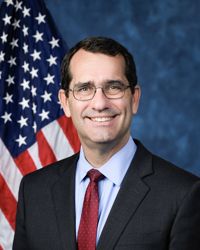
Derek Schmidt
RRepublicanKS-2 · Representative
55
/ 100
Average
Attendance99
Avg: 96
Independence4
Avg: 4
Bipartisan Tone23
Avg: 15
Ethics Record100
Avg: 99
Transparency34
Avg: 53
Accountability Score — composite of attendance, independence, bipartisan tone, ethics record & transparency.
Methodology13
Bills Sponsored
0
Enacted into Law
2
Passed a Chamber
11
In Committee
All Sponsored Bills
HR8352Passed House
Criminal History Access Act of 2026
Criminal History Access Act of 2026 This bill authorizes a new type of entity—peace officer standards and training agencies—to access criminal history record information maintained by the Federal Bureau of Investigation. The term peace officer standards and training agency means an agency of a state, the District of Columbia, or a U.S. territory that is authorized to set standards for the hiring, training, ethical conduct, and retention of its law enforcement officers through certification, licensing, or other similar qualification processes.
HR10793In Committee
To modify the authority of Department of Defense for installation support services and intergovernmental support agreements, and for other purposes.
HR4465Passed House
To amend chapters 4, 10, and 131 of title 5, United States Code, as necessary to keep those chapters current and to correct related technical errors.
This bill amends Chapter 4 (Inspectors General), Chapter 10 (Federal Advisory Committees), and Chapter 131 (Ethics in Government) of Title 5 of the U.S. Code . The amendments (1) incorporate laws enacted after October 19, 2021, that amend or repeal provisions of those chapters, and (2) make related technical corrections.
HR8276In Committee
Quindaro Townsite National Historic Landmark Act
This bill would designate the Quindaro Townsite in Kansas as a National Historic Landmark, officially recognizing its historical significance and protecting it from development. The designation would help preserve the site, which has important connections to African American history and the pre-Civil War era, and could make it eligible for federal funding and resources to support historical research and public education about the location.
HR9794In Committee
To direct the Secretary of Defense to establish the Senator Robert J. Dole Greatest Generation Education Program.
The Department of Defense would create a new education program named after Senator Robert J. Dole to support military members and veterans in pursuing educational opportunities. The program would help service members and veterans access training, scholarships, or educational benefits to advance their careers and skills after military service.
HR9298In Committee
Stopping Harmful and Outrageous Torts Act
The proposal would clarify and potentially expand legal protections that shield firearms manufacturers and retailers from being sued by victims of gun violence or their families. Currently, a 2005 law already provides broad immunity for gun makers and sellers, and this amendment would strengthen those protections further. The change would make it harder for people harmed by guns to hold the industry legally responsible for their injuries or losses.
HR9108In Committee
To amend title XVIII of the Social Security Act to adjust the eligibility for the rural emergency hospital designation under the Medicare program.
The proposal would change the rules for which rural hospitals can qualify as emergency hospitals under Medicare, potentially allowing more small hospitals in remote areas to receive this special designation and the funding that comes with it. This could help rural communities maintain emergency care services by giving their hospitals access to Medicare payments designed to support facilities serving less densely populated regions. The change would primarily affect rural hospital administrators, patients in remote areas who depend on these facilities, and Medicare's budget for rural healthcare.
HR8065In Committee
Restoring Executive Branch Authorities to Oversee Offices of the United States Attorneys Act of 2026
Restoring Executive Branch Authorities to Oversee Offices of the United States Attorneys Act of 2026 This bill expands the authority of the executive branch to appoint interim U.S. Attorneys. Current law generally requires U.S. Attorneys to be appointed by the President and confirmed by the Senate for four-year terms. However, if a position becomes vacant, then current law allows the Attorney General to appoint an interim U.S. Attorney for a term of up to 120 days. Further, if the 120-day term of an interim U.S. Attorney expires without a permanent, Senate-confirmed nominee, then the U.S. district court for the relevant judicial district may appoint a U.S. Attorney to serve until the vacancy is filled. This bill eliminates the authority for U.S. district courts to appoint U.S. Attorneys to fill a vacancy after the 120-day term of an interim U.S. Attorney expires. Additionally, the bill authorizes the Attorney General to make multiple interim appointments for 120-day terms.
HR7752In Committee
Kelsey Smith Act
The Kelsey Smith Act would require cell phone carriers to provide law enforcement with location information from mobile devices during emergencies without waiting for a court order, allowing police to quickly locate missing or endangered people. The bill aims to speed up rescue efforts in time-sensitive situations like kidnappings or missing persons cases by removing delays that can occur when obtaining traditional legal warrants. This would affect both wireless carriers, who would need to comply with emergency requests, and law enforcement agencies seeking to locate people in danger.
HR7664In Committee
State Partnerships to Enhance Removal of Criminal Aliens Act
This bill would create partnerships between the federal government and state law enforcement agencies to identify and remove immigrants who have committed crimes. It aims to give states more resources and authority to work with federal immigration officials in deporting criminal aliens, potentially affecting both state police departments and immigrants with criminal convictions.
HR6595In Committee
To direct the Secretary of Defense and the Secretary of Veterans Affairs to improve the availability of care for veterans at facilities of the Department of Defense.
HR5364In Committee
STOP FRAUD in Medicaid Act
States Taking On Power For Redressing All Unlawful Deceits in Medicaid Act or the STOP FRAUD in Medicaid Act This bill expands the scope of state Medicaid fraud control units to include investigating and prosecuting fraud in connection with the activities of individuals who apply for or receive Medicaid benefits. Currently, these units investigate and prosecute fraud in relation to Medicaid providers.
HR5211In Committee
Peace Officer Standards and Training Agency Information Access Clarification Act
Peace Officer Standards and Training Agency Information Access Clarification Act This bill authorizes a new type of entity—peace officer standards and training agencies—to access criminal history record information maintained by the Federal Bureau of Investigation. The term peace officer standards and training agency means an agency of a state, the District of Columbia, or a U.S. territory that is authorized to set standards for the hiring, training, ethical conduct, and retention of its law enforcement officers through certification, licensing, or other similar qualification processes.