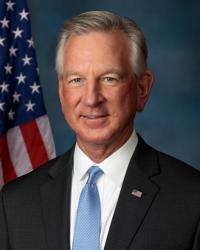
Tommy Tuberville
RRepublicanAL · Senator
52
/ 100
Average
Attendance93
Avg: 97
Independence25
Avg: 23
Bipartisan Tone11
Avg: 14
Ethics Record100
Avg: 100
Transparency12
Avg: 47
Accountability Score — composite of attendance, independence, bipartisan tone, ethics record & transparency.
Methodology27
Bills Sponsored
0
Enacted into Law
1
Passed a Chamber
24
In Committee
All Sponsored Bills
S4974Passed Senate
Making America's Food Safer Act
Making America's Food Safer Act This bill expands the Food and Drug Administration’s (FDA’s) authority to require the destruction of unsafe imported foods, share food safety information, and make use of food facility audit information. Specifically, the bill authorizes the FDA to order the destruction, without the opportunity for export, of any item that (1) is refused import into the United States; (2) violates federal law regulating food, drugs, medical devices, cosmetics, and tobacco products; and (3) presents a significant public health concern. Before issuing a destruction order, the FDA must provide an item’s owner or consignee with appropriate due process, including notice and an opportunity to appear. If an order is issued, the item’s owner or consignee must destroy it within 90 days at their own cost. The bill also generally authorizes the FDA to share unredacted food safety information with state, local, tribal, and territorial authorities, including information related to foodborne illness tracking, recalls and outbreaks, and other topics. During a food safety incident, the FDA may disclose certain commercial information that is otherwise protected from disclosure. Finally, the bill expands the FDA’s third-party audit system to make domestic food facilities eligible for voluntary audits. (Foreign facilities are eligible under current law.) The bill also authorizes the FDA to use audit results and related certifications to analyze risks and prioritize regulatory activities (e.g., inspections) to protect public health. (This information is currently used to determine whether specific food, or food from a specific facility, is eligible for import.)
S5485In Committee
Americans First Immigration Act
S4978In Committee
Stop Settlement Slush Funds Act of 2026
When the federal government settles lawsuits, it sometimes agrees to let defendants donate money to charities or causes instead of paying the full settlement amount to the government. This bill would restrict or eliminate that practice, ensuring that settlement money goes directly to the U.S. Treasury rather than to third-party organizations chosen by the defendant. The change would affect companies and individuals who settle cases with federal agencies, as well as nonprofits that currently receive donations through these settlement agreements.
S4692In Committee
Homeopathic Drug Product Safety, Quality, and Transparency Act
The proposal would change how the federal government regulates homeopathic medicines—products made by diluting substances to very small amounts—which are currently treated differently than standard drugs. The changes would affect how these products are labeled, tested, and approved, potentially bringing them under stricter oversight similar to conventional medications. This would impact manufacturers of homeopathic remedies and consumers who use these products.
S4546In Committee
ASSIMILATION Act
This bill would overhaul U.S. immigration law by making it harder to immigrate through family connections, eliminating the diversity visa lottery, tightening rules for who can claim asylum, and requiring all employers to verify workers are legally authorized to work. It would also increase penalties for overstaying visas, change citizenship requirements, and restrict certain work visa programs like H-1B visas and student work permits. The changes would affect immigrants seeking to enter or stay in the country, employers who hire workers, and families trying to reunite relatives from abroad.
S4365In Committee
FAFSA Verification Efficiency Act
FAFSA Verification Efficiency Act This bill requires the Department of Education (ED) to verify the Social Security number (SSN) and citizenship status of any individual who is required to provide information to ED for federal student aid. Currently, ED must work with the Social Security Administration (SSA) to verify the SSN of a student who is applying for federal student aid. This bill expands the requirement so that ED must work with the SSA to verify the SSN and citizenship status of any individual who is required to provide information to ED on the Free Application for Federal Student Aid (FAFSA) form, including contributors. A contributor refers to anyone (the student, the student’s spouse, the student's biological or adoptive parent, or a parent’s spouse) who is required to provide information on the FAFSA form.
S4177In Committee
Student Athlete Act of 2026
The bill would establish new rules for how college athletes can earn money from their names, images, and likenesses, likely addressing issues around compensation, eligibility, and fairness across different sports programs. It would affect student athletes, colleges and universities, and sports organizations by setting federal standards for what kinds of endorsement deals and payments are allowed. The legislation aims to create a more uniform system rather than having each state set its own rules.
S1726In Committee
ASSIST Act of 2025
Automotive Support Services to Improve Safe Transportation Act of 2025 or the ASSIST Act of 2025 This bill expands the definition of medical services for purposes of veterans’ benefits to include additional medically necessary automobile adaptations. Under the bill, the Department of Veterans Affairs may provide funding for the following medically necessary automobile adaptations for driver or passenger use: ramp and kneeling systems, lowered floors, occupied and unoccupied mobility lifts, ingress or egress accessibility modifications, and adapted seating. The bill also extends the limitation on pension amounts for certain hospitalized or institutionalized veterans through September 30, 2032.
S3936In Committee
USDA Loan Modernization Act
The bill would update how the U.S. Department of Agriculture makes loans to farmers and rural businesses, likely modernizing outdated lending practices and making it easier for agricultural borrowers to access credit. The changes would affect farmers, ranchers, and rural entrepreneurs who rely on USDA loans to start or expand their operations.
S2737In Committee
Veterans National Traumatic Brain Injury Treatment Act
The proposal would establish or expand specialized treatment programs and services for veterans who have suffered traumatic brain injuries, ensuring they have access to comprehensive care including rehabilitation, therapy, and long-term support. Veterans with brain injuries from combat or military service would benefit from improved medical facilities and trained specialists dedicated to their recovery and reintegration into civilian life. The bill addresses a significant health challenge affecting thousands of service members and veterans by dedicating federal resources to their neurological care and rehabilitation needs.
SRES524In Committee
A resolution recognizing the 90th anniversary of the Alabama Highway Patrol and commemorating its history of excellence.
S3121In Committee
UBER Act
The bill would establish new federal standards and regulations for rideshare and transportation network companies like Uber and Lyft, covering areas such as driver classification, safety requirements, and consumer protections. It affects millions of rideshare drivers and passengers across the country by setting uniform rules that companies must follow rather than allowing each state to create its own separate regulations. The legislation aims to balance the interests of workers seeking better protections and benefits with companies' operational flexibility.
S1350Reported
A bill to modify the boundaries of the Talladega National Forest, and for other purposes.
This bill would adjust the boundaries of the Talladega National Forest in Alabama, likely adding or removing land from federal management to better serve conservation, recreation, or local community needs. The changes would affect how much public land is available for activities like hiking and camping, as well as timber management and wildlife protection in the region. The bill has passed committee review and is ready for a full Senate vote.
S3008In Committee
No Shari’a Act
S3009In Committee
Preserving a Sharia-Free America Act
S2555In Committee
Student Visa Integrity Act of 2025
S635In Committee
Veterans Homecare Choice Act of 2025
Veterans Homecare Choice Act of 2025 This bill includes any nurse registry as an eligible health care provider under the Veterans Community Care Program of the Department of Veterans Affairs. Under the bill, a nurse registry is a person who satisfies applicable state licensure requirements and procures, or attempts to procure, contracts or agreements on behalf of registered nurses, licensed practical nurses, certified nursing assistants, home health aides, companions, or homemakers under which such individuals may furnish health care-related or assistive services and receive compensation.
SRES309In Committee
A resolution commemorating the 65th anniversary of the Marshall Space Flight Center and recognizing its continued leadership in the development of the Space Launch System and human space exploration.
S1988In Committee
A bill to prohibit the participation of males in athletic programs or activities at the military service academies that are designated for women or girls.
S1649In Committee
Sporting Goods Excise Tax Modernization Act
The proposal would update federal taxes on sporting goods and firearms that haven't been changed in decades, potentially adjusting rates and which products are covered. This would affect sporting goods manufacturers and retailers, as well as hunters and recreational shooters who purchase firearms and ammunition. The changes could impact how much consumers pay for these items and how much tax revenue the government collects from these sales.
SRES137In Committee
A resolution commending Volkert, Inc. on the occasion of its 100th anniversary and its century of service to the State of Alabama and the United States.
This resolution recognizes Volkert, Inc., headquartered in Alabama, for its 100th anniversary and its contributions to engineering, infrastructure, and economic development.
S862In Committee
HBOT Access Act of 2025
The legislation would expand access to hyperbaric oxygen therapy (HBOT) for veterans by requiring the Department of Veterans Affairs to cover this treatment for additional medical conditions beyond those currently approved. Veterans suffering from conditions like diabetic wounds, radiation injuries, and certain infections could potentially receive this therapy as part of their VA benefits. The bill aims to improve treatment options for veterans dealing with chronic wounds and injuries that may benefit from increased oxygen exposure.
S9Introduced
Protection of Women and Girls in Sports Act of 2025
Protection of Women and Girls in Sports Act of 2025 This bill generally prohibits school athletic programs from allowing individuals whose biological sex at birth was male to participate in programs that are for women or girls. Specifically, the bill provides that it is a violation of Title IX of the Education Amendments of 1972 for federally funded education programs or activities to operate, sponsor, or facilitate athletic programs or activities that allow individuals of the male sex to participate in programs or activities that are designated for women or girls. (Title IX prohibits discrimination on the basis of sex in federally funded education programs or activities, including in public elementary and secondary schools and in colleges and universities.) Under the bill, sex is based on an individual's reproductive biology and genetics at birth.
S618In Committee
Protecting America’s Agricultural Land from Foreign Harm Act of 2025
Protecting America's Agricultural Land from Foreign Harm Act of 2025 This bill prohibits persons associated with the governments of Iran, North Korea, China, or Russia from purchasing or leasing agricultural land in the United States. Specifically, the President must prohibit any person (individual or entity) owned by, controlled by, or subject to the jurisdiction or direction of these foreign governments from purchasing or leasing (1) public agricultural land that is owned by the United States and administered by a federal department or agency, or (2) private agricultural land that is located in the United States. A person that violates or attempts to violate this prohibition is subject to civil and criminal penalties. This prohibition does not require a person that owns or leases agricultural land as of the date of this bill's enactment to sell that land. Further, the President must prohibit a person associated with these foreign governments and who leases, or who has full or partial ownership of, agricultural land in the United States from participating in Department of Agriculture (USDA) programs. Exceptions are included to allow for participation in USDA programs related to food safety, the health and labor safety of individuals, or certain reporting and disclosure requirements. The bill excludes U.S. citizens or lawful permanent residents from these restrictions. The bill also amends the Agricultural Foreign Investment Disclosure Act of 1978 (AFIDA) to require reporting on security interests and leases. Finally, the Government Accountability Office must submit a report to Congress on AFIDA.
S458In Committee
Senior Citizens Tax Elimination Act
S405In Committee
Protection of Women in Olympic and Amateur Sports Act
Protection of Women in Olympic and Amateur Sports Act This bill requires certified national governing bodies (NGBs) of amateur sports (e.g., USA Gymnastics) to prohibit a person whose sex is male from participating in an amateur athletic competition that is designated for females, women, or girls. Under the bill, male means an individual who has, had, will have—or would have, but for a developmental or genetic anomaly or historical accident—the reproductive system that at some point produces, transports, and utilizes sperm for fertilization.
S179In Committee
FARM Act
Foreign Adversary Risk Management Act or the FARM Act This bill places the Secretary of Agriculture on the Committee on Foreign Investment in the United States (CFIUS). It also requires CFIUS to review any investment that could result in foreign control of any U.S. agricultural business. Further, the bill includes agricultural systems and supply chains in the definitions of critical infrastructure and critical technologies for the purposes of reviewing such investments. The Department of Agriculture and the Government Accountability Office must each analyze and report on foreign influence in the U.S. agricultural industry.