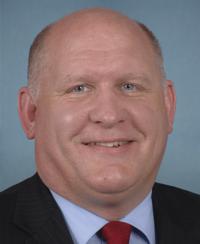
Glenn Thompson
RRepublicanPA-15 · Representative
62
/ 100
Average
Attendance99
Avg: 96
Independence2
Avg: 4
Bipartisan Tone11
Avg: 15
Ethics Record100
Avg: 99
Transparency100
Avg: 53
Accountability Score — composite of attendance, independence, bipartisan tone, ethics record & transparency.
Methodology42
Bills Sponsored
0
Enacted into Law
5
Passed a Chamber
37
In Committee
All Sponsored Bills
HRES1619In Committee
Reaffirming German-American friendship and supporting continued cooperation between the United States and Germany.
HRES1614In Committee
Expressing support for the designation of October 4 through October 10, 2026, as "National 4-H Week".
HRES1566In Committee
Expressing the sense of the House of Representatives that the third Friday of September should be recognized as "National POW/MIA Recognition Day".
HRES1513In Committee
Expressing support for the designation of the week beginning on September 6, 2026, as "Celebrate Community Week".
HR10135In Committee
Not In My Barn Yard Act
HR9974In Committee
Young Farmer Success Act
Farm and ranch workers would become eligible for federal student loan forgiveness programs that currently only cover people in traditional public service jobs like teaching, nursing, and government work. This change would allow agricultural workers who meet other requirements to have portions of their federal student loans canceled after a certain period of employment. The bill aims to recognize farm and ranch work as a form of public service comparable to other occupations already covered by loan forgiveness programs.
HR9535In Committee
Securing Agriculture's Workforce Act of 2026
Securing Agriculture's Workforce Act of 2026 This bill expands the H-2A agricultural visa program; creates online platforms for H-2A employers, workers, and agencies; and codifies certain wage calculations. Under current law, workers on H-2A visas are only allowed to perform agricultural work of a seasonal or temporary nature. Under the bill, the seasonal work requirement is removed, thus allowing H-2A workers to qualify for agricultural work that occurs year-round. The bill also expands the type of agricultural work that qualifies, including reforestation, aquaculture, and livestock work. The Department of Agriculture must issue rules to define agricultural labor or services for purposes of the H-2A program. The bill also establishes an H-2A visa pathway for current unauthorized agricultural workers who otherwise meet requirements. The Department of Labor must maintain a national, publicly accessible online job registry and database of all job offers submitted by employers seeking a labor certification required to employ H-2A workers. The Department of Homeland Security must establish an online platform for employers to submit information and documentation for review by federal agencies in the course of admitting H-2A workers. The H-2A program requires employers to provide workers with wage rates at or above those set in regulations and such wages must not adversely affect the wages and working conditions of workers similarly employed in the United States. The bill codifies the current calculation method for the adverse effect wage rate as set in regulation.
HR9304In Committee
Juice Access Improvement Act
The proposal would change the Women, Infants, and Children (WIC) nutrition program to make juice the standard beverage option included in food packages for eligible families, rather than requiring participants to specifically request it. WIC serves low-income pregnant women, new mothers, and young children by providing vouchers for nutritious foods, so this change would affect millions of families receiving this federal assistance. The shift aims to make juice more readily available to program participants without requiring them to take extra steps to access it.
HR9305In Committee
Juice for Healthy Families Act of 2026
The proposal would limit how much juice families can buy each month through the WIC program, which provides food assistance to low-income pregnant women, new mothers, and young children. By capping juice allowances, the bill aims to encourage healthier eating habits and reduce sugar consumption among these vulnerable populations. The change would affect millions of families currently receiving WIC benefits across the country.
HR9080In Committee
Mass Timber Federal Buildings Act of 2026
The federal government would be required to prioritize buying wood products made using new manufacturing techniques when constructing or renovating public buildings. This preference would apply to federal construction projects and could affect timber companies, construction firms, and government agencies that manage building projects. The goal is to boost demand for innovative wood products while potentially supporting domestic forestry and construction industries.
HR9255In Committee
Timeshare Transparency Act
The proposal would set new rules for how timeshare companies sell their properties, requiring them to provide clearer information to buyers about costs, terms, and what they're actually purchasing. These requirements aim to help consumers make better-informed decisions and reduce deceptive sales practices in the timeshare industry, which affects millions of Americans who own vacation properties.
HR9164In Committee
FRESH Act
The federal government would provide grants to schools to buy and install equipment for storing milk in cafeterias and food service areas. This funding would help elementary and secondary schools improve their ability to keep milk fresh and safe for students who participate in school lunch programs. The money would go to schools that apply for the grants and meet eligibility requirements set by the Department of Agriculture.
HR7891In Committee
Student Aid Fraud Oversight and Accountability Act of 2026
Student Aid Fraud Oversight and Accountability Act of 2026 This bill requires the Department of Education (ED) to prioritize the review of institutions of higher education (IHEs) that disburse federal student aid without verifying the identity of a student whose Free Application for Federal Student Aid (FAFSA) presents a reasonable suspicion of identity fraud. Specifically, the bill requires ED to identify each IHE that disburses, on or after October 1, 2026, federal financial aid for an award year to any student whose FAFSA presents a reasonable suspicion of identity fraud, as determined by ED's identity fraud detection system. However, the bill excludes from this identification any IHE that demonstrates to ED, for each student and before disbursing federal financial aid, that the IHE (1) verifies the student's identity in person or by live video, (2) notifies ED of the identify verification, and (3) maintains a record of such identity verification. ED may use identification information to inform program reviews, audits, investigations, and other oversight activities related to federal student aid. (On April 26, 2026, ED began implementing a real-time identity fraud detection process within the FAFSA form that places applicants into one of four risk categories. High-risk applicants must confirm their identity by presenting documentation during the online application process, including via a live camera process. Applicants who are rejected via this automated process must then have their identity verified in person by IHEs.)
HR7567Passed House
Farm, Food, and National Security Act of 2026
Farm, Food, and National Security Act of 2026 This bill (commonly known as the farm bill) reauthorizes through FY2031 and modifies Department of Agriculture programs that address commodity support, conservation, trade and international food aid, nutrition assistance, farm credit, rural development, research and extension activities, forestry, energy, horticulture, crop insurance, livestock and other animals, and foreign investments in U.S. agricultural land.
HR8714In Committee
Skill Savings Account Act of 2026
The proposal would create special savings accounts that workers can use to set aside money for job training, education, and skill-building programs without paying taxes on the earnings in those accounts. These accounts would help people pay for courses, certifications, and other training to advance their careers or switch to new fields. Workers would get a tax break on the money they save for these purposes, making it more affordable to invest in their own professional development.
HR7989In Committee
ACE Act
All Children are Equal Act or the ACE Act This bill revises the funding formulas for distributing Targeted Grants and Education Finance Incentive Grants (EFIG) to local educational agencies (LEAs). Under current law, both the Targeted Grant and EFIG formulas use a weighted formula child count to increase aid to LEAs with the highest numbers or percentages of poor and other disadvantaged children (commonly referred to as formula children ). Generally, children counted in these formulas are assigned weights based on (1) each LEA's percentage of formula children (commonly referred to as percentage weighting ), and (2) each LEA's number of formula children (commonly referred to as number weighting ). The higher of the two weighted formula child counts is then used in the formula for determining grants for an LEA. Under this bill, beginning in FY2026 and for each succeeding fiscal year after, the weighted formula child count used to determine an LEA's Targeted Grant must be based only on the percentage weighting. Additionally, the weighted formula child count used to determine an LEA's EFIG must be based only on the number weighting. For additional information see CRS Report R48893, FY2024 State Grants Under Title I-A of the Elementary and Secondary Education Act (ESEA) ; CRS Report R48890, Determining Grants Under Title I-A of the Elementary and Secondary Education Act (ESEA) ; and CRS Report R48165, The Elementary and Secondary Education Act (ESEA), as Amended by the Every Student Succeeds Act (ESSA): An Analytical Review of the Allocation Formulas .
HR7885In Committee
Cybersecurity Skills Integration Act
Cybersecurity Skills Integration Act This bill requires the Department of Education to establish a pilot program in order to award grants to partnerships between postsecondary educational institutions and employers in critical infrastructure sectors for cybersecurity education programs.
HR7517In Committee
To designate the facility of the United States Postal Service located at 10 East Main Street in Mahaffey, Pennsylvania, as the "Robert Allen Bishop, Sr. Post Office Building".
This bill designates the facility of the United States Postal Service located at 10 East Main Street in Mahaffey, Pennsylvania, as the "Robert Allen Bishop, Sr. Post Office Building".
HRES1063In Committee
Supporting the goals and ideals of "Career and Technical Education Month".
This resolution supports the designation of Career and Technical Education Month to celebrate career and technical education across the United States.
HR7411In Committee
Mammography Access for Veterans Act of 2025
The bill would expand a Veterans Affairs program that allows veterans to receive mammography screenings (breast cancer imaging) remotely through telehealth technology rather than having to visit a facility in person. This expansion would make it easier for veterans, particularly those in rural or underserved areas, to access breast cancer screening services without traveling long distances. The program aims to improve early detection of breast cancer among the veteran population.
HRES1041In Committee
Supporting the designation of "Scouting America Day" in celebration of its 116th anniversary.
This bill would officially designate a day to celebrate Scouting America's 116th anniversary as a national observance. The designation is largely ceremonial and would recognize the contributions of the youth organization without creating new laws or programs. It affects Scouting America members, their families, and communities that participate in scouting activities.
HRES975Passed House
To inform the Senate that a quorum of the House has assembled.
This is a procedural message confirming that enough House members showed up for work to conduct official business that day. It's a routine administrative step that happens regularly during congressional sessions to ensure the chamber can legally pass laws and make decisions. The message has already been approved by the House.
HRES974Passed House
Providing for a committee to notify the President of the assembly of the House of Representatives.
The House of Representatives would establish a committee responsible for formally notifying the President when the House has assembled and is ready to conduct business. This is a procedural measure that ensures proper communication between the legislative and executive branches at the start of congressional sessions. The House has already passed this measure.
HRES976Passed House
Providing for the hour of meeting of the House.
The House of Representatives set a specific time for when it will meet and conduct business on a particular day. This is a routine procedural measure that Congress uses to organize its daily schedule and ensure members know when sessions will begin.
HR6543In Committee
Health Care Worker and First Responder Fairness Act
Health Care Worker and First Responder Fairness Act This bill exempts from the Social Security Retirement Earnings Test (RET) wages earned through work as a health care professional or first responder during the COVID-19 pandemic. Under the RET, benefits are reduced for beneficiaries who are younger than full retirement age if they earn wages in excess of a specified annual limit. Further, the Social Security Administration may issue waivers to individuals employed as health care professionals or first responders during a declared public health emergency in which there is a shortage of health care workers. Wages earned by individuals granted waivers during a public health emergency are exempt from the RET.
HR4550Passed House
United States Grain Standards Reauthorization Act of 2025
United States Grain Standards Reauthorization Act of 2025 This bill reauthorizes the U.S. Grain Standards Act (USGSA) through FY2030 and modifies authorities under the act. Under the USGSA, the Department of Agriculture (USDA) establishes official marketing or quality standards for certain grains (e.g., corn, soybeans, and wheat), and the Federal Grain Inspection Service (FGIS) conducts and supervises official grain inspections and weighing services. Most provisions of the act are permanently authorized; however, several expire on September 30, 2025. Specifically, the bill reauthorizes through FY2030 FGIS's authority to collect fees for required federal supervision of inspections and weighing services; the 30% cap on administrative and supervisory costs which may be incurred for services performed, with exceptions; standardization and compliance activities and monitoring of foreign ports; and the Grain Inspection Advisory Committee. The costs associated with equipment and the development of technology are excluded from the current 30% cap for administrative and supervisory costs for services. The bill also includes a technical change that specifies fees are part of a trust fund , instead of the current fund . Under the bill, USDA may inspect domestic non-export grain that is loaded or unloaded at an export port, as needed. Further, USDA must prioritize the adoption of improved grain grading technology to provide for efficient, accurate, and consistent grading of grain. Additional revisions include allowing USDA to work in cooperation with official agencies in a continuing research program, expanding reporting requirements, and allowing an advisory committee member to serve until a new member is appointed.
HRES791In Committee
Expressing support for the designation of October 5 through October 11, 2025, as "National 4-H Week".
This resolution supports the designation of National 4–H Week and recognizes the important role of 4–H as the youth development program of the Cooperative Extension System and the Department of Agriculture.
HRES783In Committee
Reaffirming German-American friendship and supporting continued cooperation between the United States and Germany.
HRES705In Committee
Expressing support for the designation of the week beginning on September 14, 2025, as "Celebrate Community Week".
This resolution supports the designation of Celebrate Community Week.
HR4965In Committee
Counseling for Career Choice Act
The proposal would require schools to provide students with career counseling and guidance to help them explore different job options and educational paths that match their interests and skills. Students would have access to information about various careers, training programs, and job market trends to make more informed decisions about their future. This would affect high school students and their families by giving them better tools to plan for life after graduation, whether that means college, trade school, or entering the workforce directly.
HR4945In Committee
GO Ag Act
The proposal would expand educational opportunities and support programs related to agriculture, helping students learn farming and agricultural skills through schools and training initiatives. It would likely affect students interested in agriculture careers, farmers, rural communities, and educational institutions that offer farm-related programs. The bill is currently under review by the House Committee on Education and Workforce to determine whether it should move forward.
HR4742In Committee
GIVE MILK Act
Giving Increased Variety to Ensure Milk Into the Lives of Kids Act or the GIVE MILK Act This bill revises the Special Supplemental Nutrition Program for Women, Infants, and Children (WIC) to allow WIC participants (or the parent or guardian of such participants) to elect to be issued nonfat milk, 1% low-fat milk, 2% reduced-fat milk, or whole milk. Current WIC regulations restrict the milk choices for most women and children who are at least two years old to nonfat or 1% milk, with exceptions.
HR4475In Committee
Medicare Orthotics and Prosthetics Patient-Centered Care Act
This bill would change how Medicare covers artificial limbs and orthotic devices (like braces) to give patients more choice in selecting their providers and equipment. It likely aims to improve the quality of care and reduce costs by allowing beneficiaries to work directly with prosthetists and orthotists rather than being limited to certain suppliers, which could help seniors and disabled people get better-fitting devices that meet their individual needs.
HR4355In Committee
Federal Prisons Accountability Act of 2025
Federal Prisons Accountability Act of 2025 This bill modifies the appointment procedures and term of service for the Director of the Bureau of Prisons. Currently, the director is appointed by the Attorney General. This bill requires the director to be appointed by the President and confirmed by the Senate. The bill also limits the director to a single term of 10 years.
HR3791In Committee
EMS Counts Act
This bill would require emergency medical services (EMS) workers to be counted and tracked in federal labor statistics, similar to how other occupations are monitored. Currently, EMS workers are often grouped with other healthcare workers in data collection, making it hard to understand their specific employment trends, wages, and working conditions. The change would give policymakers and researchers better information about this workforce and could help identify issues like staffing shortages or pay disparities in emergency services.
HR3131In Committee
Community Services Block Grant Improvement Act of 2025
Community Services Block Grant Improvement Act of 2025 This bill reauthorizes the Community Services Block Grant (CSBG) program through FY2032 and makes certain changes to the program and associated eligibility requirements. The CSBG program supports various antipoverty activities, primarily through formula-based allotments to states, tribes, and territories, the majority of which must be made available in grants to eligible local entities. Specifically, the bill permanently sets the measure of eligibility for services, assistance, or resources provided directly to individuals or families under the program at 200% of the poverty line. (Under current law, the eligibility measure is temporarily set at 200% of the poverty line, an increase from the previous measure of 125% of the poverty line.) The bill also makes certain changes to the permitted uses of funding, including by allowing CSBG funds to be used to facilitate low-income individuals’ and communities’ access to high-speed broadband, digital literacy training, technical support, and other services. States may also use certain funds allocated for training and technical assistance to assist eligible entities in responding to statewide and regional conditions that create economic insecurity, including emergency conditions. The bill also expands requirements for the plans that states must submit to the Department of Health and Human Services in order to receive CSBG funds (e.g., transparency assurances), and sets deadlines by which states must make funds available to eligible entities. Finally, the bill repeals a provision that allowed states to use CSBG funds to offset revenue losses associated with state charity tax credits.
HR1960In Committee
Simplifying Veterans Assistance Act of 2025
Simplifying Veterans Assistance Act of 2025 This bill requires the Department of Veterans Affairs to provide specified guidance to entities seeking grants for the provision of comprehensive service programs to homeless veterans (e.g., rehabilitative services). Specifically, the VA must provide guidance and best practices on a publicly available VA website. Additionally, after the announcement of a funding notice and before the application deadline, the VA must offer at least two online information sessions for entities seeking grants.
HR1217In Committee
Orphan Well Grant Flexibility Act of 2025
Orphan Well Grant Flexibility Act of 2025 This bill removes certain requirements, including measuring methane emissions, for grants to states under the State Orphaned Wells Program. Under the program, the Department of the Interior provides grants to states for the following purposes: (1) plugging, remediating, and reclaiming orphaned wells located on federal land; (2) identifying and characterizing undocumented orphaned wells; (3) measuring and tracking emissions of gases (e.g., methane) or contamination of water associated with orphaned wells; or (4) conducting certain other related activities. Generally, orphaned wells are oil and gas wells without solvent owners or operators responsible for cleaning up leaks from the wells. In 2024, Interior issued guidance for the grant program that requires states to conduct certain measuring and tracking activities related to the orphaned wells before and after receiving grants. However, the bill specifies that states are not required to provide such information in order to receive a grant. Instead, the bill makes measuring and tracking optional. The bill also directs Interior to enter into an agreement with the National Academies of Sciences, Engineering, and Medicine to study the effect of the plugging and remediation activity on economic development, housing trends, and other potential benefits in areas where the plugging and remediation activity reclaimed a high number of well sites.
HRES121In Committee
Supporting the designation of "Scouting America Day" in celebration of its 115th anniversary.
This resolution supports the redesignation of a Scouting America Day in celebration of the 115th anniversary of the incorporation of Scouting America (formerly known as Boy Scouts of America).
HRES115In Committee
Supporting the goals and ideals of "Career and Technical Education Month".
This resolution supports the designation of Career and Technical Education Month to celebrate career and technical education across the United States.
HRES89In Committee
Providing amounts for the expenses of the Committee on Agriculture in the One Hundred Nineteenth Congress.
This resolution provides amounts for the expenses of the House Committee on Agriculture for the 119th Congress.
HR464In Committee
Skills Investment Act of 2025
The proposal would create tax incentives for businesses that invest in training and education programs for their workers, making it cheaper for companies to offer skills development courses. Workers would benefit from increased access to job training opportunities that help them learn new skills and advance their careers. The tax breaks would apply to companies of various sizes that spend money on apprenticeships, certifications, and other workforce development programs.