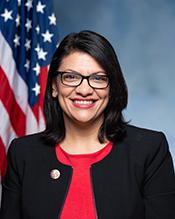
Rashida Tlaib
DDemocratMI-12 · Representative
61
/ 100
Average
Attendance98
Avg: 96
Independence6
Avg: 4
Bipartisan Tone9
Avg: 15
Ethics Record100
Avg: 99
Transparency91
Avg: 53
Accountability Score — composite of attendance, independence, bipartisan tone, ethics record & transparency.
Methodology37
Bills Sponsored
0
Enacted into Law
2
Passed a Chamber
35
In Committee
All Sponsored Bills
HR10807In Committee
Get the Flock Out of Our Communities Act
HR10040In Committee
No TSA Data for ICE Act
The proposal would restrict the Department of Homeland Security from using certain types of information when enforcing immigration and border security laws, and would limit changes the department can make to programs that allow frequent travelers to move through borders more quickly. This affects border agents, immigration enforcement officers, and people who participate in trusted traveler programs like Global Entry. The bill has been sent to multiple congressional committees for review.
HR9939In Committee
No AI Data Centers on Federal Lands Act
The proposal would prevent companies from building large artificial intelligence data centers on land owned by the federal government. This would affect tech companies and AI developers who might otherwise use public lands for these energy-intensive facilities, while protecting federal property from industrial development. The measure is currently being reviewed by the House Committee on Natural Resources.
HR9639In Committee
FAIR Credit Act
This bill would make it easier for people harmed by identity theft, fraud, or predatory lending to fix their credit reports and recover financially. It would also give vulnerable consumers better tools to protect themselves from becoming victims of these crimes in the first place, and prevent companies from continuing to harm people who have already been victimized. The changes would apply to credit reporting agencies and other companies that handle consumer financial information.
HR9374In Committee
Find Our Families Act of 2026
The government would be required to create and maintain a searchable online system where the public can find information about people being held in immigration detention facilities. This would allow families and advocates to locate detainees and access basic information about where they are being held and their status. The system would make detention records more transparent and accessible to the general public.
HCONRES108Passed House
Directing the President pursuant to section 5(c) of the War Powers Resolution to remove United States Armed Forces from hostilities in Lebanon.
This concurrent resolution directs the President to remove U.S. Armed Forces from hostilities in Lebanon within seven days of the resolution's adoption. The resolution specifies that it shall not be construed to prevent or limit security cooperation with the Lebanese Armed Forces or the protection of diplomatic facilities.
HR9490In Committee
Bank Failure Accountability Act
Large financial institutions would be required to delay part of the pay for their top executives, with that deferred money held in reserve to cover any fines the company might face for breaking laws or regulations. This approach aims to make senior leaders more financially accountable if their institution gets penalized, since they would personally lose compensation when fines are paid. The rule would apply to big banks and their related companies.
HCONRES84Passed House
Directing the President pursuant to section 5(c) of the War Powers Resolution to remove United States Armed Forces from Lebanon.
This concurrent resolution directs the President to remove U.S. Armed Forces from Lebanon within seven days of the resolution's adoption.
HRES1319In Committee
Ending child poverty.
The proposal aims to reduce the number of children living in poverty through various support mechanisms, likely including expanded assistance programs, tax credits, or increased funding for services that help low-income families. It would affect millions of children and their families across the country who struggle to afford basic necessities like food, housing, and healthcare. The bill is currently being reviewed by the House Committee on Oversight and Government Reform to determine its feasibility and potential impact.
HRES1028In Committee
Expressing the sense of the House of Representatives that the United States must act urgently to end the political and economic dominance of billionaire oligarchs, halt the corporate subsidies and tax advantages that fortify their power, and reinvest in the needs of the American people to defend democracy from authoritarianism.
This is a non-binding resolution expressing the House's view that the federal government should reduce the wealth and political influence of billionaires by eliminating corporate tax breaks and subsidies, then use that money to fund programs that benefit ordinary Americans and strengthen democratic institutions. The resolution doesn't create any new laws or require specific actions, but rather states a position that Congress believes addressing billionaire wealth concentration is important for protecting democracy. It has been referred to multiple committees for review, including those handling taxes, financial services, and government operations.
HRES1289In Committee
Recognizing the ongoing Nakba and Palestinian refugees' rights.
This resolution expresses the sense of Congress that it is the policy of the United States to recognize the Palestinian Nakba and support Palestinian refugees' rights. It also states that it is the policy of the United States to recognize that Palestinians are a unique people.
HR8715In Committee
Make DTE Pay Act
This bill would increase financial penalties for investor-owned electric and gas utility companies that raise their rates within two years before or after being penalized under the Clean Air Act for air pollution violations. The enhanced penalties aim to discourage utilities from passing the costs of environmental violations onto their customers through rate increases. This would affect utility companies and their customers who pay for electricity and natural gas.
HRES1268In Committee
Recognizing the week of May 3, 2026, through May 9, 2026, as "National Postpartum Awareness Week for Communities of Color".
The government would officially recognize the week of May 3-9, 2026, as "National Postpartum Awareness Week for Communities of Color" to highlight health challenges that affect mothers of color after childbirth. This designation aims to raise awareness about postpartum complications, mental health issues, and maternal mortality rates that disproportionately impact Black, Hispanic, and other communities of color. The recognition would encourage healthcare providers, organizations, and the public to focus attention on improving postpartum care and support for these communities.
HJRES168In Committee
Providing for congressional disapproval under chapter 8 of title 5, United States Code, of the rule submitted by the Bureau of Consumer Financial Protection relating to the withdrawal of the rule relating to "Bulletin 2022-01: Medical Debt Collection and Consumer Reporting Requirements in Connection with the No Surprises Act".
Congress would reject a decision by the Consumer Financial Protection Bureau to withdraw guidance it had issued about how debt collectors and credit reporting companies must handle medical bills under federal surprise billing protections. The rejection would force the agency to keep the original guidance in place, preventing debt collectors from using certain aggressive collection tactics on medical debts and requiring fairer treatment of patients on credit reports. This affects patients with medical debt, debt collection companies, and credit reporting agencies.
HRES1249In Committee
Unhoused Persons Bill of Rights
This resolution expresses Congress's commitment to eliminating homelessness by 2029 and protecting the rights of unhoused people, including access to housing, healthcare, jobs, education, and public spaces without discrimination or harassment from police or businesses. It calls for ensuring unhoused individuals have equal access to legal help, social services, voting rights, and internet access. The proposal has been sent to multiple House committees for review, including those handling financial services, healthcare, labor, and agriculture.
HR8494In Committee
To prohibit the Department of Homeland Security from entering into, modifying, extending, or renewing, any contract or intergovernmental service agreement to establish or operate any new immigration detention model, including the use of warehouses, modular facilities, soft-sided structures, tent systems, and processing centers.
The government would be banned from creating or using new types of immigration detention facilities, including warehouse conversions, temporary structures, tents, and processing centers. This would prevent the Department of Homeland Security from signing new contracts or agreements to build or operate these alternative detention models, though it wouldn't affect existing facilities already in use. The change would affect how immigration authorities house people in custody while their cases are processed.
HRES1181In Committee
Expressing support for the recognition of April as "National Arab American Heritage Month" (NAAHM) and celebrating the heritage and culture of Arab Americans in the United States.
This resolution would officially recognize April as National Arab American Heritage Month, allowing the federal government to celebrate and honor the contributions, history, and culture of Arab Americans across the country. The measure is largely symbolic and doesn't create new laws or programs, but it gives formal recognition to Arab American communities and their place in American society. It affects Arab Americans and anyone interested in learning about this group's heritage and achievements.
HR8254In Committee
Water Access and Affordability Act
The bill would create a federal assistance program to help low-income households afford their water bills and water system improvements, similar to existing programs that help people pay for electricity and heating. This would affect millions of families struggling with water costs and could also fund upgrades to aging water infrastructure in poor communities. The proposal is being reviewed by multiple congressional committees that handle infrastructure, energy, taxes, and government spending.
HRES1146In Committee
Standing with the people of Lebanon against the illegal invasion, war crimes, and ethnic cleansing perpetrated by the State of Israel.
This resolution expresses congressional opposition to Israeli military actions in Lebanon, characterizing them as illegal invasion, war crimes, and ethnic cleansing. The measure has been referred to the Foreign Affairs and Judiciary committees for review, though it does not propose any specific legislation or policy changes. The resolution reflects a particular political stance on the Israeli-Lebanese conflict and would serve primarily as a statement of congressional sentiment rather than a binding law.
HCONRES83In Committee
Directing the President, pursuant to section 5(c) of the War Powers Resolution, to remove the United States Armed Forces from hostilities in Lebanon that have not been authorized by Congress.
This concurrent resolution directs the President to remove U.S. Armed Forces from hostilities in Lebanon within seven days of the resolution's adoption, unless a declaration of war or authorization to use the U.S. Armed Forces for such purpose has been enacted.
HR7930In Committee
Daniel Ellsberg Press Freedom and Whistleblower Protection Act of 2026
This bill would strengthen legal protections for journalists and government whistleblowers who expose wrongdoing, making it harder for the government to prosecute them under espionage laws. It aims to balance national security concerns with the public's right to know about government activities, particularly protecting people who leak information to the press about illegal or unethical government conduct. The changes would affect how federal prosecutors can charge journalists and whistleblowers, and would give courts more flexibility in considering the public interest when evaluating these cases.
HR7854In Committee
Medicines for the People Act
The bill aims to make prescription medications more affordable and accessible for Americans by addressing drug pricing and potentially allowing the government or consumers to negotiate lower prices with pharmaceutical companies. It would likely affect patients who struggle to afford medications, insurance companies, and drug manufacturers. The proposal has been sent to two congressional committees for review and consideration.
HR7637In Committee
Head Start for America’s Children Act
This bill would expand or modify the Head Start program, which provides early childhood education and development services to low-income preschool-age children and their families. The changes likely aim to improve access, funding, or quality of these services for young children before they enter kindergarten. The bill is currently under review by the House Committee on Education and Workforce.
HRES1038In Committee
Expressing the sense of the House of Representatives that the United States must recommit to defend and uphold the rights and protections guaranteed by the Fourteenth Amendment to the United States Constitution to ensure that our democracy works for all of us, not just a powerful few.
This resolution expresses the House's position that the United States should strengthen its commitment to protecting the rights and equal protections guaranteed by the Fourteenth Amendment, which covers voting rights, due process, and equal treatment under the law. The measure emphasizes ensuring these constitutional protections work for all Americans, particularly minority groups and those with less political power, rather than primarily benefiting wealthy or influential people. As a resolution, it does not create new laws but rather states the chamber's official stance on this constitutional principle.
HR6768In Committee
Housing Our Communities Act
This bill would likely aim to increase affordable housing availability and improve community development programs, though the specific details are not yet clear from the title alone. Based on the subject matter, it probably addresses housing affordability for low- and middle-income families, possibly through funding, tax incentives, or changes to housing policies that affect renters, homebuyers, and local communities. The bill is currently under review by the House Financial Services Committee.
HR5985In Committee
Expanding Health Care Providers for Veterans Act
The legislation would allow more foreign-trained doctors and healthcare professionals to work in the Veterans Health Administration without going through the standard immigration visa process, making it easier for the VA to hire qualified medical staff. This change would help address healthcare shortages at VA facilities by streamlining hiring of international healthcare providers who want to serve veterans. Veterans seeking medical care would potentially benefit from increased access to doctors and specialists at VA hospitals and clinics.
HR5298In Committee
Tax Excessive CEO Pay Act of 2025
This bill would impose a special tax on companies whose chief executives earn significantly more than their typical workers, aiming to discourage extremely high CEO pay packages. The tax would apply to large corporations and would increase their tax burden based on the ratio between what a CEO makes compared to the median employee salary. The goal is to reduce income inequality by making it financially disadvantageous for companies to pay executives vastly more than their workforce.
HR4966In Committee
Stop Price Gouging in Grocery Stores Act of 2025
This bill would give the federal government power to prevent grocery stores from raising prices excessively during emergencies or supply shortages, allowing regulators to penalize retailers they determine are unfairly inflating food costs. The law would primarily affect large supermarket chains and food retailers, potentially limiting their ability to increase prices on essential items when demand spikes or supplies become scarce. Supporters argue it protects consumers from exploitation during crises, while critics worry it could discourage stores from stocking shelves or lead to shortages if profit margins become too thin.
HR4774In Committee
Fix Our Flooded Basements Act of 2025
This bill would provide federal funding and support to help homeowners and communities deal with basement flooding and water damage from storms and flooding events. It likely aims to improve emergency response, provide disaster relief assistance, and possibly fund infrastructure improvements to prevent future flooding in affected areas. The bill would help both individual property owners and local governments recover from and prepare for flood-related disasters.
HRES409In Committee
Recognizing the ongoing Nakba and Palestinian refugees' rights.
The measure would formally acknowledge the Nakba, the displacement of Palestinian Arabs during the 1948 Israeli-Palestinian conflict, and recognize the rights of Palestinian refugees. It calls for U.S. recognition of Palestinian refugees' claims and their right to return to their former homes or receive compensation. The resolution affects U.S. foreign policy toward the Israeli-Palestinian conflict and how America addresses refugee populations in international affairs.
HR3052In Committee
Agent Orange Relief Act of 2025
This bill would provide benefits and healthcare support to veterans and their families who were exposed to Agent Orange, a toxic chemical used during the Vietnam War that has caused serious health problems decades later. The legislation likely expands eligibility for medical treatment, disability compensation, or other assistance for affected veterans and their descendants who suffer from conditions linked to Agent Orange exposure. The bill aims to address long-term health consequences that veterans continue to face from this chemical exposure.
HR3051In Committee
Victims of Agent Orange Act of 2025
This bill would provide benefits and support to people who were exposed to Agent Orange, a toxic chemical used during the Vietnam War, and to their descendants who may have health problems as a result of that exposure. The legislation aims to help affected veterans and Vietnamese civilians get medical care, compensation, or other assistance for illnesses linked to Agent Orange contamination. The bill is being reviewed by committees that handle foreign policy and energy/environmental issues to determine what changes might be needed before a vote.
HRES351In Committee
Expressing support for the recognition of April as "National Arab American Heritage Month" (NAAHM) and celebrating the heritage and culture of Arab Americans in the United States.
This resolution would officially recognize April as National Arab American Heritage Month, designating a time to celebrate and acknowledge the contributions, history, and culture of Arab Americans across the United States. The measure affects all Americans by promoting awareness and appreciation of Arab American communities and their role in American society. The resolution is currently under review by the House Committee on Oversight and Government Reform.
HJRES85In Committee
Providing for congressional disapproval of the proposed foreign military sale to Israel of certain defense articles and services.
This joint resolution prohibits a proposed foreign military sale of certain defense articles and services to Israel.
HR1756In Committee
Stop Politicians Profiting from War Act of 2025
This bill would prevent members of Congress and their families from buying or selling stocks, bonds, and other investments related to defense contractors and military companies while serving in office. The goal is to stop lawmakers from potentially profiting off wars or military conflicts they vote to authorize or fund. The restriction would apply to Congress members themselves and likely their spouses and dependent children to close loopholes.
HR2475In Committee
Youth Homelessness Guaranteed Income Pilot Program Act of 2025
The bill would create a pilot program that gives regular cash payments to homeless young people to help them afford housing and meet basic needs. The program would test whether guaranteed income—money given with few strings attached—can help youth experiencing homelessness transition to stable housing and improve their overall well-being. This would affect homeless youth, housing organizations, and local communities where the pilot programs operate.
HR1354In Committee
Justice for All Act of 2025
Justice for All Act of 2025 This bill prohibits discrimination based on sex, sexual orientation, gender identity, or race-related characteristics in schools, businesses, federally funded programs, and other settings. It also provides statutory authority for and expands the types of civil actions that may be brought for violations. For example, the bill expands provisions under the Civil Rights Act of 1964 so as to (1) prohibit federally funded programs from discriminating based on sex or religion; and (2) prohibit public accommodations, including stores and transit services, from discriminating based on sex. The bill defines sex to include sex stereotypes, pregnancy, childbirth, sexual orientation, gender identity, and sex characteristics. It also expands the definition of race to include traits that have been historically associated with race (e.g., natural hair textures). The expanded definitions apply to the Civil Rights Act of 1964, the Fair Housing Act (discrimination in public and private housing), and Title IX of the Education Amendments of 1972 (discrimination based on sex in federally funded educational programs). Further, the bill provides statutory authority for disparate impact or intentional discrimination claims under the aforementioned acts, as well as the Age Discrimination Act of 1975 (discrimination based on age by federally funded programs) and the Rehabilitation Act of 1973 (discrimination based on disability by federally funded programs). The bill also includes other provisions that address (1) profiling by law enforcement officers, (2) employer liability with respect to civil rights violations, (3) predispute arbitration agreements in civil rights cases, and (4) governmental immunity in suits involving constitutional violations.