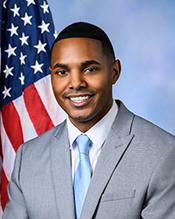
Ritchie Torres
DDemocratNY-15 · Representative
58
/ 100
Average
Attendance97
Avg: 96
Independence4
Avg: 4
Bipartisan Tone4
Avg: 15
Ethics Record100
Avg: 99
Transparency82
Avg: 53
Accountability Score — composite of attendance, independence, bipartisan tone, ethics record & transparency.
Methodology30
Bills Sponsored
0
Enacted into Law
1
Passed a Chamber
27
In Committee
All Sponsored Bills
HR10748In Committee
Balkans Security Cooperation Act
HR10107In Committee
Families Deserve to Know Act
HR9769In Committee
Duty of Transparency Act
Members of Congress would be required to publicly disclose reasons for missing votes and committee meetings, along with information about how often they are absent. The disclosures would be made available to the public so voters can see which representatives are regularly missing work and why. This would affect all senators and representatives and aim to increase accountability for congressional attendance.
HR9532In Committee
No Medicare Clawbacks Act of 2026
The proposal would prevent health insurance companies from taking back payments they made to doctors and hospitals in certain situations, protecting healthcare providers from unexpected financial penalties. This affects Medicare (the federal health insurance program for seniors and some disabled people) and the group health plans that many workers get through their employers. The bill aims to stop insurers from clawing back money after they've already paid medical claims, which can create financial hardship for healthcare providers.
HR8771In Committee
Campaign Event Contract Integrity Act
This bill would prevent people working on political campaigns from trading contracts related to political events when they have access to secret campaign information that hasn't been shared with the public. It would also require prediction market platforms (websites where people bet on future events) to put safeguards in place to stop insider trading and market manipulation. The rules aim to keep campaign insiders from profiting unfairly by using confidential information they learn through their work.
HR8669Reported
To designate the facility of the United States Postal Service located at 5951 Riverdale Avenue in Bronx, New York, as the "Eliot L. Engel Post Office".
This bill designates the facility of the United States Postal Service located at 5951 Riverdale Avenue in Bronx, New York, as the "Eliot L. Engel Post Office".
HR8912In Committee
Campaign Funds Integrity Act of 2026
The legislation would ban politicians and their campaigns from using campaign money to bet on prediction markets, which are platforms where people wager on the outcomes of future events like elections or political developments. This rule would apply to candidates, campaign committees, and their staff, preventing them from profiting off bets related to their own races or political careers. The bill aims to reduce conflicts of interest and ensure that campaign donations are spent on traditional political activities rather than speculative financial transactions.
HR8562Reported
To designate a building of the Chancery of the United States in Pristina, Kosovo, as the "Eliot L. Engel Building".
The proposal would officially name the U.S. diplomatic building in Pristina, Kosovo after Eliot L. Engel, honoring his contributions to foreign policy and international relations. This is a symbolic designation that recognizes Engel's work without changing how the building operates or affecting any government programs or services.
HJRES175In Committee
Providing for congressional disapproval under chapter 8 of title 5, United States Code, of the rule submitted by the Bureau of Consumer Financial Protection relating to the withdrawal of the rule relating to "Consumer Financial Protection Circular 2024-02: Deceptive Marketing Practices About the Speed or Cost of Sending a Remittance Transfer".
Congress would reject a Consumer Financial Protection Bureau decision to withdraw its guidance on deceptive marketing practices related to money transfer services, which means the agency's rules about how companies can advertise the speed and cost of sending money would remain in effect. This affects money transfer companies and consumers who send money domestically or internationally, as the rules require clearer and more honest advertising about how fast transfers will arrive and what fees customers will pay. The measure uses a congressional process that allows lawmakers to overturn agency decisions they disagree with.
HR8643In Committee
Financial Access Protection Act
Banks and other financial institutions would be banned from collecting, keeping, or sharing information about whether their customers are citizens or what their immigration status is. This would prevent financial companies from using this personal information in their business decisions or sharing it with other organizations. The rule would apply to all major financial institutions that serve consumers.
HRES1250In Committee
Expressing support for United States forces to remain as a part of the Kosovo Force.
This resolution expresses Congress's support for keeping U.S. military personnel stationed in Kosovo as part of the international peacekeeping force there. The measure affirms that American troops should continue their role in maintaining stability and security in the region following the conflicts of the 1990s.
HR7144In Committee
Food Rescue Act
The Food Rescue Act would likely make it easier for farmers, restaurants, and grocery stores to donate food that's still safe to eat but can't be sold, by reducing their legal liability if someone gets sick from the donated food. The bill aims to reduce food waste while helping food banks and charities feed hungry people in their communities. It would affect food businesses, nonprofits that distribute food, and people who rely on food assistance programs.
HRES1123In Committee
Recognizing the victims of the Happy Land Social Club fire in the Bronx, New York City, New York, on March 25, 1990, and designating March 25, 2026, as the day of remembrance of the Happy Land Social Club fire.
This resolution honors the 87 people who died in the Happy Land Social Club fire, one of the deadliest fires in U.S. history, and designates March 25, 2026, as a national day to remember the victims and the tragedy. The measure recognizes the significance of this disaster for the Bronx community and encourages Americans to reflect on fire safety and prevention. No new laws or government programs are created; instead, it serves as an official acknowledgment of the victims' memory.
HR7717In Committee
Community Health Profiles Act
This bill would require the creation and regular updates of detailed health profiles for communities across the country, showing information like disease rates, health risks, and available medical resources in each area. The goal is to give public health officials, doctors, and community leaders better data to identify health problems and plan improvements in their neighborhoods. The bill affects public health agencies, healthcare providers, and communities seeking to understand and address local health challenges.
HR7519In Committee
Army Corps Congressional Engagement Act
The bill would require the Army Corps of Engineers to regularly brief Congress and keep lawmakers informed about the agency's major projects, plans, and activities. This would give members of Congress better visibility into how the Corps spends money and manages infrastructure projects like dams, levees, and waterway improvements that affect their districts. The measure aims to strengthen communication between the federal agency and the legislative branch that oversees its budget and authority.
HR7233In Committee
QR Act
The bill's title "QR Act" is too vague to determine its specific purpose from the name alone. Based on its referral to the Judiciary and Homeland Security committees, it likely addresses immigration policy, though the exact provisions—whether related to border security, visa processing, deportation procedures, or another immigration matter—cannot be determined without seeing the full bill text. The measure is currently under review by both committees to determine which parts fall under each committee's authority.
HR7004In Committee
Public Integrity in Financial Prediction Markets Act of 2026
This bill would regulate financial prediction markets—platforms where people bet money on the outcomes of political events and government decisions—to prevent conflicts of interest and ensure public officials aren't profiting from insider knowledge about policy changes. The legislation likely aims to restrict government employees and elected officials from participating in these markets or would require greater transparency about who is trading and what they know. The bill addresses concerns that prediction markets could create incentives for officials to make decisions based on personal financial gain rather than the public interest.
HR6677In Committee
Professional Degree Access Restoration Act
This bill would likely restore or expand access to professional degree programs (such as law, medicine, or dentistry) for certain groups of students who currently face barriers to enrollment or completion. The exact changes would depend on the bill's specific provisions, but the intent appears to be removing obstacles that prevent qualified individuals from pursuing advanced professional education. This could affect students, educational institutions, and potentially employers in fields that rely on professionally credentialed workers.
HR6603In Committee
Our Parks Act
This bill would likely make changes to how the federal government manages and funds public parks and natural areas across the country. The specific provisions aren't yet clear since the bill is still in early stages, but based on the title and subject matter, it probably addresses issues like park maintenance, recreation access, conservation efforts, or funding for the National Park Service and other public land agencies that affect visitors, outdoor enthusiasts, and local communities near federal lands.
HR6314In Committee
Lung Cancer Screening Expansion Act of 2025
The proposal would expand access to lung cancer screening by lowering the age requirement and broadening eligibility criteria beyond current guidelines, allowing more people at risk—particularly current and former smokers—to get early detection scans. This could help catch lung cancer in earlier, more treatable stages and would likely increase the number of Americans receiving preventive screening through Medicare, Medicaid, and private insurance plans.
HR6345In Committee
Point-Access Housing Guidelines Act of 2025
This bill would establish federal guidelines for "point-access" housing programs, which typically use a scoring system to prioritize homeless individuals and families for housing assistance based on factors like vulnerability and length of homelessness. The legislation would likely standardize how local communities evaluate and place people experiencing homelessness into permanent housing, affecting both homeless service providers and the people they serve. By creating consistent national standards, the bill aims to make housing placement more fair and efficient across different cities and states.
HR6344In Committee
CAT Act
The CAT Act addresses housing and community development policy, though the vague title makes the specific provisions unclear without seeing the full bill text. Based on its referral to the Financial Services Committee, it likely involves changes to housing finance, lending rules, or community investment programs that would affect homebuyers, renters, lenders, or local development projects. The bill is currently under review and has not yet been debated or voted on.
HR5741In Committee
TRUMP Act of 2025
I don't have access to the specific details of the TRUMP Act of 2025 beyond its title and that it relates to finance and financial sector issues. To write an accurate summary explaining what the bill would actually do in concrete terms, I would need information about its specific provisions and intended effects. Could you provide the bill's summary, key provisions, or a link to the bill text?
HR4385In Committee
Helping More Families Save Act
This bill would likely create or expand savings programs to help families, particularly lower-income households, build emergency funds or save for down payments on homes. The legislation probably focuses on housing affordability by making it easier for people to accumulate money for housing-related expenses through tax incentives, matched savings accounts, or similar financial tools. It would primarily benefit working families and individuals struggling to afford housing in their communities.
HR3314In Committee
Stop Presidential Profiteering from Digital Assets Act
The legislation would prevent the President and Vice President from owning or profiting from digital assets like cryptocurrencies and NFTs while in office, requiring them to divest such holdings before taking office. The bill aims to reduce conflicts of interest by ensuring that sitting presidents and vice presidents cannot benefit financially from changes in digital asset values that their policies might influence. This would affect current and future presidents and vice presidents by restricting their personal investment options during their time in office.
HR3167In Committee
Noncontiguous Energy Relief and Access Act of 2025
HR973Passed House
Setting Consumer Standards for Lithium-Ion Batteries Act
Setting Consumer Standards for Lithium-Ion Batteries Act This bill requires the Consumer Product Safety Commission to issue a final consumer product safety rule for rechargeable lithium-ion batteries used in micromobility devices, such as electric bikes and electric scooters. Specifically, the rule must require manufacturers and distributors of such products to comply with the applicable safety standards jointly established by the American National Standards Institute, the Standards Council of Canada, and UL Solutions Inc.
HRES288In Committee
Expressing the sense that there should be established a "National Garifuna Immigrant Heritage Month" in April to celebrate the great contributions of Americans of Garifuna immigrant heritage in the United States who have enriched the history of the Nation.
The proposal would establish April as a national month to recognize and celebrate the history and contributions of Americans with Garifuna heritage, a cultural group with roots in the Caribbean and Central America. This would give official recognition to Garifuna Americans' impact on U.S. history, culture, and society, similar to how other heritage months honor different communities. The measure is currently under review by a House committee.
HRES124In Committee
Expressing continued support for the people of Puerto Rico, and urging the Federal Government to expedite the rebuilding of Puerto Rico's electrical grid.
HR638In Committee
Housing Temperature Safety Act of 2025
This bill would likely establish minimum temperature standards that landlords must maintain in rental housing to protect tenants from unsafe cold conditions. The law would probably set requirements for heating systems and allow tenants to take action if their homes fall below safe temperature levels, affecting both renters and property owners across the country.