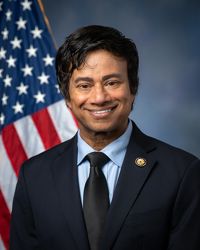
Shri Thanedar
DDemocratMI-13 · Representative
54
/ 100
Average
Attendance98
Avg: 96
Independence3
Avg: 4
Bipartisan Tone7
Avg: 15
Ethics Record100
Avg: 99
Transparency49
Avg: 53
Accountability Score — composite of attendance, independence, bipartisan tone, ethics record & transparency.
Methodology26
Bills Sponsored
0
Enacted into Law
0
Passed a Chamber
26
In Committee
All Sponsored Bills
HR10833In Committee
To allow the Secretary to insure mortgages for certain first-time homebuyers, and for other purposes.
HR10401In Committee
No ICE Deaths in the Dark Act of 2026
HRES1528In Committee
Recognizing suicide as a serious public health problem and expressing support for the designation of September, 2026, as "National Suicide Prevention Month" as well as September 10, 2026, as "World Suicide Prevention Day".
HR10105In Committee
Stop ICE Price Gouging Act
HR10007In Committee
Environmental Health Workforce Act of 2026
Environmental Health Workforce Act of 2026 This bill requires the Department of Health and Human Services (HHS) to carry out certain activities related to the environmental-health workforce. It also requires the Government Accountability Office to report on state-based practices for training and credentialing environmental-health workers. Specifically, HHS must develop model standards and guidelines for credentialing environmental-health workers and a plan to ensure its programs and activities meet the future needs of the environmental-health workforce. The bill also specifies that environmental-health workers are eligible for public-service loan forgiveness for educational loans.
HRES1464In Committee
Celebrating the opening of the Gordie Howe International Bridge and the friendship between the United States and Canada.
This resolution honors the opening of the Gordie Howe International Bridge, a new crossing between Windsor, Ontario and Detroit, Michigan that improves transportation and trade between the two countries. The bridge, named after the legendary hockey player, symbolizes the strong relationship and cooperation between the United States and Canada. The measure recognizes the significance of this infrastructure project for both nations' economies and their ongoing partnership.
HR9882In Committee
DHS Acquisition Documentation Integrity Act
The Department of Homeland Security would be required to maintain detailed documentation and follow specific procedures when purchasing or developing major equipment and technology systems. This would help ensure that large spending projects are properly tracked, justified, and managed effectively, protecting taxpayer money and improving oversight of how the agency spends billions on things like border security equipment, surveillance systems, and other critical infrastructure.
HR9717In Committee
Customer Property Protection Act
When a commodity broker goes bankrupt, this proposal would clarify how customer money and investments held by that broker should be handled and protected. The change aims to ensure that customers' funds are treated fairly and recovered as quickly as possible during the bankruptcy process, rather than being tied up in lengthy legal disputes. This affects people and businesses who trade commodities like oil, grain, and metals through brokers.
HR9206In Committee
DHS CANDOR Act
The Department of Homeland Security would be required to create a single, consistent policy for how all its offices and agencies communicate with the public. This would help ensure that DHS employees, contractors, and the public receive clear and coordinated information across different departments instead of getting conflicting messages from different parts of the agency.
HR9488In Committee
Health Disparity Zones Act of 2026
Health Disparity Zones Act of 2026 This bill provides for the designation of Health Disparity Zones in certain geographic areas with documented and measurable health disparities. This designation, which expires 10 fiscal years after the bill's enactment, confers eligibility for certain grants, student loan repayment programs, and tax credits for those working to reduce health disparities and improve health outcomes in these zones. Specifically, community-based nonprofits or local government agencies, in coalition with health care providers, social service organizations, and others, may apply to the Department of Health and Human Services (HHS) for the designation. The application must include a plan to reduce health disparities and achieve other outcomes. In implementing the program, HHS must consult with, among others, the Department of Housing and Urban Development. When approving applications, HHS shall consider factors including geographic diversity and the commitment of supporting funds from the private sector. HHS (1) may award grants to organizations or agencies that applied for the designation to support activities aligned with their plans, and (2) must carry out a student loan repayment program for health care providers who agree to provide services in a Health Disparity Zone. In addition, the bill establishes tax credits for employers that hire, and individuals who work as, Health Disparity Zone workers.
HR9303In Committee
BLANKET Act
The proposal would create new federal grants to help communities respond to severe weather emergencies affecting homeless people, such as extreme heat, cold, or storms. Local governments and nonprofits could use this funding to provide emergency shelter, warming centers, cooling stations, and other immediate assistance during dangerous weather conditions. The money would supplement existing homelessness programs to help protect vulnerable people during weather-related crises.
HR9111In Committee
Stopping Abusive Student Loan Collection Practices in Bankruptcy Act of 2026
The proposal would change bankruptcy law to prevent aggressive collection tactics by student loan companies against borrowers who file for bankruptcy protection. Currently, student loan debt is treated differently than other debts in bankruptcy, making it extremely difficult for borrowers to get relief even when they're in severe financial hardship. This bill would give bankruptcy courts more power to address unfair collection practices and potentially provide struggling borrowers with better options to manage their student loan obligations.
HR8641In Committee
Protecting Passengers from Discrimination Act
The Government Accountability Office would be required to conduct yearly reviews of how TSA airport security screening follows the agency's anti-discrimination policies, checking whether passengers are being treated fairly regardless of race, religion, or other protected characteristics. If the reviews find problems with compliance, the GAO would identify what changes are needed to improve how fairly TSA treats travelers during security checks. This would help ensure that airport security screening practices don't unfairly target or disadvantage certain groups of people.
HRES1113In Committee
Censuring Representative Andrew Ogles and Removing Him from the House Committee on Homeland Security.
This resolution would formally censure Representative Andrew Ogles, which is an official statement of disapproval by the House, and remove him from his position on the House Committee on Homeland Security. A censure is a serious rebuke but does not remove a member from office or affect their pay. The resolution has been sent to the House Ethics Committee for review.
HR7927In Committee
Land Reparations Commission Act
This bill would establish a federal commission to study and recommend policies for providing reparations to Native Americans and other groups who lost land through historical government actions or discrimination. The commission would investigate past land seizures and develop proposals for how the government might compensate affected communities or return property. This would primarily affect Native American tribes, descendants of enslaved people, and other historically marginalized groups who experienced documented land dispossession.
HRES1105In Committee
Impeaching Pamela Jo Bondi, Attorney General of the United States of America, for high crimes and misdemeanors.
This is an impeachment resolution that would formally charge Attorney General Pamela Jo Bondi with high crimes and misdemeanors, which are serious offenses that could lead to her removal from office if the House votes to impeach and the Senate votes to convict. The resolution has been sent to the House Judiciary Committee, which would investigate the allegations and determine whether to recommend impeachment to the full House. If passed by the House and then the Senate, Bondi would be removed from her position as the nation's top law enforcement official.
HR7302In Committee
Digital Literacy and Equity Act of 2026
This bill would likely fund programs to teach digital skills to people who lack access to computers and internet training, helping close the gap between those who can use technology and those who cannot. It would probably support schools, libraries, and community organizations in providing classes on basic computer use, online safety, and job-related tech skills to underserved populations. The goal is to ensure more Americans can participate fully in the digital economy and access online services for education, healthcare, and employment.
HR7303In Committee
Middle Class Tax Cut Act
This bill would reduce federal income taxes for middle-income Americans, though the specific tax cuts and income thresholds would be determined during the legislative process. The proposal aims to put more money back in the pockets of working families and small business owners by lowering their tax burden. The House Committee on Ways and Means will review the details and decide whether to move the bill forward.
HR7123In Committee
Abolish ICE Act
The proposal would eliminate Immigration and Customs Enforcement (ICE), the federal agency responsible for enforcing immigration laws and deporting people who are in the country illegally. Its functions would be transferred to other government agencies, fundamentally changing how the U.S. handles immigration enforcement and deportations. This would affect undocumented immigrants, immigration enforcement officers, and communities across the country.
HR7079In Committee
Bike the Border Act
The proposal would authorize the use of bicycles and other non-motorized vehicles as part of border patrol operations, allowing agents to access terrain that traditional vehicles cannot easily reach. This would affect Border Patrol officers and potentially improve surveillance and enforcement capabilities in remote or difficult-to-navigate areas along the U.S. borders.
HRES697In Committee
Recognizing suicide as a serious public health problem and expressing support for the designation of September as "National Suicide Prevention Month" as well as September 10, 2025, as "World Suicide Prevention Day".
This resolution expresses support for the designation of National Suicide Prevention Month and World Suicide Prevention Day.
HRES671In Committee
Prioritizing mental health to the same degree as physical health to address the epidemics of suicide and drug overdose in the United States.
This resolution expresses support for parity between insurance coverage of mental health and physical health treatment and for the Department of Health and Human Services' 2024 National Strategy for Suicide Prevention.
HR4944In Committee
Ending Qualified Immunity for ICE Agents Act
HR4422In Committee
Don’t Feed the Bears Act of 2025
The bill would establish or strengthen rules preventing people from intentionally or carelessly feeding bears on public lands, which can make bears dangerous and dependent on human food sources. It likely aims to protect both wildlife and visitors to national forests, parks, and other federal lands by imposing penalties on people who leave food out or directly feed bears. The measure affects outdoor recreationists, campers, and anyone using public lands, as well as wildlife management agencies responsible for protecting both humans and bear populations.
HR4244In Committee
Prohibition of Medicaid Funding for Conversion Therapy Act
Prohibition of Medicaid Funding for Conversion Therapy Act This bill prohibits state Medicaid programs from covering conversion therapy. The bill defines conversion therapy as any practice or treatment that seeks to change a person's sexual orientation or gender identity in exchange for monetary compensation.
HRES69In Committee
Celebrating Hindu Americans, condemning attacks on Hindu places of worship, Hinduphobia, and anti-Hindu bigotry, and for other purposes.
This resolution celebrates the historical and ongoing contributions of Hindus and Hinduism to the United States and condemns anti-Hindu sentiment.