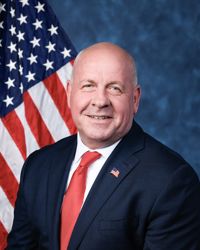
David J. Taylor
RRepublicanOH-2 · Representative
57
/ 100
Average
Attendance100
Avg: 96
Independence3
Avg: 4
Bipartisan Tone21
Avg: 15
Ethics Record100
Avg: 99
Transparency48
Avg: 53
Accountability Score — composite of attendance, independence, bipartisan tone, ethics record & transparency.
Methodology29
Bills Sponsored
0
Enacted into Law
4
Passed a Chamber
25
In Committee
All Sponsored Bills
HR10831In Committee
To amend the Mineral Leasing Act for Acquired Lands and the Mineral Leasing Act to increase the State share of oil and gas leasing revenue from acquired lands, and for other purposes.
HR10716In Committee
Integrity for Taxpayers Act
HR10507In Committee
Justice for Veterans and Victims of Terrorism Act of 2026
HR7809Passed House
To designate the facility of the United States Postal Service located at 201 East Grant Avenue in Georgetown, Ohio, as the "Ulysses S. Grant Post Office Building".
This bill designates the facility of the United States Postal Service located at 201 East Grant Avenue in Georgetown, Ohio, as the "Ulysses S. Grant Post Office Building".
HR10237In Committee
REVOKE Act
HRES1429In Committee
Expressing support for continued efforts to safeguard the supplemental nutrition assistance program under the Food and Nutrition Act of 2008 from fraud, waste, and abuse for the Nation's most vulnerable.
This resolution expresses Congress's support for protecting the food assistance program (commonly known as SNAP or food stamps) from fraud, waste, and abuse. The measure affirms commitment to ensuring that benefits reach the low-income families and individuals who depend on this program to buy groceries, while preventing misuse of taxpayer funds.
HRES1349In Committee
Expressing support for the designation of the week of May 31 through June 6, 2026, as "Our Roads, Our Safety Week".
The proposal designates the week of May 31 through June 6, 2026, as "Our Roads, Our Safety Week" to raise awareness about road safety and encourage public attention to transportation infrastructure issues. This symbolic designation aims to highlight the importance of safe roads and driving practices for all Americans who use the nation's highways and streets. The measure has been referred to the House Committee on Transportation and Infrastructure for consideration.
HR6899In Committee
CFTC Advisory Committee Improvement Act of 2025
The Commodity Futures Trading Commission (CFTC) is a federal agency that oversees futures markets and derivatives trading, and it relies on an advisory committee of industry experts and stakeholders to provide guidance on policy decisions. This bill would make changes to how that advisory committee operates, likely improving how it's structured, who serves on it, or how often it meets and reports to Congress. The changes would affect traders, financial companies, farmers, and other businesses that use futures markets to manage their risks.
HR8944In Committee
Housing Regulatory Clarity Act of 2026
The proposal would prevent the Department of Housing and Urban Development from using "disparate impact" analysis—a legal tool that identifies policies causing unequal housing outcomes for protected groups even without intentional discrimination—when making decisions about housing programs and enforcement. This would affect renters, homebuyers, and housing providers by changing how the department investigates and addresses potential discrimination in lending, rental practices, and housing policies. The change would limit one method the agency currently uses to enforce fair housing laws.
HR8640In Committee
Non-Domiciled CDL Reporting Act
The federal government would create a centralized database to track information about commercial truck and bus drivers' licenses, making it easier for regulators and law enforcement to monitor driver safety records and violations across state lines. This would help the Federal Motor Carrier Safety Administration enforce safety standards and identify problem drivers more efficiently. The database would affect commercial drivers, trucking companies, and transportation safety agencies that oversee highway safety.
HR8192In Committee
Nitazene Response Act
This bill would address the growing problem of nitazene, a dangerous synthetic opioid that has been appearing in illegal drug supplies across the country. The legislation likely aims to increase law enforcement tools, public health responses, and potentially penalties related to nitazene production and distribution to help combat this emerging drug threat. The bill would affect drug enforcement agencies, public health officials, and communities struggling with opioid addiction.
HR2474Passed House
Expanding Appalachia’s Broadband Access Act
Expanding Appalachia’s Broadband Access Act This bill requires the Government Accountability Office to study and report to Congress on the Appalachian Regional Commission’s capability to incorporate low-orbit satellites in broadband projects. Specifically, the study must review and analyze the capacity and cost-effectiveness of using satellite broadband service for business purposes and economic development.
HR7476In Committee
Water Infrastructure Assistance Reauthorization Act
This bill would reauthorize federal funding and programs that help farmers and rural communities build and maintain water systems for irrigation, drinking water, and other agricultural needs. The legislation likely extends or updates existing assistance programs that provide grants or loans to help pay for water infrastructure projects in farming areas. It would affect farmers, agricultural businesses, and rural communities that depend on federal support to develop reliable water supplies.
HR1958Passed House
Deporting Fraudsters Act of 2026
Deporting Fraudsters Act of 2026 This bill makes certain acts related to public benefits fraud grounds for (1) barring a non-U.S. national ( alien under federal law) from admission into the United States, or (2) deporting the individual. The bill also makes such an individual ineligible for immigration enforcement relief, including relief for an individual in danger of subjection to torture. Specifically, this bill applies to individuals who have been convicted of, admit to having committed, or admit to acts which constitute certain offenses. Offenses covered by this bill include (1) fraud involving Supplemental Nutrition Assistance Program (SNAP) benefits, (2) fraud involving Social Security benefits, (3) fraud involving programs that receive federal funds, and (4) the production of fraudulent identification documents.
HR8028In Committee
SNAP Fraud Reporting Act of 2026
This bill would create new requirements for states to report fraud cases involving SNAP (food stamp) benefits to federal authorities and establish procedures for investigating and prosecuting people who misuse the program. The measure aims to reduce waste and abuse of taxpayer money by making it easier to catch and punish fraud, affecting both SNAP recipients and the states that administer the program.
HR7409In Committee
Defend Rural Health Act of 2026
This bill aims to strengthen healthcare services in rural areas by likely addressing challenges like doctor shortages, hospital closures, and limited access to medical care that rural communities face. It would probably include measures such as funding incentives to attract healthcare providers to rural regions, support for rural hospitals, or expanded telehealth options to help patients in remote areas get care more easily. The legislation would affect rural residents, healthcare workers, hospitals, and potentially insurance companies operating in less populated regions.
HR7321In Committee
Towing Safety Act
This bill would establish safety standards and regulations for towing operations to protect both tow truck drivers and the public on roadways. It likely addresses issues like equipment requirements, driver training, and operational procedures to reduce accidents and injuries during vehicle towing and recovery. The rules would apply to towing companies and operators across the country.
HR6600In Committee
Main Street Lending Improvement Act of 2025
This bill would make changes to the Main Street Lending Program, a federal loan initiative that helps small and mid-sized businesses access affordable financing. The specific improvements likely aim to make it easier for eligible businesses to apply for loans, expand who qualifies, or adjust loan terms to better meet business needs. Small business owners and the lenders who work with them would be the primary beneficiaries of any streamlined processes or expanded access.
HR6233In Committee
Commercial Motor Vehicle English Proficiency Act
This bill would require commercial truck and bus drivers to demonstrate English language proficiency to ensure they can read road signs, understand safety regulations, and communicate with law enforcement and other drivers. The requirement would affect anyone seeking to obtain or renew a commercial driver's license, potentially making it harder for non-English speakers to work in the trucking and transportation industry. The goal is to improve road safety by ensuring all commercial drivers can understand critical safety information.
HR5610In Committee
Improving Drought Monitoring Act
This bill would improve the government's ability to monitor and track drought conditions across the country by enhancing data collection and forecasting systems. The changes would help farmers, water managers, and communities better prepare for and respond to droughts by providing more accurate and timely information about water availability and soil conditions. Agricultural producers and water-dependent industries would benefit from earlier warnings and better planning tools to manage their operations during dry periods.
HR3427Passed House
Water Resources Technical Assistance Review Act
Water Resources Technical Assistance Review Act This bill directs the Government Accountability Office (GAO) to review the technical assistance authority, initiatives, and programs of the Environmental Protection Agency (EPA) that are related to clean water infrastructure. Among other things, the review must include a description of the covered technical assistance available to states, tribes, local governments, and nongovernmental organizations, including activities and actions carried out during the previous five years; a comprehensive review of how the EPA Water Technical Assistance (WaterTA) initiative identifies, selects, and partners with technical assistance providers to support communities; and an assessment of the needs of economically distressed communities eligible to receive assistance under an EPA clean water infrastructure program that are not addressed through covered technical assistance. GAO must submit a report to Congress on the review, which must include any recommendations to improve covered technical assistance. Further, the EPA must submit a compliance plan to Congress annually for five years on any actions taken by the EPA to comply with GAO's recommendations.
HR4964In Committee
Child Interstate Abortion Notification Act
Child Interstate Abortion Notification Act This bill creates new federal crimes related to transporting a minor across state lines for an abortion. Specifically, the bill makes it a crime to knowingly transport a minor across a state line to obtain an abortion without satisfying the requirements of a parental involvement law in the minor's resident state. A parental involvement law requires parental consent or notification, or judicial authorization, for a minor to obtain an abortion. The bill prohibits an individual who has committed incest with a minor from knowingly transporting the minor across a state line to receive an abortion. Finally, the bill makes it a crime for a physician to knowingly perform or induce an abortion on an out-of-state minor without first notifying the minor's parent.
HRES608In Committee
Recognizing the importance of the Interstate Highway System and supporting the development of an interstate through southern Ohio.
The proposal calls for building a new interstate highway through southern Ohio to improve transportation and economic development in that region. This would affect residents, businesses, and travelers in southern Ohio by potentially reducing travel times and improving access to markets and jobs. The measure is currently being reviewed by lawmakers who focus on highway and transit issues.
HR3789In Committee
DTC Act of 2025
Drug-price Transparency for Consumers Act of 2025 or the DTC Act of 2025 This bill requires consumer advertisements for prescription drugs and biological products to include certain price information if the drug or biologic is (1) covered under Medicare or Medicaid, and (2) required to include a risk summary under current law. Specifically, such advertisements must clearly and conspicuously disclose the wholesale price for a 30-day supply of the drug or biologic and may explain that a consumer may pay a different amount for the drug or biologic depending on the consumer's health insurance coverage. The requirement does not apply to advertisements for drugs or biologics with a wholesale cost of less than $35 for a one-month supply. Each violation of this requirement is subject to a civil penalty of not more than $100,000.
HR3608In Committee
Connor’s Law
Without access to the specific provisions of Connor's Law, this bill appears to address transportation and highway safety issues, likely named after an individual affected by a transportation-related incident. Based on its referral to the Highways and Transit Subcommittee, it probably proposes changes to road safety regulations, infrastructure standards, or transit policies that would affect drivers, pedestrians, or transportation agencies. To provide a detailed summary of what the bill actually does, the specific text of the legislation would be needed.
HR3125In Committee
Rural Broadband Assistance Act
Rural Broadband Assistance Act This bill provides statutory authority for a grant program that supports the provision of technical assistance and training to facilitate rural broadband expansion. This program is administered by the Department of Agriculture (USDA) and is known as the Broadband Technical Assistance program. Under the program, USDA makes grants to organizations that will provide or receive broadband-related technical assistance and training. This assistance and training must support expanded broadband access in rural communities. Grantees may provide or receive assistance and training related to (1) identifying broadband funding sources; (2) preparing applications for broadband funding; and (3) improving operations of existing broadband facilities, among other topics. The bill requires USDA to prioritize applicants that have experience providing technical assistance and training to rural entities. Separately, the bill repeals a requirement related to the use of certain funds for a database of rural broadband projects, reporting requirements, and oversight of related USDA broadband programs.
HR2964In Committee
Fight Fentanyl Act
This bill aims to strengthen law enforcement efforts against fentanyl trafficking and distribution by likely increasing penalties for fentanyl-related crimes, improving coordination between federal agencies, and possibly expanding resources for drug enforcement operations. It would affect drug traffickers, law enforcement agencies, and communities struggling with opioid addiction. The bill has been sent to two House committees for review before moving forward.
HR2583In Committee
College Admissions Accountability Act of 2025
This bill would likely establish new requirements for how colleges and universities handle their admissions processes, possibly including transparency rules about how decisions are made or standards for fairness in selecting students. The legislation would probably affect college applicants, admissions offices, and potentially students already enrolled at higher education institutions. The specific details of what accountability measures would be required are not yet clear from the bill's current status in committee.
HR710In Committee
Regulation Decimation Act
Regulation Decimation Act This bill requires federal agencies to repeal certain existing rules prior to issuing a new rule. Specifically, the bill prohibits an agency from issuing a rule that imposes a cost or responsibility on a nongovernmental person or a state or local government unless it repeals ten or more related rules. Additionally, an agency may not issue a major rule that imposes such a cost or responsibility unless (1) the agency has repealed ten or more related rules, and (2) the cost of the new rule is less than or equal to the cost of the rules being repealed. A major rule is a rule that has resulted in or is likely to result in (1) an annual economic effect of at least $100 million; (2) a major increase in costs or prices for consumers, individual industries, government agencies, or geographic regions; or (3) significant adverse effects on competition, employment, investment, productivity, or innovation. Any such repealed rule must be published in the Federal Register. This bill does not apply to a rule or major rule that (1) relates to an internal agency policy or practice, (2) relates to procurement, or (3) is being revised to be less burdensome to decrease requirements imposed or compliance costs. Additionally, each federal agency must submit to Congress and the Office of Management and Budget a report that includes a review of each rule of the agency and that identifies whether each rule is costly, ineffective, duplicative, or outdated.