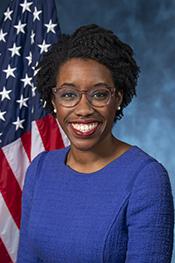
Lauren Underwood
DDemocratIL-14 · Representative
50
/ 100
Average
Attendance99
Avg: 96
Independence2
Avg: 4
Bipartisan Tone18
Avg: 15
Ethics Record100
Avg: 99
Transparency9
Avg: 53
Accountability Score — composite of attendance, independence, bipartisan tone, ethics record & transparency.
Methodology28
Bills Sponsored
0
Enacted into Law
3
Passed a Chamber
25
In Committee
All Sponsored Bills
HR10410In Committee
Educating Future Nurses Act
Educating Future Nurses Act This bill establishes a permanent National Graduate Nurse Education Program to provide clinical training to advanced practice registered nurses (APRNs), particularly with respect to services for Medicare beneficiaries. (The Centers for Medicare & Medicaid Services conducted a similar demonstration program from 2012-2016.) Under the program, hospitals may receive payments for the costs associated with providing clinical education to APRNs. Hospitals must partner with nursing schools, regional hospitals or health systems, or non-hospital community providers (e.g., nursing homes) to provide qualifying clinical education. Such education must consist of clinical experience in primary, preventive, transitional, acute, and chronic care, as well as other services that are appropriate for Medicare beneficiaries; at least half of this education must be provided in non-hospital, community-based settings. Participating hospitals must report annually on their programs, subject to payment reductions.
HR10409In Committee
Lethal Means Safety Training Act
HR6020Passed House
To designate the facility of the United States Postal Service located at 14855 South Van Dyke Road in Plainfield, Illinois, as the "Staff Sergeant Jose Dueñez Jr. Post Office Building".
This bill designates the facility of the United States Postal Service located at 14855 South Van Dyke Road in Plainfield, Illinois, as the "Staff Sergeant Jose Dueñez Jr. Post Office Building".
HR9821In Committee
Shared Values Act
I cannot provide an accurate summary because the bill's title and subjects provided do not contain sufficient information about what the legislation actually proposes to do. The referral to nearly every major congressional committee suggests this is a broad bill, but without access to the bill's text or specific policy proposals, I cannot explain its concrete effects or who it would affect.
HR9825In Committee
Data Center Water and Energy Transparency Act of 2026
Large data center companies would be required to report detailed information about how much energy and water they use to federal agencies and state governments, giving regulators better visibility into the environmental impact of the computing infrastructure that powers the internet and cloud services. These reports would help the Environmental Protection Agency, Department of Energy, and Department of Agriculture track whether data centers are becoming more efficient and identify any concerning trends in resource consumption. The requirement would affect data center operators across the country and could influence future environmental policies and energy planning.
HR9797In Committee
RESILIENCE Act of 2026
The federal government would create a training program through the Cybersecurity and Infrastructure Security Agency to teach state, local, tribal, and territorial officials how to identify security weaknesses and terrorism risks at important infrastructure sites like power plants, water systems, and transportation hubs. This pilot program would help local leaders better protect critical facilities in their communities by giving them the same security assessment skills that federal experts use. The training would apply to government officials responsible for overseeing infrastructure in their regions.
HR6238Passed House
NIH IMPROVE Act
NIH Implementing a Maternal health and PRegnancy Outcomes Vision for Everyone Act or the NIH IMPROVE Act This bill provides statutory authority for the National Institutes of Health to provide grants and other support for research on improving health outcomes for pregnant and postpartum women, especially in populations that are disproportionately affected.
HR9538In Committee
Residential Recovery for Seniors Act
Medicare would start covering residential treatment programs for people struggling with substance use disorders, allowing seniors and disabled beneficiaries to get help at facilities where they live while receiving care rather than only covering outpatient services. This change would help older adults and people with disabilities access more intensive addiction treatment options that are currently not covered by Medicare. The expansion could reduce costs for patients needing round-the-clock support to recover from alcohol or drug addiction.
HR9257In Committee
Primary and Behavioral Health Care Access Act of 2026
This proposal would require health insurance plans to cover up to three primary care doctor visits and three mental health or behavioral health visits per year without charging patients any copays, deductibles, or other out-of-pocket costs. The requirement would apply to both employer-sponsored health plans and individual insurance policies, affecting millions of workers, their families, and people who buy insurance on their own. The goal is to make it easier and more affordable for people to access routine medical care and mental health services.
HR6775In Committee
New Markets for Farmers and Families Act
The legislation would create new opportunities for farmers to sell their products directly to consumers and local markets, potentially through expanded farmers markets, community-supported agriculture programs, and direct-to-consumer sales channels. It aims to help family farms compete with large agricultural operations and give consumers better access to fresh, locally-grown food. The bill would affect farmers, rural communities, and families looking for alternative food sources.
HR6776In Committee
Farmers to Families Act
The proposal would strengthen connections between American farmers and families in need by supporting programs that distribute fresh farm products to low-income households and food banks. It aims to help farmers maintain stable markets for their goods while ensuring more people have access to nutritious, locally-grown food. The bill would affect both agricultural producers and families struggling with food insecurity across the country.
HR8807In Committee
Maternal Health Pandemic Response Act
The government would fund efforts to collect data and monitor maternal health outcomes during public health emergencies like pandemics, helping researchers understand how pregnant women and new mothers are affected during crises. This would support studies and surveillance systems that track pregnancy complications, childbirth outcomes, and postpartum health to improve emergency response and care for mothers and babies. The funding would go toward gathering this health information and conducting research to better protect maternal health when public health emergencies occur.
HR8778In Committee
EV Charging Accessibility Act
The government would be required to finalize rules ensuring that electric vehicle charging stations are accessible to people with disabilities, following accessibility standards set by a federal board. This would affect EV charging station owners and operators who would need to comply with the new accessibility requirements, as well as people with disabilities who use electric vehicles. The bill is currently being reviewed by two congressional committees to determine how to move forward.
HR8397In Committee
Protecting Moms and Babies Against Climate Change Act
The legislation would require the federal government to study and address how climate change and environmental hazards affect pregnant women and infants, including impacts from air pollution, extreme heat, and contaminated water. It would direct health agencies to develop recommendations and programs to protect maternal and child health from climate-related risks. The bill aims to help doctors, public health officials, and expectant parents better understand and reduce health dangers that climate change poses to mothers and babies.
HR7973In Committee
Momnibus Act
The Momnibus Act addresses health-related policies affecting mothers and families, though the specific provisions are not detailed in the available information. Based on its referral to multiple committees covering health, education, veterans' affairs, and other areas, the bill likely tackles issues such as maternal health care, childcare support, or family benefits across different populations. The bill is currently being reviewed by several congressional committees to determine which parts fall under each committee's responsibility.
HR8070In Committee
Child Suicide Prevention Act
The bill would establish new federal programs and funding to help prevent suicide among children and teenagers through improved screening, mental health services, and training for school staff and healthcare providers. It would likely require schools and medical facilities to identify warning signs of suicide risk and connect at-risk youth to counseling and treatment resources. The legislation aims to reduce youth suicide rates by making prevention tools and mental health support more widely available.
HR7782In Committee
American Passport Card Accessibility Act
This bill would make passport cards—smaller, wallet-sized alternatives to regular passports—more accessible and easier for Americans to obtain. The changes likely aim to streamline the application process or reduce costs for citizens who want this convenient form of identification for travel to nearby countries. The bill is currently under review by the House Committee on Foreign Affairs.
HR6607In Committee
FAAN Act
I don't have enough specific information about what "FAAN Act" stands for or what policies it would implement to write an accurate summary. Based solely on the title and "Health" subject area, I can only note that this bill addresses a health-related policy and has been sent to the House Committee on Energy and Commerce for review, but I cannot describe its concrete effects without knowing what FAAN represents or what the bill's actual provisions are.
HR4272In Committee
Prioritizing Rural Hospitals Act
This legislation would provide financial support and resources to help rural hospitals stay open and operate effectively, addressing the challenge that many small hospitals in farming communities struggle to remain financially viable. The bill would affect rural patients who depend on these hospitals for emergency care and other medical services, as well as hospital workers and administrators in agricultural areas. By strengthening these facilities, the measure aims to ensure that people in less populated regions have access to quality healthcare without having to travel long distances.
HR2234In Committee
Ensuring Veterans Timely Access to Anesthesia Care Act of 2025
The legislation would require the Department of Veterans Affairs to ensure that veterans can access anesthesia services in a timely manner, addressing delays some veterans face when needing surgical procedures or pain management treatments. The bill aims to improve wait times and availability of anesthesiologists and nurse anesthetists at VA medical facilities so veterans don't experience unnecessary delays in receiving necessary care.
HR248Passed House
Baby Changing on Board Act
Baby Changing on Board Act This bill requires Amtrak passenger rail trains to have a baby changing table in at least one restroom in each car, including in an Americans with Disabilities Act of 1990-compliant restroom. The bill applies to passenger rail trains that are (1) owned and operated by Amtrak, and (2) solicited for purchase after the bill's enactment for use by Amtrak.
HR3480In Committee
Health Coverage for IVF Act of 2025
HR3091In Committee
Health Savings and Affordability for Fertility Act
HR1646In Committee
Lactation Spaces for Veteran Moms Act
Lactation Spaces for Veteran Moms Act This bill requires the Department of Veterans Affairs to ensure that each of its medical centers contains a hygienic lactation space that is not a bathroom and meets other specifications (e.g., must be easy to locate).
HR2023In Committee
Women's Retirement Protection Act
This bill aims to address retirement security challenges that disproportionately affect women, who often have lower retirement savings due to career interruptions, lower wages, and longer lifespans. The specific provisions would likely include changes to retirement account rules, Social Security benefits, or employer pension requirements to help women build and protect retirement income. The bill has been referred to multiple committees that handle labor, financial services, and tax policy to review different aspects of how it would work.
HR1645In Committee
Climate and Health Protection Act
Climate and Health Protection Act This bill provides statutory authority for the Climate and Health Program within the Centers for Disease Control and Prevention. This program supports the efforts of state, tribal, local, and territorial public health agencies to prepare for the health impacts of climate change.
HR1035In Committee
Job Protection Act
HR247In Committee
Health Care Affordability Act of 2025
Health Care Affordability Act of 2025 This bill makes permanent temporary changes enacted by the American Rescue Plan Act of 2021 (ARPA) and the Inflation Reduction Act of 2022 (IRA) that generally expand eligibility for and increase the amount of the premium tax credit. Currently, eligible taxpayers may be able to claim the premium tax credit, which applies toward the cost of obtaining health insurance through health insurance exchanges. To be eligible for the premium tax credit, a taxpayer’s household income must meet or exceed 100% of the federal poverty level (FPL) and, after 2025, may not exceed 400% of the FPL (maximum income limit). For 2021-2025, the ARPA and IRA eliminated the maximum income limit, which generally expands eligibility for the premium tax credit. Further, under current law, the amount of the premium tax credit is (1) generally the plan premium (conditions apply), minus (2) the taxpayer’s household income multiplied by the applicable percentage. The applicable percentage is a specific percentage that varies depending on which of six income ranges (adjusted for inflation after 2025) the taxpayer’s household income falls within. For 2021-2025, the ARPA and IRA lowered the applicable percentages and eliminated the adjustment of the applicable percentages for inflation, which generally increases the amount of the premium tax credit. The bill makes permanent the elimination of the 400% maximum income limit, the lower applicable percentages, and the elimination of the inflation adjustment for the applicable percentages.