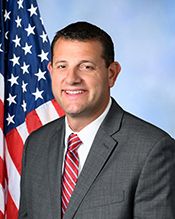
David G. Valadao
RRepublicanCA-22 · Representative
66
/ 100
Above Average
Attendance98
Avg: 96
Independence5
Avg: 4
Bipartisan Tone43
Avg: 15
Ethics Record100
Avg: 99
Transparency78
Avg: 53
Accountability Score — composite of attendance, independence, bipartisan tone, ethics record & transparency.
Methodology31
Bills Sponsored
0
Enacted into Law
6
Passed a Chamber
24
In Committee
All Sponsored Bills
HR2481Passed House
Romance Scam Prevention Act
Romance Scam Prevention Act This bill requires online dating service providers (i.e., mobile applications or websites) to provide users with a fraud ban notification if the user has established an account with the service and received a message through the service from a banned user of the service. The fraud ban notification must include (1) the username or other profile identifier of the banned user and the most recent time when the user who is receiving the notification sent or received a message through the service to or from the banned user, (2) a statement that the banned user may have been using a false identity or attempting to defraud other users, (3) a statement that the user should not send cash (or another form of currency) or personal financial information to another user, (4) information about avoiding online fraud (e.g., a link to another website or a disclosure) and (5) contact information for the provider's customer service department. The bill provides for enforcement of these requirements by the Federal Trade Commission and state attorneys general.
HRES1616In Committee
Recognizing the importance of biodiversity conservation, welcoming the Republic of Armenia as host of the Seventeenth Meeting of the Conference of the Parties to the Convention on Biological Diversity, and supporting the protection of Armenia's sovereign territory and natural heritage.
HR10528In Committee
To amend the Financial Literacy and Education Improvement Act to include secondary schools in best practices for teaching financial literacy, and for other purposes.
HR10324In Committee
ROMA Act
HRES1476In Committee
Supporting the designation of the week of August 2 through August 8, 2026, as "National Farmers Market Week".
The proposal would officially recognize the week of August 2-8, 2026, as "National Farmers Market Week" to highlight the importance of farmers markets in communities across the country. This designation would encourage Americans to shop at and support local farmers markets during that week, benefiting small-scale farmers and promoting access to fresh, locally-grown food. The measure is primarily symbolic and does not create new laws or funding, but serves to raise awareness about farmers markets and their role in local food systems.
HRES1475In Committee
Expressing support for the designation of the first week of August as "National Community Health Center Week", and encouraging all Americans to participate by visiting their local community health center and celebrating the important partnership between health centers and the communities they serve.
This resolution designates the first week of August as "National Community Health Center Week" to recognize the role that community health centers play in providing healthcare to Americans. The measure encourages people to visit their local community health centers during that week and celebrate the relationship between these centers and the communities they serve. Community health centers typically provide primary care, dental services, and mental health support to underserved populations.
HR9976In Committee
SWAT Act of 2026
Spotted Wing Abatement Trust Act of 2026 or the SWAT Act of 2026 This bill directs the Animal and Plant Health Inspection Service to establish a fund for research relating to, and activities to mitigate the negative effects of, spotted wing drosophila. Spotted wing drosophila is an invasive species of insect from East Asia that has caused significant damage to unripe berry and stone fruit crops in the United States, including raspberries, blackberries, blueberries, strawberries, peaches, plums, and cherries.
HR3168Reported
National Earthquake Hazards Reduction Program Reauthorization Act of 2025
National Earthquake Hazards Reduction Program Reauthorization Act of 2025 This bill reauthorizes through FY2030 the activities of the U.S. Geological Survey (USGS) under the National Earthquake Hazards Reduction Program (NEHRP). It also expands certain USGS activities under NEHRP relating to earthquake warnings and mapping and expands other NEHRP activities. NEHRP is a coordinated earthquake hazards reduction program administered by four federal agencies: the National Institute of Standards and Technology, USGS, the Federal Emergency Management Agency, and the National Science Foundation. Under NEHRP, USGS is responsible for monitoring and early warnings (including operating the Advanced National Seismic System, a nationwide network of seismic stations), hazard assessments and mapping, and research regarding earthquakes. The bill reauthorizes such USGS activities through FY2030. Additionally, the bill requires USGS to coordinate with the Federal Communications Commission to ensure alerts and early warnings are broadcast as rapidly as possible for maximum warning time, expand the early warning system to additional high-risk areas, issue forecasts for aftershocks following significant earthquakes, and include tsunamis and other hazards associated with earthquakes in seismic hazard maps. Also, NEHRP activities to develop building codes and standards must include recovery objectives addressing post-earthquake occupancy and functionality of infrastructure.
HR8913In Committee
Tulare Youth Recreation and Women’s History Enhancement Act
The federal government would give up its ownership claim to certain pieces of land in Tulare, California, allowing the city or current property holders to have full control without any government restrictions. This removes a legal requirement that the land revert back to federal ownership under certain conditions, making the property titles clearer and more valuable for local development or use. The change primarily affects the city of Tulare and whoever currently owns or manages these properties.
HR9376In Committee
TOURS Act
The bill would require the Department of Veterans Affairs to publish an annual report on veteran suicide prevention efforts and conduct a study examining whether chaplain services at the VA help reduce suicide risk among veterans. This would formalize suicide prevention reporting and help identify which VA support services are most effective at helping veterans in crisis. The changes would affect veterans seeking mental health support and the VA staff responsible for tracking and improving these services.
HR9006In Committee
Locating Our Unclaimed Veterans Act
The Department of Veterans Affairs would create a centralized online system to store and track information about unclaimed remains of deceased veterans, making it easier for families and officials to locate and identify these individuals. This would help ensure that veterans' remains are properly accounted for and can be reunited with their families or given appropriate burial honors. The measure affects veterans' families, VA staff, and funeral homes that may be holding unclaimed remains.
HRES1390In Committee
Expressing support for the designation of June as Portuguese National Heritage Month.
The resolution would officially recognize June as Portuguese National Heritage Month, allowing the United States to celebrate and honor the history, culture, and contributions of Portuguese Americans. This designation would encourage communities, schools, and organizations across the country to hold events and educational activities highlighting Portuguese heritage, traditions, and the impact Portuguese immigrants have had on American society.
HR9010In Committee
Making appropriations for the Legislative Branch for the fiscal year ending September 30, 2027, and for other purposes.
Legislative Branch Appropriations Act, 2027 This bill provides FY2027 appropriations for the legislative branch, including the House of Representatives and joint items such as the Joint Economic Committee, the Joint Committee on Taxation, the Office of the Attending Physician, and the Office of Congressional Accessibility Services. In addition, the bill provides FY2027 appropriations for the Capitol Police; the Office of Congressional Workplace Rights; the Congressional Budget Office; the Architect of the Capitol; the Library of Congress, including the Congressional Research Service and the Copyright Office; the Government Publishing Office; the Government Accountability Office; the Congressional Office for International Leadership Fund; and the John C. Stennis Center for Public Service Training and Development. (Pursuant to the longstanding practice of each chamber of Congress determining its own requirements, funds for the Senate are not included in the House bill.) The bill also sets forth requirements and restrictions for using funds provided by this bill.
HR8806In Committee
Supporting Newborn Parents Act of 2026
The proposal would create a new tax credit for families when they have a newborn child, reducing the amount of federal income taxes they owe. This credit would provide financial support to parents during the early years of raising a child, similar to other existing tax benefits for families with dependents. The bill is currently under review by the House Committee on Ways and Means.
HR3419Passed House
To amend the Public Health Service Act to reauthorize the telehealth network and telehealth resource centers grant programs.
This bill reauthorizes through FY2030 grant programs to support telehealth networks and telehealth resource centers, which are administered by the Office for the Advancement of Telehealth within the Health Resources and Services Administration. These programs provide grants to health care providers and related entities to establish telehealth networks that expand access to and improve the quality of health care services and information in rural and medically underserved areas and for medically underserved populations.
HR7951In Committee
Long-Term Good Neighbor Authority Act
This bill would allow the U.S. Forest Service to enter into long-term agreements with neighboring landowners and communities to manage forests and land in ways that benefit both public and private interests, such as reducing wildfire risk or improving forest health. The agreements would let the Forest Service work more flexibly with local partners on projects that might otherwise take years to approve through standard processes. This could help rural communities and farmers who live near federal forests while also achieving environmental management goals more quickly.
HR7049In Committee
Improving Mental Health Care and Coordination for Homeless Veterans Act
This bill would improve mental health services and coordination of care for homeless veterans by requiring the Department of Veterans Affairs and Department of Defense to work together on better screening, treatment, and support programs. The legislation aims to help veterans experiencing homelessness access mental health care more easily and ensure different government agencies share information to avoid gaps in services. Veterans struggling with mental health issues and homelessness would be the primary beneficiaries of these coordinated efforts.
HR7234In Committee
Human Trafficking Awareness Training Recognition Act of 2026
This bill would establish a program to recognize and certify organizations and businesses that provide training to their employees about identifying and reporting human trafficking. The measure aims to increase awareness of trafficking among workers across different industries, potentially helping more victims get help by training people who regularly interact with the public—like hotel staff, truck drivers, and healthcare workers—to spot warning signs.
HR5030In Committee
Specialty Crop Domestic Market Promotion and Development Program Act of 2025
Specialty Crop Domestic Market Promotion and Development Program Act of 2025 This bill directs the Agricultural Marketing Service to establish a grant program to encourage the development, maintenance, and expansion of the commercial domestic market for domestically produced specialty crop commodities (e.g., for advertising or other demand-oriented, generic domestic promotion activities). Organizations eligible for the grant program include those that promote U.S. produced and grown specialty crop sales and are (1) U.S. agricultural trade organizations or regional state-related organizations that do not profit directly from U.S. specialty crop sales, (2) cooperative organizations or state agencies, or (3) certain private organizations. Specialty crop organizations operating under federal marketing orders are also eligible for the grant program.
HR5059In Committee
Specialty Crop Domestic Market Promotion and Development Program Act of 2025
Specialty Crop Domestic Market Promotion and Development Program Act of 2025 This bill directs the Agricultural Marketing Service to establish a grant program to encourage the development, maintenance, and expansion of the commercial domestic market for domestically produced specialty crop commodities (e.g., for advertising or other demand-oriented, generic domestic promotion activities). Organizations eligible for the grant program include those that promote U.S. produced and grown specialty crop sales and are (1) U.S. agricultural trade organizations or regional state-related organizations that do not profit directly from U.S. specialty crop sales, (2) cooperative organizations or state agencies, or (3) certain private organizations. Specialty crop organizations operating under federal marketing orders are also eligible for the grant program.
HRES872In Committee
Supporting the goals and ideals of "Creutzfeldt-Jakob Disease (CJD) Awareness Day".
This resolution supports the goals and ideals of Creutzfeldt-Jakob Disease (CJD) Awareness Day.
HR3854Passed House
Modernizing All Veterans and Survivors
Modernizing All Veterans and Survivors Claims Processing Act This bill requires the Department of Veterans Affairs (VA) to plan and implement certain technological improvements to its systems, particularly in relation to the processing of claims and benefits. First, the bill requires the VA to submit to Congress its plan to make available an automation tool for processing claims. Such tool must automate the retrieval of the records of the veteran, compile evidence relevant to the determination of the claim, provide automated decision support relevant to the determination, automate information sharing between federal agencies, and assist in generating correspondence regarding the claim. Within one year of submitting this plan, the VA must ensure that each VA program office responsible for processing claims for pension or survivor benefits has an automation tool that at least assists in generating correspondence regarding the claim. The VA must also implement policies, processes, and technological capabilities to ensure that a claims processor is made aware of and assigned to address situations when (1) there is an increase in the amount of dependency compensation paid to a beneficiary for a child, and (2) any educational assistance is paid to the child of a veteran. Finally, the VA must submit a plan to Congress to ensure documents in the Veterans Benefits Management System are correctly labeled when uploaded.
HR5097In Committee
To amend the Agricultural Marketing Act of 1946 to direct the Secretary of Agriculture to establish a program under which the Secretary will award grants to specialty crop producers to acquire certain equipment and provide training with respect to the use of such equipment.
This bill directs the Agricultural Marketing Service to establish a grant program for commercial specialty crop producers to acquire equipment and provide related training. Funds must be used for mechanized or automated systems and tools that increase the efficiency of a task or reduce human labor for a specific activity (e.g., low-dust harvesting tools and equipment, sorting machines, and crop monitoring and analytics equipment and tools). The bill includes a minimum 50% cost-sharing requirement.
HR1044Passed House
To amend Public Law 99–338 with respect to Kaweah Project permits.
This bill authorizes the Department of the Interior to issue seven (currently, three) renewals for portions of the Kaweah Project, which is an existing hydroelectric project in Tulare County, California.
HR4249In Committee
Legislative Branch Appropriations Act, 2026
Legislative Branch Appropriations Act, 2026 This bill provides FY2026 appropriations for the legislative branch, including the House of Representatives and joint items such as the Joint Economic Committee, the Joint Committee on Taxation, the Office of the Attending Physician, and the Office of Congressional Accessibility Services. In addition, the bill provides FY2026 appropriations for the Capitol Police; the Office of Congressional Workplace Rights; the Congressional Budget Office; the Architect of the Capitol; the Library of Congress, including the Congressional Research Service and the Copyright Office; the Government Publishing Office; the Government Accountability Office; the Congressional Office for International Leadership Fund; and the John C. Stennis Center for Public Service Training and Development. (Pursuant to the longstanding practice of each chamber of Congress determining its own requirements, funds for the Senate are not included in the House bill.) The bill also sets forth requirements and restrictions for using funds provided by this bill.
HR3572In Committee
To make projects in certain counties eligible for funding under the rural surface transportation grant program, and for other purposes.
HR1147Passed House
Veterans Accessibility Advisory Committee Act of 2025
Veterans Accessibility Advisory Committee Act of 2025 This bill requires the Department of Veterans Affairs (VA) to establish the Veterans Advisory Committee on Equal Access to address the accessibility of the VA for individuals with disabilities. Prior to establishing the advisory committee, the VA must take action to abolish or consolidate advisory committees that are currently inactive. The bill also extends certain loan fee rates through June 23, 2034, under the VA's home loan program.
HR2902In Committee
SOAR Act of 2025
Supplemental Oxygen Access Reform Act of 2025 or the SOAR Act of 2025 This bill establishes certain requirements with respect to the payment and provision of supplemental oxygen and related services under Medicare. For example, the bill provides for separate payments, indexed to inflation, of oxygen and related equipment, supplies, and services under Medicare (rather than under the competitive acquisition program). It also specifically covers services that are provided by respiratory therapists under Medicare and provides for an additional payment adjustment for these services. Additionally, the bill (1) requires the Centers for Medicare & Medicaid Services to develop an electronic template for providers to use when prescribing oxygen and related equipment, supplies, and services; and (2) establishes certain rights for beneficiaries receiving these items and services, such as the right to choose their suppliers and to receive clear communications and be informed about the services provided.
HR1757In Committee
EMPSA Act
Eliminating the Marriage Penalty in SSI Act or the EMPSA Act This bill excludes a spouse's income and resources when determining eligibility for Supplemental Security Income (SSI), and disregards marital status when calculating the SSI benefit amount, for an adult who has a diagnosed intellectual or developmental disability. (SSI is a federal income supplement program designed to help aged, blind, and disabled individuals with limited income and resources meet basic needs.)
HR1585In Committee
Conrad State 30 and Physician Access Reauthorization Act
Conrad State 30 and Physician Access Reauthorization Act This bill modifies the Conrad 30 Waiver program, which incentivizes qualified foreign physicians to serve in underserved communities. It also extends statutory authority for the program for three years from this bill's enactment. Individuals coming to the United States under a J-1 nonimmigrant visa to receive medical training typically must leave the country and reside for two years abroad before being eligible to apply for an immigrant visa or permanent residence. The Conrad program waives this requirement for individuals who meet certain qualifications, including serving for a number of years at a health care facility in an underserved area. The bill increases the number of waivers that a state may obtain each fiscal year from 30 to 35 if a certain number of waivers were used the previous year, and provides for further adjustments depending on demand. A physician may be employed at an academic medical center to meet the Conrad program's employment requirements if the physician's work is in the public interest, even if the medical center is not in an underserved area. Employment contracts for physicians under the Conrad program shall contain certain information, such as the maximum number of on-call hours per week the physician shall have to work. Certain physicians (along with the physician's spouse and children) shall be exempt from the direct annual numerical limits on immigration, including those physicians that have met certain requirements related to visas for physicians to serve in underserved areas.
HR836Passed House
Emergency Wildfire Fighting Technology Act of 2025
Emergency Wildfire Fighting Technology Act of 2025 This bill requires the Forest Service and the Department of the Interior to (1) jointly evaluate the container aerial firefighting system to assess its use to mitigate and suppress wildfires, and (2) report on the results of the evaluation to Congress. The system allows for the use of airdrop-capable disposable containers of water or fire retardant in order to increase the number of airlift assets available for wildfire emergencies.