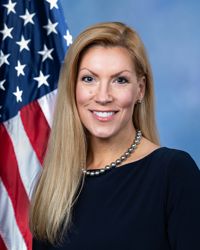
Beth Van Duyne
RRepublicanTX-24 · Representative
61
/ 100
Average
Attendance99
Avg: 96
Independence3
Avg: 4
Bipartisan Tone4
Avg: 15
Ethics Record100
Avg: 99
Transparency100
Avg: 53
Accountability Score — composite of attendance, independence, bipartisan tone, ethics record & transparency.
Methodology32
Bills Sponsored
0
Enacted into Law
4
Passed a Chamber
28
In Committee
All Sponsored Bills
HR10643In Committee
H–1B Visa Fraud Crackdown Act
HR10079In Committee
Beverage Regulatory Parity Act
HRES1436In Committee
Condemning Omar Suleiman for celebrating the death of Senator Lindsey Graham and acknowledging that House Democrats invited him to serve as the Guest Chaplain of the U.S. House of Representatives in 2019.
This resolution condemns Islamic scholar Omar Suleiman for celebrating Senator Lindsey Graham's death and acknowledges that House Democrats invited him to serve as the Guest Chaplain of the House in 2019. The measure expresses disapproval of Suleiman's statements while documenting the Democratic leadership's decision to extend the chaplaincy invitation to him several years ago. The resolution is currently under review by the House Committee on House Administration.
HR8873Passed House
Recover COVID Unemployment Fraud in Banks Act
Recover COVID Unemployment Fraud in Banks Act This bill extends to 10 years the statute of limitations for federal criminal charges or civil enforcement actions for fraud related to several unemployment insurance programs that were established during the COVID-19 pandemic. The bill also establishes a task force to locate fraudulent payments and develop strategies to recover such payments. The extension applies to Pandemic Unemployment Assistance, Federal Pandemic Unemployment Compensation, Mixed Earners Unemployment Compensation, and Pandemic Emergency Unemployment Compensation. The bill extends the statute of limitations for (1) criminal charges related to fraud, including aggravated identity theft, wire fraud, and conspiracy to commit fraud (currently subject to a 5-year statute of limitations); and (2) civil actions involving false claims (currently subject to a 6-year statute of limitations). However, the bill does not apply to a criminal prosecution or civil enforcement action if the applicable statute of limitations expired before the date of the bill's enactment. The task force established by this bill must coordinate with state agencies to identify federal pandemic unemployment compensation payments held by financial institutions and other entities or held by state agencies responsible for unclaimed property, coordinate with federal agencies to develop model processes that result in the cost-effective recovery of such payments, issue guidance to financial institutions on legal pathways for returning such payments, and issue guidance to state unclaimed property agencies on their obligation to review and return such payments.
HR5498In Committee
Small Business Health Options Awareness Act of 2026
Small business owners would get better information and resources to understand their health insurance options, including coverage through the Affordable Care Act marketplace and other available plans. The bill aims to help business owners make informed decisions about providing health benefits to their employees by improving access to educational materials and guidance. This would primarily affect small companies with fewer employees that currently struggle to navigate complex health insurance choices.
HRES1383In Committee
Commemorating the one-year anniversary of the enactment of the Working Families Tax Cuts.
This resolution commemorates the one-year anniversary of the enactment of tax relief as part of the 2025 reconciliation act. It also expresses support for tax policies that benefit American families, farmers, seniors, small businesses, and workers.
HR9447In Committee
Getting Terrorist Fanatics Out Act of 2026
The proposal would allow the U.S. government to strip citizenship from people who are found to have provided support to terrorist organizations or causes. This would apply to naturalized citizens (those who became U.S. citizens through the naturalization process rather than being born here) and could affect immigrants who have obtained citizenship but are later discovered to have ties to terrorism. The change would give authorities an additional tool to revoke citizenship status for national security purposes.
HR9112In Committee
CREATOR Act
This legislation would give visual artists legal protection against others commercially using their distinctive artistic style without permission, even if the work isn't an exact copy of their original pieces. The law would apply to cases where someone profits from or publicly distributes work that imitates an artist's recognizable style across state lines or online. This would affect artists, companies that license or sell art, and businesses that create AI-generated or human-made works inspired by established artistic styles.
HR9081In Committee
Healthcare Freedom and Fairness Act
Small businesses and self-employed workers would be allowed to band together through health marketplace pools to purchase group health insurance at lower rates, similar to how large employers can negotiate better prices. This change would make these pooling arrangements officially recognized as employers under federal retirement law, giving them the same legal status and protections as traditional companies when offering health coverage to their members. The goal is to help smaller businesses and independent workers access more affordable health insurance options.
HR8883In Committee
Protecting Seniors and Stopping Fraudsters Act
Protecting Seniors and Stopping Fraudsters Act This bill establishes additional requirements for hospice programs and home health agencies under Medicare, particularly in relation to oversight and transparency. Specifically, the bill subjects hospice programs to revalidation within one year if the program (1) is located in a state in which new hospice programs are subject to enhanced oversight, as determined by the Centers for Medicare & Medicaid Services (CMS); and (2) has not been subject to revalidation over the previous 18 months. Additionally, hospice programs and home health agencies that are newly enrolled, have undergone a change in ownership, or have had billing privileges reactivated must undergo surveys at least once every 12 months over the 36-month period following their change in status. The bill also requires hospice programs and home health agencies that do not submit required data to the CMS or that have an unusual rate of admissions or discharges to undergo additional surveys. The bill also subjects hospice programs and home health agencies that fail to submit required data to the CMS to larger payment reductions beginning in FY2029. The CMS must identify hospice programs and home health agencies that are located in a state or county for which the total number of such programs and agencies significantly exceeds the totals for the previous year. The CMS must flag these programs and agencies as being at extreme risk of fraud and institute additional screening requirements, including fingerprinting requirements for certain personnel.
HR6903Passed House
Ensuring Children Receive Support Act
Ensuring Children Receive Support Act This bill specifies that the Department of State must revoke passports for certain individuals who fail to make child support payments. Under current law, if the Office of Child Support Enforcement of the Department of Health and Human Services receives information from a state that an individual owes more than $2,500 in child support, the State Department must refuse to issue the individual a passport and may revoke a previously issued passport. The bill specifies that the State Department must revoke a previously issued passport in these circumstances. The bill also provides statutory authority for the State Department to allow such an individual to be issued a limited-duration passport for direct return to the United States. For more information about this bill, see CRS Insight IN12660 .
HR8358In Committee
Breast Cancer Research Stamp Reauthorization Act of 2026
The Postal Service would be allowed to continue selling special postage stamps that cost more than regular stamps, with the extra money going to breast cancer research organizations. These stamps, called semipostals, have been used before for charitable causes and this bill would extend the authority to keep issuing them for this specific health cause. The additional revenue from people voluntarily buying these stamps would support medical research aimed at fighting breast cancer.
HR8091In Committee
Outpatient Surgery Access Act of 2026
This bill would make it easier for patients to have certain surgeries performed at outpatient facilities (surgery centers that don't require overnight hospital stays) rather than requiring them to go to hospitals, potentially reducing costs and wait times. The legislation likely aims to expand which procedures can be done in these outpatient settings and may adjust how insurance companies reimburse these facilities to make them more competitive with hospitals. This could benefit patients who prefer quicker procedures and lower out-of-pocket costs, as well as surgery centers looking to perform a wider range of operations.
HR2965Passed House
Small Business Regulatory Reduction Act of 2025
Small Business Regulatory Reduction Act of 2025 This bill requires the Small Business Administration (SBA) to ensure the annual small business regulatory budget for the SBA in each fiscal year is no greater than zero. The small business regulatory budget is the cost to a small business of a federal rulemaking, including the cost resulting from the issuance of any new rule and the cost resulting from the modification or repeal of an existing rule.
HR5743In Committee
One Citizen, One Seat Act
This bill would likely change how House of Representatives seats are allocated among states, possibly by adjusting the current system that bases representation on population counts. The exact impact would depend on the specific method proposed, but it could affect which states gain or lose congressional seats and how much political power different regions have in the House. The bill is still in early stages and hasn't been formally reviewed by the relevant committee yet.
HR5031In Committee
Preserving Patient Access to Long-Term Care Pharmacies Act
This bill would protect patients' ability to use specialized pharmacies that deliver long-term medications and supplies directly to their homes or care facilities, likely preventing insurance companies or government programs from restricting which pharmacies people can use. The legislation would affect patients with chronic conditions who rely on mail-order or specialty pharmacies, as well as the pharmacy businesses that serve them. By preserving patient choice in pharmacy selection, the bill aims to ensure people can continue receiving medications through their preferred providers without facing new insurance barriers.
HR4620In Committee
To amend title 18, United States Code, to include rioting in the definition of racketeering activity.
The proposal would expand federal racketeering laws to treat rioting as a criminal enterprise activity, allowing prosecutors to bring more serious charges against people involved in organized riots. This could enable the government to pursue longer sentences and additional penalties for individuals participating in riots that are part of a larger criminal pattern or organization. The change would primarily affect how federal prosecutors handle cases involving group violence and civil unrest.
HR4470In Committee
Removing Burdens From Organ Donation Act
This bill would make it easier for people to become organ donors by removing administrative obstacles and reducing paperwork requirements for both donors and medical facilities involved in the donation process. The changes would aim to increase the number of available organs for transplant by streamlining how donations are registered and processed, which could help patients waiting for life-saving transplants. The bill affects hospitals, organ procurement organizations, and anyone who might want to donate organs.
HR4053In Committee
Stop Funding Rioters Act
This bill would prevent federal money from going to businesses or organizations that are found to have funded, supported, or participated in riots or violent protests. It would give the government authority to deny federal contracts, grants, and loans to companies that meet certain criteria related to funding civil unrest, potentially affecting small businesses, nonprofits, and larger contractors that receive federal funding.
HR4002In Committee
Patient Access to Higher Quality Health Care Act of 2025
Patient Access to Higher Quality Health Care Act of 2025 This bill repeals provisions under the Stark law (i.e., the Physician Self-Referral Law) that limit, for purposes of Medicare participation, self-referrals by newly constructed or expanded physician-owned hospitals.
HR2966Passed House
American Entrepreneurs First Act of 2025
American Entrepreneurs First Act This bill revises the application requirements for the Small Business Administration's 7(a) loan and 504 loan programs. Specifically, the bill requires applications for such loans to include (1) the applicant's date of birth; and (2) a certification that the applicant or all beneficial owners are citizens, nationals, or lawful permanent residents of the United States. The bill specifies that certain individuals are ineligible for such loans, including (1) asylees, (2) refugees, (3) individuals issued a visa to remain in the United States, (4) individuals legally classified as nonimmigrants, (5) individuals to whom deferred action has been granted pursuant to the Deferred Action for Childhood Arrivals, and (6) individuals without lawful status under the immigration laws of the United States.
HR3526In Committee
Uplifting First-Time Homebuyers Act of 2025
This bill would likely provide tax breaks or financial assistance to people buying their first home, making it easier for them to afford down payments or closing costs. The changes would be handled through the tax code, potentially allowing first-time buyers to deduct certain homebuying expenses or receive credits that reduce their tax bills. The goal is to help younger Americans and lower-income families enter the housing market by reducing the upfront costs they face.
HR2477In Committee
Portable Ultrasound Reimbursement Equity Act of 2025
Portable Ultrasound Reimbursement Equity Act of 2025 This bill provides for Medicare coverage of ultrasound tests performed at a beneficiary's home. The Centers for Medicare & Medicaid Services must provide for separate payments for portable ultrasound services in the same manner and to the same extent as for portable X-ray services.
HR2089In Committee
Generating Retirement Ownership through Long-Term Holding
This bill would change tax rules to encourage people to hold onto investments for longer periods by potentially offering tax breaks for long-term ownership of stocks and other assets. The goal is to make it easier for regular workers and savers to build retirement savings by rewarding them financially when they keep their investments rather than trading them frequently. The proposal would affect individual investors and potentially change how much tax people owe on investment gains depending on how long they hold their investments.
HR1548In Committee
Leveling the Playing Field 2.0 Act
Leveling the Playing Field 2.0 Act This bill addresses unfair trade practices by making various changes to U.S. antidumping and countervailing duty laws. Antidumping laws provide relief to U.S industries and workers that are materially injured or threatened with injury due to imports of like products sold in the U.S. market at less than fair value, while countervailing duty laws provide such relief from imports of products subsidized by a foreign government or public entity. Specifically, the bill establishes a process for successive antidumping and countervailing duty investigations. Successive investigations may be concurrent (an ongoing investigation of the same product) or recently completed (not more than two years before the date of the initiation of the successive investigation). Further, the bill establishes a timeline for the Department of Commerce to issue determinations in successive investigations. Among other provisions, the bill authorizes Commerce to apply countervailing duty law to subsidies provided by a foreign government or public entity to a company operating in a different country, use another method for calculating the cost of production in specific circumstances, and require importers to certify that the imported merchandise is not subject to an antidumping or countervailing duty order. Additionally, the bill statutorily establishes procedures for Commerce to conduct circumvention inquiries, including by specifying the deadlines for preliminary and final determinations. The bill also provides statutory authority for Commerce to investigate currency undervaluation as a countervailable subsidy.
HR1511In Committee
REDUCE Act
The REDUCE Act likely aims to cut government spending or reduce the size of federal agencies and operations. Without more specific details about the bill's provisions, it appears designed to streamline government functions, though the exact impact on federal workers, programs, and taxpayers would depend on which agencies or spending areas it targets.
HR1037In Committee
Voter Eligibility Verification Act of 2025
Voter Eligibility Verification Act of 2025 This bill requires the Department of Homeland Security to respond within 15 days of receiving a request from certain state officials for the immigration status of an individual on a list of potential voters.
HR640In Committee
Chemical Tax Repeal Act
Chemical Tax Repeal Act This bill repeals the Hazardous Substance Superfund excise tax imposed on certain chemicals and chemical substances. Under current law, an excise tax is imposed through December 31, 2031, on taxable chemicals and taxable chemical substances that are (1) manufactured or produced in the United States, or (2) imported into the United States. The excise tax rate varies between 44 cents per ton to $9.74 per ton, depending on the chemical and certain other variables. (There are 42 listed taxable chemicals and 151 listed taxable chemical substances.) Further, under current law, amounts collected from the excise tax on taxable chemicals and taxable chemical substances are deposited into the Hazardous Substance Superfund, which finances the remediation of certain environmentally contaminated sites.
HR595In Committee
To amend the Convention on Cultural Property Implementation Act to make certain technical corrections to facilitate the lawful trade and collecting of numismatic materials.
This bill would fix technical issues in the law that implements international agreements about protecting cultural artifacts, specifically to make it easier for people to legally buy, sell, and collect coins and other numismatic items across borders. The changes would clarify which old coins and collectible currency are protected as cultural property versus which ones can be freely traded, helping collectors and dealers understand what they can legally import and export. The bill aims to balance protecting historically significant artifacts with allowing the normal trade in coins that aren't considered irreplaceable cultural treasures.
HR548In Committee
HSA Modernization Act
HSA Modernization Act This bill increases health savings account (HSA) contribution limits, expands HSA eligibility, and makes other changes to HSAs and high-deductible health plans (HDHP). The bill increases HSA contribution limits to equal the limits on out-of-pocket expenses under an HDHP (adjusted annually). Under the bill, the maximum annual HSA contribution for 2025 is $8,300 for self-only coverage and $16,600 for family coverage. (Under current law, the maximum annual HSA contribution for 2025 is $4,300 for self-only coverage and $8,550 for family coverage.) The bill expands eligibility to make tax-deductible HSA contributions to include individuals who receive hospital care or medical services from the Department of Veterans Affairs and do not have a service-connected disability, receive hospital care or medical services provided by the Indian Health Service or a tribal organization, are at least 65 years old and enrolled in Medicare Part A, or have a bronze-level or catastrophic health insurance plan through a health insurance exchange. The bill also allows eligible married individuals to make catch-up contributions to the same HSA. Under the bill, HSA distributions may be used to pay for qualified medical expenses incurred before the HSA is established if the HSA is established within 60 days from the first day of coverage under an HDHP. Further, the bill specifies that HSA distributions may be used to pay for expenses for qualified long-term care services. Finally, the bill allows an HDHP to provide up to $500 of mental health benefits before the annual deductible is met.
HR326In Committee
Border Wall Waste Accountability Act
Border Wall Waste Accountability Act This bill requires the Government Accountability Office to report to Congress on the total cost of unused construction materials that were obtained for construction of a U.S.-Mexico border wall from January 20, 2021, through January 20, 2025.
HR327In Committee
Valor Earned Not Stolen Act of 2025
Valor Earned Not Stolen Act of 2025 This bill increases the maximum prison term—from one year to three years—for an individual who falsely claims to be the recipient of certain military awards (e.g., a Medal of Honor or Purple Heart) with the intent to obtain money, property, or other tangible benefit.