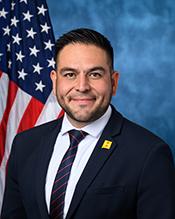
Gabe Vasquez
DDemocratNM-2 · Representative
55
/ 100
Average
Attendance99
Avg: 96
Independence8
Avg: 4
Bipartisan Tone27
Avg: 15
Ethics Record100
Avg: 99
Transparency19
Avg: 53
Accountability Score — composite of attendance, independence, bipartisan tone, ethics record & transparency.
Methodology20
Bills Sponsored
0
Enacted into Law
0
Passed a Chamber
20
In Committee
All Sponsored Bills
HR10509In Committee
BEEF Act
HR9884In Committee
CHILE Act of 2026
The proposal would create a system to help farmers who grow fruits, vegetables, and other specialty crops when they face emergencies like natural disasters, disease outbreaks, or market crashes. This framework would allow the government to provide financial assistance more quickly and flexibly to specialty crop farmers compared to current programs that mainly focus on major crops like corn and wheat. The changes would affect fruit and vegetable growers across the country who currently have fewer safety nets available during crises.
HR9377In Committee
Protecting America’s Herds Act
The federal government would create a grant program to help states and organizations prepare for and respond to New World screwworm infestations, which are parasitic pests that can devastate livestock and wildlife populations. Farmers, ranchers, veterinarians, and agricultural agencies would be eligible to receive funding for prevention efforts, emergency response, and research to control these harmful insects. The program aims to protect the nation's livestock industry and prevent economic losses from screwworm outbreaks.
HR9234In Committee
Careworker Visa Act of 2026
The proposal would create a new visa category allowing foreign workers to come to the United States temporarily to work in caregiving jobs, such as caring for elderly people, children, or individuals with disabilities. This would help address labor shortages in the care industry while giving employers access to workers from other countries through a formal legal process. The visa program would affect care facilities, families needing in-home care, and foreign workers seeking caregiving employment in the U.S.
HR9167In Committee
Public Lands Integrity Act
Public Lands Integrity Act This bill generally prohibits provisions that result in the sale, disposal, or transfer of federal lands from being included in reconciliation legislation by requiring the provisions to be considered extraneous under the Senate's Byrd Rule. The Senate's Byrd Rule (named after it's principal author, Senator Robert Byrd of West Virginia) prohibits the inclusion of matter in reconciliation legislation that is extraneous to a congressional committee's reconciliation directives in the associated congressional budget resolution. Reconciliation is an expedited method by which Congress may adopt changes in spending and revenue laws to achieve the budgetary goals reflected in a congressional budget resolution. Reconciliation bills are considered by Congress using expedited legislative procedures that prevent a filibuster and restrict amendments in the Senate. For additional information, see CRS Report R48640, The Senate’s Byrd Rule: Frequently Asked Questions.
HR7080In Committee
Waste Heat to Wattage Act of 2026
The legislation would allow farmers and agricultural operations to capture waste heat from their equipment and facilities—such as from grain dryers, livestock operations, or food processing—and convert it into electricity for their own use or to sell back to the power grid. This would help reduce energy costs for farmers while creating a new revenue stream from energy that would otherwise be wasted. The bill affects agricultural producers and rural communities that could benefit from lower operating expenses and additional income opportunities.
HR8533In Committee
Farmer to Farmer Education Act of 2026
Farmer to Farmer Education Act of 2026 This bill expands the authority of the Department of Agriculture (USDA) to provide technical assistance for farmer-to-farmer networks. USDA must use annual appropriations provided for Natural Resources Conservation Service conservation operations to implement this program. A farmer-to-farmer network means any affiliation or association of farmers that share information, technical assistance, or any other type of mutually beneficial support. Under the bill, USDA may enter into cooperative agreements with eligible entities to (1) provide assistance to farmer-to-farmer networks to build network capacity, connect farmers with mentors or group learning opportunities, and support goal setting; (2) increase technical assistance for farmers, ranchers, and forest owners who use different farming models, practices, and scales; (3) establish and steward the networks; and (4) establish reporting requirements for these activities. Those eligible for the program include nonprofit entities, farmer-to-farmer networks, tribal entities, local governments, institutions of higher education, and states. USDA must prioritize agreements with entities that seek to meet the specific needs of certain farmers, ranchers, and forest owners who are historically underserved or operating in high-poverty areas. The bill also provides for subawards to plan and conduct events, as well as to identify and develop innovative activities, in order to increase farmer access to farmer-to-farmer assistance.
HR4290In Committee
Downwinder Commemoration Act of 2025
This bill would create a way to officially recognize and commemorate people who were exposed to radiation from nuclear weapons testing conducted by the U.S. military during the Cold War era, particularly those living downwind of test sites in Nevada and other western states. The legislation aims to honor these "downwinders"—civilians and military personnel who suffered health problems from the radiation exposure—through memorials, educational efforts, or other forms of acknowledgment. The bill reflects an effort to formally recognize the government's responsibility for the harm caused to these communities during the nuclear testing program.
HR7383In Committee
Feed Our Veterans Act
This bill would likely expand food assistance programs or agricultural support specifically for veterans, helping ensure they have access to nutritious meals and food resources. The measure addresses food security among the veteran population by potentially connecting them with existing agricultural programs or creating new pathways for veterans to receive food aid. It affects veterans and possibly farmers or food producers who participate in programs serving this group.
HR7781In Committee
Parity for Tribal Educators Act
This bill would ensure that Native American teachers and educators working in tribal schools receive the same pay, benefits, and working conditions as educators in other public school systems. The legislation aims to address long-standing pay gaps and resource disparities that have made it harder for tribal schools to attract and retain qualified teachers. The bill affects Native American educators, tribal school systems, and the students who attend schools in Indian Country.
HR1965In Committee
Veteran Education Assistance Adjustment Act
This bill would likely adjust or expand education benefits available to military veterans, such as tuition assistance, GI Bill payments, or vocational training programs. The changes would help veterans pay for college, trade schools, or other educational programs after they leave the military. The bill is currently being reviewed by a congressional committee to determine whether it should move forward for a vote.
HR7478In Committee
Patient Debt Relief Act
The bill would help patients reduce or eliminate medical debt they owe to hospitals and healthcare providers, likely through mechanisms such as debt forgiveness programs, negotiated payment plans, or limits on how aggressively providers can pursue collections. It would affect millions of Americans struggling with medical bills, as well as hospitals and healthcare systems that currently collect these debts. The proposal is still in early stages and has been sent to two congressional committees for review.
HR4472In Committee
Stop COYOTES Act
The legislation would create new federal criminal penalties and enforcement tools targeting human smugglers, commonly known as coyotes, who illegally transport people across borders. It would give law enforcement agencies additional resources and authority to investigate and prosecute smuggling operations that endanger migrants' lives. The bill aims to disrupt smuggling networks that exploit vulnerable people seeking to enter the country illegally.
HR4003In Committee
Economic Opportunity for Border Communities Act
Economic Opportunity for Border Communities Act This bill requires the Department of Commerce to develop a national strategy for supporting economic opportunity in border communities. The goals of the strategy include increasing the number of jobs in border communities, strengthening U.S. competitiveness in manufacturing, reducing the costs of exports and imports, and increasing opportunities for workforce development. Border communities are municipalities located not more than 15 miles from a land port of entry.
HR3473In Committee
Humane Accountability Act
The bill would establish new accountability measures and oversight requirements for federal immigration enforcement agencies to ensure they follow humane treatment standards when detaining or processing immigrants. It likely aims to address concerns about conditions in detention facilities and enforcement practices by creating mechanisms to monitor compliance and hold agencies responsible for violations. The proposal affects immigration enforcement officials, detained immigrants, and oversight bodies like Congress and inspectors general.
HR2236In Committee
Healthy Foods for Native Seniors Act
Healthy Foods for Native Seniors Act This bill directs the Department of Agriculture to establish a demonstration project that allows tribal entities (e.g., Indian tribes) to enter into self-determination contracts to purchase agricultural commodities under the Commodity Supplemental Food Program (CSFP). The CSFP distributes monthly food packages to low-income older individuals through local organizations (including tribal organizations).
HR2235In Committee
Habitat Connectivity on Working Lands Act of 2025
This bill would help farmers and ranchers create wildlife corridors and connected habitats across their working lands by providing financial incentives and technical support for conservation practices. The goal is to allow animals to move safely between different areas while farmers continue to use their land for agriculture, benefiting both wildlife populations and rural communities that depend on farming and ranching.
HR2020In Committee
New Mexico Rural Veteran Health Care Access Act
HR1444In Committee
Zuni Indian Tribe Water Rights Settlement Act of 2025
Zuni Indian Tribe Water Rights Settlement Act of 2025 This bill recognizes and settles certain water rights claims in New Mexico of the pueblo of Zuni and establishes and provides funding for a related settlement trust fund. It also requires federal actions related to the Zuni Salt Lake in New Mexico. Specifically, the bill authorizes, ratifies, and confirms a specified water rights settlement agreement entered into by Zuni, New Mexico, and others, thus satisfying claims to water rights in the Zuni River Stream System in New Mexico. The bill establishes and provides funding for the Zuni Tribe Settlement Trust Fund (and specified accounts) for purposes of carrying out this bill. Additionally, the bill (1) specifies the water rights of the pueblo; and (2) outlines waivers, releases, and retentions of claims by the pueblo and the United States. The bill also withdraws certain federal land in New Mexico from mineral development. The bill reserves this federal land for the following three purposes: (1) the protection of the Zuni Salt Lake and Sanctuary, (2) the protection of the quality and quantity of the Zuni Salt Lake's water supply, and (3) the protection of any cultural resources associated with the Zuni Salt Lake and Sanctuary. The Bureau of Land Management must manage this land. The Department of the Interior must take certain land surrounding the Zuni Salt Lake into trust for the benefit of Zuni.
HR1038In Committee
Combating Rural Inflation Act
Combating Rural Inflation Act This bill requires the the Bureau of Labor Statistics of the Department of Labor to publish a monthly index of changes in consumer prices for individuals residing in rural communities.