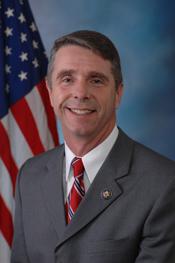
Robert J. Wittman
RRepublicanVA-1 · Representative
62
/ 100
Average
Attendance97
Avg: 96
Independence2
Avg: 4
Bipartisan Tone12
Avg: 15
Ethics Record100
Avg: 99
Transparency100
Avg: 53
Accountability Score — composite of attendance, independence, bipartisan tone, ethics record & transparency.
Methodology17
Bills Sponsored
0
Enacted into Law
6
Passed a Chamber
11
In Committee
All Sponsored Bills
HR9640In Committee
Earth MRI Reauthorization Act of 2026
The proposal would extend and continue funding for the Earth Mapping Resources Initiative, a program that uses advanced mapping technology to identify mineral and natural resources across the United States. This affects mining companies, energy producers, and government agencies that rely on detailed geological data to locate valuable materials like metals and rare earth elements needed for manufacturing and technology. The bill also allows for other related changes to the original infrastructure law that created this initiative.
HR7889Passed House
AWRC Act of 2025
Advancing Water Research and Collaboration Act of 2025 or the AWRC Act of 2025 This bill reauthorizes through FY2029 and modifies the Water Resources Research Act Program of the U.S. Geological Survey (USGS). Under the program, USGS provides grants for Water Resources Research Institutes that are in each of the 50 states as well as the District of Columbia, Puerto Rico, the U.S. Virgin Islands, and Guam. Among other activities, the institutes plan and conduct research to improve water supply reliability and address water problems.
HR6317Passed House
To designate the facility of the United States Postal Service located at 12109 New Kent Highway in New Kent, Virginia, as the "Patricia Paige Post Office".
This bill designates the facility of the United States Postal Service located at 12109 New Kent Highway in New Kent, Virginia, as the "Patricia Paige Post Office".
HR556Passed House
Protecting Access for Hunters and Anglers Act
Protecting Access for Hunters and Anglers Act of 2025 This bill bars the Fish and Wildlife Service (FWS), the Bureau of Land Management (BLM), and the Forest Service from prohibiting or regulating the use of lead ammunition or tackle on federal land or water. The bill makes exceptions for specified existing regulations and where the FWS, the BLM, or the Forest Service determines that a decline in wildlife population at the specific unit of federal land or water is primarily caused by the use of lead in ammunition or tackle, based on the field data from such unit, and the state approves the regulations.
HR7992In Committee
CANS Act of 2026
The CANS Act would likely establish new rules or programs related to environmental protection, possibly focusing on conservation, pollution control, or natural resource management. Without more specific details about the bill's provisions, the exact impact on businesses, communities, and the environment cannot be determined, but it would probably affect how companies handle environmental compliance or how federal agencies manage protected lands and resources.
HR7126In Committee
SECURE Minerals Act of 2026
This bill would likely aim to strengthen the U.S. supply of minerals critical for energy production and technology, such as lithium, cobalt, and rare earths used in batteries and renewable energy systems. It probably includes measures to support domestic mining, reduce dependence on foreign sources, and streamline the permitting process for mineral extraction projects. The changes would affect mining companies, energy producers, and consumers who depend on affordable access to these materials for electric vehicles and clean energy infrastructure.
HR2969In Committee
Finding ORE Act
This bill would establish a program to help develop and commercialize rare earth element and critical mineral extraction and processing technologies in the United States. The legislation aims to reduce American dependence on foreign sources of these materials, which are essential for manufacturing electronics, renewable energy equipment, and military hardware. It would likely provide funding and support to companies and researchers working on domestic mining and refining operations.
HR7146In Committee
PORCUPINE Act
The bill's vague title makes its specific purpose unclear, but based on its referral to the House Committee on Foreign Affairs, it likely addresses some aspect of international relations or foreign policy. Without access to the bill's actual text or more detailed subject matter, the most that can be said is that it probably involves diplomatic, trade, or security matters affecting U.S. relationships with other countries. To understand what the bill would actually do, you would need to review the full legislative text or committee materials.
HCONRES62Passed House
Authorizing the use of Emancipation Hall in the Capitol Visitor Center for an event to unveil the statue of Barbara Rose Johns.
Congress is allowing a specific event to be held in Emancipation Hall, a room in the Capitol Visitor Center, where a statue of Barbara Rose Johns will be unveiled to the public. Barbara Rose Johns was a civil rights activist who led a student strike against segregated schools in Virginia in 1951. This authorization permits the Capitol to host this commemorative event honoring her contributions to the civil rights movement.
HR906Passed House
Foreign Adversary Communications Transparency Act
Foreign Adversary Communications Transparency Act This bill requires the Federal Communications Commission (FCC) to annually publish a list of entities that hold a license or other authorization granted by the FCC and have ties to specified foreign countries. With respect to entities holding cable landing licenses (for the placement and operation of submarine communications cables) or other licenses granted via competitive auction, the FCC must publish a list of all such entities (1) in which a covered entity holds a specified voting or equity interest, or (2) that have been determined by a national security agency to be subject to the control of a covered entity. With respect to entities holding all other categories of FCC licenses or other authorizations, the FCC must first issue rules facilitating the collection of information on such licensees’ ownership structure. After that information is obtained, the FCC must add to the published list any such entity in which a covered entity holds a specified voting or equity interest. Under the bill, a covered entity is defined as an entity organized in China, Iran, North Korea, or Russia; a subsidiary of such an entity; or the government of China, Iran, North Korea, or Russia.
HR2091In Committee
Chesapeake Bay Conservation Acceleration Act of 2025
The legislation would speed up efforts to restore and protect the Chesapeake Bay by streamlining federal permitting processes and increasing funding for cleanup projects that reduce pollution from farms, cities, and industrial sources. It would affect farmers, environmental organizations, state and local governments, and communities around the bay that depend on its health for fishing, recreation, and drinking water. The bill aims to make it faster and easier for states and nonprofits to implement conservation projects without getting stuck in lengthy federal approval processes.
HR555In Committee
Veterans Affairs Transfer of Information and Sharing of Disability Examination Procedures With DOD Doctors Act
Veterans Affairs Transfer of Information and Sharing of Disability Examination Procedures With DOD Doctors Act This bill addresses the sharing of medical information and disability examination procedures between the Departments of Defense (DOD) and Veterans Affairs (VA). It requires that if a member of the Armed Forces who is required to receive a physical examination upon separation from active duty has or is believed to have a medical condition that may make the member eligible for veterans' disability compensation and benefits, the examination must be performed by a VA-certified health care provider. If the condition is discovered during the physical examination and the examining health care provider is not VA-certified, the examination must be completed by a VA-certified provider. An eligibility determination made as part of such an examination shall be binding on the VA and be used as the basis for assigning the member's disability rating. The VA and DOD shall jointly establish a system to share data and maintain the medical and personnel records of Armed Forces members and veterans.
HR553In Committee
BRAVE Act
Be Ready to Assist Veterans in Extremis Act or the BRAVE Act This bill requires the Department of Veterans Affairs (VA) to establish a patient outreach system under which it must ensure that veterans who are enrolled in the VA health care system and have experienced a traumatic or highly stressful event may elect to receive information and resources relating to mental health and available mental health care services. The VA must coordinate the system with the Transition Assistance Program of the Department of Defense.
HR1151In Committee
Freedom to Invest in Tomorrow’s Workforce Act
Freedom to Invest in Tomorrow’s Workforce Act This bill expands the expenses eligible for tax-free withdrawals from a qualified tuition program (known as a 529 plan) to include tuition, fees (including test fees), books, supplies, equipment, and other expenses related to the enrollment or attendance in a recognized postsecondary credentialing program. Under the bill, a recognized postsecondary credentialing program includes certain programs identified by a state as providing training services, a program listed in the Web Enabled Approval Management System (WEAMS) maintained by the Department of Veterans Affairs, certain examinations required to obtain or maintain a credential, and other reputable credentialing programs. Further, under the bill, such programs must be designed for an individual to obtain an industry-recognized postsecondary employment credential (e.g., project management professional certificate, advanced emergency medical technician certificate, and welding supervisor certificate), a certificate of completion of a registered and certified apprenticeship, an occupational or professional license issued or recognized by a state or the federal government (and any certification required for obtaining such license), or an associate or baccalaureate degree.
HR207Passed House
SHARKED Act of 2025
Supporting the Health of Aquatic systems through Research Knowledge and Enhanced Dialogue Act of 2025 or the SHARKED Act of 2025 This bill requires the Department of Commerce to establish a task force to address and report to Congress about critical needs with respect to shark depredation. (Shark depredation is the partial or complete removal of a hooked fish by a shark directly from a fishing line before the line is retrieved.) The duties of the task force are, among other responsibilities, to (1) develop ways to improve coordination and communication across the fisheries management and shark research communities; (2) identify research priorities and funding opportunities; (3) develop recommended management strategies to address shark depredation; and (4) coordinate the development and distribution of educational materials. The bill specifies that the task force must include representatives of each Regional Fishery Management Council, each Marine Fisheries Commission, the fish and wildlife agencies of coastal states, and the National Marine Fisheries Service. The task force must also include researchers and others with relevant expertise. The task force must report its findings to Congress within two years after the bill's enactment and every two years thereafter until the task force is terminated. The task force sunsets within seven years after the date of its establishment.
HR330In Committee
Organ Donation Referral Improvement Act
Organ Donation Referral Improvement Act This bill requires the Office of the Assistant Secretary for Planning and Evaluation (ASPE) in the Department of Health and Human Services to conduct a study on hospitals’ use of electronic automated referrals for organ donations. The bill defines electronic automated referral as an electronic system that uses electronic health records to identify patients who are potential organ donors and automatically refers those patients to organ procurement organizations. The ASPE must include specified components in the study, including identifying benefits, reviewing best practices, and developing recommendations for the use of electronic automated referrals for organ donations.
HRES12In Committee
Stay on Schedule (S.O.S.) Resolution
Stay on Schedule (S.O.S.) Resolution This resolution prevents the House of Representatives from adjourning in August until it has passed regular appropriations legislation for the fiscal year beginning in October. The resolution specifies that it is out of order for the House to consider a concurrent resolution for its adjournment during any day in August until the House has passed all of the regular appropriations bills.