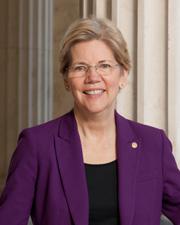
Elizabeth Warren
DDemocratMA · Senator
63
/ 100
Average
Attendance98
Avg: 97
Independence15
Avg: 23
Bipartisan Tone4
Avg: 14
Ethics Record100
Avg: 100
Transparency100
Avg: 47
Accountability Score — composite of attendance, independence, bipartisan tone, ethics record & transparency.
Methodology73
Bills Sponsored
0
Enacted into Law
0
Passed a Chamber
72
In Committee
All Sponsored Bills
S5685In Committee
A bill to require the disclosure of supervisory records of certain financial institutions that relate to Jeffrey Epstein, and for other purposes.
SRES937Introduced
A resolution recognizing the seriousness of polycystic ovary syndrome (PCOS) and expressing support for the designation of September 2026 as "PCOS Awareness Month".
SJRES220In Committee
Original Slavery Remembrance Day Resolution
S5651In Committee
National Institutes of Clean Energy Act of 2026
S5512In Committee
Stop Wall Street Looting Act
S5481In Committee
Youth Voting Rights Act
S5419In Committee
Stop Corporate Takeovers of Physicians Act of 2026
S5415In Committee
Air Traffic Noise and Pollution Expert Consensus Act of 2026
S5389In Committee
Ending Presidential Corruption in Banking Act
S5104In Committee
Fair Seeds for Farmers Act
The proposal would reduce the length and scope of patent protections that plant breeders and agricultural companies currently receive when they develop new plant varieties. This change could make it easier for farmers and competitors to use or modify existing plant designs without paying licensing fees, though it might also reduce the financial incentive for companies to invest in developing new crops. The bill is still in early stages and has been sent to the Judiciary Committee for review.
S5053In Committee
Accreditation Reform and Enhanced Accountability Act of 2026
The bill would change how colleges and universities get approved and monitored by accrediting agencies, which are organizations that verify schools meet quality standards. These reforms could affect how students choose schools, how schools maintain their federal funding eligibility, and what standards schools must meet to operate. The changes would impact students, colleges, universities, and the accrediting agencies that oversee them.
SJRES201In Committee
A joint resolution directing the Federal Trade Commission to investigate and report on anticompetitive practices and violations of the antitrust laws in the fire truck manufacturing industry.
The Federal Trade Commission would be required to investigate whether fire truck manufacturers are engaging in unfair business practices that limit competition, such as price-fixing or blocking smaller competitors from entering the market, and then report their findings to Congress. This would affect fire truck manufacturers and potentially the local governments and fire departments that purchase these vehicles. The investigation would help determine if consumers and public agencies are paying fair prices for fire trucks or if anticompetitive behavior is driving up costs.
S5056In Committee
CDC Tribal Public Health Security and Preparedness Act
The legislation would strengthen the ability of state, local, and tribal governments to prepare for and respond to public health emergencies by improving their security measures and coordination systems. It would likely provide funding, resources, and technical support to help these communities better protect their populations during disease outbreaks, natural disasters, or other health crises. The bill affects public health officials, emergency responders, and the communities they serve across the country.
S4986In Committee
Mamas First Act
Mamas First Act This bill requires state Medicaid programs to cover services furnished by doulas, midwives, and lactation support providers, including prenatal, delivery, and postpartum services, in a variety of settings.
S4987In Committee
Pharmaceutical Investment Oversight and Accountability Act
The Federal Trade Commission would be required to investigate and report on how much foreign companies and investors own or control in the U.S. pharmaceutical industry, including what types of drugs and medicines they're involved with. This report would help Congress understand whether foreign investment in American drug companies could affect drug prices, availability, or national security. The information would be useful for lawmakers deciding whether new rules are needed to protect American interests in the pharmaceutical sector.
S4946In Committee
Health and Location Data Protection Act of 2026
The legislation would prevent companies that collect and sell personal information from buying and selling sensitive data like social security numbers, financial account information, and health records without explicit permission from the people involved. Data brokers—companies that profit by gathering and reselling personal information—would face restrictions on what they can do with this most sensitive categories of data. This would primarily affect data brokers and the companies that buy information from them, while giving individuals more control over their most private information.
S4734In Committee
Critical Defense Ownership Review Act
The government would be required to review when investment companies try to buy controlling stakes in major defense contractors to ensure national security isn't compromised. This review process would give officials a chance to examine whether foreign investors or other concerning parties could gain influence over companies that make weapons and military equipment for the U.S. armed forces.
S4743In Committee
AI Bubble Transparency Act
The government's financial research office would be required to collect detailed information about how companies are funding artificial intelligence development and share that data with Congress, then recommend ways that financial regulators and lawmakers can reduce risks to the overall economy. This would help lawmakers and regulators understand whether massive investments in AI could create financial problems similar to past crises, and what safeguards might be needed. The bill affects tech companies, investors, banks, and financial regulators who oversee the stability of the financial system.
S4718In Committee
Restore Military Families’ Voices Act
Military families living in privatized housing on base would gain stronger legal protections, including the ability to speak up about unsafe or unfair housing conditions without fear of losing their homes or facing other punishment. The bill would limit the use of nondisclosure agreements that currently prevent residents from reporting problems to military officials or the public. These changes would primarily affect active-duty service members, retirees, and their families who rent housing managed by private contractors on military installations.
S4684In Committee
Protecting American Consumers Act
The proposal would guarantee a minimum level of funding for the Consumer Financial Protection Bureau, the federal agency that oversees banks, credit card companies, and other financial institutions to protect consumers from unfair or deceptive practices. Currently, the bureau's budget can fluctuate based on decisions by other agencies, but this change would ensure it receives a set amount of money each year regardless of those decisions. This would affect consumers by potentially strengthening oversight of financial companies and their lending, credit, and banking practices.
S4648In Committee
A bill to improve transparency with respect to foreign influence on Department of Defense contractors.
The bill would require Department of Defense contractors to disclose their foreign ownership, investments, and business relationships to increase transparency about potential foreign influence on military suppliers. This would help the Pentagon and Congress better understand which defense companies have significant foreign connections that could affect national security. The measure affects defense contractors and their foreign investors or business partners.
S4550In Committee
Maternal Health Pandemic Response Act
The federal government would fund efforts to collect data and monitor maternal health during public health emergencies, such as pandemics or disease outbreaks, to better understand how these crises affect pregnant women and new mothers. This would help researchers and health officials identify problems quickly and improve medical care for mothers and babies when emergencies occur. The bill allocates money for these data collection and research activities.
SRES732In Committee
A resolution expressing the sense of the Senate that over 25 years of real-world evidence and hundreds of peer-reviewed studies proving that mifepristone is safe and effective should be respected, and law and policy governing access to lifesaving, time-sensitive medication abortion care in the United States should be equitable, transparent, and based on the best available peer-reviewed evidence-based science.
This resolution expresses the Senate's view that policies governing access to mifepristone, a medication used for abortion, should be based on scientific evidence showing the drug is safe and effective, rather than other considerations. The resolution calls for medication abortion care to be equitable and transparent across the United States, reflecting what research has demonstrated over the past 25 years. The measure has been referred to the Senate's health committee for consideration.
S4509In Committee
PBM Act
The proposal would prevent pharmacy benefit managers (companies that manage prescription drug benefits for insurance plans) and pharmacies from being owned by the same parent company. This separation is intended to reduce conflicts of interest where a single company could profit by steering patients to its own pharmacies or limiting access to competitors' pharmacies, potentially affecting drug prices and patient choice for millions of Americans who use prescription medications.
SJRES112In Committee
A joint resolution providing for congressional disapproval under chapter 8 of title 5, United States Code, of the rule submitted by the Bureau of Industry and Security of the Department of Commerce relating to "One Year Suspension of Expansion of End-User Controls for Affiliates of Certain Listed Entities".
Congress is considering blocking a Commerce Department rule that temporarily paused restrictions on which companies can buy certain controlled technology products from U.S. exporters. The rule would have allowed some foreign companies affiliated with sanctioned entities to continue purchasing these items for one year, but this resolution would reject that permission and keep the stricter limits in place. This affects technology companies and exporters who sell products subject to national security controls.
S4388In Committee
Housing Survivors of Major Disasters Act of 2026
When major disasters like hurricanes, floods, or earthquakes strike, this bill would ensure that federal money and resources are available to help affected families rebuild their homes, replace lost belongings, and cover emergency expenses. The assistance would go directly to individuals and families who have suffered significant losses, helping them recover more quickly after a disaster. The bill has been sent to the Senate committee responsible for homeland security and disaster management for review.
S4299In Committee
Ban Presidential Plunder of Taxpayer Funds Act
This bill would prevent current and former Presidents and Vice Presidents from receiving money damages if they win lawsuits against the federal government, even if they successfully prove the government wronged them. The change would apply to these officials specifically, while other federal employees and private citizens could still collect damages in similar situations. The bill is currently under review by the Senate Judiciary Committee.
S4288In Committee
Educational Equity Challenge Grant Act of 2026
This bill would likely create a competitive grant program to help schools and districts address educational disparities and improve outcomes for disadvantaged students. Schools could apply for federal funding to support initiatives like teacher training, curriculum improvements, or resources for low-income and underserved communities. The program aims to give schools the financial tools they need to provide more equitable educational opportunities across different regions and student populations.
SJRES178In Committee
A joint resolution providing for congressional disapproval under chapter 8 of title 5, United States Code, of the rule submitted by the Bureau of Consumer Financial Protection relating to the withdrawal of the rule relating to "Procedures for Supervisory Designation Proceedings".
Congress is considering blocking a decision by the Consumer Financial Protection Bureau to withdraw its rules about how it designates certain financial companies for special supervision. If approved, this resolution would reverse the agency's move and keep the original oversight procedures in place, affecting how the federal government monitors large financial institutions.
SJRES170In Committee
A joint resolution providing for congressional disapproval under chapter 8 of title 5, United States Code, of the rule submitted by the Bureau of Consumer Financial Protection relating to the withdrawal of the rule relating to "Compliance Bulletin 2016-03: Detecting and Preventing Consumer Harm From Production Incentives".
Congress is considering blocking a decision by the Consumer Financial Protection Bureau to withdraw guidance that helped banks detect and prevent unfair sales practices where employees are pressured to sell products to customers who don't need them. If approved, this resolution would force the agency to keep the original guidance in place rather than allowing it to be removed. The resolution affects banks and financial institutions that sell consumer products like mortgages, credit cards, and savings accounts.
SJRES169In Committee
A joint resolution providing for congressional disapproval under chapter 8 of title 5, United States Code, of the rule submitted by the Bureau of Consumer Financial Protection relating to the withdrawal of the rule relating to "Consumer Financial Protection Circular 2022-06: Unanticipated Overdraft Fee Assessment Practices".
Congress is considering blocking a decision by the Consumer Financial Protection Bureau to withdraw its guidance on how banks charge overdraft fees to customers. If approved, this resolution would reverse the agency's move and keep the original rules in place that were meant to limit unexpected overdraft charges on bank accounts. The vote would affect how banks can charge fees when customers overdraw their accounts.
SJRES174In Committee
A joint resolution providing for congressional disapproval under chapter 8 of title 5, United States Code, of the rule submitted by the Bureau of Consumer Financial Protection relating to the withdrawal of the rule relating to "Bulletin 2022-04: Mitigating Harm From Repossession of Automobiles".
Congress is considering blocking a decision by the Consumer Financial Protection Bureau to withdraw its 2022 guidance that was meant to protect car owners from unfair repossession practices by lenders and debt collectors. If approved, this resolution would force the agency to keep that consumer protection rule in place rather than allowing it to be removed. The vote would affect millions of Americans who finance or lease vehicles and could determine whether they have stronger legal protections against losing their cars.
SJRES177In Committee
A joint resolution providing for congressional disapproval under chapter 8 of title 5, United States Code, of the rule submitted by the Bureau of Consumer Financial Protection relating to "Registry of Nonbank Covered Persons Subject to Certain Agency and Court Orders; Rescission".
Congress is considering blocking a Consumer Financial Protection Bureau rule that would have created a public registry of nonbank financial companies (like payday lenders or debt collectors) that have violated consumer protection laws or faced court orders. If approved, this resolution would prevent that registry from taking effect, keeping information about these companies' violations private rather than publicly available. The measure affects consumers who deal with nonbank financial services and the companies themselves.
SJRES167In Committee
A joint resolution providing for congressional disapproval under chapter 8 of title 5, United States Code, of the rule submitted by the Bureau of Consumer Financial Protection relating to the withdrawal of the rule relating to "Consumer Information Requests to Large Banks and Credit Unions".
Congress is considering blocking a decision by the Consumer Financial Protection Bureau to withdraw a rule that required large banks and credit unions to respond to consumer requests for their own financial information. If passed, this resolution would reverse that withdrawal and force banks to keep the requirement in place. The measure affects banks, credit unions, and consumers who want access to their own financial records.
SJRES168In Committee
A joint resolution providing for congressional disapproval under chapter 8 of title 5, United States Code, of the rule submitted by the Bureau of Consumer Financial Protection relating to the withdrawal of the rule relating to "Consumer Financial Protection Circular 2024-01: Preferencing and Steering Practices by Digital Intermediaries for Consumer Financial Products or Services".
Congress is considering blocking a Consumer Financial Protection Bureau rule that would have prevented digital platforms (like comparison websites and apps) from unfairly steering consumers toward certain financial products that benefit the platform rather than the consumer. If passed, this resolution would overturn the agency's attempt to stop practices where platforms hide better deals or promote inferior products because they earn higher commissions. The measure affects consumers shopping for financial products online and the digital platforms and financial companies that use these steering tactics.
SJRES179In Committee
A joint resolution providing for congressional disapproval under chapter 8 of title 5, United States Code, of the rule submitted by the Bureau of Consumer Financial Protection relating to the withdrawal of the rule relating to "Disclosure of Consumer Complaint Data".
Congress is considering blocking a decision by the Consumer Financial Protection Bureau to stop requiring companies to publicly disclose complaints customers file against them. If approved, this resolution would force the agency to keep the old rule in place, meaning consumers could continue to see what complaints others have made about banks, credit card companies, and other financial firms. The measure is currently under review by the Senate Banking Committee.
SJRES176In Committee
A joint resolution providing for congressional disapproval under chapter 8 of title 5, United States Code, of the rule submitted by the Bureau of Consumer Financial Protection relating to the withdrawal of the rule relating to "Disclosure of Consumer Complaint Narrative Data".
Congress is considering blocking a decision by the Consumer Financial Protection Bureau to stop requiring companies to publicly share the text of customer complaints about financial products and services. If approved, this resolution would force the agency to keep the complaint disclosure rule in place, meaning consumers and researchers would continue to have access to detailed information about problems people experience with banks, credit card companies, and other financial institutions.
SJRES175In Committee
A joint resolution providing for congressional disapproval under chapter 8 of title 5, United States Code, of the rule submitted by the Bureau of Consumer Financial Protection relating to the withdrawal of the rule relating to "Consumer Financial Protection Circular 2022-02: Deceptive Representations Involving the FDIC's Name or Logo or Deposit Insurance".
Congress is voting on whether to block a consumer protection rule that was supposed to prevent banks and financial companies from misleadingly using the FDIC's name or logo to trick people into thinking their deposits are insured when they're not. The rule was withdrawn by the Consumer Financial Protection Bureau, and this resolution would formally disapprove of that withdrawal, essentially trying to keep the consumer protection in place. This affects everyday people who use banks and financial services, as well as the financial institutions themselves.
SJRES166In Committee
A joint resolution providing for congressional disapproval under chapter 8 of title 5, United States Code, of the rule submitted by the Bureau of Consumer Financial Protection relating to the withdrawal of the rule relating to "Equal Credit Opportunity (Regulation B); Discrimination on the Bases of Sexual Orientation and Gender Identity".
Congress is considering blocking a decision by the Consumer Financial Protection Bureau to withdraw protections that prevented lenders from discriminating against borrowers based on sexual orientation or gender identity. If approved, this resolution would force the agency to keep those anti-discrimination rules in place rather than allow them to be removed. The measure affects banks, credit card companies, and other lenders, as well as LGBTQ+ individuals seeking loans or credit.
S4246In Committee
Ultra-Millionaire Tax Act of 2026
This proposal would create a new annual tax on individuals and families with a net worth exceeding $50 million, requiring them to pay a percentage of their total wealth each year rather than just income taxes. The revenue collected would go toward federal programs and deficit reduction, affecting only the wealthiest Americans while leaving middle-class and working families unchanged. The bill has been sent to the Senate Finance Committee for review and debate.
S4212In Committee
Prioritizing the Warfighter in Defense Contracting Act of 2026
This bill would change how the military buys equipment and services from private contractors to prioritize what actually helps soldiers and troops in the field. The legislation likely aims to streamline the contracting process, reduce unnecessary spending, or ensure that defense dollars go toward supplies and technology that directly support military personnel rather than bureaucratic overhead. The changes would affect defense contractors, military procurement officials, and ultimately the armed forces' ability to equip and support troops.
SJRES142In Committee
A joint resolution providing for congressional disapproval under chapter 8 of title 5, United States Code, of the rule submitted by the National Credit Union Administration relating to "Withdrawal of Fee Reporting Requirements".
Congress is considering blocking a rule that would let credit unions stop reporting certain fees to regulators, arguing that the National Credit Union Administration went too far in reducing transparency requirements. If approved, this resolution would overturn the rule and require credit unions to continue reporting fee information to federal overseers. The change affects credit unions and their members, who rely on fee disclosure to understand the true costs of their financial products.
SRES651In Committee
A resolution honoring the USS Massachusetts (SSN-798) Virginia Class nuclear submarine and her crew on the historic occasion of her commissioning, on March 28, 2026.
This resolution honors the USS Massachusetts, a new nuclear submarine, and recognizes its official commissioning ceremony scheduled for March 2026. The resolution celebrates the submarine and the sailors who will serve aboard it as part of the Navy's fleet. It's a ceremonial measure that acknowledges this military milestone rather than creating new laws or policies.
S4050In Committee
Failed Bank Executives Clawback Act
This bill would allow the government to recover compensation and bonuses paid to executives at banks that fail or require federal bailouts, clawing back money they received even after leaving their positions. The measure aims to hold bank leaders financially accountable when their decisions contribute to a bank's collapse, potentially recovering taxpayer funds used in rescues. It would affect current and former executives at financial institutions that experience significant failures.
S4029In Committee
A bill to reinforce the Foreign Corrupt Practices Act of 1977 by establishing a limitations period of 10 years for antibribery offenses, and for other purposes.
The government would set a 10-year time limit for prosecuting companies and individuals who bribe foreign officials to win business deals, meaning prosecutors would have a decade from when the offense occurs to bring charges. This change would strengthen enforcement of existing anti-bribery laws that prevent American businesses from paying off foreign government officials to gain unfair advantages in international deals. The bill affects multinational corporations, their executives, and federal prosecutors who investigate financial crimes overseas.
S4001In Committee
Supplemental Security Income Restoration Act of 2026
This bill would likely increase or restore benefits for people receiving Supplemental Security Income (SSI), a federal program that provides cash assistance to elderly, blind, and disabled individuals with limited income and resources. The changes would probably address issues like outdated income limits or benefit amounts that haven't kept pace with living costs, affecting millions of low-income seniors and people with disabilities who rely on this assistance to cover basic needs like food and housing.
S4015In Committee
Stop Militarizing Our Streets Act of 2026
This bill would likely restrict or regulate the transfer of military equipment and weapons to local police departments, aiming to prevent police forces from using military-grade gear during routine law enforcement. It would affect police departments, communities, and potentially the military by limiting what surplus military equipment can be given to civilian law enforcement agencies. The goal appears to be keeping policing more civilian in nature rather than military-like in appearance and capability.
SJRES113In Committee
A joint resolution providing congressional disapproval under chapter 8 of title 5, United States Code, of the rule submitted by the Office of the Comptroller of the Currency relating to "Rescission of Principles for Climate-Related Financial Risk Management for Large Financial Institutions".
Congress is attempting to block a decision by the Office of the Comptroller of the Currency to cancel its guidelines that required large banks to consider climate-related financial risks in their operations. If approved, this resolution would force the banking regulator to keep those climate risk management principles in place rather than eliminate them. The measure affects major financial institutions and their approach to managing long-term environmental risks to their business.
SJRES111In Committee
A joint resolution providing for congressional disapproval under chapter 8 of title 5, United States Code, of the rule submitted by the Board of Governors of the Federal Reserve System relating to "Revisions to the Large Financial Institution Rating System and Framework for the Supervision of Insurance Organizations".
Congress is considering blocking a new Federal Reserve rule that would change how large banks and insurance companies are rated and supervised. If approved, this resolution would reject the Fed's updated system for evaluating the safety and soundness of major financial institutions. The measure would affect large banks and insurance organizations that are currently subject to Federal Reserve oversight.
SJRES110In Committee
A joint resolution providing for congressional disapproval under chapter 8 of title 5, United States Code, of the rule submitted by the Department of the Treasury relating to "Regulatory Capital Rule: Modifications to the Enhanced Supplementary Leverage Ratio Standards for U.S. Global Systemically Important Bank Holding Companies and Their Subsidiary Depository Institutions; Total Loss-Absorbing Capacity and Long-Term Debt Requirements for U.S. Global Systemically Important Bank Holding Companies".
Congress is considering blocking a Treasury Department rule that would change how the largest U.S. banks calculate their financial safety buffers and manage debt requirements. The rule affects major banks like JPMorgan Chase and Bank of America by modifying how much capital they must hold in reserve to protect against financial crises. If approved, this resolution would overturn the Treasury's changes and keep the previous standards in place.
S3948In Committee
Direct File Act of 2026
This bill would allow the IRS to create a free online tax filing system that lets eligible taxpayers file their federal income taxes directly with the government, without paying private tax preparation companies. The change would primarily benefit individual workers and families who currently spend money on commercial tax software or paid preparers, while potentially reducing profits for tax preparation companies that dominate the current market.
S3904In Committee
American Homeownership Act
The American Homeownership Act would likely modify tax rules to make it easier or cheaper for people to buy homes, though the specific changes depend on the bill's details. This could affect homebuyers through changes to tax deductions, credits, or other financial incentives, as well as impact federal tax revenue. The bill is currently under review by the Senate Finance Committee.
S3829In Committee
Corporate Crimes Against Health Care Act
This bill would create new criminal penalties for corporations and their executives who commit fraud, negligence, or other serious violations in the health care industry, such as knowingly selling dangerous drugs or billing for services never provided. It aims to hold large health care companies and their leaders personally accountable through fines and potential prison time for misconduct that harms patients or defrauds the government. The measure would affect pharmaceutical companies, hospitals, insurance providers, and medical device manufacturers.
S3822In Committee
Break Up Big Medicine Act
This bill would give the federal government new tools to break apart large healthcare companies and hospital systems that are deemed too dominant in their markets, similar to antitrust actions against other large corporations. The goal is to increase competition in healthcare and potentially lower costs for patients by preventing a small number of companies from controlling too much of the medical industry. It would affect major hospital chains, insurance companies, and other large healthcare providers.
S3547In Committee
Part-Time Worker Bill of Rights Act
This bill would establish new protections and benefits for part-time workers, likely including requirements for employers to provide things like fair scheduling notice, access to health insurance, or other workplace protections currently available mainly to full-time employees. The legislation would affect millions of part-time workers across retail, food service, hospitality, and other industries where part-time employment is common. It aims to give part-time workers more job security and better working conditions while potentially increasing costs for employers who rely on part-time staff.
S3329In Committee
United States Cadet Nurse Corps Service Recognition Act of 2025
United States Cadet Nurse Corps Service Recognition Act of 2025 This bill recognizes service as a member of the U.S. Cadet Nurse Corps between July 1, 1943, and December 31, 1948, as active duty service. The active duty designation entitles qualifying individuals to certain benefits afforded to veterans, such as burial benefits (not including interment at Arlington National Cemetery) and honorary veteran status. Under the bill, the Department of Defense (DOD) must issue individuals who served in the corps during the specified period a discharge from their service under honorable conditions if such a discharge is warranted based on the duration and nature of the service. Such individuals are not entitled to Department of Veterans Affairs benefits aside from those related to burials and memorials. The bill also authorizes DOD to produce a service medal or other commendation, memorial plaque, or grave marker to honor the individuals.
S3210In Committee
EXPERTS Act of 2025
The legislation would establish a program to recruit and retain highly skilled experts in specialized fields to work for federal agencies, offering competitive compensation and flexible work arrangements to attract top talent from the private sector. It aims to help government agencies fill critical positions in areas like technology, engineering, and other technical fields where the government currently struggles to compete with private employers. The bill would allow federal agencies to hire these experts more quickly and with greater flexibility than traditional civil service hiring processes allow.
SRES466In Committee
A resolution condemning President Trump's pardoning of Binance founder Changpeng Zhao, who had violated United States anti-money laundering laws, and calling for Congress to use its authority to stop this form of corruption.
SRES422In Committee
A resolution recognizing the seriousness of polycystic ovary syndrome (PCOS) and expressing support for the designation of September 2025 as "PCOS Awareness Month".
This resolution expresses support for designating September 2025 as PCOS Awareness Month. Polycystic ovary syndrome (PCOS) is caused by a hormone imbalance and can cause symptoms such as infertility, weight gain, excess hair growth, and acne.
S2965In Committee
No Argentina Bailout Act
No Argentina Bailout Act This bill prohibits the use of the Exchange Stabilization Fund (ESF) to provide financial support to Argentina. (The ESF is an emergency reserve fund of the Department of the Treasury originally used for the purpose of maintaining the fixed dollar exchange rate. In October 2025, Treasury announced U.S. financial support for Argentina, including a $20 billion currency swap line financed through the ESF.) Specifically, the bill prohibits the use of the ESF to provide direct or indirect financial support to Argentina, including through the establishment of currency swap lines, the purchase of pesos or sovereign debt of Argentina, or the extension of any credit instrument. This prohibition terminates on December 10, 2027. Any financial contract or instrument that was entered into before the bill's enactment and violates the prohibition must be sold or terminated within seven days of the bill's enactment.
S2894In Committee
Reconciliation in Place Names Act
This bill would allow the federal government to rename geographic features on public lands that have offensive or outdated names, particularly those tied to racist or derogatory terms. The change would affect maps, official documents, and signage for mountains, valleys, lakes, and other natural landmarks across the country. The goal is to update place names to reflect modern values while potentially honoring Indigenous peoples and communities that have historically been excluded from geographic naming.
S2809In Committee
Transparency in Contracting Act of 2025
The legislation would require the Department of Defense to publicly disclose more detailed information about military contracts, including who receives them, how much they're worth, and what they're for. This increased transparency would let taxpayers, Congress, and the public better understand how defense spending money is being used and which companies are winning government contracts. The measure affects defense contractors, military officials, and citizens interested in how their tax dollars fund national security.
S1489In Committee
Anti-Racism in Public Health Act of 2025
This bill would require the federal government to develop and implement strategies to address racial disparities in public health outcomes, such as differences in disease rates, maternal mortality, and access to healthcare among different racial groups. It would direct health agencies to collect better data on health inequities, train healthcare workers on recognizing and reducing racial bias, and establish programs aimed at improving health services in underserved communities. The legislation would affect public health agencies, hospitals, healthcare providers, and communities experiencing worse health outcomes due to systemic inequalities.
S2321In Committee
Price Gouging Prevention Act of 2025
S2191In Committee
AMMO Act
S2006In Committee
Fit to Serve Act
The proposal would establish new fitness and health standards for military service, potentially allowing individuals with certain medical conditions or physical limitations to serve in the armed forces if they meet modified requirements. This could expand the pool of eligible recruits and service members by creating alternative pathways for those who don't fit traditional military fitness criteria. The changes would affect military recruitment, retention, and the composition of active duty and reserve forces.
S1996In Committee
Medicare Audiology Access Improvement Act of 2025
Medicare Audiology Access Improvement Act of 2025 This bill provides for Medicare coverage of certain audiology services. Specifically, the bill expands coverage to include diagnostic and treatment services that are furnished by audiologists and that would otherwise be covered if provided by a physician, including incidental services, regardless of whether such services are provided pursuant to a referral from, or under the supervision of, a physician or other health care practitioner.
S1914In Committee
Andrew Kearse Accountability for Denial of Medical Care Act of 2025
Andrew Kearse Accountability for Denial of Medical Care Act of 2025 This bill establishes a new federal criminal offense for failing to obtain medical attention for an individual in federal custody who displays medical distress. Specifically, the bill requires federal law enforcement officers and the Bureau of Prisons' personnel to provide or obtain immediate medical attention for an individual in federal custody who displays medical distress. It criminalizes the negligent failure to obtain or provide such medical attention that results in unnecessary pain, injury, or death. A violator is subject to criminal penalties—a fine, a prison term of up to one year, or both.
S1621In Committee
Restoring Fair Housing Protections Eliminated by Trump Act of 2025
This bill would restore housing protections that were previously eliminated, likely aiming to reinstate fair housing rules that prevent discrimination based on factors like race, religion, disability, or family status. The legislation would affect renters, homebuyers, real estate companies, and housing agencies by requiring them to follow these anti-discrimination standards when deciding who can rent or buy property. The bill is currently under review by the Senate Banking Committee.
S934In Committee
American Housing and Economic Mobility Act of 2025
American Housing and Economic Mobility Act of 2025 This bill addresses housing affordability and availability through grants, housing programs, and oversight of financial institutions. The bill also makes certain changes to the estate tax, such as by generally increasing the rate. The Department of Housing and Urban Development shall provide grants to (1) state, local, and tribal governments to remove barriers to building affordable units, (2) states to assist borrowers who have negative equity in their homes, (3) state housing finance agencies to support construction of affordable rental housing and prevent tenant displacement and harassment, and (4) eligible individuals (generally, lower income individuals who are first generation homebuyers) to help them purchase their first homes. The bill establishes and provides funding for the first-time homeowner grant program and the affordable rental housing construction program, and it also funds existing rural housing programs. The bill also requires financial regulators to generally assess the effectiveness of financial institutions in meeting the credit and lending needs of their communities, particularly of underserved populations. The bill also expands fair housing protections to prohibit discrimination based on sexual orientation, gender identity, marital status, source of income, veteran status, or an individual's perceived membership in a protected class (e.g., an individual's perceived race or sex). Additionally, the bill modifies the estate tax in various ways, including by reducing the number of brackets to three, increasing the tax rates, and reducing the basic exemption amount. The bill also places additional taxes on high-income estates and trusts.
SRES119In Committee
A resolution memorializing those lost to the COVID-19 pandemic.
This resolution expresses support for the designation of the first Monday in March as COVID-19 Victims Memorial Day.
S608In Committee
IRS MATH Act of 2025
Internal Revenue Service Math and Taxpayer Help Act of 2025 or the IRS MATH Act of 2025 This bill requires the Internal Revenue Service (IRS) to provide specific information on a notice related to a math or clerical error, send a notice related to an abatement of taxes assessed due to a math or clerical error, provide procedures for requesting such an abatement, and implement a pilot program for sending notices of a math or clerical error. Under the bill, a notice sent by the IRS regarding a math or clerical error must include a clear description of the error and the specific federal tax return line on which the error was made, an itemized computation of adjustments required to correct the error, the telephone number for the automated transcript service, and the deadline for requesting an abatement of any tax assessed due to the error. Further, the bill requires the IRS to send a notice related to an abatement of tax assessed due to a math or clerical error that clearly describes the abatement and includes an itemized computation of adjustments to be made to the items described in the notice of the error. The bill also requires the IRS to provide procedures for requesting an abatement of tax assessed due to a math or clerical error, implement a pilot program to send notices of a math or clerical error by certified or registered mail, and report to Congress certain information about the pilot program.
S589In Committee
SAD Act
Stop Antiabortion Disinformation Act or the SAD Act This bill prohibits deceptive advertising for reproductive health services. Specifically, the bill makes it unlawful for a person (i.e., individual, partnership, corporation, association, or organization) to deceptively advertise the reproductive health services they offer, including by misrepresenting that the person (1) offers or provides contraception or abortion services (or referrals for such contraception or abortion services), or (2) employs or offers access to licensed medical personnel. The bill provides for enforcement by the Federal Trade Commission. In addition to any other penalty, violations are subject to a civil penalty that may not exceed the greater of $100,000 (adjusted annually for inflation) or 50% of the revenue earned during the preceding 12-month period by the ultimate parent entity of the person who violated the bill.