Social Security Expansion Act
Sponsor
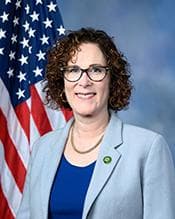
Full profile: /officials/H001094
Source: Congress.gov · FEC
Cosponsors (41)
Members who have signed on to support this bill since introduction. Source: Congress.gov.
- Andrea Salinas (D-OR-6)Original· 2025-02-27
- Chellie Pingree (D-ME-1)Original· 2025-02-27
- Christopher R. Deluzio (D-PA-17)Original· 2025-02-27
- Delia C. Ramirez (D-IL-3)Original· 2025-02-27
- Eleanor Holmes Norton (D-DC)Original· 2025-02-27
- Greg Casar (D-TX-35)Original· 2025-02-27
- Gwen Moore (D-WI-4)Original· 2025-02-27
- James P. McGovern (D-MA-2)Original· 2025-02-27
- Janice D. Schakowsky (D-IL-9)Original· 2025-02-27
- Jerrold Nadler (D-NY-12)Original· 2025-02-27
- Jill N. Tokuda (D-HI-2)Original· 2025-02-27
- Judy Chu (D-CA-28)Original· 2025-02-27
- Lois Frankel (D-FL-22)Original· 2025-02-27
- Mark Pocan (D-WI-2)Original· 2025-02-27
- Pramila Jayapal (D-WA-7)Original· 2025-02-27
- Rashida Tlaib (D-MI-12)Original· 2025-02-27
- Ro Khanna (D-CA-17)Original· 2025-02-27
- Steve Cohen (D-TN-9)Original· 2025-02-27
- Troy A. Carter (D-LA-2)Original· 2025-02-27
- Alma S. Adams (D-NC-12)· 2025-03-03
- Jesús G. "Chuy" García (D-IL-4)· 2025-03-03
- Stephen F. Lynch (D-MA-8)· 2025-03-03
- Yassamin Ansari (D-AZ-3)· 2025-03-04
- Maxine Waters (D-CA-43)· 2025-03-06
- Ilhan Omar (D-MN-5)· 2025-03-11
- Melanie A. Stansbury (D-NM-1)· 2025-03-11
- Alexandria Ocasio-Cortez (D-NY-14)· 2025-03-21
- Mary Gay Scanlon (D-PA-5)· 2025-03-21
- Shri Thanedar (D-MI-13)· 2025-03-21
- Gilbert Ray Cisneros, Jr. (D-CA-31)· 2025-03-25
- Laura Friedman (D-CA-30)· 2025-03-31
- Valerie P. Foushee (D-NC-4)· 2025-04-03
- Angie Craig (D-MN-2)· 2025-08-26
- Adelita S. Grijalva (D-AZ-7)· 2025-11-20
- Summer L. Lee (D-PA-12)· 2025-12-09
- Timothy M. Kennedy (D-NY-26)· 2026-01-15
- Julie Johnson (D-TX-32)· 2026-04-29
Latest Action
The most recent step in the bill's legislative path. Committee Activity below shows referrals and reports; the full action-by-action history including floor proceedings lives at Congress.gov →
Referred to the Subcommittee on Railroads, Pipelines, and Hazardous Materials.
2025-02-27
Source: Congress.gov
Committee Activity
Currently in
- House Committee on Ways and MeansReferred To · 2025-02-27
- House Committee on Education and WorkforceReferred To · 2025-02-27
- House Committee on Transportation and InfrastructureReferred To · 2025-02-27
Previously
- Education and Workforce CommitteeReferred To · 2025-02-27
- Transportation and Infrastructure CommitteeReferred To · 2025-02-27
- Ways and Means CommitteeReferred To · 2025-02-27
Plain-English Summary
Social Security Expansion Act This bill increases Social Security benefits, expands Social Security payroll taxes, and makes other changes to the Social Security program. Specifically, the bill changes the way Social Security benefits are calculated by increasing the primary insurance amount applicable to average monthly earnings that fall below a specified amount, and increasing bend points for individuals who become eligible for Social Security after 2025. (Bend points are dollar amounts at which earnings are segmented for the purpose of calculating an individual’s primary insurance amount. The share of an individual’s earnings that are replaced by Social Security decreases at each escalating bend point.) The bill also revises the method of calculating cost-of-living adjustments to account for the spending of individuals over the age of 62 and establishes a new minimum benefit for certain low earners. Further, the bill permits full-time students who are the children of deceased or disabled workers to collect Social Security or railroad retirement child’s benefits until they reach age 22. With respect to taxes, the bill extends payroll taxes on wages, salaries, and self-employment earnings to income above $250,000. (In 2025, the maximum amount subject to Social Security payroll tax is $176,100.) The bill also increases the net investment income tax and subjects active trade or business income to this tax. Finally, the bill combines the existing Federal Old-Age and Survivors Insurance Trust Fund and the Federal Disability Insurance Trust Fund into a single Social Security Trust Fund.
Plain-English rewrite of the Congressional Research Service summary published on Congress.gov. Cached and reviewed.
Subjects
Related legislation
Bills by the same sponsor or covering overlapping subjects.
- HR10823Northwest Wetlands Voluntary Incentives Program ActReferred to Committee · 2026-10-15
- HR10444Stop Corporate Takeovers of Physicians Act of 2026Referred to Committee · 2026-09-16
- HR10094Affordable Pricing for Taxpayer-Funded Prescription Drugs Act of 2026Referred to Committee · 2026-08-13
- HR9281DASH ActReferred to Committee · 2026-06-11