HR880Referred to Committee
Household Goods Shipping Consumer Protection Act
Introduced
In Committee
3
Passed One Chamber4
Passed Both5
Signed into Law119th
Congress
2025-01-31
Introduced
26
Cosponsors
HR
ⓘType
Sponsor
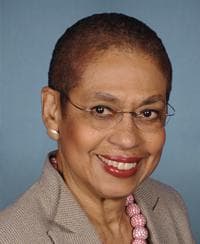
Eleanor Holmes Norton
Democrat · DC · Representative
Votes with party: 96.2% (78 recorded votes)
Full profile: /officials/N000147
Source: Congress.gov · FEC
Cosponsors (26)
Members who have signed on to support this bill since introduction. Source: Congress.gov.
- Henry Cuellar (D-TX-28)Original· 2025-01-31
- Hillary J. Scholten (D-MI-3)Original· 2025-01-31
- J. French Hill (R-AR-2)Original· 2025-01-31
- John Garamendi (D-CA-8)Original· 2025-01-31
- Julia Brownley (D-CA-26)Original· 2025-01-31
- Mike Ezell (R-MS-4)Original· 2025-01-31
- Tim Burchett (R-TN-2)Original· 2025-01-31
- Troy A. Carter (D-LA-2)Original· 2025-01-31
- Daniel Meuser (R-PA-9)· 2025-02-04
- Marc A. Veasey (D-TX-33)· 2025-02-04
- Trent Kelly (R-MS-1)· 2025-02-04
- Gabe Vasquez (D-NM-2)· 2025-02-06
- Michael Guest (R-MS-3)· 2025-02-06
- Derrick Van Orden (R-WI-3)· 2025-02-11
- Dina Titus (D-NV-1)· 2025-02-27
- Robert P. Bresnahan, Jr. (R-PA-8)· 2025-03-18
- Tracey Mann (R-KS-1)· 2025-05-15
- David J. Taylor (R-OH-2)· 2025-05-29
- Scott Franklin (R-FL-18)· 2025-05-29
- Shomari Figures (D-AL-2)· 2025-05-29
- Bruce Westerman (R-AR-4)· 2025-09-03
- Darren Soto (D-FL-9)· 2025-09-16
- Chris Pappas (D-NH-1)· 2025-09-19
- Tony Wied (R-WI-8)· 2025-10-08
- Ashley Hinson (R-IA-2)· 2025-11-04
Latest Action
The most recent step in the bill's legislative path. Committee Activity below shows referrals and reports; the full action-by-action history including floor proceedings lives at Congress.gov →
Committee Activity
Currently in
- House Committee on Transportation and InfrastructureReferred To · 2025-01-31
Plain-English Summary
Household Goods Shipping Consumer Protection Act This bill allows the Federal Motor Carrier Safety Administration (FMCSA) to assess civil penalties against motor carriers, brokers, and freight forwarders for violations related to the interstate transportation of household goods and provides states with additional related authorities. As background, a broker is the “middle person” between a shipper and a motor carrier and arranges for the transportation of household goods. A freight forwarder organizes shipments for individuals or corporations. Unlike a broker, freight forwarders assume responsibility for transportation and may transport the freight itself. The bill expands the FMCSA registration requirements to require motor carriers, brokers, and freight forwarders to designate a principal place of business (i.e., a single physical location where management officials report to work, a significant portion of the transportation business is conducted, and records are maintained). FMCSA may withhold, suspend, amend, or revoke any part of a registration for failure to designate. In addition, brokers and freight forwarders must disclose any common ownership, management, control, or familial relationship with any other carrier, freight forwarder, broker, or applicant in the previous three years. Under current law, motor carriers must disclose this information. Further, states may use certain grant funds to enforce federal household goods statutes and regulations for the interstate transportation of these goods by motor carriers and brokers. This applies to Motor Carrier Safety Assistance Program (MCSAP) grant funds and MCSAP High Priority discretionary grant funds. A state shall retain collected fines that are a result of enforcement.
Plain-English rewrite of the Congressional Research Service summary published on Congress.gov. Cached and reviewed.
Subjects
Transportation and Public Works
Full bill text is not yet cached locally.
Related legislation
Bills by the same sponsor or covering overlapping subjects.
- HRES1571Expressing support for the designation of September 23, 2026, as "Mary Church Terrell Day", and calling on Congress to recognize Mary Church Terrell's lasting contributions to the civil rights and women's rights movements.Referred to Committee · 2026-09-21
- HR10396No Fencing at the United States Capitol Complex ActReferred to Committee · 2026-09-15
- HR9104Rock Creek National Park Act of 2026Referred to Committee · 2026-09-10
- HRES1518Expressing support for the designation of September 2026 as National Campus Sexual Assault Awareness Month.Referred to Committee · 2026-09-08