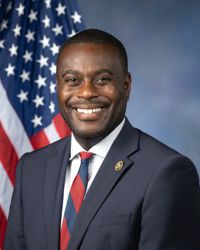
Gabe Amo
DDemocratRI-1 · Representative
55
/ 100
Average
Attendance100
Avg: 96
Independence2
Avg: 4
Bipartisan Tone19
Avg: 15
Ethics Record100
Avg: 99
Transparency41
Avg: 53
Accountability Score — composite of attendance, independence, bipartisan tone, ethics record & transparency.
Methodology17
Bills Sponsored
0
Enacted into Law
0
Passed a Chamber
16
In Committee
All Sponsored Bills
HR10514In Committee
Disaster Relief Fairness Act of 2026
HRES1358In Committee
Honoring the victims and survivors of the December 13, 2025, mass shooting at Brown University in Providence, Rhode Island.
This resolution honors the victims and survivors of a mass shooting that occurred at Brown University in Providence, Rhode Island on December 13, 2025. The measure expresses the House's condolences to those affected by the tragedy and recognizes the impact on the university community and the broader public.
HCONRES103In Committee
Directing the President, pursuant to section 5(c) of the War Powers Resolution, to remove United States Armed Forces from hostilities with Iran.
This concurrent resolution directs the President to remove U.S. Armed Forces from hostilities against Iran unless explicitly authorized by a declaration of war or a congressional authorization for use of military force against Iran. Elements of the U.S. Armed Forces needed to defend the United States, an ally, or a partner from imminent attack are not covered by this requirement provided the President complies with a specified provision of the War Powers Resolution. (The provision generally requires the President to remove U.S. Armed Forces from hostilities no more than 60 days after the President notifies or is required to notify Congress of such involvement, unless Congress authorizes such use. For more information on the War Powers Resolution, see CRS In Focus 13134 .)
HRES1218In Committee
Recognizing the importance of the special relationship between the United States and the United Kingdom and welcoming the visit of King Charles III to the United States.
This resolution expresses support for the relationship between the United States and the United Kingdom and formally welcomes King Charles III's visit to America. The measure is largely ceremonial and symbolic, affirming the historical ties and partnership between the two countries without creating new laws or policies. It has been sent to the House Committee on Foreign Affairs for consideration.
HR8288Reported
Strengthening Export Controls Compliance Act
Strengthening Export Controls Compliance Act This bill requires the President and the Department of Commerce's Bureau of Industry and Security (BIS) to provide businesses and others with assistance in complying with U.S. export control laws. Specifically, the bill directs the President to submit a plan to Congress every two years to assist U.S. persons, especially small- and medium-sized U.S. businesses, with export licensing and compliance. The bill provides statutory authority for an annual conference held by BIS, which is known as the Update Conference on Export Controls and Policy. The bill also requires BIS to (1) carry out dedicated public and industry outreach before promulgating major new rules regarding export control laws, and (2) include information on classification requests and advisory opinions in its annual report to Congress.
HR7896In Committee
NOAA Global Ocean Monitoring and Observing Research Act
This bill would expand the National Oceanic and Atmospheric Administration's ability to monitor and study the world's oceans through improved research programs and observation systems. The funding and programs would help scientists better understand ocean conditions, track changes in marine ecosystems, and improve predictions about weather and climate patterns that affect coastal communities and fishing industries. The bill aims to strengthen the scientific data available to policymakers and the public about ocean health and environmental changes.
HR7307In Committee
SUPPLIES Act
The SUPPLIES Act addresses how the U.S. government manages and distributes supplies for international activities, likely including humanitarian aid, disaster relief, or support for foreign operations. The bill has been sent to the House Committee on Foreign Affairs for review and discussion before any vote takes place.
HR7089In Committee
PARK Act
The PARK Act would likely establish new protections or management rules for public lands and natural resources, though the specific details depend on the bill's full text. Based on its focus, it probably affects how federal agencies manage national parks, forests, or other public lands, and could impact outdoor recreation, conservation efforts, or resource extraction on those lands. The bill is currently being reviewed by the House Committee on Natural Resources to determine whether it should move forward for a vote.
HR7088In Committee
NO NATO for Purchase Act
This bill would prevent the United States from purchasing military equipment or services from NATO member countries unless Congress specifically approves each purchase. The measure affects defense procurement decisions and could impact military supply chains and relationships with allied nations that manufacture weapons and defense systems.
HR6424In Committee
Social Security Survivor Benefits Equity Act
This bill would change how Social Security calculates survivor benefits for people whose spouses or parents die, likely aiming to make the benefit amounts more fair or equal across different groups of beneficiaries. The changes would affect widows, widowers, children, and other family members who receive Social Security payments based on a deceased worker's earnings record. The House Committee on Ways and Means is currently reviewing the proposal to determine whether it should move forward.
HR6425In Committee
National Strategy for Combating Scams Act of 2025
The federal government would develop and implement a coordinated national strategy to identify, prevent, and combat various types of scams that target consumers, businesses, and other victims. The plan would likely involve coordination between multiple federal agencies, law enforcement, and consumer protection offices to share information, establish best practices, and educate the public about common fraud schemes. This affects everyday people who use phones, email, and online services, as well as businesses and financial institutions that work to protect their customers from scams.
HR6426In Committee
STOP Scams Against Seniors Act
This bill would create new federal laws and enforcement tools to help protect older Americans from scams and fraud, such as phone schemes, fake investment offers, and identity theft. It would likely increase penalties for criminals who target seniors and give law enforcement agencies more resources to investigate and prosecute these crimes. The legislation aims to reduce the billions of dollars seniors lose to scammers each year.
HR6123In Committee
Promoting Diplomacy with Australia Act
The legislation aims to strengthen diplomatic and strategic relationships between the United States and Australia through enhanced cooperation on defense, trade, and regional security matters. It would support joint initiatives and partnerships between the two countries in areas like technology, infrastructure, and Indo-Pacific stability. The bill affects government agencies, military personnel, and businesses involved in U.S.-Australia trade and defense partnerships.
HR5453In Committee
RRLEF Act of 2025
Responsible Retirement of Law Enforcement Firearms Act of 2025 or the RRLEF Act of 2025 This bill establishes a framework to limit the transfer of firearms to and purchase from federally licensed gun dealers whose firearms have a short time to crime. The term short time to crime means a period of three years or less between the date of the last known retail sale of a firearm and the date a firearm is recovered in an actual or suspected criminal offense. Specifically, the bill directs the Bureau of Alcohol, Tobacco, Firearms and Explosives (ATF) to notify a state or local law enforcement agency if a firearm transferred by the agency is used, or suspected of being used, in the commission of a criminal offense, as traced by the National Tracing Center. Additionally, the bill directs the ATF to publish annually a list of federally licensed gun dealers who have 25 or more traces of firearms with a short time to crime in at least two of the three previous years. The bill prohibits a state (including the District of Columbia), territory, or local government that receives funds under the Edward Byrne Memorial Justice Assistance Grant Program from transferring a firearm to, or purchasing a firearm from, a dealer on the list. The bill removes limits on the authority of the ATF to disclose firearms tracing data.
HR4482In Committee
Stop NOAA Closures Act
The proposal would prevent the National Oceanic and Atmospheric Administration (NOAA) from closing any of its offices or facilities without first getting approval from Congress. This would affect federal employees who work at NOAA locations and the public services those offices provide, such as weather forecasting, marine research, and coastal management. The bill essentially gives lawmakers a say in whether NOAA can consolidate operations or shut down regional centers.
HRES490In Committee
Expressing support for the designation of the second Saturday in June as "Veterans Get Outside Day".
This resolution supports the designation of Veterans Get Outside Day and encourages the Department of Veterans Affairs, the Forest Service within the Department of Agriculture, and the Department of the Interior to coordinate to promote the day along with National Get Outdoors Day.
HR1277In Committee
First Rhode Island Regiment Congressional Gold Medal Act
First Rhode Island Regiment Congressional Gold Medal Act This bill provides for the award of a single Congressional Gold Medal to the First Rhode Island Regiment, collectively, in recognition of their dedicated service during the Revolutionary War.