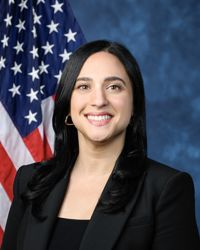
Yassamin Ansari
DDemocratAZ-3 · Representative
58
/ 100
Average
Attendance98
Avg: 96
Independence3
Avg: 4
Bipartisan Tone11
Avg: 15
Ethics Record100
Avg: 99
Transparency70
Avg: 53
Accountability Score — composite of attendance, independence, bipartisan tone, ethics record & transparency.
Methodology21
Bills Sponsored
0
Enacted into Law
0
Passed a Chamber
21
In Committee
All Sponsored Bills
HR10721In Committee
Stop Orphaned Wells Act
HR8740In Committee
Iranian Temporary Immigration Relief Act
The legislation would allow certain Iranian nationals whose immigration cases were paused in December 2025 to receive temporary protected status and work permits while their cases are being reviewed. This would enable affected individuals to legally live and work in the United States during this waiting period. The bill addresses a specific group of people whose immigration proceedings were halted and aims to provide them stability while the government processes their cases.
HR5617In Committee
Geothermal Gold Book Development Act
Geothermal Gold Book Development Act This bill directs the Department of the Interior to identify standard procedures and guidelines for efficient and environmentally responsible geothermal leasing and permitting on federal land and include the procedures and guidelines in its Surface Operating Standards and Guidelines for Oil and Gas Exploration and Development publication, commonly known as the Gold Book. Interior must (1) publish an updated version of the Gold Book within 270 days of identifying such procedures and guidelines, and (2) review the Gold Book every five years and publish an updated version if necessary to support efficient and environmentally responsible geothermal leasing and permitting. Interior must also rename the Gold Book to reflect the incorporation of standard procedures and guidelines related to geothermal development.
HRES1177In Committee
Impeaching Peter B. Hegseth, Secretary of Defense of the United States, for high crimes and misdemeanors.
This is an impeachment resolution that would remove Peter B. Hegseth from his position as Secretary of Defense if approved by Congress, based on allegations of serious wrongdoing. The resolution has been sent to the House Judiciary Committee for review and investigation. If the committee votes to recommend impeachment and the full House approves it, the case would then go to the Senate for a trial to determine whether Hegseth should be removed from office.
HR8159In Committee
Gynecologic Pain Management Study Act
This bill would require the federal government to fund and conduct research into how gynecologic pain conditions—such as endometriosis and pelvic pain—are diagnosed and treated. The research would help doctors better understand these conditions and develop more effective treatments for the millions of women and girls who experience them. By studying what works best, the government aims to improve care and reduce suffering from these often-overlooked health problems.
HR8160In Committee
Premenstrual Dysphoric Disorder Awareness and Research Act of 2026
This bill would increase funding and support for research into premenstrual dysphoric disorder (PMDD), a severe form of PMS that causes significant mood and physical symptoms in some people, and would require better public education about the condition so more people understand and can get treatment. The legislation would affect healthcare providers, researchers studying the disorder, and the millions of people—mostly women and people assigned female at birth—who experience PMDD symptoms. By boosting awareness and research, the bill aims to improve diagnosis rates and treatment options for a condition that currently goes unrecognized or untreated in many cases.
HR8158In Committee
Reproductive Healthcare Leave Act
This bill would require employers to provide paid leave to employees for reproductive healthcare services, including abortion, contraception, fertility treatments, and pregnancy-related care. The law would apply to most private employers and federal workers, allowing employees time off without losing pay or facing retaliation for seeking these medical services. The bill aims to ensure workers can access reproductive healthcare without jeopardizing their jobs or income.
HRES1147In Committee
Recognizing the United States legacy of dismissed pain and denied autonomy in women's health care, and affirming the Federal Government's duty to protect individual dignity and advance patient-centered care in women's health.
This resolution acknowledges that women have historically faced dismissal of their health concerns and loss of control over their own medical decisions, and calls on the federal government to ensure women receive respectful, patient-centered healthcare that values their input and protects their right to make decisions about their own bodies. The measure aims to address longstanding problems like doctors not taking women's symptoms seriously and medical decisions being made without women's full consent or participation. It does not create new laws but rather expresses Congress's commitment to improving how women are treated within the healthcare system.
HR7483In Committee
Dual Hatting Limitation Act of 2026
This bill would prevent federal employees from holding two government jobs at the same time, a practice sometimes called "dual hatting." The restriction would apply to civilian workers across federal agencies and is intended to ensure that government employees dedicate their full attention to a single position rather than splitting their time between multiple roles.
HR7347In Committee
Stop Inhumane Conditions in ICE Detention Act of 2026
This bill would establish minimum standards for conditions at immigration detention facilities run by ICE, such as requirements for adequate food, medical care, sanitation, and living space for detainees. It aims to address complaints about overcrowding and poor conditions that immigrants in government custody have experienced. The bill would affect immigration detention facilities and the people held in them while awaiting immigration proceedings.
HR7346In Committee
Drain ICE Act of 2026
The bill would redirect federal funding away from Immigration and Customs Enforcement (ICE) operations, likely reducing the agency's budget for detention facilities, enforcement activities, and personnel. The changes would affect how immigration enforcement is carried out across the country and could impact both undocumented immigrants in detention and communities where ICE operates.
HR7345In Committee
Studying Disastrous Impacts of Mass Deportation Act
This bill would require the federal government to study and report on the economic, social, and public health effects that would result from large-scale deportation of immigrants. The research would examine impacts on workers, businesses, communities, and government services to help lawmakers understand the real-world consequences of such policies.
HRES993In Committee
Recognizing and expressing support for the Iranian people protesting for a free and democratic Iran.
This resolution condemns Iran’s use of military force to suppress civilian protestors and commends the Iranian people in their fight for a democratic Iran. The resolution calls for Iran to cease all threats, intimidation, and violence against peaceful protesters and urges expansion of unrestricted internet access and lines of communication. Lastly, the resolution urges the United States to coordinate with its allies to consider and implement measures to prevent further violence against protesters.
HR5541In Committee
Every Kid Outdoors Reauthorization Act
Every Kid Outdoors Reauthorization Act This bill expands and permanently reauthorizes the Every Kid Outdoors Program, which provides passes for free access to federal lands and waters to certain students and accompanying individuals. The existing program applies to fourth-grade students (of any age) and home school learners who are 10 years old. The bill expands the program to include fifth-grade students (of any age) and home-schooled learners who are 11 years of age.
HRES773In Committee
Honoring the foundational principle of separation of church and state, opposing extreme right-wing Christian nationalism, and recognizing the 65th anniversary of President John F. Kennedy's address to the Greater Houston Ministerial Association and 150th anniversary of President Ulysses S. Grant's speech to the Society of the Army of the Tennessee.
This resolution expresses support for keeping religion and government separate and criticizes what supporters view as Christian nationalism—the idea that Christianity should have a special role in American government and law. The resolution also commemorates two historical speeches about religious freedom and civil rights, one by President Kennedy in 1963 and another by President Grant in 1874.
HR4627In Committee
To amend the Foreign Assistance Act of 1961 to modify treatment activities for assistance to combat HIV/AIDS.
The government would change how it provides foreign aid money to fight HIV/AIDS around the world, specifically adjusting what types of treatment activities can receive funding. The bill modifies rules set by the Foreign Assistance Act of 1961 to update which HIV/AIDS programs and services in other countries qualify for U.S. financial support. This affects international health organizations, foreign governments, and health workers who rely on American aid to treat and manage HIV/AIDS in developing nations.
HR4628In Committee
AI Impersonation Prevention Act of 2025
The legislation would make it illegal to use artificial intelligence to impersonate real people without their permission, particularly in ways designed to deceive others or commit fraud. This would apply to deepfakes and other AI-generated content that mimics someone's voice, face, or likeness for harmful purposes, and would create criminal penalties for violators. The law would protect everyday people, public figures, and businesses from identity theft and scams involving AI technology.
HR3704In Committee
Coordinated Federal Response to Extreme Heat Act of 2025
The federal government would create a coordinated plan to respond to dangerous heat waves, bringing together different agencies to better protect public health during extreme temperatures. This would affect vulnerable populations like elderly people, outdoor workers, and those without reliable air conditioning by improving warning systems, cooling centers, and emergency response efforts. The bill aims to reduce heat-related deaths and illnesses by ensuring federal agencies work together rather than separately on this growing health threat.
HR3703In Committee
Excess Urban Heat Mitigation Act of 2025
This bill would help cities reduce dangerous heat by funding projects that cool down neighborhoods, such as planting trees, creating green spaces, and installing reflective surfaces on roofs and streets. The funding would support communities most affected by extreme heat, particularly lower-income areas where residents lack air conditioning or tree cover. The money would come through housing and community development programs to help make neighborhoods safer and more livable during hot summers.
HR2486In Committee
Heating and Cooling Relief Act
The bill would provide financial assistance or tax relief to help households afford heating and cooling costs, particularly for low-income families and seniors who struggle with energy bills during extreme weather. It addresses concerns about energy affordability by potentially offering rebates, subsidies, or other support mechanisms to reduce the burden of heating in winter and air conditioning in summer. The proposal is currently being reviewed by congressional committees to determine which parts fall under energy policy versus workforce and education matters.
HRES126In Committee
Celebrating the legacy and contributions of immigrants and opposing discriminatory immigration policies.
This resolution recognizes and celebrates the contributions of immigrants to the United States; condemns discrimination against immigrants; and supports comprehensive immigration reform that addresses the needs of the economy, strengthens communities, and reflects the values of compassion, fairness, and opportunity for all.