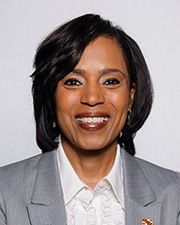
Angela D. Alsobrooks
DDemocratMD · Senator
52
/ 100
Average
Attendance98
Avg: 97
Independence15
Avg: 23
Bipartisan Tone5
Avg: 14
Ethics Record100
Avg: 100
Transparency24
Avg: 47
Accountability Score — composite of attendance, independence, bipartisan tone, ethics record & transparency.
Methodology26
Bills Sponsored
0
Enacted into Law
0
Passed a Chamber
26
In Committee
All Sponsored Bills
S5339In Committee
Back-to-School Supplies Affordability Act
S5216In Committee
Senior Accessible Housing Tax Credit Act of 2026
The proposal would let homeowners and renters claim a tax credit to help pay for modifications that make homes more accessible for people with disabilities, such as installing ramps, widening doorways, or adding grab bars. This tax break would reduce the amount of federal income tax owed by people who spend money on these types of home improvements. The change would make it more affordable for disabled individuals and aging Americans to modify their living spaces to meet their accessibility needs.
S5089In Committee
Medicare Dental Benefit Act of 2026
Medicare Dental Benefit Act of 2026 This bill provides for Medicare coverage of dental and oral health services, including routine diagnostic and preventive services, basic and major dental services, and emergency care; dental prostheses are also covered. Currently, such services are excluded from Medicare coverage.
S5091In Committee
Medicaid Dental Benefit Act of 2026
Medicaid Dental Benefit Act of 2026 This bill requires state Medicaid programs to cover dental and oral health services for adults. It also increases the Federal Medical Assistance Percentage (i.e., federal matching rate) for such services. The Centers for Medicare & Medicaid Services must develop oral health quality and equity measures and conduct outreach relating to such coverage. Additionally, the Medicaid and Children's Health Insurance Program (CHIP) Payment and Access Commission must report on specified information relating to adult oral health care.
S5088In Committee
Ensuring Kids Have Access to Medically Necessary Dental Care Act
Ensuring Kids Have Access to Medically Necessary Dental Care Act This bill modifies dental coverage under the Children's Health Insurance Program (CHIP). Specifically, the bill prohibits lifetime or annual limits on CHIP dental coverage. It also requires states to offer dental-only supplemental coverage under CHIP to children who have other health insurance but are otherwise eligible for CHIP (i.e., wraparound coverage); such coverage is currently at the option of the state.
S5080In Committee
Modal Parity in Permitting Act
The bill would clarify what types of financial help are available to cities and transit agencies that receive federal funding for public transportation projects when they need to buy land or property for those projects. This would make the rules clearer for local governments and transit systems that are trying to acquire real estate for building or expanding bus, train, and other public transit infrastructure.
S4888In Committee
PREVENT Act
The CDC would be required to keep running and grow its programs that work to prevent child sexual abuse, including education and training efforts. This would affect children, parents, schools, and healthcare providers who rely on the CDC's resources and guidance for recognizing and preventing abuse. The bill aims to ensure the agency continues investing in research and public awareness about child sexual abuse prevention strategies.
S4820In Committee
Regional Export Promotion Act of 2026
The bill would make permanent and expand a program that helps the Export-Import Bank support small and medium-sized businesses in different regions of the country as they try to sell their products overseas. Currently this regional support program operates on a temporary basis, so the change would give it lasting authority and potentially allow it to do more to help local businesses compete in international markets. Small manufacturers and exporters in various states would be the main beneficiaries of this expanded assistance.
SCONRES34In Committee
A concurrent resolution recognizing the importance of saving lives, reducing gun violence, and strengthening public safety as the United States celebrates its 250th anniversary.
This resolution expresses Congress's support for efforts to save lives, reduce gun violence, and improve public safety as the nation marks 250 years since its founding. The measure recognizes these goals as important priorities but does not create new laws or require specific actions. It has been sent to the Judiciary Committee for consideration.
SJRES125In Committee
A joint resolution providing for congressional disapproval under chapter 8 of title 5, United States Code, of the rule submitted by the Bureau of Consumer Financial Protection relating to the withdrawal of the rule relating to "Debt Collection Practices (Regulation F); Pay-to-Pay Fees".
Congress is considering blocking a decision by the Consumer Financial Protection Bureau to withdraw its rule that banned "pay-to-pay" fees charged by debt collectors—fees that borrowers have to pay just to make a payment on their debts. If approved, this would reinstate the protection that prevents debt collectors from charging these extra fees. The resolution affects debt collectors and millions of Americans struggling with debt who could face additional charges when trying to pay what they owe.
S4496In Committee
A bill to amend the Higher Education Act of 1965 to provide for additional uses of funds for grants to strengthen historically Black colleges and universities, and for other purposes.
The bill would expand how historically Black colleges and universities can use federal grant money, allowing them to spend funds on additional programs and initiatives beyond their current permitted uses. This change would give these institutions more flexibility to address their specific needs, whether that involves strengthening academics, improving facilities, or supporting student services. The bill affects the colleges themselves and their students by providing them with greater control over how federal education funding is spent.
S4450In Committee
Financial Access Protection Act
Banks and other financial institutions would be banned from collecting, keeping, or sharing information about whether their customers are citizens or what their immigration status is. This would affect millions of people who use banking services and could limit how financial companies verify customer identity or comply with federal regulations. The measure is currently under review by the Senate Banking Committee.
S4191In Committee
Extending WIC for New Moms Act
Extending WIC for New Moms Act This bill extends the eligibility periods for breastfeeding and postpartum women under the Special Supplemental Nutrition Program for Women, Infants, and Children (WIC). Specifically, a state program may elect to certify a breastfeeding woman for up to 24 months (currently 1 year) postpartum. The bill also expands the eligibility period for postpartum women to up to 24 months after termination of pregnancy (currently 6 months). The Department of Agriculture must submit a report to Congress evaluating the effect of these changes to the WIC program on (1) maternal and infant health outcomes, (2) breastfeeding rates, and (3) qualitative evaluations of family experiences under WIC.
S2531In Committee
Uterine Fibroid Intervention and Gynecological Health Treatment Act of 2025
Uterine Fibroid Intervention and Gynecological Health Treatment Act of 2025 This bill authorizes grants to support early detection of and intervention for uterine fibroids. Uterine fibroids are tumors in the wall of the uterus that are usually benign but can cause painful and heavy menstrual bleeding and other symptoms. The bill requires the Department of Health and Human Services (HHS) to (1) conduct or support research on increasing early detection of and medical intervention for uterine fibroids, and (2) formulate strategies to increase early detection based on such research. Also, the bill authorizes HHS to provide grants to states to increase early detection of and intervention for uterine fibroids (e.g., screenings) and to carry out public awareness campaigns. Additionally, the bill authorizes HHS to provide grants to states for research relating to (1) disparities in pain management in uterine fibroid surgical treatment; or (2) uterine health conditions, as determined appropriate by HHS. HHS must report to Congress every two years on the activities funded by grants under the bill, including findings from the research conducted by states.
S3944In Committee
Women’s Heart Health Expansion Act of 2026
Women’s Heart Health Expansion Act of 2026 This bill reauthorizes through FY2031 and expands a grant program that supports preventive health services (e.g., screenings, referrals) regarding women’s cardiovascular health. This program is known as the Well-Integrated Screening and Evaluation of Women Across the Nation (WISEWOMAN) program, which is administered by the Centers for Disease Control and Prevention (CDC). Under current law, only three states may receive a WISEWOMAN grant, and health care providers and recipients of services must participate in the CDC’s National Breast and Cervical Cancer Early Detection Program in order to qualify under the WISEWOMAN program. The bill revises the WISEWOMAN program by (1) removing the three-state limitation, (2) allowing providers to participate even if not providing services under the other CDC program (as determined by the CDC), and (3) allowing participation of high-risk women who are not eligible under the other CDC program (based on CDC criteria). Additionally, the bill requires the Government Accountability Office to report to Congress on the work of the WISEWOMAN program.
S4039In Committee
Professional Degree Access Restoration Act
This bill would likely restore or expand access to federal student aid programs for people pursuing professional degrees like law, medicine, and dentistry. The legislation appears aimed at removing barriers that may have been created by previous policies that limited financial assistance for graduate and professional students. It would help make these expensive advanced degrees more affordable for students who rely on federal loans and grants.
S3986In Committee
Maryland Whole Watershed Program Federal Partnership Act of 2026
This bill would establish a federal partnership program to help Maryland protect and restore its watersheds—the areas of land where water drains into rivers, streams, and the Chesapeake Bay. The program would likely provide funding and coordination between federal agencies and Maryland to improve water quality, protect natural habitats, and manage pollution across entire watershed regions rather than just individual waterways. This would affect Maryland residents, farmers, businesses, and environmental organizations working on water conservation and pollution reduction.
S3890In Committee
National Council on African American History and Culture Act of 2026
This bill would establish a new National Council on African American History and Culture to promote education, research, and public awareness about African American contributions to American history and society. The council would likely coordinate with museums, schools, and cultural organizations to develop programs and resources that help Americans better understand African American heritage and accomplishments. This would affect educators, students, cultural institutions, and the general public interested in learning about this important part of American history.
S3844In Committee
Fiscal Harms of Federal Firing Act
This bill would restrict the federal government's ability to fire employees, likely making it harder for agencies to remove workers and potentially requiring more extensive procedures before termination. The measure would affect federal workers across all government agencies by providing them with greater job protection and due process rights. The bill appears designed to limit what supporters view as arbitrary or politically motivated firings in the federal workforce.
S3629In Committee
Transportation Project Accountability Act of 2026
S3556In Committee
Wildlife Crossings Program Reauthorization Act of 2025
This bill would continue federal funding and support for wildlife crossing projects that help animals safely cross highways and roads without being hit by vehicles. The program works with states and local communities to build bridges, underpasses, and other structures that reduce wildlife deaths while also making roads safer for drivers. It affects transportation agencies, environmental groups, and communities working to protect animal populations and reduce accidents caused by wildlife on roadways.
S3340In Committee
21st Century STEM for Girls and Underrepresented Minorities Act
21st Century STEM for Girls and Underrepresented Minorities Act This bill directs the Department of Education to make grants to local educational agencies to pay the costs of carrying out science, technology, engineering, and mathematics (STEM) education activities for girls and underrepresented minorities.
S3070In Committee
Shutdown Student Loans for Feds Act
This bill would prevent federal employees from using the Public Service Loan Forgiveness program, which currently allows government workers to have their student loans forgiven after 10 years of public service. The change would affect current and future federal workers who are counting on loan forgiveness as part of their compensation package, potentially increasing their out-of-pocket education costs over their careers.
S2948In Committee
Help FEDS Act
The bill aims to improve how federal employees are managed and evaluated, likely by changing hiring practices, performance standards, or workplace policies across government agencies. The specific reforms would affect millions of federal workers and could influence how efficiently government operates and delivers services to the public. The proposal is currently under review by the Senate Finance Committee.
S2912In Committee
Deceptive Practices and Voter Intimidation Prevention Act of 2025
Deceptive Practices and Voter Intimidation Prevention Act of 2025 This bill generally prohibits deceptive communications and voter interference regarding federal elections. Specifically, the bill prohibits any person, within 60 days before a federal election, from communicating, causing to be communicated, or producing for communication certain information on voting, if the person (1) knows such information to be materially false, and (2) has the intent to impede or prevent another person from voting in an election. Additionally, the bill prohibits any person, within 60 days before a federal election, from using an artificial intelligence system to produce certain information on voting, if the person has the intent to use the system to (1) produce false information, and (2) impede or prevent another person from voting in an election. The bill also prohibits hindering, interfering with, or preventing voting or registering to vote. A private right of action for preventive relief is established for persons aggrieved by violations of these prohibitions. Criminal penalties are also established for violations. If the Department of Justice (DOJ) receives a credible report that materially false information has been or is being communicated in violation of the prohibitions on deceptive communications, and state and local election officials have not adequately communicated corrected information, then DOJ must communicate to the public accurate information designed to correct the materially false information. The bill extends the prohibition on certain types of intimidation in federal elections to also prohibit intimidation for processing ballots or tabulating, canvassing, or certifying votes.
S2913In Committee
Protecting Students with Disabilities Act