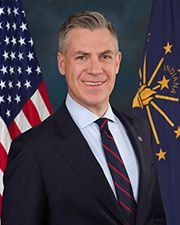
Jim Banks
RRepublicanIN · Senator
52
/ 100
Average
Attendance99
Avg: 97
Independence23
Avg: 23
Bipartisan Tone5
Avg: 14
Ethics Record100
Avg: 100
Transparency12
Avg: 47
Accountability Score — composite of attendance, independence, bipartisan tone, ethics record & transparency.
Methodology73
Bills Sponsored
0
Enacted into Law
1
Passed a Chamber
67
In Committee
All Sponsored Bills
S5598In Committee
Blocking Foreign Cellular Modules in Defense Systems Act of 2026
S5599In Committee
River Ridge Land Conveyance Act
SRES917Introduced
A resolution expressing support for the designation of September as "Dystonia Awareness Month" to promote public awareness and understanding of dystonia.
S5595In Committee
Weapons Resupply, Stockpile, and Assurance Act
S5596In Committee
Military DEI Repeal Act of 2026
S5590In Committee
Electric Grid Supply Chain Security Act
S5601In Committee
Insider Threat Reporting and Security Guidance Act of 2026
S5597In Committee
Service Academy Testing Enhancement Act of 2026
S5451In Committee
A bill to amend the Higher Education Act of 1965 to require that recipients of Pell Grants be citizens or nationals of the United States.
S3589Reported
RISE Act
The bill would expand access to education and training programs, particularly for students and workers seeking to develop new skills or advance their careers. It aims to increase funding and support for educational initiatives that help people prepare for jobs in growing industries. The measure would affect students, workers, educators, and educational institutions across the country.
S5267In Committee
Accountable Produce is Medicine Act of 2026
S5242In Committee
Prescription Information Modernization Act of 2026
S5172In Committee
Kidd’s Stuttering Act
The bill would require Medicaid and the Children's Health Insurance Program (CHIP) to cover screening for stuttering and other childhood speech fluency disorders, as well as pay for speech therapy services to treat these conditions. This would help ensure that children from low-income families can get early diagnosis and treatment for speech problems that might otherwise affect their education and development. The change would apply to both state Medicaid programs and CHIP, which together cover millions of children nationwide.
S3794Reported
SAFE Drugs Act of 2026
Safeguarding Americans from Fraudulent and Experimental Drugs Act of 2026 or the SAFE Drugs Act of 2026 This bill provides for increased oversight of drug compounding and imposes statutory limits on compounded drugs that are essentially copies of commercially available drugs. Currently, subject to certain requirements, compounded drugs (i.e., drugs that are mixed or altered to meet patient needs) do not require Food and Drug Administration (FDA) approval. Additional limits apply to the compounding of drugs that are essentially copies of commercially available drug products. Under the bill, a compounded drug is essentially a copy of a commercially available drug product if (1) the compounded drug contains any active ingredient found in a commercially available drug product, and (2) there is no change made for an individual patient that results in a significant difference between the compounded drug and the commercially available drug. (The FDA’s current definition of the term also addresses dosage strength and route of administration.) The bill increases the frequency at which a licensed pharmacist or physician may compound a drug that is essentially a copy of a commercially available drug to 20 times per month. Current FDA policy allows four such prescriptions per month. The bill also imposes annual reporting requirements on physicians, facilities, and pharmacies (except hospital-based pharmacies) that compound certain drug products for out-of-state patients more than 20 times per month. Further, the bill subjects certain large-scale outsourcing facilities (i.e., FDA-registered facilities that compound in bulk) to regular inspection and reporting requirements.
S5127In Committee
Harley Jacobsen Clinical Trial Participant Income Exemption Act of 2026
People who participate in medical research studies would not have to pay income taxes on the money they receive as compensation for their participation. This change would apply to clinical trial payments, making it easier for individuals to volunteer for medical research without worrying about tax consequences on those earnings. The change affects both the participants who volunteer for studies and the medical research companies or institutions that conduct the trials.
S4953In Committee
Form 5500 Filing Simplification Act
The bill would make it easier for companies and organizations to file required paperwork about their employee retirement and benefit plans by simplifying the Form 5500, which administrators currently must submit to the government each year. This change would reduce the administrative burden and costs for employers managing pension plans and health insurance programs for their workers. The measure is currently under review by the Senate committee responsible for labor and employment issues.
S4954In Committee
Citizenship Act of 2026
This bill would change who automatically becomes a U.S. citizen at birth by denying citizenship to children born in the United States if their parents entered the country illegally or came specifically to give birth here. It would affect millions of immigrants and their children by removing a constitutional right that has existed for over 150 years, potentially creating a large population of people born in the U.S. who are not citizens. The proposal would require changes to the Constitution and would significantly impact immigration policy and family rights.
S4925In Committee
Stop the Sexualization of Children Act
Schools receiving federal education funding would be prohibited from using that money for programs, activities, or materials containing sexually oriented content aimed at children under 18. The ban would apply to curriculum development, classroom activities, library materials, and school-sponsored events. Schools that violate this restriction could lose their federal education funding.
S4777In Committee
Blast Overpressure Research and Mitigation Task Force Act
The Department of Veterans Affairs would create a task force to study and address blast overpressure injuries—the invisible wounds caused by explosions that affect many veterans from Iraq and Afghanistan. The task force would research these injuries, improve how they're diagnosed and treated, and develop better support programs for affected veterans. This effort aims to better understand a serious health problem that has impacted thousands of service members but remains less visible than other combat injuries.
S4741In Committee
SAFE for Kids Act of 2026
The bill would require businesses that sell age-restricted products or services—such as alcohol, tobacco, or adult content—to use age verification systems to confirm customers are old enough before completing sales. This would affect retailers, online platforms, and other commercial companies that currently rely on manual ID checks or honor systems. The requirement aims to prevent minors from accessing products legally restricted to adults.
S4658In Committee
Parkinson’s Protection for Firefighters Act
Firefighters who develop Parkinson's disease would be able to claim it as a work-related illness, making them eligible for federal benefits and compensation. Currently, Parkinson's is not officially recognized as a disease caused by firefighting work, even though research suggests firefighters face higher rates of the condition. This change would help firefighters and their families access medical care and financial support for a disease they may have developed on the job.
S4607In Committee
DOD and USDA Interagency Research Act
The Department of Defense and Department of Agriculture would work together on research and development projects that benefit both agencies and the public. This collaboration could lead to innovations in areas like food security, agricultural technology, and rural infrastructure that support both military readiness and farming communities. The bill is currently under review by the Senate Armed Services Committee.
S4525In Committee
Securing Innovation and Research from Adversaries Act
The bill would prevent U.S. government agencies from funding research projects that involve collaboration with certain foreign entities, likely targeting countries or organizations considered security risks. This would affect universities, research institutions, and scientists who receive federal grants, potentially limiting their international partnerships and research opportunities. The measure aims to protect sensitive research and national security interests while potentially slowing some collaborative scientific work.
S4519In Committee
Medical Device Electronic Labeling Act
The proposal would allow medical device manufacturers to provide required product labels and instructions electronically instead of printing them on physical packaging or paper inserts, as long as customers can easily access the information online. This change would apply to more types of medical devices than currently allowed and could reduce printing costs and packaging waste. Patients and healthcare providers would need to rely on digital access to get device instructions and safety information.
S4456In Committee
AI OVERWATCH Act
The government would require companies to get special permission before selling or transferring advanced computer chips to other countries or moving them within the U.S., giving officials more control over technology that could be used for military or security purposes. This affects tech companies, manufacturers, and exporters who work with high-performance semiconductors. The measure aims to prevent sensitive chip technology from reaching countries or groups that could pose national security risks.
S4043In Committee
Health Care for Homeless Veterans Act
This bill would improve access to health care services for veterans experiencing homelessness by expanding VA medical facilities and programs that serve this vulnerable population. It likely aims to address gaps in mental health treatment, substance abuse services, and housing-related medical care that homeless veterans often struggle to obtain. The changes would affect both the Department of Veterans Affairs and the homeless veteran population seeking better coordinated health services.
S3992In Committee
Joint Medical Facilities Fund Act of 2026
This bill would likely establish or modify a shared funding system for medical facilities that serve both active-duty military members and veterans, potentially allowing the Department of Defense and Veterans Affairs to pool resources and coordinate healthcare services. The goal would probably be to reduce costs and improve efficiency by consolidating overlapping medical operations rather than maintaining completely separate hospital and clinic systems. Veterans, active-duty service members, and military families would be the primary groups affected by any changes to how their healthcare is delivered and funded.
S4409In Committee
START Act
The bill would streamline and clarify how apprenticeship programs register and meet federal standards, making it easier for employers and training organizations to establish and maintain registered apprenticeships. This affects workers seeking job training, employers looking to hire trained workers, and organizations that run apprenticeship programs across various industries. The changes aim to reduce confusion and administrative burden in the apprenticeship registration process.
S4360In Committee
INSIGHT Act
I don't have enough information to write an accurate summary. The bill title "INSIGHT Act" and referral to the health, education, labor, and pensions committee suggest it addresses one of those policy areas, but without the bill's actual text or stated subjects, I cannot determine what it would specifically do or who it would affect. To provide you with a factual summary, I would need access to the bill's language or its stated purposes.
S4348In Committee
PARITY Act
I don't have enough information to write an accurate summary. The bill's subjects are listed as "None," and without knowing the specific provisions of this PARITY Act, I cannot determine what it would do, who it affects, or what changes it would make. Could you provide the bill number, text, or subject matter so I can write an accurate plain-English summary?
S4341In Committee
Faster Department of Veterans Affairs Construction Act of 2026
The Department of Veterans Affairs would be allowed to use building codes and standards from the private construction industry instead of or alongside federal government standards when building or renovating VA facilities like hospitals and clinics. This change could potentially speed up construction projects and reduce costs by giving the VA more flexibility in how it designs and builds facilities for veterans. The bill is currently under review by the Senate Committee on Veterans' Affairs.
S921Passed Senate
Tyler’s Law
I don't have enough specific information about what Tyler's Law actually does to write an accurate summary. While the bill has passed the Senate, the subjects listed only indicate it relates to health policy. To provide a meaningful explanation of who it affects and what concrete changes it would make, I would need details about the bill's actual provisions. If you can share what the bill specifically addresses—such as a particular health condition, treatment, or healthcare practice—I can write an appropriate summary.
S4156In Committee
GAMES Act
The GAMES Act would likely establish or modify programs related to military readiness, training, or operations, though the specific details depend on the bill's full text. Based on its referral to the Veterans' Affairs Committee, it may affect how the military trains personnel, manages resources, or supports service members and veterans. The bill is currently under review and has not yet been debated or voted on by Congress.
S1657In Committee
Review Every Veteran’s Claim Act of 2025
Review Every Veteran's Claim Act of 2025 This bill prohibits the Department of Veterans Affairs (VA) from denying a claim for benefits on the sole basis that a veteran failed to appear for a medical examination provided by the VA in conjunction with the claim for benefits.
S1116In Committee
Ensuring Veterans’ Final Resting Place Act of 2025
Ensuring Veterans’ Final Resting Place Act of 2025 This bill provides that the provision of an urn or commemorative plaque does not prohibit an individual from receiving a headstone or marker or other burial benefits (i.e., interment at a national cemetery) from the Department of Veterans Affairs. Under current law, individuals who request an urn or plaque do so in lieu of being furnished a headstone or burial benefit.
S3138In Committee
Veterans SPORT Act
Veterans Supporting Prosthetics Opportunities and Recreational Therapy Act or the Veterans SPORT Act This bill includes adaptive prostheses and terminal devices for sports and other recreational activities within the definition of medical services under the laws administered by the Department of Veterans Affairs (VA). Under the bill, these artificial limbs must be furnished as medical services to eligible veterans.
S4061In Committee
RAYS Act
The RAYS Act addresses education policy, though the specific details of what it would change are not clear from the title alone. Based on its referral to the education committee, the bill likely aims to modify some aspect of how schools operate, how students are served, or how education funding works. Without more information about the bill's contents, the exact impact on students, teachers, schools, or families cannot be determined.
S3917In Committee
The Dalilah Law
I don't have enough information about the specific provisions of the Dalilah Law to write an accurate summary. The bill's title and immigration subject area don't clearly indicate what policy changes it would make or who it would affect. To provide a meaningful summary, I would need access to the bill's actual text or a description of its key provisions.
S3610In Committee
No Funding for Foreign Agents Act
S3538In Committee
Student Loan Tax Elimination Act
The proposal would eliminate federal income taxes on student loan forgiveness, meaning borrowers whose remaining student debt is canceled wouldn't have to pay income tax on that forgiven amount. Currently, when student loans are forgiven through programs like Public Service Loan Forgiveness or income-driven repayment plans, borrowers may owe federal taxes on the forgiven balance as if it were income. This change would benefit millions of Americans with student debt by reducing the tax bill they face when their loans are discharged.
S1992In Committee
Veterans Appeals Efficiency Act of 2025
The legislation aims to speed up the process for veterans to appeal decisions about their benefits and disability claims through the Department of Veterans Affairs. By streamlining how appeals are handled and potentially reducing wait times, the bill would help veterans get faster decisions on disputed benefits like disability compensation, healthcare coverage, and other services they've earned through military service. The measure has been reviewed by the Senate Veterans' Affairs Committee, which held public hearings to examine its potential impact.
S2385In Committee
Restoring Truth and Sanity to American History Act
This bill would likely restrict how American history is taught in schools and federal institutions, particularly regarding topics related to race, religion, and cultural identity. The measure appears designed to influence curriculum standards and educational materials used in public schools and at federally-funded cultural sites. It would affect teachers, students, and cultural organizations that receive federal funding or operate on federal lands.
S972Reported
Fairness in Veterans' Education Act of 2025
Fairness in Veterans’ Education Act of 2025 This bill modifies the process for repaying service members and veterans who paid to keep benefits under the Montgomery GI Bill, but later chose to utilize Post-9/11 GI Bill benefits. Specifically, the bill removes the requirement for the Department of Veterans Affairs (VA) to issue the repayments with the last monthly housing stipend under the Post-9/11 GI Bill. This requirement has limited the repayments to individuals who are receiving stipends. Under the bill, the VA must make such a repayment before the exhaustion of the individual's entitlement to education assistance.
S2308In Committee
PATRIOT Parks Act
This bill would likely establish new national parks or expand protections for existing public lands and natural areas across the country. The legislation would affect outdoor enthusiasts, local communities near these lands, and conservation groups by potentially restricting certain activities or uses on designated properties while preserving them for future generations. The bill is currently being reviewed by Congress's committee responsible for managing national parks and public lands.
S3339In Committee
AI Workforce PREPARE Act
This bill would help workers prepare for jobs in artificial intelligence and related fields by funding training programs, education initiatives, and workforce development efforts. It aims to make sure Americans have the skills needed to compete in an AI-driven economy while helping workers whose jobs may be affected by automation transition to new careers. The legislation would likely support community colleges, vocational schools, and other training providers in teaching AI-related skills to both current workers and people entering the job market.
S3028In Committee
Protecting Ballot Measures From Foreign Influence Act of 2025
Protecting Ballot Measures From Foreign Influence Act of 2025 This bill prohibits contributions or donations by foreign nationals in connection with state or local ballot initiatives or referenda.
S2992In Committee
Gas Can Freedom Act of 2025
S2962In Committee
Small Business Investor Tax Parity Act of 2025
This bill would change how the federal government taxes investment gains for small business owners, likely aiming to give them more favorable tax treatment similar to what larger investors receive. The measure would affect entrepreneurs and small business investors by potentially reducing the taxes they owe on profits from selling their businesses or investment stakes. The specific details of what tax breaks would be included are being reviewed by the Senate Finance Committee.
S2955In Committee
Forced Abortion Prevention and Accountability Act
This bill would make it a federal crime to coerce, intimidate, or force someone into having an abortion against their will, and would establish penalties for those who do so. It would also allow victims to sue those who forced them to have an abortion and seek damages. The law would apply to anyone—including family members, partners, or others—who uses threats or pressure to compel someone to end a pregnancy.
SRES397In Committee
A resolution expressing support for the designation of September as "Dystonia Awareness Month" to promote public awareness and understanding of dystonia.
S2821In Committee
American Tech Workforce Act of 2025
The legislation would create new visa pathways and immigration programs designed to help U.S. technology companies hire skilled foreign workers for jobs in software development, engineering, and other tech fields. It would affect both tech companies looking to fill positions and foreign workers seeking to come to the United States for employment in the technology sector. The bill aims to address labor shortages in the tech industry while managing immigration through a structured visa system.
S2758In Committee
Freight RAILCAR Act of 2025
The proposal would modify tax rules related to freight railcars, likely affecting how railroad companies and businesses that own or lease freight cars calculate their taxes. The changes could impact shipping costs and logistics expenses for companies that transport goods by rail, potentially affecting prices for consumers and businesses that rely on rail freight services.
S2743In Committee
Save Our Safety-Net Hospitals Act of 2025
The legislation would provide additional federal funding and support to hospitals that serve large numbers of uninsured and low-income patients, helping them stay financially stable while continuing to provide emergency and essential care to vulnerable populations. These safety-net hospitals, which are often located in rural or economically disadvantaged areas, would receive resources to offset the costs of treating patients who cannot pay for their care. The bill aims to prevent closures of these critical facilities that communities depend on for basic medical services.
S2292Reported
Over-the-Counter Monograph Drug User Fee Amendments
Over-the-Counter Monograph Drug User Fee Amendments This bill reauthorizes the Over-the-Counter (OTC) Monograph Drug User Fee Program (OMUFA); revises procedures used by the Food and Drug Administration (FDA) to evaluate topical, nonprescription drugs (e.g., sunscreens); and requires the FDA to clarify the process through which a prescription drug may be switched to nonprescription status. Under current law, many OTC drugs are marketed through compliance with an OTC monograph issued by the FDA, rather than through an approved new drug application. Monographs establish the conditions under which OTC drugs are generally recognized as safe and effective. The bill reauthorizes the collection of OMUFA fees from OTC drug facilities through FY2030 and revises methods for calculating such fees. Separately, the bill requires the FDA to allow for the use of real-world evidence to demonstrate the safety and effectiveness of active ingredients in topical, nonprescription drugs. The FDA must consider nonclinical tests and other alternatives to animal testing in evaluating such drugs. The FDA must also issue guidance to clarify the application process for nonprescription drugs, including applications to switch a prescription drug to nonprescription status. The FDA must plan to engage stakeholders in identifying drugs that are promising candidates for a switch. Moreover, applicants seeking a switch may request to meet with the FDA to develop a plan for the requisite application. Finally, the Government Accountability Office must report on (1) the OTC monograph drug supply chain, and (2) the FDA’s handling of applications to switch a prescription drug to nonprescription status.
S2726In Committee
Beautifying Federal Civic Architecture Act of 2025
This bill would require the federal government to improve the appearance and design of public buildings and spaces that citizens interact with regularly, such as federal courthouses, post offices, and government offices. The changes would likely involve updating outdated architecture, improving landscaping, and making these civic buildings more visually appealing and welcoming to the public. The effort would affect federal agencies responsible for maintaining government properties and could influence how Americans experience their interactions with federal institutions.
S2702In Committee
Empower Parents to Protect their Kids Act of 2025
S2101In Committee
Delivering Digitally to Our Veterans Act of 2025
Delivering Digitally to Our Veterans Act of 2025 This bill requires the Department of Veterans Affairs (VA) to provide a way for individuals who are entitled to VA educational assistance to electronically send and receive correspondence with the VA related to such assistance. The VA must ensure individuals are provided an opportunity to opt in to electronic correspondence.
S1937In Committee
Visa Overstay Penalties Act of 2025
S1886In Committee
ANTE Act
Axing Nonmarket Tariff Evasion Act or the ANTE Act This bill authorizes the Office of the U.S. Trade Representative (USTR) to investigate and take remedial action against covered entities that evade or attempt to evade duties (i.e., tariffs) that were imposed on nonmarket economy countries (e.g., China) by investing in other countries. Under the bill, a covered entity (e.g., business) (1) is owned, controlled, subject to the jurisdiction or direction of, or operated by a nonmarket economy country; and (2) includes an entity for which, on any date during the most recent 12-month period, at least 25% of the equity interests in such entity were held directly or indirectly by one or more entities organized under the laws of a nonmarket economy country. Currently, Section 301 of the Trade Act of 1974 allows the USTR to impose tariffs in response to actions by foreign countries that violate U.S. rights under international trade agreements or that burden or restrict U.S. commerce in unjustifiable, unreasonable, or discriminatory ways. In 2018, for example, the USTR used Section 301 to impose tariffs on many imports from China. This bill allows the USTR to investigate whether a covered entity is establishing or has established investments (e.g., manufacturing operations) in another country that is not subject to Section 301 tariffs in order to evade those tariffs. Upon an affirmative determination, the USTR may impose certain remedial measures, such as imposing a tariff equivalent to the original tariff on goods associated with the nonmarket economy country.
S1543In Committee
Veterans Opportunity Act of 2025
Veterans Opportunity Act of 2025 This bill establishes the Veterans Economic Opportunity and Transition Administration to administer economic opportunity assistance programs for veterans and their dependents and survivors. Specifically, the Veterans Economic Opportunity and Transition Administration must administer the following Department of Veterans Affairs (VA) programs: vocational rehabilitation and employment programs, educational assistance programs, veterans' housing loan and related programs, the responsibilities of the VA with respect to the Transition Assistance Program, and any other VA program that the VA determines is appropriate. Prior to the transfer of administrative responsibilities, the bill requires the VA to certify that (1) the transition of the provision of services will not negatively affect the provision of such services to veterans, and (2) such services are ready to be transferred.
S1569In Committee
Fairness in Higher Education Accreditation Act
S1384In Committee
Abortion Funding Awareness Act of 2025
Abortion Funding Awareness Act of 2025 This bill establishes reporting requirements for states regarding certain Medicaid payments to abortion providers. Specifically, the bill requires states that make Medicaid payments using federal funds for any items or services furnished by an abortion provider to annually (1) submit a report to the Centers for Medicare & Medicaid Services on all such payments, and (2) publish the report on the state's website. The report must include specified information, including the number of abortions performed by the providers and the gestational age with respect to each such abortion. (Current law restricts the use of federal funds for abortions to cases of rape, incest, or life endangerment of the woman. States may use their own funds to cover abortions in other cases.)
S1328In Committee
Nuclear Family Priority Act
The legislation would prioritize family reunification in immigration policy by giving preference to nuclear family members (spouses and children) over other relatives when processing immigration applications and green cards. This would affect both immigrants seeking to bring family members to the United States and the relatives waiting to immigrate, potentially changing how quickly some family members can join their relatives already living in the country.
S1253In Committee
College Admissions Accountability Act of 2025
S1225In Committee
Freedom of Association in Higher Education Act of 2025
The legislation would protect students' rights to form and join student organizations at colleges and universities without government interference or institutional penalties. It would prevent schools from denying recognition, funding, or facilities to student groups based on their viewpoints or political beliefs, while still allowing institutions to enforce basic conduct standards. The law would affect college students, universities, and student organizations across the country.
S1123In Committee
College Employment Accountability Act
College Employment Accountability Act This bill prohibits an institution of higher education (IHE) from receiving certain federal funds or participating in federal student aid programs if the IHE does not take certain actions to prohibit the employment at the IHE of non-U.S. nationals ( aliens under federal law) who do not have work authorization. Specifically, the bill prohibits an IHE from receiving federal funds for student assistance or institutional aid if the IHE employs unauthorized individuals in violation of a specified section of the Immigration and Nationality Act (INA). (The section prohibits an employer from knowingly hiring, recruiting or referring for a fee, or continuing to employ a non-U.S. national who lacks work authorization.) Additionally, the bill requires an IHE that participates in federal student aid programs to participate in the E-Verify system. (This system allows employers and recruiters to verify an individual's eligibility for employment. The system is largely voluntary; however, federal employers, including federal contractors, must use E-Verify. Some IHEs currently participate in the system.) The bill directs the Department of Homeland Security (DHS) to, every six months, monitor whether an IHE is participating in the E-Verify system. Further, DHS must notify the Department of Education within 10 days of finding that an IHE (1) employs unauthorized individuals in violation of the INA, or (2) is not participating in the E-Verify system.
SRES135In Committee
A resolution recognizing a century of broadcasting excellence from WOWO and celebrating the radio station's 100th anniversary.
This resolution celebrates March 31, 2025, as the 100th anniversary of the Fort Wayne, Indiana radio station WOWO.
S744In Committee
Maintaining American Superiority by Improving Export Control Transparency Act
Maintaining American Superiority by Improving Export Control Transparency Act This bill requires the Department of Commerce's Bureau of Industry and Security (BIS) to annually report to Congress on export control licensing. Under current law, BIS administers and enforces controls on the export of dual-use goods (e.g., items with both civilian and military uses) and certain military parts and components. These export controls are implemented primarily under the Export Control Reform Act of 2018 (ECRA) through the Export Administration Regulations (EAR). Under this bill, BIS must annually report to Congress on license applications, enforcement actions, and other requests for authorization for the export, reexport, release, and in-country transfer of items subject to the EAR to covered entities. A covered entity is any entity that (1) is located or operating in a country listed in Country Group D:5 (countries that are identified by the Department of State as subject to U.S. arms embargoes), and (2) is included on the Entity List or the Military End-User List (two of the lists published by BIS containing information on the individuals, organizations, and addresses subject to restrictions involving items subject to the EAR). The bill requires this report to include specified information, such as the name of the entity submitting the application, where the item is being exported, the decision with respect to the license application or authorization, and information on related enforcement activities to ensure compliance with U.S. export controls. The information shall be exempt from public disclosure (except for aggregate statistics).
S746In Committee
Defund NPR Act
Defund NPR Act This bill prohibits federal funding of National Public Radio (NPR) or any successor organization. The prohibition includes the payment of dues to or the purchase of programming from NPR by a public broadcast station using federal funds.
S418In Committee
Defending Defense Research from Chinese Communist Party Espionage Act of 2025
This bill would strengthen security measures to protect military research and defense technology from being stolen or accessed by Chinese government agents and spies. It likely includes new rules for how defense contractors and research institutions handle sensitive information, requirements for background checks or security clearances, and penalties for unauthorized sharing of classified defense work. The changes would affect defense companies, military laboratories, and universities that conduct government-funded research on weapons systems and military technology.
S225In Committee
End Unaccountable Amnesty Act
End Unaccountable Amnesty Act This bill revises, restricts, and repeals various laws and programs addressing the admissibility and deportability of certain non-U.S. nationals ( aliens under federal law). The bill includes changes to the Temporary Protected Status (TPS) program, the treatment of unaccompanied children, and removal proceedings. Under current law, the Department of Homeland Security (DHS) may grant a foreign state Temporary Protected Status (TPS), which protects qualified nationals of that foreign state from removal from the United States. The bill instead requires an act of Congress to grant TPS to a foreign state. The bill limits TPS status to 12 months, subject to extension. The bill also generally requires the return of unaccompanied inadmissible children to their country of nationality or last habitual residence, among other changes. Under current law, DHS is authorized (not required) to return these children, and only if their country of nationality or last habitual residence is contiguous to the United States. The bill also repeals the law allowing for the cancellation of removal or adjustment of the immigration status of qualifying non-U.S. nationals. Under the bill, certain forms of identification, including a Notice to Appear issued by DHS, are no longer valid documents for purposes of airport security checkpoints. The bill also limits the ability of DHS to grant parole (temporary admission granted on a case-by-case basis). For example, the bill limits the granting of parole to a list of specific situations, such as the imminent death of a close family member.
S122In Committee
Qualified Immunity Act of 2025
Qualified Immunity Act of 2025 This bill provides statutory authority for qualified immunity for law enforcement officers in civil cases involving constitutional violations. Current law provides a statutory civil cause of action against state and local government actors (e.g., law enforcement officers) for violations of constitutional rights, also known as Section 1983 lawsuits. The Supreme Court has also found an implied cause of action against federal law enforcement officers in certain situations (e.g., Fourth Amendment violations), also known as Bivens lawsuits. However, under the judicial doctrine of qualified immunity, government officials performing discretionary duties are generally shielded from civil liability, unless their actions violate clearly established rights of which a reasonable person would have known. The bill provides statutory authority for these principles with respect to law enforcement officers. Specifically, under the bill, law enforcement officers are entitled to qualified immunity if (1) at the time of the alleged violation, the constitutional right at issue was not clearly established or the state of the law was not sufficiently clear that any reasonable officer would have known that the conduct was unconstitutional; or (2) a court has held that the specific conduct at issue is constitutional. The bill applies to federal, state, and local law enforcement officers. It also specifies that law enforcement agencies and local governments may not be held liable if their officers are entitled to qualified immunity.
S63In Committee
CBW Fentanyl Act
Countering Beijing’s Weaponization of Fentanyl Act or the CBW Fentanyl Act This bill establishes escalating sanctions to be applied to a foreign country when certain individuals associated with its government cause harm to another country through actions related to a program to produce, develop, or distribute chemical or biological weapons or specified molecules related to fentanyl production. Specifically, if the President determines that an official, employee, or agent of a foreign governmental entity (including a foreign government or an entity receiving significant material support from a foreign government) acts in a manner that the individual knew, or should have known, would harm another country through actions related to such a program, then the President must impose initial sanctions. Initial sanctions include prohibiting the procurement of goods or services from persons operating in that country's chemical or biological sectors. If the foreign governmental entity does not take corrective actions, the President must impose additional sanctions, which may include terminating certain foreign assistance to the country. If corrective actions are still not taken, the President must prohibit transactions that (1) are subject to U.S. jurisdiction; (2) involve a financial interest of the sanctioned country; and (3) are in foreign commerce or are financial institution transfers or payments. Within five years of enactment, the President may temporarily waive sanctions for vital national security interests. The President must terminate sanctions when certain conditions are met, including that the sanctionable conduct has been addressed.