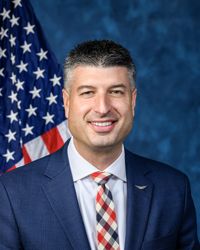
Tom Barrett
RRepublicanMI-7 · Representative
56
/ 100
Average
Attendance99
Avg: 96
Independence4
Avg: 4
Bipartisan Tone9
Avg: 15
Ethics Record100
Avg: 99
Transparency55
Avg: 53
Accountability Score — composite of attendance, independence, bipartisan tone, ethics record & transparency.
Methodology45
Bills Sponsored
0
Enacted into Law
7
Passed a Chamber
38
In Committee
All Sponsored Bills
HR10768In Committee
To establish the Office of Artificial Intelligence and Emerging Technology Threats within the Executive Office of the President, and for other purposes.
HR9570Passed House
To designate the facility of the United States Postal Service located at 117 West Lovett Street in Charlotte, Michigan, as the "Francis C. Flaherty Post Office Building".
This bill designates the facility of the United States Postal Service located at 117 West Lovett Street in Charlotte, Michigan, as the "Francis C. Flaherty Post Office Building".
HR10418In Committee
VA Claims AI Accountability Act
HR10417In Committee
VA AI Transparency Act of 2026
HR7083In Committee
CRUISE Act
The CRUISE Act likely addresses military readiness, operations, or personnel matters within the armed forces, though the specific policy details would depend on the bill's actual provisions. Based on its status in committee review, it appears to be a defense-related measure that lawmakers are evaluating for potential passage. The bill would affect military personnel, defense operations, or national security procedures once enacted.
HR10118In Committee
No Data Center NDAs Act
HR10119In Committee
Protecting Local Control of Data Centers Act
HR9952In Committee
Healthy Recess for Learning Act
The proposal would encourage schools to give students at least one hour of physical activity each school day, whether through gym class, recess, or other movement-based activities. This would affect students, teachers, and school administrators who would need to adjust schedules and programs to meet the activity requirement. The bill aims to improve student health and fitness by making exercise a regular part of the school day.
HR9949In Committee
Safe Baby Formula Act of 2026
The government would be required to study how toxic metals like arsenic, cadmium, mercury, and lead in infant formula affect babies' health and development. Based on the findings, the Health and Human Services Department would then set safety limits for how much of these harmful substances are allowed in infant formula sold in the United States. This would protect infants from potential poisoning and long-term health problems caused by exposure to these toxic metals.
HR9951In Committee
Know What’s on the Tray Act of 2026
Schools that participate in federal lunch and breakfast programs would be required to publicly share detailed information about every food item they serve, including ingredients and nutritional content. This would give students and parents easy access to know what's in the meals being offered at school. The requirement aims to increase transparency around school food offerings.
HR9950In Committee
Healthy Commissaries, Healthy Families Act
The legislation would require military commissaries—stores where service members and their families shop—to stock and promote healthier food options like fresh produce, whole grains, and lean proteins. This would affect millions of military personnel, retirees, and their dependents who use these stores, potentially improving their nutrition and reducing diet-related health problems. The bill also includes other provisions related to military food services and nutrition programs.
HR9727In Committee
Outside Influence Prevention Act
This bill would require that at least half the money spent on independent political ads in a state must come from donors who live in that state. The goal is to reduce the influence of out-of-state money on local elections by ensuring that a significant portion of funding for these ads comes from within the community being targeted. The requirement would apply to independent expenditures, which are political spending done separately from candidates' official campaigns.
HR9726In Committee
CAP Act
The proposal would set a cap on how much money candidates running for the U.S. House of Representatives can spend on their campaigns. This would limit the total amount candidates can use from their own funds, donations, and other sources to pay for advertising, staff, and other election activities. The change would affect anyone running for the House and could reshape how competitive campaigns are funded.
HR9620In Committee
Military Next-Gen Collision Avoidance Act of 2026
The Department of Defense would be required to develop and submit a detailed plan to Congress for deploying an advanced collision avoidance system on military aircraft. This system, called Airborne Collision Avoidance System-X, helps prevent mid-air collisions by alerting pilots to nearby aircraft and suggesting evasive maneuvers. The plan would outline how and when the military intends to install this safety technology across its fleet.
HJRES191In Committee
Proposing an amendment to the Constitution of the United States to provide that Congress and the States shall have certain authority to regulate and limit contributions and spending in campaigns for elections for public office, elections for public office, and ballot initiatives and referendums.
This proposed constitutional amendment would give Congress and state governments the power to set limits on how much money people and organizations can contribute to political campaigns and how much candidates and groups can spend on elections and ballot measures. Currently, the Supreme Court has blocked many campaign finance restrictions, so this amendment would override those court decisions and allow lawmakers to regulate campaign money more strictly. The change would affect candidates, political parties, donors, and advocacy groups involved in elections at all levels of government.
HRES1334In Committee
Reaffirming the Nation's commitment to one Nation Under God in the Pledge of Allegiance.
This resolution expresses Congress's support for keeping the phrase "under God" in the Pledge of Allegiance, which was added to the pledge in 1954. The measure reaffirms that the government believes this language should remain part of the pledge recited in schools and public settings across the country. It does not change any laws but serves as a formal statement of congressional intent on this cultural and religious matter.
HR6047Passed House
Sharri Briley and Eric Edmundson Veterans Benefits Expansion Act of 2026
Sharri Briley and Eric Edmundson Veterans Benefits Expansion Act of 2026 This bill expands specified benefits programs for veterans and their survivors and establishes a supplemental monthly allowance for certain disabled veterans. The bill establishes a supplemental monthly allowance of $833.33 for veterans who are already eligible for a monthly aid and attendance allowance due to service-connected disabilities or traumatic brain injury. The bill increases the rate of dependency and indemnity compensation (DIC) by an additional 1% the next time DIC is adjusted for cost of living and an additional 0.5% the following adjustment. DIC is a monthly payment made to eligible survivors of (1) certain veterans who died due to a service-connected condition; (2) service members killed in the line of duty; or (3) veterans who were totally disabled by a service-connected disability for a certain period. The bill expands eligibility for loans under the Department of Veterans Affairs (VA) home loan program to certain members of the reserve components and National Guard by expanding what qualifies as active duty. The bill includes annual training duty as qualifying active duty and grants eligibility for VA loan guarantees after 14 days of active-duty service (with an additional fee). Under the VA home loan program, the bill extends certain loan fee rates through September 30, 2036, and increases the fees for certain refinancing loans and loan assumptions. The bill extends the limitation on pension amounts for certain hospitalized or institutionalized veterans through September 30, 2036.
HR9046In Committee
COVID-19 Military Mandate Transparency Act
The Department of Defense would be required to study military members who left the Armed Forces because of COVID-19 vaccine requirements, including how many separated and what happened to their education benefits. The study would examine whether these former service members were able to transfer their unused education benefits to family members or use them for their own education. This would help Congress understand the scope of separations related to vaccine mandates and the financial impact on affected military families.
HR3482Passed House
Veterans Community Care Scheduling Improvement Act
Veterans Community Care Scheduling Improvement Act This bill requires the Department of Veterans Affairs (VA) to implement an electronic process for scheduling health care appointments furnished by the VA or through the Veterans Community Care Program (VCCP) and extends an existing limitation on certain pensions. Under the bill, the VA must implement the electronic process not later than two years after the enactment of this bill. The VA must implement a mandatory training program for VA schedulers or other employees involved in scheduling appointments regarding guidelines for the implementation of the electronic process. Additionally, the VA must prescribe performance benchmarks and outcome-based metrics for the electronic process. The VA must also implement an outreach strategy to encourage non-VA health care providers participating in the VCCP to participate in the electronic process. Under current law, the pension paid to veterans who reside in Medicaid nursing homes and have no spouse or child is limited to $90 a month through January 31, 2033. The bill extends this limitation through June 30, 2033.
HR6833In Committee
ARCA Act of 2025
The bill would reorganize how the Department of Veterans Affairs buys goods and services, and would create a new leadership position called the Director of Cost Assessment and Program Evaluation to help the department manage spending and evaluate whether its programs are working effectively. These changes aim to make the VA's purchasing process more efficient and help the department make better decisions about how it spends money on veteran services and benefits.
HJRES176In Committee
2026 Authorization for Use of Military Force Against Iran
This proposal would give the President legal authority to use military force against Iran if he determines it necessary, without requiring a separate declaration of war from Congress. The authorization would apply to military operations related to Iran's government, military, or designated terrorist organizations. This type of measure allows the executive branch to conduct military actions while still involving Congress in the decision, though it gives the President significant flexibility in how and when to use that authority.
HR8673In Committee
To exempt stinger-steered combinations from a requirement to include warning flags on projecting loads.
Trucks that use a special steering system called "stinger steering" would no longer be required to display warning flags on cargo that sticks out beyond the vehicle's normal width or length. Currently, all vehicles carrying loads that extend past their sides or rear must use flags to alert other drivers to the hazard. This change would apply specifically to the trucking industry and companies that operate these specialized vehicles.
HJRES159In Committee
Proposing an amendment to the Constitution of the United States relating to the duration of authorizations of the use of force.
This proposed constitutional amendment would require Congress to renew its approval for military operations every few years rather than allowing a single authorization to last indefinitely. Currently, the military can operate under decades-old congressional approvals, but this change would force lawmakers to regularly vote on whether to continue specific military missions. The amendment would affect military personnel, defense policy, and Congress's power to control when and how the U.S. military fights overseas.
HR8435In Committee
War Powers Priority Procedures Modernization Act
This legislation would update the procedures Congress uses to authorize military actions and oversee the President's war powers, making the process more efficient for modern conflicts. The changes would affect how quickly Congress can debate and vote on military decisions, potentially giving lawmakers clearer timelines and procedures for approving or rejecting military operations. The bill is currently being reviewed by the Foreign Affairs and Rules committees to determine which parts fall under each committee's authority.
HR8434In Committee
Prevent Endless Wars Act
The proposal would limit the president's ability to wage military operations without getting approval from Congress first, requiring lawmakers to vote on any major military action rather than letting the president act alone. This would affect military personnel, defense contractors, and taxpayers by giving Congress more say over when and where the U.S. military fights overseas. The bill aims to restore Congress's constitutional power to declare war, which has been sidelined for decades as presidents have launched military campaigns on their own authority.
HR8436In Committee
Cold War Military Force Repeal Act
The legislation would repeal two Cold War-era authorizations that allow the President to use military force against communist countries without getting a new approval from Congress. This would require the President to seek fresh congressional authorization before taking military action in situations covered by those old Cold War laws, giving lawmakers a say in modern military decisions rather than relying on decades-old permissions.
HR8072In Committee
Safety in Shared Skies Act of 2026
This bill would establish rules and safety standards for military and civilian aircraft operating in the same airspace, aiming to prevent collisions and accidents between military jets, helicopters, and commercial planes. The legislation likely requires the military and Federal Aviation Administration to coordinate better on flight paths, communication systems, and emergency procedures to protect both military personnel and civilian passengers and crews. It affects military pilots, commercial airlines, air traffic controllers, and anyone who flies in U.S. airspace.
HR7861In Committee
Care Over Profits Act of 2026
This bill would likely impose new regulations on health insurance companies and healthcare providers to prioritize patient care over financial profits, though the specific measures are not yet detailed in the referred version. The changes could affect how insurance companies make coverage decisions, how much patients pay out of pocket, or how hospitals and doctors are paid for their services. Patients, healthcare workers, insurance companies, and employers who provide health benefits would all be impacted by whatever restrictions or requirements the final bill includes.
HR7860In Committee
Stop ACA Enrollment Fraud Act of 2026
This bill would add new safeguards and penalties to prevent people from fraudulently signing up for health insurance through the Affordable Care Act marketplace or improperly claiming subsidies they don't qualify for. It would affect both individuals applying for coverage and the government agencies responsible for managing the health insurance program. The bill aims to reduce waste and ensure that financial assistance goes only to people who genuinely meet eligibility requirements.
HR7754In Committee
Take Your Rate Act of 2026
Without specific subjects listed, this bill likely addresses interest rates or pricing in some financial context, though the exact focus is unclear. The vague title "Take Your Rate" could relate to consumer lending, mortgage rates, credit card rates, or another financial product where customers choose or lock in rates. Once the House Committee on Financial Services reviews it, the bill's actual purpose and who it affects—whether borrowers, lenders, or financial institutions—should become clearer.
HR7755In Committee
Housing for Our Hometown Heroes Act
Based on the title and referral to the Financial Services Committee, this bill likely aims to help veterans or military service members afford housing by creating new loan programs, down payment assistance, or other financial incentives. The measure would probably make it easier for former service members to buy homes by reducing barriers like high upfront costs or strict credit requirements. Veterans and their families would be the primary beneficiaries of these housing assistance programs.
HR7753In Committee
First Look for First-time Homebuyers Act of 2026
This bill would give first-time homebuyers a period of time to make an offer on certain properties before other buyers can bid on them, helping people without prior home-buying experience compete in the housing market. The policy aims to make homeownership more accessible by reducing competition from investors and experienced buyers during an initial window. The bill has been sent to the House Financial Services Committee for review.
HR7756In Committee
First-time Homebuyer Savings Account Act of 2026
This bill would create special savings accounts that allow first-time homebuyers to set aside money tax-free to use toward purchasing their first home, similar to how retirement accounts work. People could contribute to these accounts and withdraw the savings without paying taxes on the earnings, making it easier to save for a down payment. The accounts would help younger and lower-income Americans afford to buy homes by reducing the tax burden on their savings.
HR7009In Committee
Home Affordability for Guard and Reserve Act
This bill would help members of the National Guard and military reserves buy homes by making it easier for them to qualify for mortgages and potentially offering financial assistance for down payments or closing costs. The measure recognizes that Guard and Reserve members often have irregular income and employment patterns that can make traditional home loans difficult to obtain, even though they serve their country. The bill aims to remove barriers that prevent these part-time military personnel from achieving homeownership.
HR7349In Committee
Time to Heal Act
Without access to the bill's specific text, this legislation appears to address tax policy, though the exact provisions are unclear from the title alone. Based on the referral to the House Ways and Means Committee, it likely proposes changes to federal tax law that could affect individuals, businesses, or specific industries, but the concrete details of what those changes would be cannot be determined without reviewing the actual bill language.
HR7239In Committee
Next-Gen Collision Avoidance Act
This bill would likely establish or update safety standards for collision avoidance technology in vehicles, requiring manufacturers to install advanced systems that automatically detect and prevent crashes. The rules would apply to cars, trucks, and possibly other vehicles sold in the United States, aiming to reduce traffic accidents and save lives by making newer safety features mandatory rather than optional.
HR7240In Committee
Military ADS–B Out Loophole Act
This bill would close a gap in federal aviation rules that currently allows military aircraft to avoid installing the same collision-avoidance tracking systems that commercial planes must use. The change would make military planes broadcast their location to air traffic control and other aircraft just like civilian flights do, improving safety in shared airspace. The bill affects the Department of Defense and military aviation operations.
HR7196In Committee
To amend the District of Columbia Home Rule Act to prohibit the Council of the District of Columbia from enacting any law to permit euthanasia and assisted suicide in the District of Columbia, and for other purposes.
This bill would prevent Washington, D.C.'s city council from legalizing euthanasia or physician-assisted suicide, overriding local authority on this medical and end-of-life care issue. The measure would restrict D.C. residents' ability to access these practices even if the city government wanted to permit them, affecting patients, doctors, and local policymaking in the nation's capital.
HR7167In Committee
Make It Count Act
Without access to the bill's specific text, this legislation appears to address government operations and political processes, likely aimed at improving how federal agencies or electoral systems function. The bill has been sent to committees that handle government oversight and legal matters, suggesting it may involve reforms to government accountability, voting procedures, or how federal agencies operate. To understand the concrete changes it would make, the actual bill text would need to be reviewed.
HR3481Passed House
Delivering Digitally to Our Veterans Act of 2025
Delivering Digitally to Our Veterans Act of 2025 This bill requires the Department of Veterans Affairs (VA) to provide a way for individuals who are entitled to VA educational assistance to electronically send and receive correspondence with the VA related to such assistance. The VA must ensure individuals are provided an opportunity to opt in to electronic correspondence.
HR3055Passed House
TRANSPORT Jobs Act
Transitioning Retiring And New Service Members to Port Ocean Rail and Truck Jobs Act or the TRANSPORT Jobs Act This bill requires the Department of Transportation (DOT) to develop and make public the Veteran to Supply Chain Employee Action Plan. Among other elements, the plan must identify (1) barriers and challenges of members of the Armed Forces who are eligible for counseling under the Transition Assistance Program and veterans in searching or training for employment in the supply chain industry, and (2) challenges that supply chain employers face when recruiting, hiring, or retaining veterans and such members of the Armed Forces. The plan must also recommend specific short- and long-term actions that DOT, the Department of Defense, the Department of Veterans Affairs, or the Department of Labor can take to help veterans and such members of the Armed Forces in becoming supply chain employees.
HR1364Passed House
Automotive Support Services to Improve Safe Transportation Act of 2025
Automotive Support Services to Improve Safe Transportation Act of 2025 or the ASSIST Act of 2025 This bill expands the definition of medical services for purposes of veterans’ benefits to include additional medically necessary automobile adaptations. Under the bill, the Department of Veterans Affairs may provide funding for ramp and kneeling systems, lowered floors, mobility device lifts, non-articulating trailers, and ingress or egress accessibility modifications.
HR3088In Committee
Veterans Hearing Health Expansion Act
HR1039Passed House
Clear Communication for Veterans Claims Act
Clear Communication for Veterans Claims Act This bill requires the Department of Veterans Affairs (VA) to seek to enter into an agreement with a federally funded research and development center to assess notices that the VA sends to claimants applying for or submitting claims for VA benefits. The VA must report on the findings of the assessment and implement recommendations in the assessment. The bill also extends certain loan fee rates through June 23, 2034, under the VA's home loan program.
HR1898In Committee
Military Helicopter Training Safety Act of 2025
Military Helicopter Training Safety Act of 2025 This bill requires the Department of Defense (DOD) to report on the feasibility of installing a traffic alert and collision avoidance system in each military rotary-wing aircraft. Additionally, DOD must also report on the feasibility of installing automatic dependent surveillance-broadcast IN (ADS-B IN) capability in each military rotary-wing aircraft. (ADS-B IN generally provides operators of properly equipped aircraft with weather and traffic position information.)