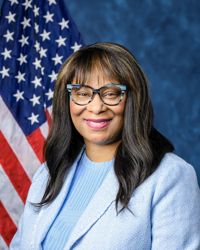
Janelle S. Bynum
DDemocratOR-5 · Representative
54
/ 100
Average
Attendance100
Avg: 96
Independence4
Avg: 4
Bipartisan Tone13
Avg: 15
Ethics Record100
Avg: 99
Transparency40
Avg: 53
Accountability Score — composite of attendance, independence, bipartisan tone, ethics record & transparency.
Methodology20
Bills Sponsored
0
Enacted into Law
1
Passed a Chamber
19
In Committee
All Sponsored Bills
HRES1568In Committee
Recognizing the 25th pastoral anniversary of Bishop C.T. Wells and the ministry of Emmanuel Church.
HR10252In Committee
Launching with Healthcare Act
HR10082In Committee
Credit Union Investment Authority Act
HJRES182In Committee
Providing for congressional disapproval under chapter 8 of title 5, United States Code, of the rule submitted by the Bureau of Consumer Financial Protection relating to the withdrawal of the rule relating to "Bulletin 2023-01: Unfair Billing and Collection Practices After Bankruptcy Discharges of Certain Student Loan Debts".
Congress would reject a decision by the Consumer Financial Protection Bureau to withdraw its guidance that protects borrowers from unfair billing and collection practices on student loans after bankruptcy. This would keep the agency's protections in place, preventing debt collectors and loan servicers from pursuing borrowers for student loan debts that have been legally discharged through bankruptcy. The measure affects student loan borrowers who have gone through bankruptcy proceedings and want protection from continued collection efforts.
HJRES183In Committee
Providing for congressional disapproval under chapter 8 of title 5, United States Code, of the rule submitted by the Bureau of Consumer Financial Protection relating to the withdrawal of the rule relating to "Consumer Financial Protection Circular 2023-01: Unlawful Negative Option Marketing Practices".
Congress would reject a decision by the Consumer Financial Protection Bureau to withdraw its guidance on illegal negative option marketing practices—the deceptive billing tactics where companies automatically charge customers for subscriptions or services without clear consent. This would force the agency to keep its rules in place that protect consumers from being tricked into recurring charges they didn't knowingly agree to. The measure affects everyday people who use online services and subscriptions, as well as the companies that offer them.
HRES1276In Committee
Recognizing the 100th anniversary of the Bend Chamber of Commerce.
This resolution honors the Bend Chamber of Commerce on reaching its 100-year milestone, recognizing the organization's contributions to the local business community and economic development in Bend, Oregon. The measure is a ceremonial acknowledgment with no direct impact on laws or regulations, serving primarily to celebrate the chamber's century of supporting local businesses and community initiatives.
HR8041In Committee
Supporting VA Families Act
This bill would provide additional support and benefits to military families and veterans' families, though the specific provisions aren't detailed in the available information. Based on its focus, it likely aims to improve access to services, financial assistance, or other resources for people whose family members serve or have served in the armed forces. The bill is currently being reviewed by Congress and has advanced from a subcommittee to the full committee for further consideration.
HR6618Passed House
Wildfire Aerial Response Safety Act
Wildfire Aerial Response Safety Act This bill directs the Federal Aviation Administration (FAA) to study the effects of unmanned aircraft system (i.e., drone) incursions on wildfire suppression on public lands. Specifically, the FAA must study drone operations in any airspace for which the FAA issued a temporary flight restriction because of a wildfire on land managed by the Departments of Agriculture or the Interior. Among other things, the study must determine the number of occurrences over the last five years in which a drone incursion interfered with wildfire suppression and estimate the effects of each occurrence. The study must also evaluate the feasibility and effectiveness of (1) deploying counter-drone systems to detect, mitigate, and prevent drone incursions during wildfire suppression operations; and (2) disseminating educational materials related to the effects of the incursions on wildfire suppression operations. The FAA must submit a report to Congress on the study's findings and any related recommendations.
HR7201In Committee
Rural Service and Workforce Corps Act
This bill would create a new program to train and employ workers in rural areas, likely through service corps or apprenticeships that help address labor shortages in agriculture, infrastructure, and other rural industries. The program would aim to provide job training and employment opportunities for rural residents while helping rural communities fill workforce gaps. It's currently being reviewed by committees focused on agriculture and education to determine which parts fall under their jurisdiction.
HR7242In Committee
Homebuilders Corps Act of 2026
This bill would likely create a new workforce program to train and employ people in homebuilding and construction trades, similar to how the military runs job training programs. It would help address labor shortages in the construction industry by giving workers the skills they need for jobs in building homes and related fields. The program would affect construction companies looking to hire skilled workers and people seeking careers in the building trades.
HR7244In Committee
First-Time Home Buyers Match Act
This bill would likely create a matching grant or savings program to help first-time home buyers afford down payments and closing costs on their first home purchase. The program would probably match money that eligible buyers save or contribute themselves, making homeownership more accessible to people who struggle to accumulate the large upfront costs required by lenders. The bill would affect individuals trying to buy their first home, particularly those with lower to moderate incomes.
HR7243In Committee
SPUR Housing Act
The SPUR Housing Act aims to increase the supply of affordable housing and streamline the development process for new residential construction. The bill likely includes provisions to reduce regulatory barriers, provide funding or incentives for housing projects, or modify zoning rules to make it easier to build homes—affecting developers, local governments, and people seeking affordable places to live.
HR7204In Committee
School Bus Stop-Arm Safety Camera Act
The bill would allow school districts to install cameras on school buses that record when drivers illegally pass stopped buses, helping enforce traffic laws that protect children getting on and off buses. These camera recordings could be used as evidence to ticket or fine drivers who violate stop-arm laws, which currently exist in most states but are often ignored. The measure aims to reduce dangerous traffic violations around school buses and improve safety for students and bus drivers.
HR7205In Committee
Application FEES Act
The bill would likely modify how application fees are taxed or treated under federal tax law. Without more specific details about which applications or fees are targeted, the exact impact is unclear, but it could affect businesses that charge application fees, the individuals or organizations paying those fees, or how the government collects tax revenue from these transactions.
HR7202In Committee
Invest in Rural Teachers Act
This bill would likely provide funding or incentives to attract and keep teachers in rural schools, which often struggle to compete with better-paying urban and suburban districts. The measure would help rural students by addressing teacher shortages and improving educational quality in communities that have fewer resources to recruit qualified educators.
HR7203In Committee
CHIPS Child Care Act
This bill would likely provide financial assistance or tax benefits to help families afford child care services, making it easier for parents—especially those with lower incomes—to pay for childcare while they work or pursue education. The proposal has been sent to two congressional committees to review different aspects: one committee will examine education and workforce issues, while the other will look at how to fund it through the tax system or budget.
HR6430In Committee
Junk Fee Prevention Act
The proposal would require companies to disclose all fees upfront before customers complete a purchase, preventing surprise charges that appear only at checkout. It would apply to airlines, hotels, ticketing services, and other businesses that commonly add hidden fees, giving consumers a clearer picture of the true cost before they buy. The bill aims to make it easier for shoppers to compare prices fairly across different companies.
HR5907In Committee
To authorize the Secretary of Housing and Urban Development to award grants to eligible entities to select pre-reviewed designs of covered structures of mixed-income housing for use in the jurisdiction of the eligible entity, and for other purposes.
The federal government would give money to local housing organizations and developers to build mixed-income apartment buildings using pre-approved designs that have already been reviewed for quality and safety. This would make it faster and cheaper to construct affordable housing by allowing builders to skip some of the design approval process and use proven plans instead. Communities and housing developers would benefit from easier access to funding and streamlined construction timelines.
HR4486In Committee
Microplastics Safety Act
This bill would require the federal government to study and regulate microplastics—tiny plastic particles found in food, water, and consumer products—to protect public health. It would likely direct agencies to set safety standards, require companies to test products for microplastics, and inform consumers about potential health risks from exposure to these particles. The legislation affects manufacturers, food and beverage companies, and consumers concerned about the health impacts of microplastics in everyday products.
HRES443In Committee
Expressing support for the designation of May 2025 as "National Electrical Safety Month".
Congress would officially recognize May 2025 as "National Electrical Safety Month" to raise awareness about the dangers of electrical hazards and promote safe practices among workers, homeowners, and the general public. The designation would encourage electrical companies, safety organizations, and government agencies to highlight the importance of proper electrical installation, maintenance, and usage to prevent injuries and deaths from electrical accidents. This is a symbolic measure intended to draw attention to electrical safety education and prevention efforts rather than create new laws or regulations.