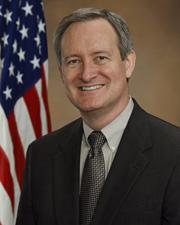
Mike Crapo
RRepublicanID · Senator
58
/ 100
Average
Attendance99
Avg: 97
Independence23
Avg: 23
Bipartisan Tone32
Avg: 14
Ethics Record100
Avg: 100
Transparency14
Avg: 47
Accountability Score — composite of attendance, independence, bipartisan tone, ethics record & transparency.
Methodology29
Bills Sponsored
1
Enacted into Law
0
Passed a Chamber
21
In Committee
Bills That Became Law
All Sponsored Bills
SRES942Introduced
A resolution recognizing and supporting the goals and ideals of National Forensic Science Week.
S5608In Committee
Secure Rural Schools Reauthorization Act of 2026
S5441Introduced
TAS Act
S24Reported
A bill to designate the facility of the United States Postal Service located at 154 First Avenue East in Jerome, Idaho, as the "Representative Maxine Bell Post Office".
This bill designates the facility of the U.S. Postal Service located at 154 First Avenue East in Jerome, Idaho, as the Representative Maxine Bell Post Office.
S3226In Committee
Bring Our Heroes Home Act
This bill likely aims to address the return or repatriation of American military personnel, prisoners of war, or missing service members, though the specific mechanism isn't clear from the title alone. The bill has been sent to the Homeland Security committee for review, suggesting it may involve coordination between military and government agencies to locate, recover, or bring home Americans held or missing abroad. Veterans, military families, and government agencies would be the primary groups affected by whatever provisions the bill ultimately contains.
S5092In Committee
RAAM Act
The proposal would remove federal requirements that car manufacturers meet minimum fuel efficiency standards on average across their vehicle fleets. This would affect automakers, consumers who buy vehicles, and potentially gas prices and air quality, since less efficient cars typically consume more fuel and produce more emissions. The bill is currently under review by the Senate Commerce Committee.
SRES723Introduced
A resolution honoring the life of Dirk Arthur Kempthorne, former United States Senator for the State of Idaho.
This resolution honors the life of Dirk Kempthorne, former Senator for the state of Idaho, and offers condolences to his family and loved ones.
S3985In Committee
State Boating Act
This bill would establish or modify state regulations governing recreational and commercial boating activities, likely covering safety standards, licensing requirements, and waterway management. It would affect boat owners, operators, and water recreation businesses by setting rules they must follow when operating vessels on state waterways. The specific provisions aren't yet clear since the bill is still in early stages of review by the Senate Commerce Committee.
S3931In Committee
TAS Act
I don't have enough information to write an accurate summary. "TAS Act" is too vague a title, and the subjects listed only indicate this involves taxation without specifying what tax changes it would make or who it affects. To provide a meaningful summary, I would need the bill's full official title or a description of its specific provisions.
S356Enacted
Secure Rural Schools Reauthorization Act of 2025
Secure Rural Schools Reauthorization Act of 2025 This act extends and modifies the Secure Rural Schools (SRS) program, under which states and counties containing certain federal land may receive payments from the Forest Service or the Bureau of Land Management (BLM) for schools, roads, and certain other municipal services. The act modifies the SRS program, including by extending payments made to states and counties containing federal land through FY2026, providing lapsed payments for FY2024 and FY2025, extending the authority of counties to initiate projects using such funds through FY2028, and extending the authority to initiate projects proposed by resource advisory committees through FY2028.
S3532In Committee
State Veterans Homes Inspection Simplification Act
This bill would streamline the inspection process for state-run nursing homes that care for veterans, making it easier for these facilities to operate while maintaining safety standards. The changes would likely reduce paperwork and bureaucratic requirements that states currently face when running these homes, allowing them to focus more resources on caring for elderly and disabled veterans. The bill is currently under review by the Senate Finance Committee.
S3386Introduced
Health Care Freedom for Patients Act of 2025
Health Care Freedom for Patients Act of 2025 This bill allows certain individuals with health savings accounts (HSAs) to receive federal payments. It also restricts payments under Medicaid and the Children's Health Insurance Program (CHIP) regarding certain noncitizens and restricts coverage of gender-transition procedures. Specifically, the bill provides funds for the Department of Health and Human Services to deposit payments into an individual’s HSA during 2026-2027 if the individual has a bronze or catastrophic plan through a health insurance exchange, is between the ages of 18 and 64, and has income up to 700% of the federal poverty level (FPL). Individuals may receive $1,000 or $1,500 annually, depending on age. The bill also provides funds, beginning in 2027, for cost-sharing reductions for certain individuals who have a silver plan and income up to 250% of the FPL. Beginning in 2027, the bill allows any individual to enroll in a catastrophic plan. Currently, these plans are limited to those under the age of 30 or who have certain exemptions. The bill also reduces the enhanced federal matching rate for the Medicaid expansion population in states that provide any health benefits for individuals who are not qualified aliens under federal law. The bill makes Medicaid and CHIP coverage of individuals while their status is being verified optional and conditions federal payment during this period on verification. Finally, the bill prohibits exchange plans from covering gender-transition procedures as an essential health benefit and prohibits federal payment under Medicaid and CHIP for these procedures.
S3345In Committee
PBM Price Transparency and Accountability Act
SRES436Introduced
A resolution expressing support for the designation of September 2025 as "National Prostate Cancer Awareness Month".
SRES395Introduced
A resolution recognizing and supporting the goals and ideals of National Forensic Science Week.
This resolution expresses support for the goals and ideals of National Forensic Science Week.
S2360In Committee
Judicial Reorganization Act of 2025
Judicial Reorganization Act of 2025 This bill establishes a new U.S. Court of Appeals. Specifically, the bill divides the U.S. Court of Appeals for the Ninth Circuit into two judicial circuits: (1) the Ninth Circuit, and (2) a new Twelfth Circuit. The Ninth Circuit is composed of California, Guam, and Hawaii. The new Twelfth Circuit is composed of Alaska, Arizona, Idaho, Montana, Nevada, Oregon, and Washington.
S2019In Committee
TRAPS Act
The TRAPS Act addresses financial regulations and oversight in the banking and housing sectors, likely aiming to modify how financial institutions operate or are regulated. Based on its referral to the Banking Committee, the bill probably affects banks, lenders, and potentially borrowers or homebuyers, though the specific changes would depend on the bill's detailed provisions. The measure is currently under review and has not yet been debated or voted on.
S1532In Committee
A bill to amend the Internal Revenue Code of 1986 to modify the railroad track maintenance credit.
This bill increases the annual limit on the tax credit for qualified railroad track maintenance expenses (also referred to as the short line railroad tax credit) and expands eligibility for claiming the credit. Under current law, the tax credit is limited each tax year to $3,500 multiplied by the sum of the number of miles of railroad track owned or leased by the taxpayer (miles owned or leased) and the number of railroad track miles assigned to the taxpayer by a Class II or III railroad (miles assigned). This bill increases the annual limit to $6,100 multiplied by the sum of miles owned or leased and miles assigned. The $6,100 amount used in the calculation of the tax credit limit is adjusted for inflation for tax years beginning after 2025. The bill also expands eligibility for the tax credit to include gross expenses for maintaining railroad tracks owned or leased as of January 1, 2024. Under current law, the tax credit is limited to gross expenses for maintaining railroad tracks owned or leased as of January 1, 2015.
S1163In Committee
Rural Veterinary Workforce Act
This bill would likely use tax incentives or credits to encourage veterinarians to work in rural areas where there's a shortage of animal healthcare services. The measure aims to help farmers, ranchers, and rural pet owners get better access to veterinary care by making it more financially attractive for vets to practice in remote communities.
S995In Committee
Choice in Automobile Retail Sales Act of 2025
S364In Committee
Hearing Protection Act
This proposal would reduce federal taxes on firearm silencers by removing them from the National Firearms Act tax stamp requirement, which currently charges a $200 federal tax and requires registration. The change would make silencers more affordable and accessible to gun owners while potentially reducing the administrative burden on the federal government. Hunters, sport shooters, and firearms manufacturers would be the primary groups affected by this tax reduction.
S339In Committee
Nancy Gardner Sewell Medicare Multi-Cancer Early Detection Screening Coverage Act
This bill would require Medicare to cover blood tests that can detect multiple types of cancer early, before symptoms appear. The coverage would help seniors catch cancers at earlier stages when treatment is often more effective, though it would also increase Medicare's healthcare costs. The change would apply to all Medicare beneficiaries who qualify for the screening tests.
SCONRES6In Committee
A concurrent resolution expressing the sense of Congress that tax-exempt fraternal benefit societies have historically provided and continue to provide critical benefits to the people and communities of the United States.
This concurrent resolution expresses the sense of Congress that tax-exempt fraternal benefit societies serve as a private economic and social support system, providing benefits to their members is necessary to support the charitable and fraternal activities of the volunteer chapters, and their work should continue to be promoted.
S199In Committee
A bill to amend the Internal Revenue Code of 1986 to provide special rules for the taxation of certain residents of Taiwan with income from sources within the United States.
This bill would create special tax rules for people who live in Taiwan but earn income from U.S. sources, likely affecting how they report and pay taxes on that American income. The changes would apply specifically to Taiwan residents and could alter their tax obligations compared to other foreign workers earning money in the United States. The proposal is currently under review by the Senate Finance Committee.
S54In Committee
A bill to authorize an additional district judgeship for the district of Idaho.
This bill increases from two to three the total number of U.S. district court judgeships for the District of Idaho. The President must appoint, with the advice and consent of the Senate, one additional judge for that judicial district.
S3660In Committee
National Monument Designation Transparency and Accountability Act of 2010
National Monument Designation Transparency and Accountability Act of 2010 - Amends the Antiquities Act of 1906 to require land reserved as part of a national monument to be confined to the smallest area necessary to ensure the proper care and management of the objects to be protected by the monument. Sets forth requirements for the designation of national monuments under the Act. Bars the President from issuing a proclamation to designate a national monument under this Act before the date that is 30 days after the date on which the proposed proclamation is provided by the President to Congress, the governor of each state, and specified local and tribal government officials having jurisdiction over any parcel of land within the boundary of the proposed monument. Requires at least one public hearing and a notice and comment period after the issuance of a proclamation to designate a national monument. Requires the President to report to Congress on any hearings held, any written comments received, and the impact of such designation on communities within the boundary of the monument, the nation's energy security, and interests, rights, and uses associated with the land within the monument. Makes a proclamation ineffective two years after its issuance, unless it is approved by an Act of Congress. Bars the issuance of a proclamation by the President that is substantially similar to a previously issued proclamation that Congress did not approve within the two-year period.
S3294In Committee
Central Idaho Economic Development and Recreation Act
Central Idaho Economic Development and Recreation Act - Designates specified parcels of federal land in central Idaho as wilderness areas and as components of the National Wilderness Preservation System (NWPS). Repeals existing law requiring review of portions of the Sawtooth National Recreation Area (SNRA) for possible inclusion in the NWPS. Provides for the use of an appropriate site in the vicinity of the Smiley Creek community in Blaine County in central Idaho for construction and use of a fire station for the Smiley Creek Rural Fire Protection District. Authorizes: (1) the use of such site through a special use permit or conveyance to the District; and (2) the issuance of a special use permit to the District for development of a well for fire protection and other public purposes. Requires the conveyance of specified parcels of federal land to Blaine and Custer Counties and the cities of Challis and Clayton in central Idaho. Sets forth requirements regarding travel management in Germania Creek Trail, Forest Service Trails 109 and 671, and Frog Lake Loop Trail. Authorizes such improvements as may be necessary for maintainance of the first mile of the Murdock Creek Trail as a primitive, nonpaved, and wheel-chair accessible trail.
S816In Committee
Preservation of the Second Amendment in National Parks and National Wildlife Refuges Act
Preservation of the Second Amendment in National Parks and National Wildlife Refuges Act - Allows, except as provided under federal criminal law relating to the possession of firearms and other dangerous weapons in federal facilities, a person to possess, carry, and transport concealed, loaded, and operable firearms within a national park area or national wildlife refuge area in accordance with the laws of the state in which such area, or that portion thereof, is located.
S452In Committee
Backcountry Landing Strip Access Act
Backcountry Landing Strip Access Act - Prohibits the Secretaries of the Interior or Agriculture from taking any action that would permanently close, restrict, or render or declare unserviceable any aircraft landing strip located on land under their jurisdiction unless: (1) the action has been approved by the head of the aviation department of the state in which the landing strip is located; (2) the Secretary publishes notice of the proposed action and provides for a 90-day public comment thereafter; and (3) the Secretary and appropriate state aviation department head have taken into consideration any comments received. Requires the Secretaries to: (1) establish a nationwide policy for governing backcountry aviation issues relating to the management of federal land under the jurisdiction of the Departments of the Interior and Agriculture; and (2) require officials with jurisdiction over such land to adhere to such policy. Requires private and publicly-owned aircraft land strips acquired by the government to be made available to the public for unrestricted use.