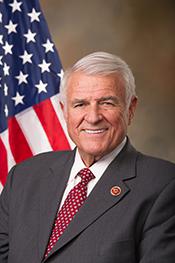
John R. Carter
RRepublicanTX-31 · Representative
55
/ 100
Average
Attendance98
Avg: 96
Independence2
Avg: 4
Bipartisan Tone4
Avg: 15
Ethics Record100
Avg: 99
Transparency59
Avg: 53
Accountability Score — composite of attendance, independence, bipartisan tone, ethics record & transparency.
Methodology4
Bills Sponsored
0
Enacted into Law
2
Passed a Chamber
2
In Committee
All Sponsored Bills
HR8469Passed House
Making appropriations for military construction, the Department of Veterans Affairs, and related agencies for the fiscal year ending September 30, 2027, and for other purposes.
Military Construction, Veterans Affairs, and Related Agencies Appropriations Act, 2027 This bill provides FY2027 appropriations for military construction, the Department of Veterans Affairs (VA), and related agencies. The bill provides appropriations to the Department of Defense (DOD) for military construction for the Army; the Navy and Marine Corps; the Air Force; Defense-wide agencies and activities; the Army and Air National Guard; and the Army, Navy, and Air Force Reserves. The bill also provides appropriations to DOD for the North Atlantic Treaty Organization (NATO) Security Investment Program; the Base Closure Account; Construction and Operation and Maintenance of Family Housing for the Army, the Navy and Marine Corps, the Air Force, and Defense-wide agencies and activities; the Family Housing Improvement Fund; and the Military Unaccompanied Housing Improvement Fund. Within the VA budget, the bill provides appropriations for the Veterans Benefits Administration, the Veterans Health Administration, the National Cemetery Administration, Departmental Administration, and the Cost of War Toxic Exposures Fund. The bill provides appropriations for related agencies and programs, including the American Battle Monuments Commission, the U.S. Court of Appeals for Veterans Claims, Cemeterial Expenses of the Army, and the Armed Forces Retirement Home. The bill also sets forth requirements and restrictions for using funds provided by this and other appropriations acts.
HR7489In Committee
Georgetown VA Community-Based Outpatient Clinic Authorization Act of 2026
This bill would authorize the Department of Veterans Affairs to establish a new community-based outpatient clinic in Georgetown to provide medical services to veterans in that area. The clinic would allow veterans to receive VA healthcare closer to home without having to travel to a full VA medical center. This expansion aims to improve healthcare access for veterans living in or near Georgetown.
HR3944Passed Both
Military Construction and Veterans Affairs, Agriculture, and Legislative Branch Appropriations Act, 2026
Military Construction and Veterans Affairs, Agriculture, and Legislative Branch Appropriations Act, 2026 This bill provides FY2026 appropriations to several federal departments and agencies for activities and programs related to military construction, veterans, agriculture, and the legislative branch. Specifically, the bill includes 3 of the 12 regular FY2026 appropriations bills: the Military Construction, Veterans Affairs, and Related Agencies Appropriations Act, 2026; the Agriculture, Rural Development, Food and Drug Administration, and Related Agencies Appropriations Act, 2026; and the Legislative Branch Appropriations Act, 2026. The departments, agencies, and activities funded in the bill include Department of Defense military construction and family housing activities, the Department of Veterans Affairs, the Department of Agriculture, the Food and Drug Administration, the Senate, various agencies that support Congress, and several related and independent agencies. (Pursuant to the longstanding practice of each chamber of Congress determining its own requirements, funds for the House of Representatives are not included in the Senate bill.) The bill also sets forth requirements and restrictions for using funds provided by this and other appropriations acts.
HR2360In Committee
To permanently extend the exemption from the engine compartment portion of the pre-trip vehicle inspection skills testing requirement for school bus drivers, and for other purposes.
This bill directs the Federal Motor Carrier Safety Administration (FMCSA) to permanently allow states to exempt school bus drivers from the “under-the-hood” testing requirement for a commercial driver's license (CDL). As background, on December 2, 2024, the FMCSA renewed an exemption through November 28, 2026, that allows states to exempt all school bus driver applicants for a CDL from the engine compartment portion of the pre-trip vehicle inspection skills testing requirement, commonly referred to as the under-the-hood testing requirement. States must meet certain terms and conditions for the exemption. Under the bill, the FMCSA must make permanent the December 2, 2024, exemption, thus permanently allowing states to exempt school bus drivers from the under-the-hood testing requirement. States must meet the additional terms and conditions for an exemption, which include (1) restricting school bus drivers who are issued a CDL based on the exemption to the intrastate operation of school buses, and (2) requiring states to conduct the remaining pre-trip vehicle inspection components of the skills test. Further, the FMCSA must require any state participating in the exemption to submit an annual report describing the number of drivers that obtain a CDL under the exemption.