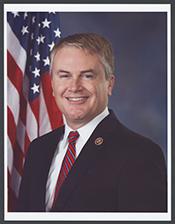
James Comer
RRepublicanKY-1 · Representative
57
/ 100
Average
Attendance97
Avg: 96
Independence4
Avg: 4
Bipartisan Tone15
Avg: 15
Ethics Record100
Avg: 99
Transparency61
Avg: 53
Accountability Score — composite of attendance, independence, bipartisan tone, ethics record & transparency.
Methodology11
Bills Sponsored
1
Enacted into Law
5
Passed a Chamber
5
In Committee
Bills That Became Law
All Sponsored Bills
HRES1543Passed House
Recommending that the House of Representatives find Leon D. Black in contempt of Congress for refusal to comply with subpoenas duly issued by the Committee on Oversight and Government Reform.
HR10389In Committee
Survivor’s Voice Protection Act
HR1276Enacted
To remove restrictions from a parcel of land in Paducah, Kentucky.
This bill directs the Department of the Interior to remove all deed restrictions from approximately 3.62 acres located at 2956 Park Avenue, on the Paducah Memorial Army Reserve Center in Paducah, Kentucky. The restrictions include easements, exceptions, reservations, terms, conditions, and covenants described in the quitclaim deed that was executed on April 27, 2012. The deed conveyed land from Interior to the City of Paducah, Kentucky.
HR9720In Committee
D.C. Taxing Authority Review Act
This bill would give Congress the power to review and potentially block tax increases that Washington D.C.'s local government tries to impose on residents and businesses. The measure affects D.C. residents and companies operating in the nation's capital by requiring federal approval before local tax changes can take effect. It essentially limits the District's ability to raise taxes without congressional oversight.
HR8464Passed House
Stopping Fraudulent Payments Act
Stopping Fraudulent Payments Act This bill establishes requirements to prevent fraudulent or improper payments from federal programs. Specifically, the bill directs executive agencies to take corrective actions to temporarily pause, condition, or segment payment voucher requests before certifying them if the agencies have sufficient reason to determine that the payments present elevated risks of fraud or improper payments resulting in financial loss to the government. The corrective actions must be (1) based on objective, documented fraud-risk indicators; (2) narrowly applied to the portion of the payments presenting the elevated risk; and (3) limited in duration to the minimum period necessary to verify the eligibility or accuracy of the payments. The Department of the Treasury must return certified payment vouchers to agencies for corrective action if they present an elevated risk of fraud based on an output of Treasury’s Do Not Pay system. The bill also prohibits officers or employees of the federal government from being personally liable for actions taken in good faith under this bill.
HR8463Passed House
Pre-Payment Fraud Prevention and Treasury Data Access Act
Pre-Payment Fraud Prevention and Treasury Data Access Act This bill expands efforts to identify, prevent, and recover improper payments of federal funds (e.g., overpayments, underpayments, payments to ineligible recipients). Specifically, the Department of the Treasury must establish certain requirements that agencies must meet before directing Treasury to make a payment of federal funds. These pre-payment requirements must include verification of payee information, payment details, and fund availability. Further, agencies must, to the extent practicable, verify the accuracy of payee bank account information before directing Treasury to make a payment. The bill also expands the Do Not Pay system, which provides agencies with access to centralized data for the purpose of verifying payee eligibility, and provides statutory authority for Treasury’s role as administrator of the system. The bill requires specified data assets to be added to the system and authorizes Treasury to (1) designate additional data assets for inclusion, and (2) access certain taxpayer and Social Security information for the system. The bill specifies that information obtained through the system may only be used to prevent and recover improper payments and establishes penalties for the unlawful disclosure of such information. The bill explicitly requires executive agencies and state and local governments administering federally funded programs to screen payees against all appropriate Do Not Pay data assets and risk tools before making an award or directing a payment. Finally, the bill establishes post-award reporting requirements for certain first-time fund recipients under federal programs for awards of $50,000 or more.
HR7248In Committee
MARINA Act
The MARINA Act would establish or modify rules for managing marinas and waterfront facilities on public lands. The bill likely affects boat owners, marina operators, and communities that rely on public water access by determining how these facilities are developed, maintained, and operated.
HR1295In Committee
Reorganizing Government Act of 2025
Reorganizing Government Act of 2025 This bill revives expedited congressional consideration of certain Presidential plans to reorganize the executive branch, expands permissible plan purposes, and changes the prohibitions on plan content. The bill reauthorizes through 2026 a currently expired authority that requires expedited congressional consideration of certain executive branch reorganization plans submitted by the President. The bill also expands the purposes for which such reorganization plans may be undertaken, to include reducing the number of federal employees; eliminating unnecessary and burdensome rules, regulations, and other requirements; and eliminating government operations that do not serve the public interest. The bill removes the following prohibitions on the contents of such plans: creating new executive departments or renaming existing executive departments; abolishing or transferring executive departments or independent regulatory agencies or all of their functions; and consolidating executive departments or independent regulatory agencies or all of their functions. The bill also adds a new prohibition on content, specifying that any such plan may not create a net increase in federal workers or expenditures.
HR4366Passed House
Save Local Business Act
Save Local Business Act This bill provides that a person may be considered a joint employer of the employees of another employer under federal labor law only if such person directly, actually, and immediately exercises significant control over the essential terms and conditions of employment. Such control may by demonstrated by hiring and discharging employees; determining individual employee rates of pay and benefits; day-to-day supervision of employees; assigning individual work schedules, positions, or tasks; or administering employee discipline.
HR1515Passed House
GOOD Act
Guidance Out Of Darkness Act or the GOOD Act This bill establishes requirements concerning the posting of agency guidance documents. Specifically, an agency must publish guidance documents online on the dates they are issued, publish all of its guidance documents that are in effect in a single location on a designated website, display a hyperlink on its website that provides access to the guidance documents on such website, and indicate on such website if a guidance document has been rescinded. The documents must be categorized as guidance documents and further divided into subcategories. No later than five years after the enactment of this bill, the Government Accountability Office must report on agency compliance with these requirements.
HRES82In Committee
Providing amounts for the expenses of the Committee on Oversight and Government Reform in the One Hundred Nineteenth Congress.
This resolution provides amounts for the expenses of the House Committee on Oversight and Government Reform for the 119th Congress.