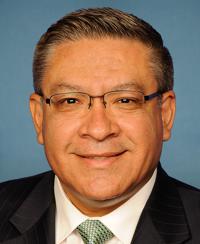
Salud O. Carbajal
DDemocratCA-24 · Representative
59
/ 100
Average
Attendance99
Avg: 96
Independence2
Avg: 4
Bipartisan Tone33
Avg: 15
Ethics Record100
Avg: 99
Transparency47
Avg: 53
Accountability Score — composite of attendance, independence, bipartisan tone, ethics record & transparency.
Methodology24
Bills Sponsored
0
Enacted into Law
3
Passed a Chamber
21
In Committee
All Sponsored Bills
HR10536In Committee
Ocean Protection and DDT Reduction Act
HR2175Passed House
To designate the facility of the United States Postal Service located at 130 South Patterson Avenue in Santa Barbara, California, as the "Brigadier General Frederick R. Lopez Post Office Building".
This bill designates the facility of the United States Postal Service located at 130 South Patterson Avenue in Santa Barbara, California, as the "Brigadier General Frederick R. Lopez Post Office Building".
HRES1459In Committee
Expressing support for the designation of July 2026 as "American Grown Flower and Foliage Month".
This resolution supports the goals and ideals of American Grown Flower and Foliage Month and recognizes that purchasing flowers and foliage grown in the United States supports the farmers, small businesses, jobs, and economy of the United States.
HR9185In Committee
Alan S. Lowenthal Blue Whales, Blue Skies Act
The federal government would create a program that encourages ships traveling along the U.S. West Coast to voluntarily slow down, which would reduce air pollution, underwater noise that harms whales, and the risk of deadly collisions between vessels and blue whales. Ships that participate in this voluntary speed reduction program would receive official recognition for their environmental efforts. The program would be run by the National Oceanic and Atmospheric Administration, the federal agency responsible for ocean and atmospheric issues.
HR8785In Committee
Medium Transit Intensive Cities Authorization Act of 2026
The proposal would change how federal transit funding is distributed to medium-sized cities that rely heavily on public transportation, potentially giving some of these cities a larger share of available money. This affects local transit agencies, commuters in mid-sized urban areas, and how cities can invest in buses, trains, and other public transportation systems. The bill is currently under review by the House Committee on Transportation and Infrastructure.
HR8439In Committee
Commission on Natural Disaster Risk Management and Insurance Act
The bill would create a new commission to study how the United States manages risks from natural disasters like hurricanes, earthquakes, and floods, and how insurance plays a role in protecting people and property. The commission would bring together experts to examine current policies and likely recommend ways to improve how the government and insurance companies work together to help communities prepare for and recover from disasters. This would affect homeowners, businesses, insurance companies, and government agencies involved in disaster response and recovery.
HR7976In Committee
Moral Injury Recognition and Restitution Act
This bill would recognize and address "moral injury"—the psychological harm that military members experience when forced to act against their personal values during combat or military service—and would likely establish support programs or compensation for affected veterans. The legislation aims to help service members and veterans who suffer from guilt, shame, or trauma related to their military experiences get better mental health treatment and potentially financial assistance. It focuses on a specific type of psychological damage that differs from conditions like PTSD and affects how the military and Veterans Affairs system treats and supports those who experience it.
HR7526In Committee
Safe Skies Act of 2026
Safe Skies Act of 2026 This bill directs the Department of Transportation (DOT) to expand specified duty and rest requirements to apply the requirements to all-cargo flight crew members. Currently, a DOT final rule on flight crew member duty and rest requirements only applies to flight crew members in passenger operations conducted by air carriers. Under the bill, DOT must modify this final rule so that the requirements also apply to all-cargo flight crew members.
HR5017In Committee
Greyhound Protection Act of 2025
This bill would establish new federal protections for greyhound dogs, likely including regulations on breeding, racing, and care standards for the animals. The legislation would probably affect greyhound racing facilities, breeders, and owners by imposing requirements to ensure the dogs' health and welfare. Animal welfare advocates support such measures, while the racing industry would face new compliance obligations.
HR5566In Committee
Water Infrastructure Resilience and Sustainability Act
This bill would likely provide funding and establish programs to help communities upgrade aging water systems, protect against flooding and droughts, and reduce pollution in rivers and lakes. It would affect water utilities, municipalities, and residents by improving the reliability and safety of drinking water and stormwater infrastructure. The legislation aims to make water systems more resilient to climate change and environmental challenges while protecting natural water resources.
HR5936In Committee
Home for the Brave Act of 2025
This bill aims to help veterans find stable housing by creating or expanding programs that provide affordable homes or rental assistance specifically for people who served in the military. The legislation likely addresses the homelessness crisis among veterans by offering financial support, down payment assistance, or dedicated housing resources. Veterans and housing organizations would be the primary beneficiaries of these new or improved housing programs.
HRES616In Committee
Expressing support for the designation of July 2025 as "American Grown Flower and Foliage Month".
This resolution supports the designation of American Grown Flower and Foliage Month and recognizes that purchasing flowers and foliage grown in the United States supports the farmers, small businesses, jobs, and economy of the United States.
HR4784In Committee
Don Young American Grown Act
Don Young American Grown Act This bill prohibits the official display of a cut flower or green in any public area of a building of the Executive Office of the President, the Department of State, or the Department of Defense unless it is grown in the United States. The prohibition does not apply to any cut flower or green used by a federal officer or employee for personal display.
HR4315In Committee
National Infrastructure Investment Corporation Act of 2025
National Infrastructure Investment Corporation Act of 2025 This bill establishes the National Infrastructure Investment Corporation as a government corporation to finance infrastructure projects that are beyond the financing capabilities of states and cities, including to (1) prioritize projects in a fair and efficient manner, and (2) minimize financial costs to the federal government. The corporation must provide loans, loan guarantees, and bonds to eligible applicants for infrastructure projects (including transportation, energy, environment, and telecommunications projects) in the United States. The corporation must submit a report to Congress describing each application 60 days before any loan or loan guarantee is awarded under this bill. The corporation may award the loan or loan agreement after such period unless Congress enacts a joint resolution disapproving the application with an explanation for such disapproval. An application that addresses the basis for the disapproval may be resubmitted to the corporation. Every five years, the Government Accountability Office must evaluate the activities of the corporation from the previous five fiscal years and submit a report to Congress.
HR4252In Committee
Extreme Risk Protection Order Expansion Act of 2025
Extreme Risk Protection Order Expansion Act of 2025 This bill establishes grants to support the implementation of extreme risk protection order laws at the state and local levels, extends federal firearms restrictions to individuals who are subject to extreme risk protection orders, and expands related data collection. Extreme risk protection order laws, or red flag laws, generally allow certain individuals (e.g., law enforcement officers or family members) to petition a court for a temporary order that prohibits an at-risk individual from purchasing and possessing firearms. Among its provisions, the bill directs the Department of Justice to establish a grant program to help states, local governments, Indian tribes, and other entities implement extreme risk protection order laws; extends federal restrictions on the receipt, possession, shipment, and transportation of firearms and ammunition to individuals who are subject to extreme risk protection orders; and requires the Federal Bureau of Investigation to compile records from federal, tribal, and state courts and other agencies that identify individuals who are subject to extreme risk protection orders.
HR4022In Committee
Increasing Behavioral Health Treatment Act
Increasing Behavioral Health Treatment Act This bill repeals restrictions that generally prohibit federal payment under Medicaid for services provided in institutions for mental diseases (IMDs) for individuals under the age of 65. (Currently, states may receive payment for such services through certain mechanisms, such as through a Medicaid demonstration waiver.) The bill also requires state Medicaid programs that cover IMD services to improve patient access to outpatient and community-based behavioral health care, expand crisis stabilization services, facilitate care coordination between providers and first responders, and report specified information relating to IMD utilization and costs.
HR4024In Committee
Filling Public Safety Vacancies Act
Filling Public Safety Vacancies Act The bill provides additional funding for grants for the hiring and rehiring of additional career law enforcement officers under the Department of Justice's Community Oriented Policing Services (COPS) program. The bill also requires law enforcement agencies that use the funds to hire or rehire a law enforcement officer to (1) perform a background check on the law enforcement officer, and (2) ensure that the law enforcement officer undergoes a psychological evaluation.
HR4023In Committee
American Dream for All Act
This bill would likely create or expand programs to help more Americans afford homes, possibly through down payment assistance, lower-interest loans, or other financial support for first-time homebuyers and lower-income families. The changes would affect both prospective homeowners struggling to enter the housing market and potentially mortgage lenders and housing agencies that administer these programs. The bill is still in early stages and has been sent to the House Financial Services Committee for review.
HR2035Passed House
American Cargo for American Ships Act
American Cargo for American Ships Act This bill requires 100% of equipment, materials, and commodities procured, furnished, or financed by the Department of Transportation (DOT) and transported on ocean vessels to be transported on U.S.-flagged commercial vessels. (Current cargo preference laws require that a minimum percentage of federally financed ocean cargo be transported on U.S.-flagged commercial vessels. For civilian agencies and agricultural cargo, the minimum is generally 50%.) Specifically, the bill imposes the requirement on DOT (for cargo it contracts for or procures for itself) and recipients of DOT funding (for cargo DOT has financed with federal funds or advanced funds for the recipient to obtain). As under current cargo preference laws, the requirement applies to the extent those vessels are available at fair and reasonable rates for U.S.-flagged commercial vessels, in a manner that will ensure fair and reasonable participation of U.S.-flagged commercial vessels by geographic area.
HR2492Passed House
Fire Safe Electrical Corridors Act of 2025
Fire Safe Electrical Corridors Act of 2025 This bill allows the Forest Service and the Bureau of Land Management (BLM) to expedite the removal of trees or other vegetation near electrical lines on their lands under certain circumstances. Specifically, the Forest Service and the BLM may include in special use permits or easements provided to electrical utilities permission to cut, remove, and sell trees or other vegetation near electrical lines on such lands without a separate timber sale if the cutting or removal is consistent with (1) any applicable land and resource management plan, and (2) other applicable environmental laws. A special use permit or easement that includes permission for cutting and removal of trees or vegetation must include a requirement that, if the applicable electrical utility sells any portion of the material removed under the permit or easement, the utility must provide to the Forest Service or the BLM any proceeds received from the sale, less any transportation costs incurred in the sale.
HR2990In Committee
Coastal State Climate Preparedness Act of 2025
This bill would help coastal states prepare for and adapt to climate change impacts like rising sea levels and stronger storms by providing federal funding and resources for planning and infrastructure projects. It would affect coastal communities, local governments, and businesses in states along the Atlantic, Pacific, and Gulf coasts that need to protect their shorelines and prepare for climate-related disasters. The funding could support projects like improved flood defenses, wetland restoration, and community relocation planning.
HR2820In Committee
California Clean Coast Act of 2025
This bill would likely establish new environmental protections or regulations for California's coastal areas, particularly related to energy production and development. It probably aims to reduce pollution, protect marine ecosystems, or limit offshore drilling and other energy activities that could harm the coast. The measure would affect energy companies, coastal communities, and potentially consumers through changes to how energy is produced or transported along California's shores.
HR1826In Committee
Child Care Workforce Act
The legislation would improve pay, benefits, and working conditions for child care workers by providing federal funding to increase their wages and support professional development opportunities. This would affect millions of child care providers and teachers who work in early childhood education centers, helping them earn more competitive salaries while potentially making quality child care more affordable and accessible for families.
HR1827In Committee
Child Care Availability and Affordability Act
This bill would likely make child care more affordable for families by using tax breaks or credits to help parents pay for care services. It could expand existing tax benefits like the child and dependent care credit, reduce the cost burden on working families, and potentially increase access to quality child care options. The changes would primarily affect working parents and families struggling with child care expenses.