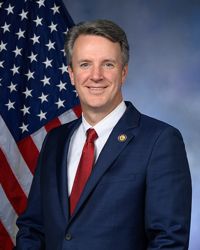
Ben Cline
RRepublicanVA-6 · Representative
56
/ 100
Average
Attendance99
Avg: 96
Independence6
Avg: 4
Bipartisan Tone11
Avg: 15
Ethics Record100
Avg: 99
Transparency53
Avg: 53
Accountability Score — composite of attendance, independence, bipartisan tone, ethics record & transparency.
Methodology24
Bills Sponsored
0
Enacted into Law
1
Passed a Chamber
23
In Committee
All Sponsored Bills
HR7730Passed House
Bankruptcy Threshold Adjustment Act
Bankruptcy Threshold Adjustment Act of 2026 This bill restores changes that expired in 2024 applicable to debt limits for Subchapter V (small business reorganization) and Chapter 13 (the wage earner's plan) bankruptcies. Specifically, the bill increases the debt limit under Subchapter V from approximately $3.4 million to $7.5 million and increases the cumulative debt limit under Chapter 13 from approximately $2.1 million to $2.75 million. The bill also applies both secured and unsecured debt towards the Chapter 13 limit. (Currently, separate limits apply to secured and unsecured debt under Chapter 13 bankruptcy.)
HR10016In Committee
Veterans Entrepreneurship Act of 2026
The Small Business Administration would launch a pilot program to give grants to veterans who want to start or buy their own businesses. This would help military veterans get financial support to become entrepreneurs without having to rely solely on loans. The program would test whether direct grants are an effective way to help veterans launch successful small businesses.
HR9701In Committee
Daughters of the American Revolution Membership Integrity Act.
Daughters of the American Revolution Membership Integrity Act This bill limits membership eligibility for the National Society of the Daughters of the American Revolution (commonly known as the Daughters of the American Revolution, or DAR) to biological women. (Under the bill, biological women are human females who naturally have, had, will have, or would have—if not for a congenital anomaly or intentional or unintentional disruption—a female reproductive system.) Members must also satisfy any genealogical and membership qualifications the organization establishes, as under current law. As background, DAR's federal charter provides that its purposes include perpetuating the memory and spirit of the men and women who achieved American independence.
HR2675In Committee
Protecting Our Courts from Foreign Manipulation Act
Protecting Our Courts from Foreign Manipulation Act This bill limits third-party financing of civil litigation by foreign entities in federal courts and establishes related disclosure requirements. The bill makes it unlawful for a foreign state or sovereign wealth fund to provide any monetary support for a civil action in which it is not a named party. The bill also makes it unlawful for any party or counsel to receive monetary support for civil litigation from a foreign state or sovereign wealth fund that is not a party. The bill also prohibits third-party litigation funding agreements involving money from a foreign state or sovereign wealth fund in which someone other than named parties or counsel of record receives a payment that is contingent on the outcome or proceeds from the civil action or from any matter within a portfolio that includes the civil action. The bill requires any party or counsel in a civil action to disclose the name of any foreign person, state, or sovereign wealth fund that has agreed to provide monetary support for the civil action, has a right to receive a payment contingent upon the outcome of the civil action, or has the right to receive payment that is contingent on proceeds from any matter within a portfolio that includes the civil action. The bill also requires parties to produce the agreement creating a contingent right to payment. These requirements apply to claims that are pending on or commenced after this bill's date of enactment.
HR8787In Committee
Servicemember Payment Data Privacy and Security Act
The Department of Defense would be banned from doing business with retail companies that use certain types of payment processing equipment, systems, or services. This restriction would affect defense contractors and suppliers who sell to the military, potentially limiting where the Pentagon can purchase goods and services. The goal appears to be controlling which payment technologies the military indirectly supports through its spending.
HR8570In Committee
Cost Estimate Clarity Act
The bill would require the Congressional Budget Office to explain how their cost estimates for proposed laws might change depending on which baseline assumptions they use when doing their calculations. This would give Congress and the public a clearer picture of how different starting points affect budget projections, making it easier to understand the real financial impact of new legislation.
HR8569In Committee
No Bias in the Baseline Act
This bill would change how Congress calculates budget baselines—the starting point used to measure whether spending proposals increase or decrease the budget. Instead of assuming spending will automatically adjust with inflation, the baseline would assume discretionary spending stays at current levels. This affects how lawmakers and budget analysts evaluate the cost of new legislation and spending proposals.
HR8077In Committee
287(g) Cooperation Act of 2026
This bill would expand and strengthen a federal program that allows local police departments to work directly with immigration authorities to identify and detain people suspected of being in the country illegally. The program, known as 287(g), would likely receive more funding and clearer guidelines to help state and local law enforcement participate in immigration enforcement alongside federal agents. The changes would affect both local police departments and immigrant communities, potentially increasing deportations and changing how local police interact with residents.
HR4642In Committee
Fiscal Contingency Preparedness Act
The bill would require the federal government to develop and maintain plans for continuing essential operations during budget crises, such as when Congress fails to pass a spending bill on time. It would establish procedures to keep critical services running for workers, veterans, and the public during these financial emergencies, while also setting rules for how agencies should manage their resources when funding is uncertain.
HR7900In Committee
Protecting Access to American Products Act
This bill would likely restrict or regulate the use of foreign-made products in American transportation and infrastructure projects, potentially requiring that materials and equipment used in federally-funded construction meet certain domestic content requirements. The measure would affect construction companies, manufacturers, and infrastructure projects receiving government funding by limiting their ability to source materials from overseas suppliers. The goal appears to be protecting American manufacturing jobs and ensuring that taxpayer money spent on infrastructure primarily benefits domestic producers.
HR7687In Committee
No Tax on Takings Act
This bill would prevent the federal government from taxing compensation that property owners receive when the government takes their land for public use, such as for highways or parks. Currently, when someone is paid for property seized through eminent domain, that payment may be subject to federal income tax; this legislation would make such payments tax-free. The change would primarily benefit property owners who lose land to government projects.
HR6622In Committee
Sunshine for Regulatory Decrees and Settlements Act of 2025
The legislation would require federal agencies to publicly disclose the details of settlement agreements and regulatory decisions they make with companies and organizations, making these deals transparent to the public rather than keeping them confidential. This affects businesses, nonprofits, and citizens who want to know what agreements their government has reached on regulations and enforcement actions. The bill aims to increase government accountability by ensuring that major regulatory deals are subject to public scrutiny rather than being negotiated behind closed doors.
HR6738In Committee
Protecting Ballot Measures From Foreign Influence Act of 2025
Protecting Ballot Measures From Foreign Influence Act of 2025 This bill prohibits contributions or donations by foreign nationals in connection with state or local ballot initiatives or referenda.
HR6485In Committee
Skinny Labels, Big Savings Act
Skinny Labels, Big Savings Act This bill provides a statutory safe harbor from patent infringement claims for generic or biosimilar manufacturers that seek or obtain approval for skinny labels of their drugs. Under current law, the Food and Drug Administration (FDA) may approve generic and biosimilar drugs through a process known as skinny labeling, which allows a generic manufacturer to seek approval only for approved uses of the drug that are no longer protected by patents. However, in GlaxoSmithKline LLC v. Teva Pharmaceuticals USA, Inc. , a court held that a generic manufacturer may sometimes be liable for patent infringement when it markets skinny label generics. The bill specifically lists the following as actions that are not considered infringement of a method of use claim in a patent under the Federal Food, Drug, and Cosmetic Act: submitting or seeking approval of a skinny label for a generic or biosimilar drug; promoting or commercially marketing a drug with skinny labeling approved by the FDA; or describing a drug product approved by the FDA as a generic of, or therapeutically equivalent to, the branded drug. The bill also applies the safe harbor to similar actions under the Public Health Service Act.
HR5874In Committee
Firearm Access During Shutdowns Act
Firearm Access During Shutdowns Act This bill requires various federal agencies to continue certain operations, functions, and services related to firearms during a government shutdown. The bill applies to the Federal Bureau of Investigation's National Instant Criminal Background Check System, including the processing of background checks in support of the operations of the Directorate of Enforcement Programs and Services of the Bureau of Alcohol, Tobacco, Firearms and Explosives (ATF); the ATF's Directorate of Enforcement Programs and Services; the activities of the Department of Commerce's Bureau of Industry and Security relating to firearms and firearm-related products, including activities related to processing of applications for export licenses; and the activities of the Department of State's Directorate of Defense Trade Controls relating to firearms and firearm-related products, including activities related to processing of applications for export licenses. Under the bill, (1) these operations, functions, and services are deemed to relate to an emergency involving the safety of human life or the protection of property; and (2) employees carrying out the operations, functions, and services are deemed to be excepted employees. (Under an exception in the Antideficiency Act, an employee whose duties involve the safety of human life or the protection of property may be required to work during a government shutdown. Employees who are required to work during a government shutdown because they fall under this or other exceptions are known as excepted employees.)
HR421In Committee
Small Business Regulatory Flexibility Improvements Act
Small Business Regulatory Flexibility Improvements Act This bill modifies the rulemaking requirements and procedures of federal agencies under the Regulatory Flexibility Act of 1980 and the Small Business Regulatory Enforcement Fairness Act of 1996, including how agencies consider economic impact with respect to small entities. Specifically, the bill requires agencies to consider the direct, and the reasonably foreseeable indirect, economic effect of a rule on small entities when determining whether a rule is likely to have a significant economic impact. Further, the regulatory flexibility analysis for rules with a significant economic impact must include a detailed description of alternatives to a proposed rule that minimize any adverse significant economic impact or maximize any beneficial significant economic impact on small entities. The bill also expands the types of agency actions (e.g., revisions to land management plans) that are subject to a regulatory impact analysis. The bill removes the authority for an agency to waive the regulatory flexibility analysis requirements and requires the Office of Advocacy of the Small Business Administration to issue rules for compliance with such requirements. The bill also modifies the procedures for the (1) gathering of comments for a proposed rule, (2) periodic review of agency rules, and (3) judicial review of final rules.
HR416In Committee
No Welfare for the Wealthy Act of 2025
No Welfare for the Wealthy Act of 2025 This bill requires all households participating in the Supplemental Nutrition Assistance Program (SNAP) to meet the program's income and asset requirements, thereby eliminating certain alternative SNAP eligibility pathways. Currently, a household may be eligible for SNAP by meeting program-specific federal eligibility requirements, which include both income and asset tests. A household may also be automatically or categorically eligible for SNAP based on eligibility for or receiving cash benefits from other specified low-income assistance programs (e.g., Temporary Assistance for Needy Families [TANF]). Under this categorical eligibility, households that already meet financial eligibility rules in a program like TANF are not required to go through a SNAP financial eligibility determination. A majority of states also provide broad-based categorical eligibility (BBCE), a policy that makes most households with an income below a certain threshold categorically eligible for SNAP. Under BBCE, these states typically make households categorically eligible through receiving or being authorized to receive a minimal non-cash TANF benefit or service (e.g., a pamphlet). A state may set its own BBCE financial eligibility requirements for a household so long as the gross income requirement is below a certain level. A state's requirements do not have to match SNAP program-specific eligibility requirements. For example, most states that provide BBCE do not have an asset test for SNAP eligibility. The bill requires all SNAP households, including those that qualify under categorical eligibility, to meet the program's income and asset requirements.
HR422In Committee
No Subsidies for Wealthy Universities Act
No Subsidies for Wealthy Universities Act This bill limits the indirect costs that are allowable under federal research awards to institutions of higher education (IHEs) with endowments above specified thresholds. (Generally, indirect costs represent expenses that are not specific to a research project but are needed to maintain the infrastructure and administrative support for federally funded research.) Specifically, the National Center for Education Statistics (NCES) must annually collect information regarding the endowments of each IHE that has entered into a program participation agreement with the Department of Education. With this collected information, NCES must identify and make lists of (1) each IHE with an endowment of more than $5 billion, and (2) each IHE with an endowment of more than $2 billion (but not more than $5 billion). NCES must submit these lists to the Office of Management and Budget, which must then distribute the lists to federal agencies, Congress, and the public. The bill establishes the following limits on the indirect costs allowable under federal research awards: for an IHE with an endowment of more than $5 billion, the IHE is prohibited from using these awards for indirect costs; for an IHE with an endowment of more than $2 billion (but not more than $5 billion), the IHE is limited to an indirect cost rate of 8%; and for all other IHEs, an indirect cost rate of 15%. The Government Accountability Office must annually report to Congress on indirect cost reimbursement on federal research awards for IHEs.
HR404In Committee
Hearing Protection Act
This bill would remove the federal tax and licensing requirements that currently apply to firearm silencers, making them cheaper and easier for gun owners to purchase by eliminating a $200 tax stamp and registration process. The change would affect gun manufacturers, dealers, and individual firearm owners who want to use silencers for hearing protection or noise reduction. The bill is currently being reviewed by two congressional committees to determine which parts fall under their areas of responsibility.
HR419In Committee
Protecting America From Spies Act
Protecting America From Spies Act This bill expands the grounds for barring non-U.S. nationals ( aliens under federal law) from entering the United States on the basis of espionage or sabotage. Currently, an individual is inadmissible if the individual seeks to enter the United States to engage in an act that (1) violates a U.S. law relating to espionage or sabotage; or (2) violates any U.S. law prohibiting the export of goods, technology, or sensitive information. Under the bill, an individual is inadmissible if the individual engages, has engaged, or will engage in such an act or in an act that would violate any U.S. law relating to espionage or sabotage if it occurred in the United States. Furthermore, the bill expands these grounds of inadmissibility and other security-related grounds to cover the spouse or child of the barred individual if the act occurred in the last five years.
HR418In Committee
Ensuring Accountability in Agency Rulemaking Act
Ensuring Accountability in Agency Rulemaking Act This bill requires, subject to a limited exception, that any agency rule promulgated under notice and comment procedures must be (1) initiated by a senior appointee (e.g., an individual who was appointed by the President or is a non-career member of the Senior Executive Service), and (2) issued and signed by an individual who was appointed by the President and confirmed by the Senate. The Office of Information and Regulatory Affairs must issue guidance for agencies to implement this requirement.
HR417In Committee
End U.N. Censorship Act
End U.N. Censorship Act This bill specifies that no federal funds may be made available to support the iVerify tool (a fact-checking tool developed by the United Nations Development Programme) or any other effort that seeks to label speech or expression as mal-, mis-, or dis-information.
HR420In Committee
Federal Grant Accountability Act
Federal Grant Accountability Act This bill limits the indirect costs that are allowable under federal research awards to institutions of higher education (IHEs). (Generally, indirect costs represent expenses that are not specific to a research project but are needed to maintain the infrastructure and administrative support for federally funded research.) Specifically, the total amount of indirect costs allowable under a federal research award may not exceed the total amount of indirect costs allowable under private research awards. The Office of Management and Budget must determine the average indirect cost rate applicable to private research awards. Additionally, the Government Accountability Office must study and report on (1) the indirect cost rates allowable under federal research awards to IHEs, including awards made by the National Institutes of Health, the National Science Foundation, and other such organizations; and (2) the indirect cost rates allowable under private research awards to IHEs.
HR384In Committee
One Agency Act
One Agency Act This bill consolidates federal antitrust enforcement authority in one department by transferring the Federal Trade Commission's (FTC) antitrust functions, employees, assets, and funding to the Department of Justice (DOJ). The bill provides a one-year period for DOJ to implement the transition and allows DOJ to extend the period once for an additional 180 days. During the transition period, DOJ may restructure the department's antitrust division and deputize FTC antitrust employees to investigate and prosecute antitrust violations on behalf of DOJ prior to the completion of the transfer of personnel from the FTC to DOJ. DOJ is also authorized to require businesses to file annual or special reports about the business’s organization, conduct, practices, management, and relationship to other businesses filing such reports.