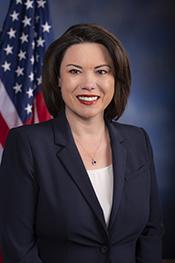
Angie Craig
DDemocratMN-2 · Representative
53
/ 100
Average
Attendance96
Avg: 96
Independence4
Avg: 4
Bipartisan Tone13
Avg: 15
Ethics Record100
Avg: 99
Transparency34
Avg: 53
Accountability Score — composite of attendance, independence, bipartisan tone, ethics record & transparency.
Methodology12
Bills Sponsored
0
Enacted into Law
0
Passed a Chamber
12
In Committee
All Sponsored Bills
HR9702In Committee
Medicare-X Choice Act of 2026
The proposal would create a new government-run health insurance option that Americans could choose as an alternative to private insurance plans. This public plan would compete with existing insurance companies and could help reduce healthcare costs for individuals and families who enroll in it. The plan would affect millions of Americans seeking health coverage, insurance companies, and healthcare providers across the country.
HR9120In Committee
To require the Postal Service to implement recommendations from the Inspector General of the United States Postal Service for improving identification and notification of undelivered and partially delivered routes, and for other purposes.
The bill would require the U.S. Postal Service to follow recommendations from its Inspector General about better identifying and notifying customers when mail routes aren't fully delivered or have problems. This would help the Postal Service track delivery issues more effectively and keep people informed when their mail isn't reaching them as expected.
HRES1306In Committee
Recognizing "National Public Works Week" and the essential contributions of public works professionals.
This resolution designates a specific week as "National Public Works Week" to honor the workers who build and maintain the roads, bridges, water systems, and other infrastructure that communities depend on every day. The recognition highlights the important contributions of engineers, construction workers, and other professionals in the public works field who keep essential services running. The measure has been sent to the House Committee on Transportation and Infrastructure for consideration.
HR8442In Committee
Patient Refunds for Bad Denials Act of 2026
When health insurance companies wrongly deny claims for dental work, patients would be entitled to get their money back plus interest if the denial is later overturned. The law would require insurers to process these refunds quickly and would establish penalties for companies that delay or refuse to pay patients what they owe. This affects anyone with dental insurance coverage who has had a claim denied and had to pay out of pocket.
HR7206In Committee
Farm and Family Relief Act
The bill aims to provide financial assistance and relief measures to farmers and rural families, likely through tax breaks, direct payments, or loan programs to help them weather economic hardship. The proposal has been sent to multiple congressional committees that handle agriculture, taxes, and federal spending to review different parts of the legislation before it moves forward. Farmers, agricultural workers, and rural communities would be the primary groups affected by any relief provisions included in the final bill.
HR7207In Committee
Presidential Conflicts of Interest Accountability Act
This bill would establish rules requiring the president to disclose financial interests and divest from business holdings to avoid conflicts of interest, similar to ethics requirements that apply to other federal officials. It aims to prevent situations where a president's personal financial interests could influence their official decisions on matters affecting their businesses or investments. The bill has been sent to two House committees for review and potential amendments.
HR6255In Committee
Affordable Insulin Now Act
The proposal would make insulin more affordable for Americans by capping what patients have to pay out of pocket for the medication, likely through price controls or insurance coverage requirements. This would primarily affect diabetics who depend on insulin to manage their condition, as well as insurance companies and pharmaceutical manufacturers. The bill is currently being reviewed by three House committees to determine which parts fall under their areas of responsibility.
HR5678In Committee
No Pay for Disarray Act
No Pay for Disarray Act This bill withholds or eliminates the pay of Members of Congress during a government shutdown. Through the day of the general election in November 2026, any salary earned by Members during a government shutdown must be held in escrow and released on the last day of the 119th Congress. After the November 2026 general election, a Member shall not be paid for any day during which a government shutdown is in effect.
HR4588In Committee
Supporting Apprenticeship Colleges Act of 2025
Supporting Apprenticeship Colleges Act of 2025 This bill directs the Department of Education to award grants to institutions of higher education that sponsor construction and manufacturing-oriented registered apprenticeship programs for (1) expanding or supporting outreach to high schools, local businesses, local workforce development boards, and apprenticeship intermediaries; and (2) providing advising and support services to students who are enrolled in these apprenticeship programs.
HRES418In Committee
Ride-Along Resolution
HR3275In Committee
Small Business Tax Relief Act
Small Business Tax Relief Act This bill reduces the federal corporate income tax rate for certain small businesses, increases the federal tax deduction for self-employment taxes, modifies the taxation of carried interest, and increases the federal excise tax on stock buybacks. For corporations with taxable income that does not exceed $5 million, the bill reduces the income tax rate on the portion of the corporation's taxable income that does not exceed $400,000 to 18% (currently 21%). The bill increases the tax deduction for self-employment taxes for individuals with an adjusted gross income of less than $400,000 to 75% (from 50%) of such taxes paid. Under the bill, net capital gain and loss attributable to carried interest is taxed at ordinary income tax rates. (Carried interest is currently taxed at capital gains tax rates, which may be lower than applicable ordinary income tax rates. Carried interest is the share of profits received by the general partner in a private equity firm or hedge fund from the assets managed by that general partner.) The bill treats as ordinary the money (or fair market value of property) received by a partner in a sale or exchange of carried interest, requires distributions of carried interest by a partnership in exchange for interest in other partnership property to be recognized ordinary gain, and imposes self-employment taxes on carried interest income. Finally, the bill increases the excise tax on stock buybacks to 1.5% (from 1%) of the repurchased stock’s fair market value.
HR2909In Committee
You Earned It, You Keep It Act
Based on the title and tax focus, this bill likely aims to reduce taxes on workers' earnings or allow people to keep more of their income by lowering tax rates or removing certain tax requirements. The bill has been sent to congressional committees that handle tax policy and related economic matters for review and consideration. Without seeing the specific details, the general intent appears to be giving workers or taxpayers relief by letting them retain more of what they earn.