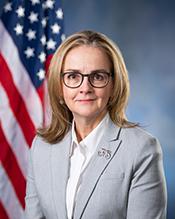
Madeleine Dean
DDemocratPA-4 · Representative
62
/ 100
Average
Attendance98
Avg: 96
Independence1
Avg: 4
Bipartisan Tone15
Avg: 15
Ethics Record100
Avg: 99
Transparency96
Avg: 53
Accountability Score — composite of attendance, independence, bipartisan tone, ethics record & transparency.
Methodology21
Bills Sponsored
0
Enacted into Law
0
Passed a Chamber
21
In Committee
All Sponsored Bills
HR10733In Committee
To establish a Science Advisory Board at the Department of Justice, and for other purposes.
HR10659In Committee
Removing Access Barriers to Running for Elected Office for People with Disabilities Act
HR10660In Committee
AID Local Government Leadership Act
HR10661In Committee
Beyond the Box for Higher Education Act of 2026
Beyond the Box for Higher Education Act of 2026 This bill requires the Department of Education to issue guidance and recommendations for institutions of higher education to remove criminal and juvenile justice questions from their admission applications.
HR10543In Committee
PREP Act
HR10254In Committee
MORE Savings Act
Maximizing Opioid Recovery Emergency Savings Act or the MORE Savings Act This bill modifies coverage of opioid treatments and recovery support services under Medicare, Medicaid, and private health insurance. Specifically, the bill requires the Center for Medicare and Medicaid Innovation to test a model in which specified opioid treatments and recovery support services are provided under Medicare without cost-sharing (e.g., coinsurance, copayments, and deductibles). The bill also allows state Medicaid programs to cover recovery support services as part of medication-assisted treatment (MAT) and increases the applicable Federal Medical Assistance Percentage for MAT. Additionally, beginning in 2027, private health insurers must cover specified opioid treatments and MAT-associated recovery support services without cost-sharing.
HR10226In Committee
To prohibit the use of shock gloves by Federal law enforcement officers to enforce the immigration laws, and for other purposes.
HR10018In Committee
Fair Debt Collection Practices for Servicemembers Act
The proposal would strengthen rules that protect military members and veterans from aggressive debt collection tactics, such as repeated calls, threats, or contact at inconvenient times. It would give service members additional legal tools to fight harassment from debt collectors and potentially increase penalties for companies that violate these protections. The changes aim to address the particular financial vulnerabilities that active-duty personnel and veterans may face.
HR8681In Committee
SHIELD Act
The proposal would punish foreign companies and individuals that use forced labor or child labor to mine cobalt, a mineral used in batteries and electronics, by blocking them from doing business with the United States and freezing any assets they have in America. This would affect mining operations and companies that buy cobalt from suppliers using exploitative labor practices, potentially making electronics and battery manufacturers more careful about where they source their materials. The measure aims to discourage human rights abuses in cobalt mining, particularly in countries where such practices are common.
HRES1158In Committee
Recognizing the importance of sleep health and expressing support for the designation of the week of March 9 through March 13, 2026, as "Sleep Awareness Week".
This resolution designates the week of March 9-13, 2026, as "Sleep Awareness Week" to highlight the importance of healthy sleep habits for public health. The measure expresses congressional support for raising awareness about sleep disorders and encouraging Americans to prioritize getting enough rest. It does not create new laws or programs, but rather serves as a symbolic statement recognizing sleep health as an important health issue.
HR7491In Committee
Effective Assistance of Counsel in the Digital Era Act
Effective Assistance of Counsel in the Digital Era Act This bill prohibits the Department of Justice from monitoring the contents of a privileged electronic communication between an incarcerated person and his or her legal representative.
HR7355In Committee
Flood History Information Act of 2026
This bill would require lenders and financial institutions to provide borrowers with information about a property's flood history before approving mortgages or loans. The requirement aims to help homebuyers and property owners make informed decisions by knowing whether a property has experienced flooding in the past, which could affect its value, insurance costs, and future risk.
HR7209In Committee
TRAIN Act
Without access to the specific bill text, the TRAIN Act appears to address commerce-related matters and has been referred to the House Judiciary Committee, suggesting it likely involves legal or regulatory frameworks affecting business operations or trade. To provide an accurate summary of what this bill would actually do and who it affects, the specific provisions would need to be reviewed.
HR6434In Committee
Freedom to Heal Act of 2025
Without access to the bill's specific text, this legislation appears to address health policy matters and has been sent to two committees for review. Based on the title's reference to "freedom to heal," the bill likely aims to expand patient or provider options in healthcare, though the exact provisions—whether involving treatment access, medical decision-making, insurance choices, or regulatory changes—cannot be determined from the referral information alone. Once the committees review it, the specific impacts on patients, doctors, insurers, or the healthcare system will become clearer.
HRES845In Committee
Expressing support for the recognition of the week of November 2 through November 8, 2025, as "Drowsy Driving Prevention Week".
This resolution (1) supports the designation of Drowsy Driving Prevention Week to raise awareness about the dangers of drowsy driving, and (2) encourages people across the United States to take preventable steps against drowsy driving.
HR4221In Committee
Undetectable Firearms Modernization Act
Undetectable Firearms Modernization Act This bill strengthens the detectability standard for firearms under federal firearms laws. Current law requires firearms to be detectable by walk-through metal detectors after the removal of grips, stocks, and magazines. Specifically, firearms must be as detectable as a security exemplar (i.e., a piece of stainless steel that is 3.7 ounces and in a shape resembling a handgun). There are exceptions, including for firearms manufactured for or sold to U.S. military or intelligence agencies. This bill requires firearms to contain detectable material after the removal of all parts other than major components. It defines detectable material as material that produces a magnetic field equivalent to that produced by 3.7 ounces of stainless steel. The bill also revises and broadens the exceptions to include firearms (1) received by, in the possession of, or under the control of the United States; or (2) produced pursuant to a contract with the United States.
HR4223In Committee
Gun Records Restoration and Preservation Act
Gun Records Restoration and Preservation Act This bill removes limitations on the authority of the Bureau of Alcohol, Tobacco, Firearms and Explosives to conduct activities related to the administration of federal firearms laws. Specifically, the bill removes provisions that limit the use of firearms tracing data, limit the disclosure of data under the Freedom of Information Act, prohibit imposing a requirement that gun dealers conduct a physical inventory, prohibit consolidating or centralizing records maintained by federal firearm licensees (e.g., gun dealers), and require background check records to be destroyed within 24 hours.
HR4222In Committee
Fire Sale Loophole Closing Act of 2025
Fire Sale Loophole Closing Act of 2025 This bill establishes restrictions on the transfer of business inventory firearms by a federally licensed dealer, importer, or manufacturer of firearms (i.e., a federal firearms licensee, or FFL) whose license is revoked or denied. The term business inventory firearm means a firearm that is required to be recorded in the acquisition and disposition logs of a firearms business. Among the restrictions, the bill generally prohibits the transfer of a business inventory firearm by an FFL to their personal collection or employee after they receive written notice revoking or denying their license or by a former FFL to any non-FFL on or after the date their license is revoked. The bill also prohibits the transfer of a former business inventory firearm from a personal collection within one year of the date the firearm was transferred to the personal collection. An individual who violates the restrictions is subject to criminal penalties—a fine, prison term of up to one year (or five years if the violation was willful), or both. Finally, the bill requires the written notice revoking or denying a license to include the federal statutes and regulations that prohibit a non-FFL from engaging in the business of dealing in firearms, as well as the restrictions on transferring business inventory firearms by an FFL or former FFL whose license is revoked or denied.
HR3178In Committee
Save Healthcare Workers Act
Save Healthcare Workers Act This bill establishes a new criminal offense for knowingly assaulting hospital personnel during the performance of their official duties in a manner that interferes with their performance of the duties or limits their ability to perform the duties. Violations are subject to a fine, imprisonment of up to 10 years, or both. Violations that involve dangerous weapons, result in bodily injury, or are committed during a declared public emergency are subject to an enhanced penalty of a fine, imprisonment of up to 20 years, or both. Additionally, the bill authorizes grants to reduce the incidence of violence at hospitals, including violence or intimidation against hospital personnel in the performance of their duties.
HR2420In Committee
Northern Rockies Ecosystem Protection Act of 2025
The proposal would permanently protect approximately 3.1 million acres of federal land in Montana, Idaho, and Wyoming from oil and gas drilling, mining, and commercial logging, while allowing hunting, fishing, and recreation. It would affect energy companies, mining operations, and timber companies that currently have access to these lands, while benefiting outdoor enthusiasts, conservationists, and communities that depend on tourism and clean water from these ecosystems. The protected areas would include wilderness regions, national forests, and other public lands in the Northern Rockies region.
HRES235In Committee
Recognizing the importance of sleep health and expressing support for the designation of the week of March 9 through March 15, 2025, as "Sleep Awareness Week".
This resolution supports the designation of Sleep Awareness Week.