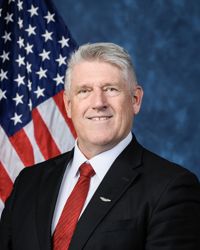
Troy Downing
RRepublicanMT-2 · Representative
56
/ 100
Average
Attendance99
Avg: 96
Independence4
Avg: 4
Bipartisan Tone15
Avg: 15
Ethics Record100
Avg: 99
Transparency47
Avg: 53
Accountability Score — composite of attendance, independence, bipartisan tone, ethics record & transparency.
Methodology21
Bills Sponsored
2
Enacted into Law
2
Passed a Chamber
17
In Committee
Bills That Became Law
HR7250To reauthorize the Fort Peck Reservation Rural Water System Act of 2000.HJRES104Providing for congressional disapproval under chapter 8 of title 5, United States Code, of the rule submitted by the Bureau of Land Management relating to "Miles City Field Office Record of Decision and Approved Resource Management Plan Amendment".
All Sponsored Bills
HR1190Passed House
Expanding Access to Capital for Rural Job Creators Act
Expanding Access to Capital for Rural Job Creators Act This bill requires the Office of the Advocate for Small Business Capital Formation within the Securities and Exchange Commission to report on issues encountered by rural-area small businesses.
HR7250Enacted
To reauthorize the Fort Peck Reservation Rural Water System Act of 2000.
This bill reauthorizes through FY2028 the planning, design, and construction of the Assiniboine and Sioux Rural Water System and the Dry Prairie Rural Water System, both located in Montana.
HR6788In Committee
Montana Sportsmen Conservation Act
This bill would likely protect or manage public lands in Montana for hunting, fishing, and outdoor recreation purposes. It probably addresses conservation of wildlife and natural resources while balancing the interests of sportsmen and outdoor enthusiasts who use public lands. The specific details would determine whether it expands access to certain areas, protects habitat, or adjusts hunting and fishing regulations.
HR10222In Committee
No HUD Funding for Sanctuary Cities Act
HR726In Committee
Crow Tribe Water Rights Settlement Amendments Act of 2025
Crow Tribe Water Rights Settlement Amendments Act of 2025 This bill revises the water rights settlement agreement entered into by the Crow Tribe of Montana and Montana. The Crow Tribe Water Rights Settlement Act of 2010 ratified, authorized, and confirmed the water rights compact between the tribe and Montana. Among other provisions, this settlement act authorized the Bureau of Reclamation to plan, design and construct the following two major projects on the Crow Reservation: (1) the rehabilitation and improvement of the Crow Irrigation Project (CIP); and (2) the planning, design, and construction of the MR&I System (the municipal, rural, and industrial water system of the Crow Reservation). Among other provisions, the bill revises the settlement act to replace references to the MR&I System with MR&I Projects ; establish a nontrust, interest-bearing account (to be known as the Crow CIP Implementation Account) to allow Reclamation to continue to work on the rehabilitation of the CIP; create a new MR&I Projects Account, through which the tribe must use funds for activities related to water production, treatment, or delivery infrastructure; and extend by five years (to 2030) the period during which the tribe has the exclusive right to construct hydropower facilities on the Yellowtail Afterbay Dam in Montana.
HR9574In Committee
Informed Investor Access Act
The proposal would expand who qualifies as an "accredited investor" — a status that currently allows wealthier individuals to invest in riskier, less-regulated investments like private companies and hedge funds — by letting people with lower incomes also participate if they're getting advice from licensed financial professionals. This change would give more Americans access to investment opportunities previously limited to the wealthy, though it could also expose more people to higher-risk investments. The measure is intended to democratize investment options while relying on professional advisors to help guide these decisions.
HR8682In Committee
Accelerating Forest Management Act
The federal government would officially approve a streamlined environmental review process for salvage logging operations on public lands managed by the Bureau of Land Management, allowing companies to harvest dead or dying trees more quickly without the full environmental impact studies normally required. This change would affect timber companies, environmental groups, and communities that depend on or care about public forests, by making it faster to remove trees damaged by fire, disease, or insects but potentially reducing the level of environmental scrutiny applied to these projects.
HR8745In Committee
Dry-Redwater Regional Water Authorization Act
The proposal would officially authorize a new water system in Montana called the Dry-Redwater Regional Water Authority, allowing it to operate and manage water resources in that region. This affects residents and businesses in the affected Montana area who depend on reliable water supplies for drinking, agriculture, and other uses. The bill is currently under review by the House Committee on Natural Resources.
HR8726In Committee
PARTNERS Act of 2026
States would gain the power to enforce rules that Medicare Advantage insurance plans must follow, rather than having only the federal government oversee these requirements. This change would affect seniors enrolled in Medicare Advantage plans and the insurance companies that offer them, potentially giving states more authority to protect beneficiaries and ensure plans comply with regulations in their jurisdictions.
HR8092In Committee
Native American Housing Assistance and Self-Determination Modernization Act of 2026
This bill would update federal housing programs for Native Americans and Alaska Natives, likely making it easier for tribes to manage their own housing assistance programs and modernizing rules that haven't changed in decades. The changes would give tribal governments more control over how they spend federal housing money and could help more Native American families afford safe homes on and near reservations. The bill affects Native American communities, tribal governments, and federal agencies that currently oversee these housing programs.
HR3959In Committee
Protecting Private Job Creators Act
Protecting Private Job Creators Act This bill provides statutory authority for an exemption from specified disclosure requirements applicable to fixed-income securities (e.g., corporate bonds or a certificate of deposit). Under current securities regulations, brokers and dealers are generally prohibited from publishing securities quotations (i.e., the sale price) in over-the-counter (i.e., not on a national exchange) markets unless they have certain information about the securities issuer in their records. The Securities and Exchange Commission issued a series of orders (with the latest order issued in November 2024) granting an exemption to this rule to fixed-income securities that comply with specified safe-harbor rules. The bill provides statutory authority for this exemption.
HR6568In Committee
Lower Yellowstone River Native Fish Conservation Act
This bill would protect native fish species in the Lower Yellowstone River by establishing conservation requirements for water management and dam operations in that region. The legislation would likely affect farmers, hydroelectric power operators, and environmental groups by setting new rules for how water is released from dams to maintain healthy fish populations and river conditions. The bill aims to balance the needs of native fish species with existing water uses in the area.
HR7130In Committee
McCarran-Ferguson Restoration Act
The legislation would restore certain antitrust exemptions for the insurance industry that were previously limited by court decisions, allowing insurance companies to work together on setting rates and sharing information without facing federal antitrust lawsuits. This would primarily affect insurance companies and potentially impact consumers through changes in how insurance premiums are priced and what coverage options are available. The bill aims to give insurers more flexibility in their business practices while reducing their legal exposure under federal competition laws.
HR725In Committee
Crow Revenue Act
Crow Revenue Act This bill addresses the exchange of mineral interests in Montana involving the federal government, the Crow Tribe of Montana, and a private party. Specifically, the bill requires the Department of the Interior to accept the relinquishment of a specified federal coal lease associated with the Bull Mountains Mine near Roundup, Montana (the current operator of the mine is Signal Peak Energy); the Joe and Barbara Hope Mineral Trust (Hope Family Trust) to convey approximately 4,660 acres of subsurface mineral interests located within the boundaries of the Crow Indian Reservation in Big Horn County, Montana, to the tribe; and Interior to convey approximately 4,530 acres of subsurface mineral interests and 940 acres of surface interests located in Musselshell County, Montana, to the Hope Family Trust. Prior to these conveyances, the tribe must notify Interior that the tribe and the Hope Family Trust have agreed on a revenue-sharing formula for the development of the mineral and surface interests in Musselshell County, Montana. The mineral interests conveyed by the Hope Family Trust to the tribe shall be held in trust by the United States for the benefit of the tribe, upon the tribe's request. These mineral interests shall not be subject to state or local taxation.
HJRES104Enacted
Providing for congressional disapproval under chapter 8 of title 5, United States Code, of the rule submitted by the Bureau of Land Management relating to "Miles City Field Office Record of Decision and Approved Resource Management Plan Amendment".
This joint resolution opens certain land administered by the Bureau of Land Management (BLM) in eastern Montana to coal leasing. Specifically, it nullifies the rule issued by the Bureau of Land Management (BLM) relating to the Record of Decision and Approved Resource Management Plan (RMP) Amendment for the Miles City Field Office in Montana. The BLM approved the RMP Amendment on November 20, 2024. The RMP Amendment made no acres available for coal leasing and 1,745,040 acres unavailable for further consideration for coal leasing to reduce greenhouse gas emissions.
HR4495Passed House
SBA Fraud Enforcement Extension Act
SBA Fraud Enforcement Extension Act This bill extends the statute of limitations to 10 years for fraud-based criminal and civil offenses with respect to the Shuttered Venue Operators Grant and the Restaurant Revitalization Fund COVID-19 relief programs.
HR6256In Committee
Floodplain Enhancement and Recovery Act
This bill would likely create or modify financial programs and incentives to help communities recover from flooding and reduce future flood damage in floodplain areas. It probably involves funding mechanisms, insurance adjustments, or lending programs that would help homeowners, businesses, and local governments rebuild after floods or invest in flood prevention measures. The bill affects property owners in flood-prone areas, insurance companies, banks, and communities seeking federal financial support for flood recovery and resilience.
HR5942In Committee
National Cemetery Access Act
National Cemetery Access Act This bill requires that national cemeteries administered by the Department of Defense, Department of Veterans Affairs, or the National Park Service must be open to visitors on the 11 legal public holidays (e.g., Memorial Day).
HR931In Committee
To allow certain Federal minerals to be mined consistent with the Bull Mountains Mining Plan Modification, and for other purposes.
This bill authorizes coal to be mined on approximately 800 acres of federal land in Musselshell County, Montana. Specifically, it allows all federal coal reserves in such federal land and leased under Federal Coal Lease MTM 97988 to be mined in accordance with the 2020 Bull Mountains Mining Plan Modification. The Bull Mountains Mine is operated by Signal Peak Energy. This bill directs the Department of the Interior, without modification or delay, to approve the Bull Mountains Mining Plan Modification to the extent necessary to mine such land.
HR3318In Committee
SEC Modernization Act
HR643In Committee
Federal Insurance Office Elimination Act
Federal Insurance Office Elimination Act This bill eliminates the Federal Insurance Office (FIO) within the Department of the Treasury. The bill also removes the FIO director as a nonvoting member of the Financial Stability Oversight Council.