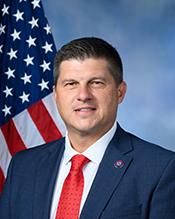
Brad Finstad
RRepublicanMN-1 · Representative
57
/ 100
Average
Attendance99
Avg: 96
Independence1
Avg: 4
Bipartisan Tone8
Avg: 15
Ethics Record100
Avg: 99
Transparency72
Avg: 53
Accountability Score — composite of attendance, independence, bipartisan tone, ethics record & transparency.
Methodology29
Bills Sponsored
0
Enacted into Law
3
Passed a Chamber
25
In Committee
All Sponsored Bills
HR10353Reported
SBIC Reporting Modernization Act of 2026
HR10736In Committee
Safeguarding Technology from CCP Influence Act
HR9576Passed House
National Fraud Enforcement Division Act of 2026
National Fraud Enforcement Division Act of 2026 This bill provides statutory authority for the National Fraud Enforcement Division within the Department of Justice (DOJ). The division investigates and prosecutes fraud against taxpayer dollars and taxpayer-funded programs. The National Fraud Enforcement Division was established by DOJ in April 2026.
HR10260In Committee
Reducing Arbitrary Barriers to Apprenticeship Act of 2026
HR10021In Committee
To authorize the President to award the Medal of Honor to Earl L. Nolte for acts of valor as a member of the Army during World War II.
The proposal would allow the President to award the Medal of Honor, the military's highest decoration for bravery, to Earl L. Nolte for his courageous actions as an Army soldier during World War II. The Medal of Honor recognizes extraordinary heroism in combat, and this bill would authorize the President to present this honor to Nolte for his service decades after the war ended. The measure is currently under review by the House Committee on Armed Services.
HR8881Passed House
SBA Artificial Intelligence Utilization Act of 2026
SBA Artificial Intelligence Utilization Act of 2026 This bill requires the Small Business Administration (SBA) to annually report on the SBA's use of artificial intelligence and machine learning. The report must include information about (1) the benefits and risks posed by the SBA's use of artificial intelligence and machine learning; and (2) measures that the SBA can take to identify, evaluate, and manage such benefits and risks, including explanations of how the SBA can retain human involvement in decisions informed by the use of artificial intelligence or machine learning. Additionally, not later than 30 days after submitting each report, the SBA must brief the House Committee on Small Business and the Senate Committee on Small Business and Entrepreneurship about the report.
HR9055In Committee
Veteran Burial Benefit Correction Act
The bill would increase the amount of money the Department of Veterans Affairs pays toward burial and funeral costs when a veteran dies from a service-connected disability. This would help veteran families cover these expenses more fully, reducing their out-of-pocket costs during an already difficult time. The change would affect veterans and their families who are eligible for VA burial benefits.
HR9025In Committee
To designate the facility of the United States Postal Service located at 200 1st Avenue Southeast in Austin, Minnesota, as the "John Madden Memorial Post Office".
This bill designates the facility of the United States Postal Service located at 200 1st Avenue Southeast in Austin, Minnesota, as the "John Madden Memorial Post Office".
HRES1310In Committee
Expressing support for continued efforts to safeguard Medicare, Medicaid, and other Federal health care programs from fraud, waste, abuse, and improper payments through strengthened program integrity measures, enhanced oversight, and coordinated enforcement actions, and recognizing the work of the Trump administration and congressional Republicans to investigate and prosecute fraud and protect taxpayer dollars and preserve the long-term sustainability of the Nation's health care safety net.
This resolution expresses support for efforts to prevent fraud, waste, and improper payments in Medicare, Medicaid, and other federal health programs through stronger oversight and enforcement actions. It recognizes work by the Trump administration and congressional Republicans to investigate healthcare fraud and protect taxpayer money while maintaining these programs' long-term viability. The measure is a statement of support rather than a law that would create new requirements or programs.
HR8848In Committee
National Guard Relief Act
The National Guard Relief Foundation, which provides financial assistance to National Guard members and their families during hardship, would be officially recognized as a "military welfare society" under federal law. This change would allow the foundation to access certain benefits and protections that other military support organizations currently receive. The bill primarily affects National Guard members and their families who may need emergency financial assistance.
HRES1261In Committee
Expressing support for the designation of the week of May 3 through May 9, 2026, as "National Small Business Week" to celebrate the contributions of small businesses and entrepreneurs in every community in the United States.
This resolution honors the contributions of small businesses in the United States and supports the designation of National Small Business Week.
HR1163In Committee
Prove It Act
Prove It Act of 2025 This bill expands the requirements for federal agency rulemaking with respect to small businesses, organizations, and governmental jurisdictions. Specifically, when conducting an initial regulatory flexibility analysis, agencies must include, where feasible, any reasonably foreseeable indirect costs the proposed rule may impose on small entities. Further, if an agency certifies that an initial regulatory flexibility analysis is not required because the rule will not have a significant economic impact on a substantial number of small entities, the agency must provide such certification within 10 days to the Office of Advocacy of the Small Business Administration. A small entity or group of small entities may petition the Office of Advocacy to review such certification. The petition must include specified information, such as the issues the petitioner believes should be addressed and a proposed solution to the issues raised. If the Office of Advocacy ultimately determines, upon a full review of the petition, that the proposed rule would have a significant economic impact on a substantial number of small entities, the agency promulgating the rule must perform an initial and final regulatory flexibility analysis for the rule. Additionally, if the agency does not participate or assist in the full review process, the finalized rule shall not apply to small entities. The bill also requires agencies to publish, and allow for comments on, all guidance documents with respect to any rule an agency determines is likely to have a significant economic impact on a substantial number of small entities.
HR7426In Committee
USDA Express Loan Act of 2026
The bill would create a faster, simpler loan program through the USDA to help farmers and agricultural businesses get financing more quickly than through traditional channels. This would likely allow smaller farms and rural businesses to access credit with less paperwork and quicker approval times, making it easier for them to buy equipment, land, or cover operating costs.
HR7789In Committee
Federal Loan Systems Modernization Act of 2026
This bill would update the technology and processes used by federal loan programs to make them more efficient and easier for borrowers to use. The changes would likely affect federal student loans, small business loans, and other government lending programs by modernizing outdated computer systems and streamlining how applications are processed. The goal is to reduce errors, speed up loan approvals, and improve the overall experience for the millions of Americans who borrow from federal programs.
HR6978In Committee
Preserving Integrity in Immigration Benefits Act
Preserving Integrity in Immigration Benefits Act This bill requires the U.S. Citizenship and Immigration Services (USCIS) to review certain approved immigration benefit requests for proper approval. The review must include requests approved during the period starting on January 20, 2021, and ending on the date of enactment of this bill. Immigration benefit requests covered by this bill include those conferred during this period to individuals from the following countries: Angola, Afghanistan, Antigua and Barbuda, Benin, Burkina Faso, Burma, Burundi, Chad, the Republic of the Congo, Cote d'Ivoire, Cuba, Dominica, Equatorial Guinea, Eritrea, Gabon, the Gambia, Haiti, Iran, Laos, Libya, Malawi, Mali, Mauritania, Niger, Nigeria, Senegal, Sierra Leone, Somalia, Sudan, South Sudan, Syria, Tanzania, Togo, Tonga, Turkmenistan, Venezuela, Yemen, Zambia, and Zimbabwe. This also includes individuals traveling using documents issued or endorsed by the Palestinian Authority. The bill requires USCIS to report on any findings by September 15, 2026.
HR6520In Committee
SNAP Data Transparency and Oversight Act of 2025
This bill would require the government to publicly share more detailed information about how the food stamp program (SNAP) is being used and administered across different states and regions. The measure aims to give Congress, researchers, and the public better visibility into program spending, fraud prevention efforts, and how effectively benefits are reaching eligible families. It affects SNAP recipients, state agencies that run the program, and taxpayers funding these food assistance benefits.
HR6388In Committee
Conservation Reserve Program Modernization Act
The proposal would update the Conservation Reserve Program, a decades-old government initiative that pays farmers to temporarily take environmentally sensitive land out of production to prevent soil erosion and protect wildlife habitats. The changes would modernize how the program operates, potentially adjusting payment rates, eligibility requirements, or contract terms to better reflect current agricultural and environmental conditions. Farmers, landowners, and conservation organizations would be most directly affected by any modifications to this program.
HR5038In Committee
American Protein Processing Modernization Act
The legislation would update federal rules and provide funding to help meat and poultry processing plants modernize their equipment and facilities, making them more efficient and safer for workers. It would affect meat companies, poultry producers, and the workers employed in processing plants across the country. The changes aim to help American food processors compete better while improving working conditions and food safety standards.
HR6855In Committee
White House Conference on Small Business Act of 2025
This bill would establish a White House Conference on Small Business to bring together small business owners, entrepreneurs, and government officials to discuss challenges facing small companies and develop policy recommendations. The conference would provide a forum for small business leaders to share their concerns directly with federal policymakers and help shape future government decisions that affect their operations. The event would likely focus on issues like access to funding, regulations, taxes, and other factors that impact small business growth and competitiveness.
HR6685In Committee
To amend the Internal Revenue Code of 1986 to establish an exception for multiemployer plan participants to the requirements for automatic enrollment.
Workers covered by multiemployer pension plans (typically union workers in construction, trucking, and similar industries) would be exempt from automatic enrollment requirements that normally apply to retirement savings plans. This means employers wouldn't be required to automatically enroll these workers in retirement accounts, since they're already covered by their union pension plans. The change recognizes that multiemployer plan participants already have retirement benefits through their union agreements.
HR5548In Committee
Fraud Accountability and Recovery Act
This bill would establish new rules and procedures to identify, investigate, and recover money lost to fraud in U.S. international aid and foreign assistance programs. It likely aims to strengthen oversight of how federal agencies spend money abroad and create better systems to catch and punish people who steal or misuse those funds. The bill would affect federal agencies that manage foreign aid, international organizations receiving U.S. funds, and potentially contractors and individuals involved in overseas programs.
HR5180In Committee
To amend the National Defense Authorization Act for Fiscal Year 2000 to modify and extend the annual report on military and security developments involving the People's Republic of China.
The government currently publishes a yearly report analyzing China's military capabilities and security activities, and this bill would update and extend that reporting requirement. The changes would likely modify what information gets included in the report and ensure it continues to be produced going forward. This affects policymakers and the public who rely on this intelligence assessment to understand China's military developments.
HR5138In Committee
ASPIRE Act
Agriculture Skills Preparation for Industry Recruitment Efforts Act or the ASPIRE Act This bill directs the National Institute of Food and Agriculture to establish a grant program within its Beginning Farmer and Rancher Development Program for eligible educational institutions to develop and carry out agriculture workforce training programs. Eligible institutions include U.S. land-grant universities, non-land-grant colleges of agriculture, junior or community colleges with agriculture programs, and area career and technical education schools with agriculture programs. The grants must be used to develop and carry out agriculture workforce training programs to (1) promote the growth of the agriculture industry, (2) foster competitiveness within the industry, and (3) improve the training and retention of workers in the industry. An agriculture workforce training program is a program developed by an eligible institution in collaboration with a targeted industry partner through which the industry partner provides training to enrolled students. This may include training through internships, apprenticeships, experience-based curricula, and educational programs and workshops. The program must be implemented by January 31, 2026.
HR4657In Committee
Next Generation Farmer Act
The legislation would provide financial assistance and training programs to help new and beginning farmers get started in agriculture, including support for purchasing land and equipment. It aims to make farming more accessible to younger people and those from underrepresented backgrounds who want to enter the agricultural industry. The bill would affect aspiring farmers, agricultural lenders, and rural communities looking to develop the next generation of agricultural workers.
HR4590In Committee
To codify Executive Order 14305 (relating to restoring American airspace sovereignty).
The legislation would turn an executive order into permanent law that aims to protect American airspace from unauthorized foreign aircraft and drones. It would establish rules and procedures for detecting, tracking, and responding to aircraft that enter U.S. airspace without permission, affecting both civilian aviation and national security operations. The measure would give federal agencies clearer authority to manage airspace security threats.
HR2931Passed House
Save SBA from Sanctuary Cities Act of 2025
Save SBA from Sanctuary Cities Act This bill requires the relocation of a regional, district, or local office of the Small Business Administration (SBA) if the SBA makes a public determination that the office is located in a sanctuary jurisdiction. The SBA must relocate that office, within 60 days of such determination, to a location that is not a sanctuary jurisdiction. Under the bill, a sanctuary jurisdiction is a state or political subdivision thereof that prohibits or restricts any government entity or official from (1) exchanging with another government entity information regarding the citizenship or immigration status of an individual; or (2) complying with specified requests by the Department of Homeland Security. Additionally, the SBA may not establish an office in a sanctuary jurisdiction.
HR1604In Committee
Farm and Food Cybersecurity Act of 2025
Farm and Food Cybersecurity Act of 2025 This bill directs the Department of Agriculture (USDA) to (1) assess cybersecurity threats in the agriculture and food critical infrastructure sector, and (2) conduct annual crisis simulation exercises for food-related emergencies or disruptions. The agriculture and food critical infrastructure sector includes (1) any activity relating to the production, processing, distribution, storage, transportation, consumption, or disposal of agricultural or food products; and (2) any entity involved in any of these activities. Specifically, USDA must conduct a risk assessment every two years on the cybersecurity threats to, and security vulnerabilities in, this sector. The risk assessment must include any recommendations for federal legislative or administrative actions to address related threats and vulnerabilities. USDA must also conduct an annual simulation exercise relating to a food-related emergency or disruption in coordination with the Department of Homeland Security (DHS), the Department of Health and Human Services (HHS), and the Office of the Director of National Intelligence (ODNI). Among other things, the exercise must (1) involve a realistic and plausible scenario that simulates a food-related emergency or disruption that affects multiple sectors and jurisdictions, and (2) incorporate input from experts and stakeholders from various disciplines and sectors (e.g., agriculture, public health, emergency management, transportation, and energy). USDA, in consultation with DHS, HHS, and ODNI, must submit a report to Congress on each simulation exercise, including recommendations to enhance the cybersecurity and resilience of the agriculture and food critical infrastructure sector.
HR1302In Committee
GRAIN DRY Act
Growing Rural Agricultural Infrastructure Needs to Deliver Rising Yields Act or the GRAIN DRY Act This bill specifies that funds provided under the Farm Storage Facility Loan Program may be used to construct or upgrade storage facilities for propane that is primarily used for agricultural production. This Department of Agriculture loan program provides low-interest financing for agricultural producers to build or upgrade commodity storage facilities. Some agricultural producers use propane to power agricultural operations (e.g., grain dryers, irrigation engines, and barn heating).
HR1063In Committee
Farm Credit Administration Independent Authority Act
This bill would make the Farm Credit Administration, which oversees lending to farmers and rural businesses, more independent from direct government control. The change would likely give the agency more freedom to set its own policies and operations without as much oversight from Congress or the executive branch, similar to how some other financial regulators operate. Farmers and rural lenders who depend on Farm Credit System loans could see changes in how the agency manages credit availability and lending standards.