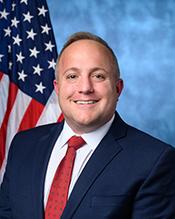
Russell Fry
RRepublicanSC-7 · Representative
53
/ 100
Average
Attendance99
Avg: 96
Independence7
Avg: 4
Bipartisan Tone8
Avg: 15
Ethics Record100
Avg: 99
Transparency32
Avg: 53
Accountability Score — composite of attendance, independence, bipartisan tone, ethics record & transparency.
Methodology16
Bills Sponsored
1
Enacted into Law
3
Passed a Chamber
11
In Committee
Bills That Became Law
All Sponsored Bills
HR10668In Committee
EASE Act
HR3100In Committee
To amend the National Child Protection Act of 1993 to ensure that businesses and organizations that work with vulnerable populations are able to request background checks for their contractors who work with those populations, as well as for individuals that the businesses or organizations license or certify to provide care for those populations.
This bill restores the authority for businesses and organizations that provide care or care placement services for children, the elderly, or individuals with disabilities (care-providing businesses and organizations) to request national criminal history background checks for contractors and for individuals they certify or license. Federal law authorizes care-providing businesses and organizations to request national criminal history background checks for certain covered individuals . From 1994 to 2018, covered individuals included three categories of individuals: (1) current or prospective employees or volunteers; (2) current or prospective owners or operators; and (3) anyone who had, may have had, or sought to have access to children, the elderly, or individuals with disabilities (e.g., contractors and licensees). In 2018, the Child Protection Improvements Act removed the third category, narrowing the scope of covered individuals to just two categories: (1) current or prospective employees or volunteers, and (2) current or prospective owners or operators. Under the law, an individual in one of the categories who has, may have, or seeks to have access to children, the elderly, or individuals with disabilities is a covered individual . This bill expands covered individuals to include additional categories: (1) current or prospective contractors, (2) current or prospective employees or volunteers for a contracted entity, and (3) individuals licensed or certified by a business or organization. Like the 2018 law, an individual in one of the categories who has, may have, or seeks to have access to children, the elderly, or individuals with disabilities is a covered individual .
HR9612In Committee
American Enrichment Deployment Act
The proposal would streamline the government's approval process for uranium enrichment plants, which produce fuel used in nuclear power reactors and other applications, to help these facilities get built and operating faster while maintaining safety standards. This would affect nuclear energy companies and utilities that rely on enriched uranium, as well as communities where these facilities might be located. The changes aim to modernize licensing rules that haven't been substantially updated since 1954.
HR8849In Committee
Promoting Police Leadership Act
Promoting Police Leadership Act This bill directs the Department of Justice (DOJ) to develop training curricula or identify existing training curricula for command-level personnel related to leadership and strategic thinking, critical incident response and management, risk management, officer wellness, data analysis and data-driven policing tactics, evidence-based decision-making, and building community trust. The term command-level personnel means state, local, or tribal law enforcement officers whose responsibilities include managing, directing, or overseeing law enforcement operations in a geographic subunit of the jurisdiction. In developing and identifying curricula, the bill requires DOJ to consult with relevant state and local law enforcement agencies, universities with appropriate enforcement or leadership programs, and other entities. DOJ must also develop a process for certifying training programs that include the curricula. Finally, the bill requires the Government Accountability Office to review and report on the process for developing and identifying curricula and the certification of training programs.
HR8611In Committee
Logan's Law
The proposal would create a public online database listing people convicted of violent crimes so that anyone could search for this information. This would affect convicted individuals by making their criminal records easily accessible to the general public, and would potentially impact employers, landlords, and community members who might use the database when making decisions about hiring, housing, or safety. The measure is currently under review by the House Judiciary Committee.
HR3340Reported
Modernizing Access to Our Public Oceans Act
Modernizing Access to Our Public Oceans Act This bill directs the National Oceanic and Atmospheric Administration (NOAA) to publish geospatial data related to public recreational use of federal waterways (e.g., boating and fishing). Under the bill, NOAA must consult with relevant stakeholders (including state and local governments, Indian tribes, and Native Hawaiian organizations) to develop and adopt standards for the coordination and dissemination of geospatial data relating to fishing restrictions and recreational vessels' use of federal waterways, including the exclusive economic zone of the United States (EEZ). (The EEZ generally includes waters between 3 and 200 miles seaward from the U.S. coastline.) Within four years after the bill is enacted, NOAA must provide geographic information system data on a public website that identifies and describes the locations where and conditions under which certain recreational activities are restricted in federal waterways. Specifically, the website must identify (1) locations where fishing restrictions are imposed, (2) areas in the EEZ with restrictions on specified recreational vessel types, and (3) federally protected areas (e.g., National Marine Sanctuaries). NOAA must also continue to provide digitized navigation information related to the EEZ and make the information available on the website to the extent practicable. The bill allows NOAA to coordinate and partner with nonfederal entities to carry out this bill. It also directs NOAA to work with other federal agencies to ensure compatibility and interoperability among federal databases with respect to collecting and disseminating geospatial data related to the public outdoor recreational use of the EEZ.
HR4323Enacted
Trafficking Survivors Relief Act
Trafficking Survivors Relief Act This act establishes a process to vacate convictions and expunge arrest records for certain criminal offenses committed by victims of human trafficking that directly result from or relate to having been a trafficking victim. It defines the offenses eligible to be vacated or expunged and sets forth procedures for filing a motion. The Government Accountability Office must assess the impact of this process, including the number of human trafficking survivors who file motions to vacate convictions or expunge records. Under the act, U.S. Attorneys' Offices must report to the Department of Justice (DOJ) on the number of motions to vacate convictions or expunge arrest records that are filed. Additionally, the DOJ must report to Congress on professional training received by U.S. Attorneys on indicators of human trafficking during the preceding 12-month period. The act permits certain grants for legal representation to be used to seek post-conviction relief. Finally, the act allows a defendant to establish, as a defense, that the offenses were committed under duress by demonstrating that he or she was a victim of human trafficking at the time of the offense.
HR4593Passed House
SHOWER Act
Saving Homeowners from Overregulation With Exceptional Rinsing Act or the SHOWER Act This bill provides statutory authority for a revised definition of showerhead for the purpose of federal water efficiency regulations. Specifically, the bill adopts the definition of showerhead established by the American Society of Mechanical Engineers (ASME). The bill also requires the Department of Energy (DOE) to revise existing regulations to reflect the new definition. Executive Order 14264 (titled Maintaining Acceptable Water Pressure in Showerheads and issued on April 9, 2025) directed DOE to rescind its regulatory definition of showerhead. This bill provides statutory authority for a new definition that replaces the rescinded regulations.
HR4371Passed House
Kayla Hamilton Act
Kayla Hamilton Act This bill requires the Department of Health and Human Services (HHS) to consider additional information when it makes placement determinations for unaccompanied alien children in its custody. Under federal law, an unaccompanied alien child is a minor with no lawful immigration status and no parent or legal guardian in the United States to provide care and physical custody. Current law requires HHS to (1) place a child in the least restrictive setting that is in the child's best interest, and (2) assess the safety and suitability of a sponsor prior to placing a child with that sponsor. In determining the least restrictive setting, this bill requires (currently, permits) HHS to consider the child's danger to self, danger to the community, and flight risk. Additionally, the bill requires placement in a secure facility in the case of a child who is 13 years of age or older and has gang-related markings or tattoos or a history of gang-related arrests or criminal conduct. In assessing the safety and suitability of a sponsor, this bill requires HHS to collect and provide to the Department of Homeland Security information about all adult residents of the household, including name, date of birth, Social Security number, immigration status, contact information, and the results of all background and criminal records checks. The bill also prohibits HHS from placing a child with a sponsor who is unlawfully present in the United States.
HR6437In Committee
Kids Internet Safety Partnership Act
The legislation would establish a partnership between the federal government and internet companies to develop better tools and standards for protecting children online from harmful content, predators, and privacy violations. It would require companies to implement age-appropriate safeguards and give parents more control over what their children can access on digital platforms. The bill affects tech companies, parents, and children by creating new safety requirements for websites and apps that young people use.
HR4128In Committee
CIRCUIT Act
The CIRCUIT Act addresses tax policy, though the specific details of what changes it would make are not clear from the title alone. Based on its referral to the House Ways and Means Committee, it likely proposes modifications to how certain businesses or individuals are taxed. Without more information about the bill's contents, the exact impact on taxpayers, workers, or companies cannot be determined.
HR3537In Committee
Targeting Child Predators Act of 2025
Targeting Child Predators Act of 2025 This bill lengthens the duration of a nondisclosure order issued in connection with an administrative subpoena in a child exploitation or abuse investigation. The bill also subjects the nondisclosure order to judicial review. Current law permits the government to issue an administrative subpoena that compels providers of remote computing services or electronic communication services (providers) to disclose information pertaining to a subscriber in connection with a child exploitation or abuse investigation. Providers may notify customers and subscribers of the administrative subpoena unless the government obtains a court order—a nondisclosure order—that prohibits the notification. A nondisclosure order is currently valid for up to 90 days. This bill allows the government to obtain a nondisclosure order for 180 days in connection with a child exploitation or abuse investigation if the administrative subpoena includes a certification of necessity and notice of the right to judicial review.
HR2255Passed House
Federal Law Enforcement Officer Service Weapon Purchase Act of 2025
Federal Law Enforcement Officer Service Weapon Purchase Act This bill directs the General Services Administration to establish a program under which a federal law enforcement officer may purchase a retired firearm from the agency that issued the firearm to the officer.
HR1789In Committee
Promptly Ending Political Prosecutions and Executive Retaliation Act of 2025
Promptly Ending Political Prosecutions and Executive Retaliation Act of 2025 This bill expands the types of federal officials who may remove (i.e., transfer) state cases brought against them to federal court. It also establishes a presumption of immunity for federal officials in these cases. The federal officer removal statute authorizes certain defendants (e.g., federal officers) to remove to federal court a civil action or criminal prosecution brought against them in state court if the claims or charges relate to official duties. Often, defendants who invoke the federal officer removal statute raise claims of official immunity. In recent years, the statute received public attention when then-former President Donald Trump and former officials sought to invoke the statute. For example, in Georgia v. Meadows , the U.S. Court of Appeals for the Eleventh Circuit held that former White House Chief of Staff Mark Meadows could not remove Georgia’s criminal prosecution of him to federal court based on the federal officer removal statute because it does not apply to former federal officers, and even if it did, the charges were not related to Meadows’s official duties. This bill allows a defendant who is a former federal officer or current or former President or Vice President to remove state cases brought against them to federal court based on the federal officer removal statute. It also establishes a presumption that federal officials have immunity in cases that are removable, which may only be rebutted by a showing that their actions were not related to official duties.
HR1379In Committee
Trafficking Survivors Relief Act of 2025
Trafficking Survivors Relief Act of 2025 This bill establishes a process to vacate convictions and expunge arrest records for certain criminal offenses committed by victims of human trafficking that directly result from or relate to having been a trafficking victim. It defines the offenses eligible to be vacated or expunged and sets forth procedures for filing a motion. The Government Accountability Office must assess the impact of this process, including the number of human trafficking survivors who file motions to vacate convictions or expunge records. The bill permits certain grants for legal representation to be used to seek post-conviction relief. Finally, the bill creates a rebuttable presumption that a defendant committed certain offenses under duress if the defendant establishes by clear and convincing evidence that he or she was a victim of human trafficking at the time of the offense.
HR934In Committee
Chinese Spy Balloon Assessment Act
Chinese Spy Balloon Assessment Act This bill requires the Department of Defense to consult with the President and report on the effects on national security of surveillance conducted by China via the high-altitude surveillance balloon shot down in the United States in February 2023. The report must be submitted in an unclassified form, but may include a classified annex.