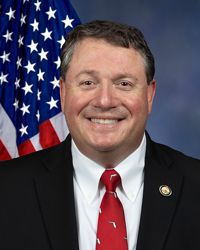
Randy Fine
RRepublicanFL-6 · Representative
58
/ 100
Average
Attendance95
Avg: 96
Independence9
Avg: 4
Bipartisan Tone33
Avg: 15
Ethics Record100
Avg: 99
Transparency41
Avg: 53
Accountability Score — composite of attendance, independence, bipartisan tone, ethics record & transparency.
Methodology19
Bills Sponsored
0
Enacted into Law
1
Passed a Chamber
17
In Committee
All Sponsored Bills
HR8476In Committee
No Antisemitism in Education Act of 2026
No Antisemitism in Education Act of 2026 This bill requires local educational agencies (LEAs) and institutions of higher education (IHEs), as a condition of receiving federal funds, to treat discrimination that is motivated by antisemitism as vigorously as the LEA or IHE treats all other forms of discrimination prohibited by Title VI of the Civil Rights Act of 1964. (Title VI of the Civil Rights Act of 1964 prohibits discrimination based on race, color, or national origin in federally funded programs or activities.) The bill requires federal agencies, LEAs, and IHEs to consider the definition of antisemitism contained in a December 11, 2019, executive order when reviewing or investigating whether a discriminatory act or omission was motivated by discriminatory antisemitic intent. The executive order incorporates the International Holocaust Remembrance Alliance's (IHRA's) working definition of antisemitism . According to the IHRA's working definition, antisemitism is a certain perception of Jews, which may be expressed as hatred toward Jews.
HR9850In Committee
No Deliveries Act
The proposal would make it illegal for foreign nationals to come to the United States specifically to give birth so their child can become a U.S. citizen, and would create penalties for people who organize or profit from such arrangements. This would affect pregnant women from other countries, maternity tourism businesses, and potentially hospitals and doctors who treat these patients. The measure aims to prevent what supporters view as exploitation of birthright citizenship laws.
HR8747In Committee
K–12 AI Literacy and Readiness Act of 2026
K-12 AI Literacy and Readiness Act of 2026 This bill authorizes states and local educational agencies (LEAs) to use Student Support and Academic Enrichment Grants for programs and activities that support instruction on the use of artificial intelligence (AI). For example, LEAs may use these grants to provide teachers, school librarians, administrators, and others with the knowledge and skills to use (and teach the use of) AI safely, effectively, and responsibly, including through professional development.
HR6297Passed House
PEACE Act
Protecting Europe from Antisemitic Crime and Extremism Act or the PEACE Act This bill requires the Department of State to periodically brief Congress over the next three years on (1) the threat of antisemitism and acts of international terrorism in Europe; and (2) diplomatic engagements with certain governments on transatlantic cooperative efforts to counter antisemitism and acts of international terrorism that may threaten transatlantic stability, the safety and security of U.S. citizens, and institutions abroad.
HR8543In Committee
Build the Ballroom Act
The proposal would allow for the construction of a new ballroom building on the White House grounds to provide additional space for official events and ceremonies. This would affect White House operations and event hosting capacity, potentially requiring changes to the grounds layout and infrastructure. The measure is currently under review by the House Committee on Transportation and Infrastructure.
HR6996In Committee
Full AI Stack Export Promotion Act
Full AI Stack Export Promotion Act This bill requires specified departments to promote the export of the U.S. full artificial intelligence (AI) stack. Full AI stack refers to the compute and data infrastructure that enables AI research and development, including high-performance computing resources, data centers, trained algorithms deployed on such infrastructure, cloud services and infrastructure, and technical standards with which these facets operate. Specifically, the Department of Commerce must establish and carry out a program to identify and receive proposals from industry consortia for exporting the U.S. full AI stack to allies and partners. (Commerce implemented this program following a July 2025 executive order .) Additionally, Commerce must work with foreign purchasers of the U.S. full AI stack to institute security measures to prevent illicit or unauthorized foreign adversary (e.g., China) access to the U.S. full AI stack; develop practices and standards to demonstrate to potential purchasers the benefits of adopting the U.S. full AI stack; and complete, on a biannual basis for five years, an estimate of the success of exporting the U.S. full AI stack. The bill directs the Department of State to increase efforts to eliminate foreign barriers to exporting the U.S. full AI stack; establish a diplomatic strategy outlining how the United States will address certain issues, such as communicating to foreign countries the importance and benefits of using the U.S. full AI stack to deploy AI; and study the benefits and impact of the global deployment of AI. The bill also requires certain reports to Congress.
HR6084In Committee
ERISA Litigation Reform Act
This bill would change the rules for lawsuits involving employee retirement and health benefit plans, likely making it harder for workers to sue their employers or plan administrators over disputes about benefits. The changes would affect how these cases are filed, what evidence can be used, and what damages workers can recover if they win, potentially reducing legal costs for companies but also limiting workers' ability to challenge benefit decisions.
HR7611In Committee
Protecting Puppies from Sharia Act
I cannot write a meaningful summary of this bill based on the information provided. The title appears to be inflammatory political rhetoric rather than a description of actual legislation, and the subject line (Government Operations and Politics) is too broad to clarify what policy the bill would actually address. To write an accurate summary, I would need to review the bill's actual text to understand what specific government operations or policies it proposes to change.
HR7534In Committee
Contract Our Veterans Act of 2026
This bill would make it easier for veteran-owned small businesses to win federal government contracts by giving them special advantages in the bidding process. The goal is to help veterans transition to civilian business ownership and increase their economic opportunities by directing more government spending toward companies they own or operate. Veterans and small business owners would be the primary beneficiaries, while federal agencies would need to adjust their contracting procedures to prioritize veteran-owned firms.
HR7357In Committee
TSP Fiduciary Security Act of 2026
This bill would establish new security and oversight requirements for the Thrift Savings Plan, a retirement savings program for federal employees and military members, to protect their investments from fraud and mismanagement. The legislation likely aims to strengthen rules around how plan administrators handle money and make investment decisions on behalf of the roughly 6 million federal workers and retirees who participate in the program. Federal employees and retirees would benefit from increased protections ensuring their retirement savings are managed responsibly.
HR4054In Committee
Accreditation Choice and Innovation Act
Accreditation Choice and Innovation Act This bill revises the accreditation process for reviewing the quality of education offered by institutions of higher education (IHEs). Under current law, an IHE seeking to participate in many federal programs (e.g., federal student aid programs) must be accredited by an agency recognized by the Department of Education (ED) as a reliable authority on the quality of the education being offered at the IHE. An ED-recognized accrediting agency must meet various provisions under the Higher Education Act of 1965 and in regulations. Under this bill, states may designate an entity (e.g., an industry-specific quality assurance entity) as an accrediting agency for programs or IHEs in the state. The bill outlines the requirements for the state to submit a plan to ED and for ED to respond to the plan. Additionally, the bill provides an accelerated path to recognition by authorizing ED to recognize new accrediting agencies within two years of their application. ED must convene a panel of experts to develop common terminology for accrediting agencies to use in making accrediting decisions and publish those recommendations. Further, the bill (1) requires accrediting agencies to establish specified standards for measures assessing student success (e.g., labor market outcomes), and (2) requires accrediting agencies to establish procedures for assessing compliance with agency standards that reflect an IHE's risk of losing accreditation. The bill reauthorizes through September 30, 2028, and revises the National Advisory Committee on Institutional Quality and Integrity, which advises ED on matters related to accreditation.
HR4291Reported
Sanctions Lists Harmonization Act
The federal government maintains multiple separate lists of individuals and organizations it sanctions for national security reasons, but these lists don't always match up with each other, creating confusion and enforcement problems. This legislation would require the State Department, Treasury Department, and other agencies to coordinate and align their sanctions lists so they're consistent across government. The change would make it easier for banks, businesses, and other organizations to comply with sanctions rules by having one clear, unified list to follow.
HR5817In Committee
Disqualifying Dual Loyalty Act of 2025
This bill would establish rules to disqualify members of Congress from serving if they hold citizenship or loyalty to another country, or would require them to renounce dual citizenship to remain in office. The measure aims to ensure that elected representatives have undivided loyalty to the United States, affecting current and future members of the House and Senate. It would likely involve verification procedures to confirm that congressional candidates and members meet citizenship and loyalty requirements.
HR5512In Committee
No Shari’a Act
This bill would prohibit U.S. courts from applying Islamic law (Sharia) in legal cases, even when parties voluntarily agree to it. The legislation aims to ensure that American legal proceedings follow U.S. law rather than religious legal systems, affecting anyone involved in disputes where Islamic law might otherwise be considered.
HR4655In Committee
United States-Israel PTSD Collaborative Research Act
This bill would establish a research partnership between the United States and Israel to study and develop better treatments for post-traumatic stress disorder (PTSD) affecting military veterans and service members. The collaboration would combine expertise from both countries' medical and military institutions to improve how PTSD is diagnosed, prevented, and treated for people who have experienced combat or military service.
HR4656In Committee
Path to Florida Springs National Park Act
The proposal would establish a new national park in Florida to protect the state's natural springs and surrounding ecosystems. This would preserve these freshwater areas for conservation and public recreation while potentially bringing tourism and economic benefits to local communities. The park would be managed by the National Park Service, similar to other national parks across the country.
HR4033In Committee
Sturgeon Conservation and Sustainability Act of 2025
This bill would establish new protections and management practices for sturgeon populations in U.S. waters, likely including rules about fishing limits, habitat restoration, and monitoring of these ancient fish species. The legislation would affect commercial and recreational fishermen, state wildlife agencies, and environmental organizations working to prevent sturgeon from becoming extinct or further declining. Sturgeon are valuable both as a food source and for their eggs (caviar), making their conservation important to fishing communities and ecosystems.
HR4226In Committee
ICE Act
I don't have enough information to write an accurate summary. The title "ICE Act" and subject "Immigration" could refer to multiple different bills with different purposes. To provide you with a factual, nonpartisan summary of what this specific bill would do, I would need additional details such as the bill number, the year it was introduced, or the specific provisions it contains.
HR4097In Committee
Designate CAIR as a Terrorist Organization Act
This bill would officially label the Council on American-Islamic Relations (CAIR), a Muslim advocacy organization, as a terrorist organization under U.S. law. If passed, this designation would restrict CAIR's activities, freeze its assets, and make it illegal for Americans to provide support to the group, though CAIR and its supporters argue the organization is a legitimate civil rights group. The bill has been referred to the House Judiciary Committee for consideration.