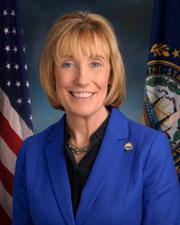
Margaret Wood Hassan
DDemocratNH · Senator
54
/ 100
Average
Attendance98
Avg: 97
Independence25
Avg: 23
Bipartisan Tone6
Avg: 14
Ethics Record100
Avg: 100
Transparency21
Avg: 47
Accountability Score — composite of attendance, independence, bipartisan tone, ethics record & transparency.
Methodology40
Bills Sponsored
0
Enacted into Law
4
Passed a Chamber
29
In Committee
All Sponsored Bills
S5671In Committee
State Strategic Stockpile Act of 2026
SRES921In Committee
A resolution expressing the sense of the Senate that the advertisements promoting President Donald Trump that aired in September 2026, which included the direct language "paid for by the U.S. Government," should not be paid for by the United States Government.
This resolution expresses the sense of the Senate that certain advertisements promoting President Donald Trump should not be paid for by the U.S. government.
S5516In Committee
Keep Food Containers Safe from PFAS Act of 2026
S5502In Committee
Protecting Biotechnology and Biomanufacturing as Critical Infrastructure Act
SRES892Introduced
A resolution supporting the designation of September 18, 2026, as "National Concussion Awareness Day".
S5425In Committee
Addiction Grants Modernization Act
S2801Reported
Canterbury Shaker Village National Heritage Area Study Authorization Act
This bill would authorize a study to determine whether the Canterbury Shaker Village in New Hampshire should be designated as a National Heritage Area, which would bring federal recognition and potential funding to preserve the historic site and its cultural significance. The study would examine the village's historical importance, its role in American religious and communal history, and how designation might benefit local communities and tourism. If approved after the study, such a designation would help protect the village's buildings and landscape while supporting educational programs about the Shakers who lived there.
S3211Reported
Recognizing the Role of Direct Support Professionals Act
This bill would formally recognize and highlight the important work of direct support professionals—people who provide personal care and assistance to individuals with disabilities or developmental delays. The legislation aims to bring attention to this workforce, which includes home health aides and personal care attendants, likely to support efforts for better working conditions, pay, or training standards for these essential workers.
S850Passed Senate
Northern Border Security Enhancement and Review Act
Northern Border Security Enhancement and Review Act This bill requires the Department of Homeland Security (DHS) to regularly perform a threat analysis of the northern U.S. border. The analysis must be performed every three years and include terroristic and criminal threats, recent changes in apprehensions, and improvements needed to prevent terrorism and reduce criminal activity. DHS must update its northern border strategy not later than September 2, 2026, and every five years thereafter, incorporating the results from the latest threat analysis. DHS must also provide a classified briefing to the appropriate congressional committees. U.S. Customs and Border Protection’s Air and Marine Operations (AMO) must develop performance metrics to assess the AMO’s effectiveness at securing the northern border between ports of entry in air and maritime environments.
S5236In Committee
Improving CARE for Youth Act
Improving Coordination and Access to Resources Equitably for Youth Act or the Improving CARE for Youth Act This bill prohibits state Medicaid programs from denying coverage for primary care and mental health services that are furnished on the same day at the same office, clinic, or other outpatient facility.
S5237In Committee
Stop Superbugs Act
S2658Reported
Medication Affordability and Patent Integrity Act
This bill would allow the federal government to negotiate drug prices directly with pharmaceutical companies for Medicare patients, while also limiting how long companies can extend their patent protections to keep generic competitors off the market. The changes would aim to lower medication costs for seniors and other patients, though drug manufacturers would face reduced profits from their patents. The bill affects pharmaceutical companies, Medicare beneficiaries, and patients who rely on prescription medications.
S380Reported
Rural Obstetrics Readiness Act
Rural Obstetrics Readiness Act This bill creates and expands federal grant programs within the Health Resources and Services Administration (HRSA) to increase capacity to provide emergency obstetric health services in rural areas or areas without practitioners or facilities specializing in obstetric services. Specifically, HRSA must establish a program for providing grants to certain hospitals or consortiums that include hospitals in rural areas or areas with maternal health care professional shortages for training, developing a workforce, and purchasing equipment relating to obstetric emergencies. In addition, the bill requires HRSA’s Alliance for Innovation on Maternal Health Capacity program to provide grants for training on emergency obstetric services for practitioners in rural health care facilities without dedicated obstetric units. HRSA must also establish a pilot program to provide grants to government entities for developing or improving telehealth access programs to support urgent maternal health care in rural facilities without a dedicated obstetric unit.
S5133In Committee
Preventing Tax Fraud and Identity Theft Act
The proposal would change the deadlines for when businesses must submit certain tax information forms to the IRS, potentially giving companies more time to gather and file paperwork about employee wages, payments to contractors, and other financial details. The exact impact would depend on which forms are affected and how much the deadlines shift, but the change could reduce administrative burden on employers and payroll departments while potentially affecting when the IRS receives this information.
S5065In Committee
Help Grandfamilies Prevent Child Abuse Act
The proposal would strengthen protections and support for children living with relatives (like grandparents or aunts and uncles) outside the formal foster care system, ensuring these kinship families have access to the same safeguards and resources as children in traditional foster care. Currently, many children in kinship arrangements lack legal oversight and services that could help keep them safe and healthy. The changes would help close this gap by extending child abuse prevention standards and support services to these informal family arrangements.
S5067In Committee
Federal Cybersecurity Workforce Expansion Act
The government would create a new apprenticeship program run by the Cybersecurity and Infrastructure Security Agency to train people in cybersecurity skills, and would also set up a pilot program specifically designed to teach cybersecurity to veterans and active-duty military members preparing to enter civilian jobs. This would help address the shortage of cybersecurity workers while giving military personnel a pathway to well-paying tech careers after their service ends.
S4782In Committee
ReportScams.gov Act
The federal government would create an official priority goal focused on fighting scams, establish a committee to coordinate anti-scam efforts across agencies, and develop a national action plan with strategies to prevent fraud. A new government website would provide scam information and prevention resources to help the public recognize and avoid becoming victims of scams. This affects everyday Americans who are vulnerable to fraud schemes, as well as federal agencies that would need to work together on this initiative.
S4759In Committee
Tax Relief for Innocent Spouses Act
The bill would allow taxpayers who claim "innocent spouse" status—meaning they shouldn't be held responsible for taxes owed by their spouse due to underreporting or fraud—to have their cases fully reviewed by the Tax Court and other courts rather than just by the IRS. Currently, these cases have limited review options, so this change would give taxpayers more opportunities to challenge the IRS's decision if they disagree with it. This affects married couples dealing with tax disputes where one spouse claims they were unaware of or didn't participate in tax problems.
S4736In Committee
Multigenerational Care and Support Act
The proposal would expand volunteer opportunities for seniors at facilities serving older adults and younger people, allowing more older Americans to contribute their time and skills in community settings. This could help address staffing needs at nursing homes, senior centers, and youth programs while giving older adults meaningful ways to stay active and engaged in their communities.
S4578In Committee
Gateway to Careers Act of 2026
The federal government would create a new grant program to help community colleges, workforce agencies, and other organizations develop training programs that guide students and workers through connected educational steps leading to good-paying jobs. These "career pathways" would combine classroom learning with work experience, allowing people to earn credentials at different levels while moving toward higher-skilled positions in fields like healthcare, manufacturing, and technology. The grants would support programs serving workers of all ages, including those returning to the workforce or switching careers.
S4510In Committee
Relief for Families of the Fallen Act
Families of police officers, firefighters, and other public safety workers who are killed in the line of duty would receive tax breaks on money they inherit or receive as benefits following their loved one's death. The bill would reduce the tax burden on these families during an already difficult time by modifying how the federal government taxes survivor benefits and inheritance. This change would primarily help the spouses and children of public safety officers who die performing their duties.
SRES687In Committee
A resolution supporting the designation of the week of April 27 through May 1, 2026, as "National Specialized Instructional Support Personnel Appreciation Week".
This resolution would officially recognize the week of April 27 through May 1, 2026, as "National Specialized Instructional Support Personnel Appreciation Week" to honor school employees like counselors, speech therapists, special education aides, and other support staff who help students succeed. The designation would raise awareness about the important work these professionals do in schools across the country. This is a symbolic measure that does not create new laws or funding, but rather celebrates and acknowledges these workers' contributions to education.
S4332In Committee
Medication Competition Act
The federal government would be required to clearly determine and announce how long pharmaceutical companies can have exclusive rights to sell newly approved biological medicines (like vaccines and gene therapies) before generic competitors can enter the market. This would give drugmakers and patients more certainty about when cheaper alternatives might become available, and could affect how quickly generic versions of expensive biologic drugs reach consumers. The change would apply to the Food and Drug Administration's decisions about these exclusivity periods.
S4230In Committee
Protecting Stolen Encrypted Data Act of 2026
This bill would likely create new legal protections and penalties related to stolen encrypted data that affects national security or the military. It probably aims to strengthen how the government handles cases where sensitive encrypted information is stolen, potentially by establishing clearer rules about what counts as a serious crime and what punishments apply. The bill would primarily affect federal law enforcement agencies, military personnel, and possibly cybersecurity professionals who work with classified information.
S1602Reported
Mathematical and Statistical Modeling Education Act
The bill would support education programs that teach students mathematical and statistical modeling skills, likely through funding, curriculum development, or teacher training initiatives. These skills help students understand how to use math and data to solve real-world problems in fields like science, engineering, and business. The legislation aims to improve American competitiveness by ensuring more students graduate with strong quantitative reasoning abilities.
S4071In Committee
Child Care Tax Benefit Outreach and Assistance Act
This bill would require the federal government to conduct outreach and provide assistance to help families understand and access existing tax benefits for child care expenses, such as the child and dependent care credit. The goal is to make sure more parents and guardians who qualify for these tax breaks actually know about them and can claim the money they're entitled to. The legislation aims to reduce confusion and increase participation in child care tax benefits that already exist but may be underused.
S3962In Committee
Housing and Economic Development Act
This bill would likely provide funding and programs to improve housing availability and affordability while supporting economic development in communities, though the specific details are not yet clear since it's still in early stages. It would probably affect low-income families looking for housing, developers building new projects, and local communities trying to revitalize neighborhoods. The bill has been sent to the Senate Banking Committee for review and discussion.
S3714In Committee
Family-to-Family Reauthorization Act of 2026
This bill would reauthorize and likely update federal funding and programs that help families access health services, mental health support, or other family-focused health initiatives. The specific changes would affect families seeking health care, potentially including children, parents, and caregivers who rely on these federally supported programs. Once the Finance Committee reviews it, Congress will decide whether to continue, modify, or expand these family health services.
S3596In Committee
Stronger Start for Working Families Act
This bill would likely expand tax credits or deductions for working families with lower and middle incomes, making it easier for them to keep more of their earnings or receive larger refunds. The changes would probably target families with children or those struggling to afford basic expenses like childcare or housing. Workers and families earning modest incomes would be the main beneficiaries of any tax relief included in the proposal.
S607Passed Senate
Improving Veteran Access to Care Act
Improving Veteran Access to Care Act This bill requires the Department of Veterans Affairs (VA) to establish an integrated project team to improve the process for scheduling VA health care appointments. Among other objectives, the team must (1) develop or continue the development of a scheduling system and platform that enables personnel and patients of the VA to view available appointments for VA care, (2) create a process through which patients can telephonically speak with a scheduler who can assist in determining availability and scheduling, and (3) carry out other functions with respect to health care appointments furnished by the VA. In carrying out its objectives, the team must consult and coordinate with the deployment schedule and capabilities of the VA’s Electronic Health Record Modernization Program. If the VA determines a required objective or any feature or service in connection with an objective cannot be implemented or incorporated, the VA must report to Congress providing an explanation and setting forth a plan without that objective. The VA must also report to Congress on the progress in fulfilling the team’s objectives under the bill.
S1204Passed Senate
Gold Star and Surviving Spouse Career Services Act
Gold Star and Surviving Spouse Career Services Act This bill expands eligibility for the Disabled Veterans’ Outreach Program to the spouses of certain veterans and members of the Armed Forces. Such program is administered by the Department of Labor and generally provides career and employment services to disabled veterans. The bill expands eligibility for the program to spouses of persons who died while members of the Armed Forces; persons who died of a service-connected disability; members of the Armed Forces serving on active duty who, for more than 90 days, are listed as missing in action, captured by a hostile force, or forcibly detained or interned in the line of duty by a foreign government power; persons who have a total permanent disability resulting from a service-connected disability; and persons who died while an evaluated total disability was in existence.
S3359In Committee
Fast Track To and Through College Act
Fast Track To and Through College Act This bill requires the Department of Education to award grants to certain partnerships with state educational agencies to support statewide implementation of early college fast track pathways and early high school graduation fast track pathways. The bill defines early college fast track pathways as programs of advanced coursework resulting in credit that (1) is equivalent to at least two semesters of full-time postsecondary enrollment, and (2) satisfies the requirements for a high school diploma. In addition, the bill defines early high school graduation fast track pathways as scholarships for students who graduate high school early, do not require remedial coursework in postsecondary education, and attend a public two- or four-year institution of higher education. The bill also makes certain high school students participating in an early college fast track pathway eligible to receive Pell Grants.
S3336In Committee
Reliable Artificial Intelligence Research Act of 2025
S2947In Committee
Pray Safe Act of 2025
The bill would require the federal government to develop safety guidelines and emergency preparedness standards specifically for places of worship, helping religious organizations better protect their members during threats or disasters. It would likely provide resources, training, and coordination between faith communities and emergency management agencies to improve security planning at churches, synagogues, mosques, temples, and other religious facilities. The measure aims to help religious leaders and their congregations prepare for and respond to emergencies more effectively.
SRES420Introduced
A resolution supporting the designation of September 19, 2025, as "National Concussion Awareness Day".
This resolution supports the designation of September 19, 2025, as National Concussion Awareness Day.
S1136Passed Senate
DETERRENCE Act
Deterring External Threats and Ensuring Robust Responses to Egregious and Nefarious Criminal Endeavors Act or the DETERRENCE Act This bill establishes sentencing enhancements for various federal criminal offenses if the offenses are directed by or coordinated with a foreign government.
S1975In Committee
Dark Web Interdiction Act of 2025
Dark Web Interdiction Act of 2025 This bill establishes enhanced criminal penalties for distributing controlled substances via the dark web. It also establishes other programs and requirements to address the use of the dark web for illicit drug activities. ( Dark web means the portions of the internet with hidden sites and services that (1) are not generally searchable, and (2) can only be accessed with specialized devices or services that conceal the identities and locations of users.) Specifically, the bill provides an enhanced criminal penalty for delivering, distributing, or dispensing controlled substances via the dark web. The bill also provides statutory authority for the Joint Criminal Opioid and Darknet Enforcement Task Force, which supports the investigation and prosecution of drug offenses committed via the dark web domestically and internationally. In addition, the Department of Justice must report on how and to what extent virtual currencies are used for opioid distribution via the dark web.
S1840In Committee
Retirement Investment in Small Employers Act
Retirement Investment in Small Employers Act This bill increases the federal tax credit limit for startup costs incurred by certain small businesses to establish a qualified retirement plan. As background, a federal tax credit is allowed for 50% of the costs incurred by a small business with no more than 100 qualified employees (or 100% of such costs for a small business with no more than 50 qualified employees) to establish a qualified retirement plan. Under current law, the tax credit is limited to the greater of (1) $500, or (2) the lesser of $250 per eligible employee or $5,000. (Additional limits may apply.) The bill increases the limit on the tax credit for retirement plan startup costs for employers with no more than 10 employees to the greater of (1) $2,500, or (2) the lesser of $250 per employee or $5,000. For the increased tax credit limit to apply, the retirement plan established by the business must accept payment of the matching contribution under the Saver’s Match program. Under the Saver's Match program, beginning in 2027, individuals that meet certain requirements are eligible to have a federal matching contribution of up to $1,000 (or $2,000 for married joint filers) deposited into a qualified retirement account.
S1164In Committee
Increasing Access to Dental Insurance Act
Increasing Access to Dental Insurance Act This bill permits individuals to enroll in a dental benefits plan on a health insurance exchange without also enrolling in a qualified health plan.
S1138In Committee
Enhancing Southbound Inspections to Combat Cartels Act