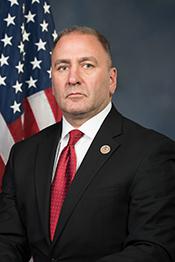
Clay Higgins
RRepublicanLA-3 · Representative
57
/ 100
Average
Attendance97
Avg: 96
Independence9
Avg: 4
Bipartisan Tone18
Avg: 15
Ethics Record100
Avg: 99
Transparency47
Avg: 53
Accountability Score — composite of attendance, independence, bipartisan tone, ethics record & transparency.
Methodology28
Bills Sponsored
0
Enacted into Law
4
Passed a Chamber
24
In Committee
All Sponsored Bills
HR10243In Committee
Protecting Elders From Government Error Act
HR10242In Committee
Janie Wynn Protecting Elders from Financial Exploitation Act
HR9725In Committee
Restoring Integrity and Efficiency to Inspector General Oversight Act of 2026
The proposal would eliminate the Council of the Inspectors General on Integrity and Efficiency, a government watchdog organization that coordinates oversight activities across federal agencies to detect fraud, waste, and misconduct. This would affect federal employees and the public by potentially reducing coordination between the various inspectors general who investigate wrongdoing in different government departments. The bill is currently under review by the House Committee on Oversight and Government Reform.
HR9643In Committee
Comment Integrity and Management Act
Comment Integrity and Management Act This bill establishes requirements with respect to the submission of mass comments and computer-generated comments in the federal rulemaking process. Specifically, the bill requires federal agencies to verify, to the greatest extent possible at the time a public comment is submitted, whether the comment has been submitted by a human being. An agency also must determine whether comments are mass comments and may publish on the docket only a single representative copy of such comments or a single copy of one variation of mass comments that use standardized but not identical language. If the agency publishes only a single copy of a mass comment, the agency also must indicate the number of mass comments submitted that were identical or substantively identical to the representative copy or variation that the agency published. Additionally, each agency must establish a policy with respect to the posting and consideration of computer-generated comments and mass-comments during the agency's rulemaking process. The Office of Management and Budget must issue guidance for implementing the requirements of the bill, and the Government Accountability Office must report on the identification and effect of computer-generated comments in the rulemaking process. Additionally, the General Services Administration must update regulations.gov and the eRulemaking system as necessary to ensure compliance with the requirements the bill.
HR2715Passed House
Destruction of Hazardous Imports Act
Destruction of Hazardous Imports Act This bill expands the Food and Drug Administration’s (FDA’s) authority to require the destruction of certain items that are refused import into the United States and pose a risk to public health. Under current law, imported food, drugs, medical devices, tobacco products, and cosmetics are subject to FDA review. If an imported item is deficient in a specified manner (e.g., counterfeit, misbranded, or manufactured under insanitary conditions), the item is generally refused admission to the United States. An item refused admission may generally be exported, except that the FDA may destroy a drug, medical device, or tobacco product that is valued under $2,500 without the opportunity for export. Under the bill, the FDA may order the destruction, without the opportunity for export, of any food, drug, medical device, tobacco product, or cosmetic that is refused admission if the item presents a significant public health concern. If such an order is issued, the item’s owner or consignee must destroy it within 90 days at their own cost. The bill also prohibits the unauthorized movement (e.g., export) of an item subject to a destruction order. A violator is subject to a fine, a prison term of up to one year, or both. The FDA must promulgate regulations to carry out these provisions. These regulations must provide for due process for the owner or consignee of an item subject to a destruction order, including notice and an opportunity to appear before the item is destroyed.
HR9781In Committee
Defend American Agriculture Act
The proposal would change how the federal government funds and provides assistance through the Commodity Credit Corporation, a government agency that helps farmers and agricultural producers. The specific changes would affect how money is allocated and what types of aid farmers can receive, though the exact details would be determined during the legislative process. This could impact farmers, agricultural businesses, and rural communities that depend on these federal support programs.
HR6963Passed House
To designate the community-based outpatient clinic of the Department of Veterans Affairs in Lafayette, Louisiana, as the "Rodney C. Hamilton Sr. VA Clinic".
This bill designates the community-based outpatient clinic of the Department of Veterans Affairs in Lafayette, Louisiana, as the Rodney C. Hamilton Sr. VA Clinic.
HR9115In Committee
To amend the FISA Amendments Act of 2008 to extend the authorities of title VII of the Foreign Intelligence Surveillance Act of 1978, and for other purposes.
The government would be allowed to continue using a surveillance program that lets intelligence agencies collect communications involving foreign targets without getting individual court warrants, as long as they follow certain procedures to protect Americans' privacy. The program, which is set to expire, would be extended for additional years so spy agencies can monitor suspected foreign threats and their communications. This affects how the FBI, NSA, and other intelligence agencies can conduct surveillance operations and how much oversight Congress and courts have over their activities.
HR8656In Committee
Ballistic Armor Made in America Act of 2026
The federal government would be required to buy bulletproof vests for law enforcement and other agencies only from manufacturers that use American-made ballistic fibers in their products. This would affect federal agencies like the FBI and DEA, as well as potentially state and local police departments that receive federal funding or equipment. The requirement aims to support domestic manufacturers of protective materials while ensuring federal law enforcement has access to body armor.
HR8512In Committee
To amend the FISA Amendments Act of 2008 to extend the authorities of title VII of the Foreign Intelligence Surveillance Act of 1978 through April 20, 2029, and for other purposes.
The government's ability to conduct certain types of foreign intelligence surveillance would be extended for several more years under this proposal. Specifically, it would allow federal agencies to continue monitoring communications involving foreign targets without a traditional warrant, a power that's set to expire soon but would now remain in effect through April 2029. The measure affects how the FBI, NSA, and other intelligence agencies can gather information on suspected foreign threats and spies.
HR8131In Committee
To authorize the creation of a service ribbon to be awarded to a member of the National Guard who performs homeland defense duty.
The bill would create a new military ribbon that National Guard members could receive when they perform homeland defense duties within the United States. This ribbon would recognize and honor Guard members who serve their country by responding to emergencies, natural disasters, or other domestic security needs rather than overseas deployments. The change would give these service members official recognition similar to what soldiers receive for other types of military service.
HR7996In Committee
Linemen Legacy Act
This bill would likely establish protections or benefits for electrical linemen and other utility workers who respond to emergencies like storms and natural disasters. The measure would probably address workplace safety, compensation, or support for workers injured or killed while restoring power and other essential services during crises. It affects utility companies, linemen, and potentially their families.
HR7874In Committee
Mail Ballot Integrity Act
This bill would establish new rules and requirements for mail-in voting to address concerns about ballot security and accuracy. It likely includes measures such as voter identification requirements, ballot tracking systems, or stricter deadlines for mail ballot submission and counting that would affect voters who choose to vote by mail. The specific changes would apply to how states handle mail ballots in federal elections.
HR2716In Committee
Ending Improper Payments to Deceased People Act
Ending Improper Payments to Deceased People Act This bill permanently allows the Department of the Treasury to access certain death records maintained by the Social Security Administration (SSA) in order to facilitate the identification and prevention of improper payments (e.g., payments to deceased individuals). Current law requires the SSA to share its Death Master File with the Do Not Pay system maintained by Treasury for three years. The bill makes this requirement permanent.
HR5581In Committee
Uniform Standards Protection Act of 2025
The bill would establish consistent national standards for how law enforcement agencies conduct investigations and enforce laws, aiming to reduce variations in police procedures across different states and jurisdictions. This would affect police departments, federal agencies, and the people they interact with by creating more uniform rules around investigative practices, arrest procedures, and evidence handling. The goal appears to be improving accountability and fairness in the criminal justice system by ensuring similar conduct standards apply nationwide rather than having each state or local agency operate under different rules.
HR5143Passed House
District of Columbia Policing Protection Act of 2025
District of Columbia Policing Protection Act This bill repeals restrictions on the circumstances under which law enforcement officers in the District of Columbia (DC) may engage in vehicular pursuits (i.e., police chases) of suspects fleeing in motor vehicles, and instead generally requires such pursuits in the absence of other means of apprehension. Currently, pursuant to DC's Comprehensive Policing and Justice Reform Amendment Act of 2022, law enforcement officers generally may not engage in vehicular pursuits of suspects fleeing in motor vehicles unless the officer reasonably believes (1) the suspect was involved in a crime of violence or poses an immediate and serious threat to another person, (2) the pursuit is necessary to prevent that threat and is not likely to result in death or serious injury to any person, and (3) all other options have been exhausted or are unreasonable given the circumstances. The bill repeals these restrictions and instead requires law enforcement officers to engage in vehicular pursuits of suspects fleeing in motor vehicles unless the officer or a higher-ranking officer reasonably believes that (1) such pursuit would be futile, (2) the pursuit would entail an unacceptable risk of harm to a person other than the suspect, or (3) the suspect can be apprehended more effectively or expeditiously by other means. The bill also requires the Department of Justice to report to Congress on the costs and benefits of DC’s Metropolitan Police Department adopting technology that alerts the public of an active police pursuit in their immediate vicinity.
HRES539In Committee
Censuring Representative LaMonica McIver and removing her from the Committee on Homeland Security.
This resolution censures Representative LaMonica McIver and removes her from the Committee on Homeland Security.
HR4800In Committee
Fisheries Modernization Act of 2025
The proposal would update federal rules governing commercial and recreational fishing to reflect modern practices and technology. It would affect fishing companies, recreational anglers, and coastal communities by potentially changing how fishing licenses are issued, what equipment is allowed, and how fish populations are monitored and protected. The changes aim to balance the needs of the fishing industry with conservation efforts to keep fish stocks healthy for future generations.
HR2056Passed House
District of Columbia Federal Immigration Compliance Act of 2025
District of Columbia Federal Immigration Compliance Act This bill prohibits the District of Columbia (DC) from limiting its cooperation with federal immigration enforcement activities, except for certain instances involving witnesses and victims of crime. Specifically, the bill bars DC from adopting a law, policy, or practice prohibiting DC governmental entities from sending, receiving, maintaining, or exchanging information regarding the citizenship or immigration status of any individual with a federal, state, or local government entity. Further, DC may not adopt a law, policy, or practice of not complying with lawful requests from the Department of Homeland Security (DHS) to comply with a detainer for, or notify about the release of, an individual from custody. (A detainer is a formal request from DHS that a state or locality hold an individual in custody for up to 48 hours after the individual would otherwise be released so that DHS may facilitate the individual's removal.) The bill provides exceptions allowing DC to adopt policies of not sharing information or complying with a detainer request regarding an individual who comes forward as a victim or a witness of a crime.
HR513In Committee
Offshore Lands Authorities Act of 2025
Offshore Lands Authorities Act of 2025 This bill limits the withdrawal of unleased lands of the Outer Continental Shelf (OCS) from areas that may be leased for mineral development and nullifies certain past withdrawals. The OCS includes the federally managed ocean area extending from the outer boundaries of state-controlled waters (generally 3 nautical miles [nmi] from shore) to 200 nmi from shore, with some exceptions. Specifically, the bill limits the President's authority to restrict offshore development of minerals, such as oil and gas, on the OCS. For example, the bill (1) caps the number of acres of OCS lands that a President may withdraw from areas that may be leased; (2) prohibits withdrawals from being made for a period longer than 20 years; (3) prohibits the President from making withdrawals of unleased land that conflict with areas included in lease sales scheduled under approved oil and gas leasing programs; and (4) prohibits the President from withdrawing unleased lands unless the Department of the Interior has completed assessments addressing issues such as mineral resources and the national security, economic, and energy value of the identified mineral deposits. The President must also obtain congressional approval before withdrawing more than 500,000 acres cumulatively. Further, the bill gives Congress the authority to review and disapprove withdrawals by enacting a joint resolution. In addition, the bill nullifies certain presidential memoranda and executive orders related to withdrawing unleased land from areas that may be leased for the development of oil, gas, or other minerals on the OCS.
HR3378In Committee
Racehorse Health and Safety Act of 2025
This bill would establish new safety and health standards for racehorses, likely including rules about veterinary care, track conditions, and training practices to reduce injuries and deaths in horse racing. The regulations would apply to racetracks, trainers, and racing organizations across the country. The goal is to protect the animals involved in the sport while maintaining the racing industry.
HR3347In Committee
Sovereign States Emergency Management Act
The proposal would give individual states more control over how they respond to emergencies and disasters within their borders, rather than having the federal government direct those responses. States would have greater flexibility in deciding how to use federal emergency funds and coordinate their own disaster relief efforts. This would primarily affect state and local emergency management agencies, first responders, and residents dealing with natural disasters or other emergencies.
HR2126In Committee
FOCA Act of 2025
Fair and Open Competition Act of 2025 or the FOCA Act of 2025 This bill requires that federal contracts for construction projects neither require nor prohibit a bidder, offeror, contractor, or subcontractor from entering into agreements with one or more labor organizations with respect to such projects or related projects. Under the bill, the controlling documents for federal construction contracts (such as bid specifications and project agreements) may not require or prohibit a bidder, offeror, contractor, or subcontractor from entering into or adhering to such labor agreements. Additionally, the controlling documents may not discriminate against or give preference to a bidder, offeror, contractor, or subcontractor who signs or refuses to sign such a labor agreement. These requirements also apply to any (1) construction manager acting on behalf of the federal government with respect to such contract, (2) recipient of a federal grant or financial assistance for construction projects or construction manager acting on the recipient's behalf, and (3) party to a federal cooperative agreement for construction projects or construction managers acting on the party's behalf. An agency may exempt a project from this prohibition to avert an imminent threat to public health or safety or to serve the national security.
HR1698In Committee
Law Enforcement Protection and Privacy Act of 2025
Based on the title and subject matter, this bill likely aims to establish new rules around how law enforcement agencies collect, use, and protect personal information while also safeguarding police officers themselves. The legislation would probably balance privacy protections for the public with security measures for law enforcement personnel, affecting how police departments handle data and conduct investigations. The bill is currently being reviewed by two House committees to determine which parts fall under each committee's authority.
HR1194In Committee
Federal Lands and Waters Leasing Transparency Act
This bill would require the federal government to provide more public information and transparency about how it leases federal lands and waters for energy development, such as oil, gas, and renewable energy projects. The legislation aims to give citizens, environmental groups, and other stakeholders better access to details about lease sales, bidding processes, and terms so they can understand and potentially challenge these deals. The bill affects energy companies, federal agencies that manage public lands, and the public interest in how natural resources are managed.
HR1070In Committee
Restoring Competitive Property Insurance Availability Act
Restoring Competitive Property Insurance Availability Act This bill allows certain insurance companies to temporarily exclude premiums paid for real property insurance on property located in a federally-declared disaster area from the company's gross income for federal tax purposes. Specifically, under the bill, an insurance company (other than a life insurance company) that provided real property insurance immediately prior to a federally-declared disaster for property located in the disaster area may exclude from gross income (1) the amount of premiums paid for such insurance, minus (2) any tax deductions properly attributed to such premiums. Further, such premiums may be excluded for the first five tax years ending after the date of the disaster.
HR434In Committee
CBP Workload Staffing Model Act
CBP Workload Staffing Model Act This bill requires the U.S. Customs and Border Protection (CBP) to develop and implement a workload staffing model for each of the U.S. Border Patrol and Air and Marine Operations. Such model shall include (1) consideration for essential frontline operator activities and functions, (2) variations in operating environments, and (3) present and planned infrastructure and technology. The CBP must also develop standard operating procedures for a workforce tracking system, train the workforce on the use of such system, and implement internal controls to ensure timely and accurate scheduling and reporting. The Department of Homeland Security (DHS) must review the model and provide feedback regarding the degree to which it is responsive to certain DHS recommendations.
HR163In Committee
Finish the Wall Act
Finish the Wall Act This bill requires the Department of Homeland Security (DHS) to resume activities related to the construction of a barrier system along the U.S.-Mexico border and addresses other border-related issues. DHS must resume all such construction activities that were planned or underway prior to January 20, 2021. DHS must also expend all funds appropriated or explicitly obligated since October 1, 2016, for construction of this barrier system. DHS may not cancel contracts for activities related to such construction entered into on or before January 20, 2021. Furthermore, within 14 days of this bill's enactment, DHS must certify to Congress that U.S. Customs and Border Protection facilities that process adults taken into custody at the border are fully compliant with certain laws related to the collection of DNA. (Among other things, these laws allow for the collection of DNA samples from non-U.S. persons detained under U.S. authority.)