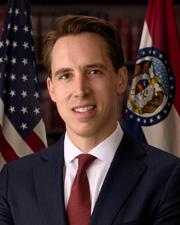
Josh Hawley
RRepublicanMO · Senator
57
/ 100
Average
Attendance96
Avg: 97
Independence27
Avg: 23
Bipartisan Tone10
Avg: 14
Ethics Record100
Avg: 100
Transparency35
Avg: 47
Accountability Score — composite of attendance, independence, bipartisan tone, ethics record & transparency.
Methodology34
Bills Sponsored
0
Enacted into Law
1
Passed a Chamber
27
In Committee
All Sponsored Bills
S2938In Committee
Artificial Intelligence Risk Evaluation Act of 2025
This bill would require the government to evaluate and assess the risks posed by artificial intelligence systems before they're widely deployed, similar to how new drugs are tested for safety. It would likely establish standards or processes for identifying potential harms from AI technology and could affect companies developing AI, researchers, and ultimately the consumers and workers who use these systems. The goal appears to be preventing serious problems from AI systems by catching safety issues early rather than after they cause damage.
S5418In Committee
No Tax Breaks for Data Centers Act
S5163Reported
No Bonuses for Bad Service Act
The legislation would prevent federal employees from receiving bonuses or performance awards if they have been disciplined for misconduct or poor performance within a certain timeframe. This would apply across all federal agencies and is intended to ensure that taxpayer money spent on employee bonuses goes only to workers with good records. The measure affects federal workers and aims to hold government employees accountable for their job performance.
S4927In Committee
Rural Hospital Emergency Room Guarantee Act
The proposal would create a dedicated funding source to help rural hospitals maintain their emergency rooms, which many small communities depend on for urgent medical care. Rural emergency departments have been closing at increasing rates, leaving residents in remote areas with longer travel times to reach emergency services. The bill aims to prevent further closures by ensuring these hospitals have reliable financial support to keep their ERs operating.
S4485In Committee
Gas Tax Suspension Act
The proposal would temporarily suspend federal taxes on gasoline and diesel fuel, reducing what drivers pay at the pump. This tax break would apply to all consumers who buy these fuels for vehicles and other uses, potentially lowering gas prices across the country for the duration of the holiday. The measure is currently under review by the Senate Finance Committee.
S3062Reported
GUARD Act
Guidelines for User Age-verification and Responsible Dialogue Act of 2026 or the GUARD Act This bill establishes requirements for and limitations on entities that provide publicly available artificial intelligence (AI) chatbots, including AI companions. Under the bill, an AI chatbot is an application or program that simulates human conversation by generating responses to user prompts. An AI companion is a type of AI chatbot that simulates a sustained interpersonal relationship or emotional interaction with the user. The bill makes it a federal crime to provide an AI chatbot that exposes minors to sexual content or encourages minors to commit suicide or carry out nonsuicidal self-injury, unlawful physical or sexual violence, or homicide. A violation is subject to a criminal fine of up to $250,000 per offense. Additionally, the bill prohibits minors from accessing AI companions. Under the bill, an entity that provides an AI chatbot must require each individual who accesses an AI companion to set up a user account and must also verify that the user is an adult. A violation is subject to a civil penalty of up to $250,000 per violation. Finally, the bill requires an AI chatbot that is publicly available to disclose that the AI chatbot is not a human and is not a licensed professional (e.g. doctor, lawyer, or therapist). A violation is subject to a civil penalty of up to $250,000 per violation.
S4366In Committee
Know Your Labor Rights Act
The legislation would require employers to provide workers with clear, written information about their basic labor rights, including details about minimum wage, overtime pay, workplace safety, and the right to organize. This would help employees understand protections they're entitled to under federal law, particularly benefiting workers who may be unaware of their rights or work for employers who don't voluntarily share this information. The bill affects all employers and their workers across the country.
S4343In Committee
No Pensions for Congressional Predators Act
Members of Congress who are convicted of serious sexual abuse crimes would lose their federal retirement benefits earned through their congressional service. The bill aims to prevent lawmakers found guilty of these felonies from receiving taxpayer-funded pensions based on their time in office. This would affect current and former members of Congress facing such convictions.
S4066In Committee
Safeguarding Women from Chemical Abortion Act
This bill would restrict access to medication used for abortion by requiring stricter federal oversight of drugs that can end pregnancies and potentially limiting how they are distributed and prescribed. The legislation would affect women seeking abortion services, healthcare providers who prescribe these medications, and pharmaceutical companies that manufacture them. The bill is currently under review by a Senate committee focused on health policy.
SRES630In Committee
A resolution honoring the lives of fallen Missouri police officers and expressing condolences to their families.
This resolution honors Missouri police officers who have died in the line of duty and expresses sympathy to their families and colleagues. While it doesn't create new laws or programs, it formally recognizes the sacrifice these officers made and the impact their deaths have on their communities. The resolution is currently being reviewed by the House Judiciary Committee.
S3937In Committee
Homes for American Families Act
This bill likely aims to address housing affordability and availability for American families, though the specific details are unclear from the title alone. Based on its referral to the Judiciary Committee, it probably involves changes to housing laws, regulations, or policies that affect how homes are built, sold, or financed. The bill would impact homebuyers, renters, real estate companies, and potentially local zoning rules or lending practices.
S3852In Committee
GRID Act
The GRID Act would modernize the nation's electrical power system by updating regulations and infrastructure standards to support cleaner energy sources and improve reliability. The legislation would affect utility companies, renewable energy producers, and consumers by establishing new requirements for how electricity is transmitted and distributed across the country. The bill aims to make the power grid more efficient and better equipped to handle energy from solar, wind, and other renewable sources.
S2169Reported
Rural Hospital Cybersecurity Enhancement Act
Rural Hospital Cybersecurity Enhancement Act This bill requires the Department of Health and Human Services (HHS) to create a workforce development strategy to address the need for cybersecurity professionals in rural hospitals. Among other topics, the strategy must consider (1) partnerships between rural hospitals, hospitals that are not rural hospitals, educational institutions, and private nonprofit or for-profit entities; and (2) the development of a cybersecurity curriculum for use in rural educational institutions. HHS must annually brief Congress on the strategy and any programs or initiatives established thereunder. Additionally, HHS must disseminate free materials that rural hospitals may use to train staff about cybersecurity.
S3643In Committee
Special Inspector General for Program Fraud Act
This bill would create a new government watchdog position—a Special Inspector General—whose job is to investigate and prevent fraud in federal programs. The inspector would have the authority to audit spending, investigate suspicious activities, and report findings to Congress and the public, helping ensure that taxpayer money is spent properly and not stolen or misused by contractors, agencies, or individuals.
S3490Passed Senate
National Historical Park and National Historic Landmark Establishment and Boundary Adjustments Act of 2025
The legislation establishes new national historical parks and adjusts the boundaries of existing ones to protect additional historic sites and landmarks across the country. These changes would allow the National Park Service to preserve more American historical locations and make them accessible to the public for education and recreation. The bill affects park visitors, local communities near these sites, and the Park Service's management of federal lands.
S1498Reported
Halting Ownership and Non-Ethical Stock Transactions (HONEST) Act
Halting Ownership and Non-Ethical Stock Transactions (HONEST) Act This bill generally prohibits the President, Vice President, and Members of Congress (and their spouses and dependents) from owning, acquiring, or selling certain investments, including individual stocks and digital assets. Violations are subject to specified civil penalties. Under the bill, covered officials and their spouses and dependents may not purchase or sell individual stocks, digital assets, or related financial instruments that are not diversified investment funds, Treasury securities, or certain other holdings. The bill also prohibits covered officials, their spouses, or their dependents from maintaining a qualified blind trust. The bill requires covered officials to divest from prohibited investments they, their spouse, or their dependent owns or controls. The bill establishes processes for divestment from qualified blind trusts and disposition of certain inherited investments. Violations are subject to specified civil penalties. Covered officials, their spouses, and their dependents are prohibited from controlling or purchasing prohibited investments until 90 days after the covered official ceases to serve in office. Each applicable supervising ethics office must make related information (e.g., certain notices of divestiture; descriptions of assets held in trusts; and federal loans, grants, or related benefits that the official received) available online in a searchable format. Further, the bill imposes penalties on Members of and candidates for Congress and congressional employees for failing to comply with existing financial disclosure requirements.
S3310In Committee
Afghanistan Vetting and Accountability Act of 2025
This bill would establish stricter screening and background check procedures for Afghan nationals entering the United States, likely including additional security vetting requirements and documentation standards. It would also create accountability measures for government agencies responsible for processing Afghan refugees and immigrants, potentially including oversight mechanisms or penalties for agencies that fail to meet security standards. The legislation affects Afghan refugees and immigrants seeking entry to the U.S. as well as the federal agencies that handle their applications and admissions.
S3108In Committee
AI-Related Job Impacts Clarity Act
This bill would require the government to study and report on how artificial intelligence is affecting American workers and jobs, including which industries and types of workers are most impacted. The legislation aims to provide clear information about AI's effects on employment so that policymakers and workers can better understand and prepare for changes in the job market. Workers, employers, and government agencies would all benefit from having reliable data about AI's impact on hiring, wages, and job availability.
S2736In Committee
In God We Trust Act
This bill would require the phrase "In God We Trust" to be displayed in federal buildings and facilities. The requirement would affect all government agencies and their offices, potentially impacting millions of federal employees and visitors who use these spaces daily.
S2475In Committee
American Worker Rebate Act of 2025
This bill would provide tax rebates or credits to American workers, likely reducing the amount of taxes they owe or providing direct payments to eligible employees. The specific details of who qualifies, how much workers would receive, and how the program would be funded would be determined as the bill moves through Congress. The measure aims to put money back in workers' pockets through the tax system.
S2367In Committee
AI Accountability and Personal Data Protection Act
This bill would require companies that use artificial intelligence to be transparent about how their AI systems work and to take responsibility if those systems cause harm to people. It would also give individuals stronger protections over their personal data, including the right to know what information companies collect about them and how it's being used. The law would apply to tech companies, financial institutions, and other businesses that deploy AI systems or handle personal information.
S1829Reported
STOP CSAM Act of 2025
Strengthening Transparency and Obligations to Protect Children Suffering from Abuse and Mistreatment Act of 2025 or the STOP CSAM Act of 2025 This bill revises the federal framework governing the prevention of online child sexual exploitation to expand protections for victims, expand requirements for electronic communication service providers and remote computing service providers (providers), and expand related penalties and remedies. The bill extends protections for child victims and witnesses who testify in federal court (e.g., privacy protections) to child victims and witnesses of kidnapping offenses and to child victims and witnesses who were under 18 years of age at the time of the crime, even if they are 18 or older at the time of court proceedings. Additionally, the bill establishes statutory procedures for courts to appoint a trustee to hold restitution payments for certain victims (e.g., minor victims) of offenses involving human trafficking, sexual abuse, child sexual abuse material, illegal sexual activity and related crimes, or crimes of violence. The bill requires providers to report online child sexual exploitation to the CyberTipline (i.e., the national reporting system for online child sexual exploitation) within 60 days. Reports must include specified information, such as information about repeat offenders. The bill establishes criminal and civil penalties for providers who fail to comply with the requirements. Finally, the bill prohibits providers from hosting or storing child pornography or knowingly facilitating the sexual exploitation of children and allows victims to pursue civil remedies.
S2079In Committee
Enhanced Penalties for Criminal Flag Burners Act
SRES258In Committee
A resolution honoring the lives and service of Natalie and Davy Lloyd and expressing condolence to the family of Natalie and Davy Lloyd.
S419Reported
Reauthorizing Support and Treatment for Officers in Crisis Act of 2025
Reauthorizing Support and Treatment for Officers in Crisis Act of 2025 This bill reauthorizes through FY2029 grants for state and local law enforcement agencies and other organizations to provide family support services and mental health services to law enforcement personnel.
S1099In Committee
Nationwide Injunction Abuse Prevention Act of 2025
S920In Committee
Preventing Child Labor Exploitation in Federal Contracting Act
Preventing Child Labor Exploitation in Federal Contracting Act This bill prohibits federal agencies from awarding contracts to entities and offerors that (1) admit to having violated federal child labor laws, and (2) have failed to take corrective action. The bill also increases civil penalties for violations of specified child labor provisions. Under the bill, the Federal Acquisition Regulatory Council must amend regulations to require any entity that enters into a contract with a federal agency to annually represent whether such entity has been determined to have violated federal child labor laws in the preceding three years, and any offeror, as well as each subcontractor or service provider to be used in performing the offeror's contract or considered for the performance of such contract, to certify whether it has been determined to have violated federal child labor laws in the preceding three years. Those who affirm they have violated child labor laws must update their representation or certification regarding any corrective measures they have taken. Federal agencies are prohibited from awarding contracts to entities or offerors (including applicable subcontractors or service providers) that affirm they have violated federal child labor law and that have failed to implement required corrective measures. The Department of Labor must annually prepare a list of entities, offerors, subcontractors, and service providers that are subject to this prohibition and conduct suspension and debarment proceedings against them. Federal agencies may not solicit offers, award contracts, or consent to subcontracts with those listed for at least four years.
S844In Committee
Faster Labor Contracts Act
This bill would likely speed up the process for negotiating labor contracts between employers and unions, possibly by setting shorter timeframes for negotiations or streamlining the approval process. The changes would affect workers, unions, and employers across various industries by making it faster to reach new employment agreements. The specific details of how negotiations would be accelerated would depend on the bill's actual provisions.
S731In Committee
Time to Choose Act of 2025
Time to Choose Act of 2025 This bill prohibits the federal government from awarding consulting services contracts to any entity that provides consulting services to covered foreign entities. Foreign entities covered by the bill include the government of China, the Chinese Communist Party, the People's Liberation Army, or any Chinese security service or intelligence agency; the government of Russia or any entity sanctioned under Executive Order 13662 ; the government of any country determined by the Department of State to have repeatedly provided support for international terrorism; and any entity on certain lists maintained by the Department of Commerce, such as the Denied Persons List or the Military End User List. An agency may waive the prohibition on a case-by-case basis if it is in the national security interests of the United States and no other entity without a conflict of interest can perform the work.
S650In Committee
America's National Churchill Museum National Historic Landmark Act
America's National Churchill Museum National Historic Landmark Act This bill designates the America’s National Churchill Museum, including the Winston Churchill Memorial, located at Westminster College in Fulton, Missouri, as the America’s National Churchill Museum National Historic Landmark. (Former British Prime Minister Winston Churchill gave a speech titled The Sinews of Peace , also widely known as the Iron Curtain Speech, at the college in 1946.) The bill permits the Department of the Interior to enter into cooperative agreements with public and private entities for the purposes of protecting historic resources at the landmark and providing educational and interpretive facilities for the public. Interior may provide technical and financial assistance to partner entities. The bill also directs Interior to conduct a special resource study to evaluate the national significance of the landmark and to determine the suitability and feasibility of designating it as a unit of the National Park System. The study must consider alternatives to that designation for the preservation, protection, and interpretation of the landmark, and must include cost estimates associated with identified alternatives.
S671In Committee
Inspector General for Ukraine Act
Inspector General for Ukraine Act This bill establishes the Office of the Inspector General for Ukraine, led by the Inspector General for Ukraine who shall be appointed by the President with the advice and consent of the Senate. The duties of the office include conducting, supervising, and coordinating audits and investigations of the amounts appropriated or otherwise made available for the military and nonmilitary support of Ukraine, and of the programs, operations, and contracts carried out utilizing such funds; establishing, maintaining, and overseeing such systems, procedures, and controls as the office considers appropriate for such audits and investigations; and coordinating with the Offices of Inspector General of the Department of Defense (DOD), the Department of State, and the U.S. Agency for International Development. Whenever information or assistance requested by the office is unreasonably refused or not provided, the office shall report the circumstances to the State Department or DOD, as appropriate, and to Congress without delay. The office shall submit a report to Congress on a quarterly basis.
S312In Committee
Jamie Reed Protecting Our Kids from Child Abuse Act
This bill would strengthen protections for children by establishing or enhancing requirements for reporting suspected child abuse and improving how authorities respond to abuse cases. It likely aims to make it easier for healthcare providers, teachers, and other professionals who work with children to report concerns and ensure that reports are taken seriously and investigated promptly. The changes would affect schools, hospitals, child welfare agencies, and professionals who work with children across the country.
S321In Committee
Decoupling America's Artificial Intelligence Capabilities from China Act of 2025
S243In Committee
Radiation Exposure Compensation Reauthorization Act
Radiation Exposure Compensation Reauthorization Act This bill reauthorizes and expands programs that compensate individuals who were exposed to radiation during certain nuclear testing or uranium mining and who subsequently developed medical conditions, including cancers. Under current law, compensation is payable to individuals based on requirements including the (1) dates when exposure occurred, (2) duration of exposure, (3) type of exposure, and (4) resulting medical condition. Among other changes to this program, the bill (1) extends the eligible dates when qualifying atmospheric exposure occurred, (2) authorizes compensation to individuals with combined work histories in uranium mining, (3) adds core drilling as an eligible mining occupation, and (4) increases the amount of compensation awarded to qualifying individuals. The bill also expands this program to compensate individuals located in specified areas in Alaska, Kentucky, Missouri, and Tennessee associated with waste from the Manhattan Project and who subsequently developed specified types of cancer. The bill extends until five years after this bill's enactment the statute of limitations for the filing of claims. The bill also expands eligibility under an existing occupational illness compensation program for former Department of Energy employees. The bill also establishes a grant program for institutions of higher education to study the epidemiological impacts of uranium mining and milling among individuals without occupational exposure. The bill directs the Government Accountability Office to study and report to Congress on the unmet medical benefits coverage for individuals who were exposed to radiation in atmospheric nuclear tests conducted by the federal government.