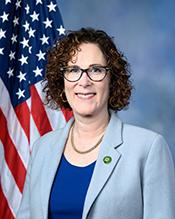
Val T. Hoyle
DDemocratOR-4 · Representative
64
/ 100
Average
Attendance98
Avg: 96
Independence4
Avg: 4
Bipartisan Tone22
Avg: 15
Ethics Record100
Avg: 99
Transparency92
Avg: 53
Accountability Score — composite of attendance, independence, bipartisan tone, ethics record & transparency.
Methodology13
Bills Sponsored
0
Enacted into Law
1
Passed a Chamber
12
In Committee
All Sponsored Bills
HR10823In Committee
Northwest Wetlands Voluntary Incentives Program Act
HR10444In Committee
Stop Corporate Takeovers of Physicians Act of 2026
HR10094In Committee
Affordable Pricing for Taxpayer-Funded Prescription Drugs Act of 2026
HR9281In Committee
DASH Act
The bill would provide rental vouchers to help homeless people afford housing by subsidizing their rent payments. This assistance would help vulnerable individuals and families secure stable housing while potentially reducing costs associated with homelessness for communities and government services.
HR8719In Committee
Shared Micromobility Investment Act
The bill would provide federal funding and support for shared micromobility systems like bike-sharing and scooter-sharing programs in cities across the country. It aims to help local communities expand these transportation options, which can reduce traffic congestion and provide affordable alternatives to cars for short trips. The funding would benefit city planners, transportation agencies, and residents who use or could benefit from easier access to these services.
HR8592In Committee
No WAR Act
No War Appropriations through Reconciliation Act or the No WAR Act This bill establishes a budget point of order that prohibits considering reconciliation legislation that provides funding for unauthorized military force against Iran. (Reconciliation is an expedited method by which Congress may adopt changes in spending and revenue laws to achieve the budgetary goals reflected in a congressional budget resolution. Reconciliation bills are considered by Congress using expedited legislative procedures that prevent a filibuster and restrict amendments in the Senate.) Specifically, the point of order may be raised to prohibit the consideration of reconciliation legislation that provides budget authority for hostilities, including hostilities conducted by a proxy force, against Iran unless Congress has authorized such hostilities through a declaration of war or a specific authorization for use of military force. Under the bill, hostilities includes any offensive military operation, strike, covert action, or sustained engagement involving armed conflict against Iranian military forces, territory, or government institutions. The point of order may be waived by a vote of at least three-fifths of all Senators duly chosen and sworn (60 votes if there are no vacancies).
HR6864In Committee
SAW Act
The SAW Act likely addresses management or use of public lands and natural resources, though the specific details depend on the bill's full text. Based on its referral to the Judiciary Committee, it probably involves legal frameworks or regulatory changes affecting how federal lands are used, protected, or developed. This could impact outdoor recreation, conservation, resource extraction, or environmental protection on public property.
HR4675In Committee
Columbia River Clean-Up Act
The legislation would authorize federal funding and coordinate cleanup efforts to remove pollution and contamination from the Columbia River, which flows through Washington and Oregon and serves millions of people for drinking water, fishing, and recreation. The bill would direct resources toward addressing industrial waste, radioactive materials, and other hazardous substances that have accumulated in the river over decades. Communities along the river, fishing industries, and environmental groups would benefit from the restoration efforts.
HR4453In Committee
To amend title 5, United States Code, to include Parkinson's disease in the list of illnesses and diseases deemed to be proximately caused by employment in fire protection activities, and for other purposes.
Firefighters who develop Parkinson's disease would be able to claim it as a work-related illness and receive federal benefits, similar to how other job-related health conditions are already covered for federal employees in fire protection roles. The change recognizes that firefighters' exposure to hazardous materials and chemicals on the job may cause this neurological disease, making them eligible for compensation and medical coverage without having to prove the connection themselves.
HR4035In Committee
Wall Street Tax Act of 2025
This bill would impose a small tax on financial transactions like stock and bond sales, with the goal of raising revenue and potentially reducing high-frequency trading. The tax would primarily affect Wall Street firms, investment banks, and wealthy investors who frequently buy and sell securities, though it could indirectly impact regular people with retirement accounts or mutual funds. Revenue collected would go to the federal government to help pay for government programs.
HR2847In Committee
Vote at Home Act of 2025
Vote at Home Act of 2025 This bill expands voting by mail in federal elections and provides for automatic voter registration through state motor vehicle authorities. Specifically, the bill prohibits states from imposing additional conditions or requirements on the eligibility of individuals to cast ballots by mail in federal elections, except states may impose a deadline for requesting the ballot and related voting materials and for returning a ballot. Further, states must mail ballots to individuals registered to vote in a federal election not later than two weeks before the election. In addition, the U.S. Postal Service must carry ballots for federal elections expeditiously and free of postage. Finally, the bill provides for automatic voter registration of individuals through state motor vehicle authorities.
HR1700In Committee
Social Security Expansion Act
Social Security Expansion Act This bill increases Social Security benefits, expands Social Security payroll taxes, and makes other changes to the Social Security program. Specifically, the bill changes the way Social Security benefits are calculated by increasing the primary insurance amount applicable to average monthly earnings that fall below a specified amount, and increasing bend points for individuals who become eligible for Social Security after 2025. (Bend points are dollar amounts at which earnings are segmented for the purpose of calculating an individual’s primary insurance amount. The share of an individual’s earnings that are replaced by Social Security decreases at each escalating bend point.) The bill also revises the method of calculating cost-of-living adjustments to account for the spending of individuals over the age of 62 and establishes a new minimum benefit for certain low earners. Further, the bill permits full-time students who are the children of deceased or disabled workers to collect Social Security or railroad retirement child’s benefits until they reach age 22. With respect to taxes, the bill extends payroll taxes on wages, salaries, and self-employment earnings to income above $250,000. (In 2025, the maximum amount subject to Social Security payroll tax is $176,100.) The bill also increases the net investment income tax and subjects active trade or business income to this tax. Finally, the bill combines the existing Federal Old-Age and Survivors Insurance Trust Fund and the Federal Disability Insurance Trust Fund into a single Social Security Trust Fund.
HR164Passed House
POWER Act of 2025
Promoting Opportunities to Widen Electrical Resilience Act of 2025 or the POWER Act of 2025 This bill authorizes electric utilities receiving certain emergency assistance for the restoration of power to also carry out cost-effective hazard mitigation activities in combination with the power restoration activities. Additionally, the bill specifies that electric utilities receiving such assistance for a facility may, if otherwise eligible, also receive hazard mitigation assistance for the same facility under the Federal Emergency Management Agency's Public Assistance program.