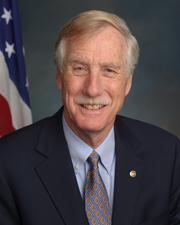
Angus S. King Jr.
IIndependentME · Senator
68
/ 100
Above Average
Attendance98
Avg: 97
Independence100
Avg: 23
Bipartisan Tone0
Avg: 14
Ethics Record100
Avg: 100
Transparency26
Avg: 47
Accountability Score — composite of attendance, independence, bipartisan tone, ethics record & transparency.
Methodology27
Bills Sponsored
0
Enacted into Law
1
Passed a Chamber
24
In Committee
All Sponsored Bills
S5652In Committee
Build American Efficiency Act
S5497In Committee
Providing Veterans Essential Medications Act
SRES905Introduced
A resolution designating September 25, 2026, as "National Lobster Day".
S5466In Committee
FASTER Act
S5406In Committee
VA Salary Cap Waiver Adjustment Act
S5378In Committee
Outer Continental Shelf Lease Restoration Act of 2026
S5213In Committee
SMASH 2.0 Act
The federal government would fund and support programs that track and control diseases spread by mosquitoes and other insects like ticks, helping states and local health departments detect outbreaks early and prevent the spread of illnesses such as Zika, West Nile virus, and Lyme disease. This would benefit public health agencies, healthcare providers, and communities by providing resources for mosquito monitoring, testing, and control efforts. The bill is currently under review by the Senate committee responsible for health policy.
S5137In Committee
CARE for Mental Health Professionals Act
The federal government would create a grant program to help mental health professionals more easily work across state lines by reducing barriers related to getting licensed in multiple states. States and organizations that participate would receive federal funding to streamline their licensing processes and recognize credentials from other states. This would make it easier for therapists, counselors, and other mental health workers to serve patients in different states without having to go through lengthy re-licensing procedures in each one.
S4754In Committee
Primary and Behavioral Health Care Access Act of 2026
The bill would require health insurance plans to cover up to three primary care doctor visits and three mental health or behavioral health visits each year without requiring patients to pay any out-of-pocket costs like copays or deductibles. This would apply to both employer-sponsored health plans and individual insurance policies. The change would make it easier and more affordable for people to access routine medical care and mental health services.
S3591In Committee
Thomas M. Conway Veterans Access to Resources in the Workplace Act
The legislation would require employers to provide veterans with information about and access to resources that help them transition to civilian jobs, manage service-related health issues, and connect with support services. This would affect both veterans entering the workforce and the companies that hire them, ensuring that employers play a role in helping former military members successfully adjust to civilian employment. The bill aims to bridge the gap between military service and civilian career success by making workplace support more readily available.
S4298In Committee
Stop CHEATERS Act
Stop Corporations and High Earners from Avoiding Taxes and Enforce the Rules Strictly Act or the Stop CHEATERS Act This bill provides additional appropriations to the Internal Revenue Service (IRS) for FY2026-FY2031 and establishes reporting requirements related to tax enforcement for high-income individuals and corporations. The bill provides specified appropriations to the IRS for FY2026-FY2031 for purposes such as tax enforcement, taxpayer services, technology and operations support, and business systems modernization. The funds provided by the bill remain available until expended. The bill also requires the IRS to submit a report to Congress every two years that includes a comprehensive description of a plan to shift more IRS auditing and enforcement assets toward high-income individuals and large corporations, recruit and retain auditors with the skills essential to audit high-income individuals and large corporations, and increase voluntary compliance among high-income individuals and large corporations. The report must also include (1) a description of the progress that has been made in implementing the plan; and (2) an analysis of how much of the difference between the taxes owed and the taxes collected by the IRS is attributable to taxpayers at different income levels, including high-income individuals and large corporations. The bill also requires the Treasury Inspector General for Tax Administration to submit a report to Congress evaluating the IRS's plan and its progress in implementing the plan.
S4162In Committee
Get Justice-Involved Veterans BACK HOME Act
This bill aims to help veterans who have been involved with the criminal justice system by providing them with housing assistance, mental health services, and job training to help them reintegrate into their communities after incarceration. The program would connect justice-involved veterans with existing VA benefits and support services they may not know about or have access to. The goal is to reduce recidivism and homelessness among this vulnerable veteran population.
S2833In Committee
Stand Strong Falls Prevention Act
Stand Strong Falls Prevention Act This bill establishes an advisory committee on falls prevention to assess federal efforts to prevent falls and recommend related policies to the Administration on Aging (AOA). The advisory committee must oversee the creation and maintenance of a national plan to address falls prevention, including through the advancement of programs or interventions to prevent falls and reduce the number and severity of fall-related injuries. The committee must also assist the AOA in coordinating falls prevention research and services across federal agencies. The committee must be comprised of members representing specified federal agencies, non-government organizations, and populations (e.g., caregivers and health care providers). Within a specified period, the advisory committee must submit an initial report to the AOA and Congress, including • an evaluation of all federally funded efforts related to falls prevention and recommendations for adjusting these efforts based on their purpose and performance; • a recommendation for developing a Medicare pilot or demonstration program to provide coverage for basic home modifications to reduce falls; and • recommendations for increasing provider use of a fall risk screening, assessment, and intervention tool developed by the Centers for Disease Control and Prevention. The AOA must submit regular reports to Congress with assessments of U.S. progress in addressing falls prevention, outcomes of the committee’s recommendations, and recommended priority actions. These reports must evaluate the implementation of any Medicare program initiated pursuant to a committee recommendation.
S2841In Committee
CIVICS Act of 2025
The CIVICS Act would require schools to teach students about the structure and function of government, voting rights, and civic responsibilities. The bill aims to improve civics education across the country so that young people better understand how democracy works and how to participate in it. This would affect students, teachers, and school districts that would need to implement or expand civics curriculum.
S3938In Committee
TAP Promotion Act
TAP Promotion Act This bill requires that pre-separation counseling under the Transition Assistance Program include a presentation that promotes the benefits available to veterans from the Department of Veterans Affairs (VA). The bill also requires the VA to annually report on the presentation to (1) identify veterans service organizations that participate, (2) provide the number of members of the Armed Forces who attend, and (3) provide any recommendations for changes to the presentation.
S3818In Committee
Ensuring Benefits for Disabled Veterans Act
This bill would protect disability benefits for veterans who have service-connected disabilities, ensuring they continue receiving the support they've earned through their military service. The legislation likely addresses gaps or vulnerabilities in how these benefits are currently administered or paid to disabled veterans and their families. Veterans with disabilities from their time in the military would be the primary beneficiaries of any protections or improvements this bill creates.
S282Passed Senate
Katahdin Woods and Waters National Monument Access Act
This bill would improve public access to the Katahdin Woods and Waters National Monument in Maine by authorizing funding for roads, parking areas, and visitor facilities that make it easier for people to reach and explore the protected land. The measure would help both outdoor enthusiasts who want to visit the monument and local communities nearby by supporting infrastructure improvements that have been limited since the monument was established.
SJRES82In Committee
A joint resolution providing for congressional disapproval under chapter 8 of title 5, United States Code, of the rule submitted by the Office of the Secretary of the Department of Health and Human Services relating to "Policy on Adhering to the Text of the Administrative Procedure Act".
Congress attempted to block a Health and Human Services Department rule about how the agency follows federal administrative procedures, but the effort failed in the Senate with a tied vote. The rule deals with how the department interprets and applies the Administrative Procedure Act, which sets out the basic rules agencies must follow when making decisions and creating regulations. This type of resolution allows Congress to reject agency rules it disagrees with, though in this case supporters and opponents were evenly split.
S668In Committee
SAFE STEPS for Veterans Act of 2025
Supporting Access to Falls Education and Prevention and Strengthening Training Efforts and Promoting Safety Initiatives for Veterans Act of 2025 or the SAFE STEPS for Veterans Act of 2025 This bill addresses certain mobility and aging care and services provided by the Department of Veterans Affairs (VA). First, the bill requires the establishment and operation of the Office of Falls Prevention within the Veterans Health Administration (VHA) for purposes of providing, evaluating, and improving VA health care services related to falls prevention. Among other duties, the office must oversee and support a national education campaign for veterans, their families, and health care providers that focuses on reducing falls and increases awareness of available benefits or services provided by the VA to reduce falls. The bill also expands membership of the Interagency Coordinating Committee on Healthy Aging and Age-Friendly Communities by including the VA. The VA must issue or update directives of the VHA for facilities and providers relating to safe patient handling and mobility policies. Additionally, the VA must determine the feasibility and advisability of implementing a pilot program to provide home improvements and structural alterations to prevent falls for veterans who are eligible for such services under VA laws. Finally, the bill requires the VA to ensure certain veterans receive a falls risk assessment from a licensed physical therapist or occupational therapist.
S926In Committee
Saving Our Veterans Lives Act of 2025
Saving Our Veterans Lives Act of 2025 This bill requires the Department of Veterans Affairs (VA) to implement a program to provide, upon request, a firearm lockbox (or voucher for such item) to eligible individuals. Currently, there is a pilot program under which certain veterans may be prescribed a lockbox by a VA clinician. The VA must also provide information with respect to the benefits of and options for secure firearm storage. The VA must develop an informational video on the secure storage of firearms as a suicide prevention strategy and publish the video on its website. Additionally, the VA must publish information to inform individuals who participate in the lockbox program that such lockboxes are not for resale. The VA must also implement a public education campaign to educate eligible individuals about the availability of lockboxes under the program and that participation in the program does not affect the rights of an individual with respect to the lawful ownership of a firearm.
S2831In Committee
Stand Strong for Medicare Act
The proposal would protect Medicare benefits and prevent cuts to the program's funding and services for seniors and disabled Americans. It aims to strengthen Medicare's financial stability and ensure that beneficiaries continue receiving the healthcare coverage they rely on without reductions in coverage or increases in out-of-pocket costs.
SRES393Introduced
A resolution designating September 25, 2025, as "National Lobster Day".
S2409In Committee
PRIME Act
The PRIME Act would allow small meat producers to process and sell their products directly to consumers without going through large commercial slaughterhouses, making it easier for local farms and ranches to bring meat to market. This would give farmers more control over their operations and potentially lower costs, while giving consumers access to locally-raised meat products. The bill affects small agricultural producers, consumers interested in local food sources, and the meat processing industry.
S585In Committee
Servicemember to Veteran Health Care Connection Act of 2025
This bill aims to improve the transition of military service members to veteran status by strengthening the connection between military health care and Veterans Affairs health care services. It likely seeks to reduce gaps in medical coverage and ensure smoother access to VA benefits for newly separated service members. The legislation would affect active-duty personnel, veterans, and the military and VA health care systems.
S1336In Committee
Jobs in the Woods Act
This bill would create or expand job programs focused on forestry and land management work on public lands, likely including activities like forest maintenance, wildfire prevention, and trail upkeep. The legislation would provide employment opportunities for workers in rural and forested areas while addressing forest health and conservation needs on federal property. It affects both workers seeking jobs in outdoor and natural resource sectors and federal land management agencies responsible for maintaining public forests.
S1279In Committee
A bill to redesignate the Hulls Cove Visitor Center at Acadia National Park as the George J. Mitchell Visitor Center.
The bill would rename the visitor center at Acadia National Park in Maine after George J. Mitchell, a former U.S. Senator from Maine. This change honors Mitchell's legacy and would affect how the facility is officially identified and referred to by the National Park Service and visitors to the park.
S264In Committee
Improving Veterans’ Experience Act of 2025
Improving Veterans’ Experience Act of 2025 This bill establishes the Veterans Experience Office within the Department of Veterans Affairs (VA) to carry out the key customer experience initiatives of the VA relating to veterans’ and beneficiaries’ satisfaction with and usage of VA benefits and services. Additionally, the office must require the heads of other organizations and offices within the VA to report regularly on customer experience metrics, action plans, and other customer experience improvement efforts; collect veteran-derived data to determine satisfaction and for use in policymaking; provide strategic guidance and strategies to VA entities for engaging with veterans and beneficiaries; assess and advise the VA on the accuracy and helpfulness of websites and customer-facing information of the VA; and assess and advise the VA on the status and opportunities for improvement of the customer service efforts of the VA. The requirements of this bill terminate on September 30, 2028. The Government Accountability Office must analyze and report on the methodology, effectiveness, and implementation of the VA’s approach to improving veteran and beneficiary customer experience and satisfaction.