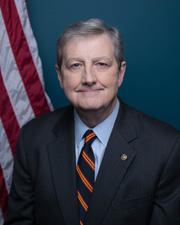
John Kennedy
RRepublicanLA · Senator
63
/ 100
Average
Attendance98
Avg: 97
Independence24
Avg: 23
Bipartisan Tone25
Avg: 14
Ethics Record100
Avg: 100
Transparency57
Avg: 47
Accountability Score — composite of attendance, independence, bipartisan tone, ethics record & transparency.
Methodology59
Bills Sponsored
4
Enacted into Law
1
Passed a Chamber
53
In Committee
Bills That Became Law
S269Ending Improper Payments to Deceased People ActS616Foundation of the Federal Bar Association Charter Amendments Act of 2025SJRES13A joint resolution providing for congressional disapproval under chapter 8 of title 5, United States Code, of the rule submitted by the Office of the Comptroller of the Currency of the Department of the Treasury relating to the review of applications under the Bank Merger Act.SJRES11A joint resolution providing for congressional disapproval under chapter 8 of title 5, United States Code, of the rule submitted by the Bureau of Ocean Energy Management relating to "Protection of Marine Archaeological Resources".
All Sponsored Bills
S5628In Committee
Transparency in CFPB Cost-Benefit Analysis Act
S5487In Committee
TWICE Act
S5423In Committee
Support Our Educators Act of 2026
S5417In Committee
AI Emergency Button Act
S4850Passed Senate
Diversity Jurisdiction Inflation Adjustment Act
Diversity Jurisdiction Inflation Adjustment Act This bill raises the minimum amount in controversy for federal diversity jurisdiction. Under current law, federal courts have jurisdiction over civil cases in which the monetary amount in controversy exceeds $75,000 and there is diversity of citizenship among the parties (e.g., the parties are citizens of different states). This bill raises the minimum amount in controversy from $75,000 to $150,000 and adjusts the amount for inflation every 10 years beginning in 2030.
S5210In Committee
Display America's Art Act
Members of Congress would be allowed to display artwork that is currently stored away in congressional buildings, rather than keeping it hidden in storage facilities. This would let lawmakers showcase pieces from the government's art collection in their offices and other spaces around Capitol Hill. The change would make the artwork visible to the public and staff who visit Congress.
S5085In Committee
A bill to amend the Internal Revenue Code of 1986 to apply inflation adjustments to the additional hospital insurance tax on high income taxpayers.
The proposal would adjust the income thresholds for the additional Medicare hospital insurance tax that applies to high earners, so that the tax brackets increase along with inflation each year. Currently, these thresholds remain fixed, meaning more middle-class workers get caught by the tax over time even if their real income hasn't changed. This change would affect higher-income individuals and married couples who pay this extra 0.9% tax on wages and self-employment income above certain income levels.
S5084In Committee
A bill to amend the Internal Revenue Code of 1986 to apply inflation adjustments to the base amount and adjusted base amount for purposes of determining taxable social security benefits.
The proposal would adjust the income thresholds used to determine how much of a person's Social Security benefits are taxed, based on inflation each year. Currently, these thresholds have remained fixed since 1984, meaning more retirees pay taxes on their benefits as their incomes rise over time. This change would help prevent seniors from facing higher tax bills on their Social Security income simply due to inflation.
S4883In Committee
A bill to amend the Export Control Reform Act of 2018 to increase the civil penalties that may be imposed under that Act.
This bill increases civil penalties for violations of U.S. export control laws. Specifically, the bill increases the maximum statutory civil penalty for each violation of any regulation, order, or license issued under the Export Control Reform Act of 2018 (ECRA) to $1.2 million or four times the value of the transaction, whichever is greater. (Currently, the maximum statutory civil penalty for each violation of ECRA is $300,000 or twice the value of the transaction, whichever is greater. The Department of Commerce's Bureau of Industry and Security adjusts this maximum amount annually for inflation.)
S4917In Committee
Monitor Accountability Act
Courts sometimes appoint monitors to oversee compliance with court orders, particularly in cases involving large organizations or government agencies, and this bill would establish rules and conditions for how those monitors can be appointed and operate. The legislation would likely affect businesses, government agencies, and other entities that face court-ordered monitoring, as well as the judges and monitors involved in these oversight arrangements. By setting clearer standards for monitor appointments, the bill aims to ensure these oversight processes work fairly and effectively.
S4667In Committee
Open Courts Act of 2026
The federal court system would receive funding and authorization to upgrade its outdated computer systems for managing legal cases, making it easier for judges, lawyers, and court staff to access and process case information electronically. These modernized systems would help courts operate more efficiently and reduce paperwork, potentially speeding up how quickly cases move through the judicial system. The bill affects anyone involved in federal court proceedings, including litigants, attorneys, and court employees.
S4622In Committee
PATCH Act
Medical debt would no longer appear on credit reports that lenders and other companies use to decide whether to give people loans or credit. This change would prevent unpaid medical bills from damaging someone's credit score, which currently can make it harder to get a mortgage, car loan, or credit card. The proposal affects consumers who have medical debt and the credit reporting agencies that compile financial information about borrowers.
SRES526Reported
A resolution withholding the pay of Senators if a Government shutdown occurs.
This resolution withholds compensation from Senators during any federal government shutdown (i.e., lapse in appropriations for one or more federal agencies or departments). Senators are to be paid as soon as practicable after the date on which the government shutdown ends. The restriction applies beginning on the day after the regularly scheduled general election for federal office held in November 2026. (As background, the U.S. Constitution provides that legislation varying the level of compensation paid to members of Congress may not take effect until an intervening election has occurred.)
S4512In Committee
Affordable Insulin Now Act of 2026
Affordable Insulin Now Act of 2026 This bill limits cost-sharing for insulin under private health insurance and establishes a program to provide insulin to individuals without insurance. Specifically, the bill caps cost-sharing under private health insurance for a month's supply of selected insulin products at $35 or 25% of a plan's negotiated price (after any price concessions), whichever is less, beginning in 2027. Further, the Department of Health and Human Services (HHS) must enter into agreements with pharmacies or health care providers to provide insulin to individuals without insurance. HHS must pay such pharmacies or providers an amount equal to the difference between the out-of-pocket cost to the individual for a 30-day supply of such insulin products and $35.
S4500In Committee
VICTIM Act of 2026
The federal government would create a new grant program that gives money to law enforcement agencies to help them solve violent crimes more quickly and effectively by using new investigative techniques and technology. Police departments could use these grants to purchase equipment, train officers, and implement new methods for investigating murders, assaults, and other serious violent offenses. The Attorney General would oversee the program and decide which law enforcement agencies receive funding.
S3170In Committee
Stuck On Hold Act
Stuck On Hold Act This bill requires the Department of Veterans Affairs (VA) to implement automated systems for their customer phone lines that inform callers of the expected wait time and that offer callbacks for wait times of more than 10 minutes. The VA must also issue guidance to reduce the average wait time to no more than 10 minutes.
S4419In Committee
A bill to amend title 31, United States Code, to require only foreign entities to report beneficial ownership information, and for other purposes.
The bill would change federal reporting requirements so that only foreign-owned companies have to disclose who actually owns and controls them, while exempting U.S.-based companies from the same disclosure rules. Currently, both domestic and foreign entities face similar beneficial ownership reporting requirements designed to prevent money laundering and financial crimes. This change would affect banks, financial institutions, and law enforcement agencies that rely on ownership information to verify the legitimacy of business transactions.
S4379In Committee
Russia’s War on Faith Act
The government would be required to investigate and report on how Russia is restricting religious freedom in Ukraine, and the President would then impose financial sanctions against foreign individuals and organizations found responsible for these violations. The State Department and Defense Department would work together to document these abuses and identify who should face penalties like frozen assets and trade restrictions. This would give the U.S. a tool to punish those involved in suppressing religious practices in Ukraine.
S4308In Committee
A bill to prohibit the Export-Import Bank of the United States from providing financing to persons with seriously delinquent tax debt.
This bill prohibits the Export-Import Bank of the United States from providing financing to a person with seriously delinquent tax debt or for a project in which any participant has seriously delinquent tax debt. The bill allows the President to waive this prohibition if the President (1) determines that there are urgent and compelling circumstances significantly affecting U.S. interests that require the financing to be provided; and (2) submits to Congress, within 30 days after making the determination, a report that includes the rationale for the determination and relevant supporting information.
S4019In Committee
Diego Garcia Treaty Oversight Act
This bill would establish congressional oversight of agreements and arrangements involving Diego Garcia, a U.S. military base in the Indian Ocean that has been a subject of diplomatic disputes. The legislation would require the State Department and Defense Department to report to Congress on any treaties, leases, or deals related to the island, ensuring lawmakers have visibility into how the U.S. manages this strategically important territory. The measure affects military operations, diplomatic relations with countries in the region, and how the U.S. handles its overseas military installations.
S3973In Committee
National Domestic Preparedness Consortium Reauthorization Act
This bill would renew and continue funding for the National Domestic Preparedness Consortium, a network of universities and organizations that trains emergency responders like firefighters, police officers, and emergency managers in how to handle disasters and terrorist attacks. The training programs help first responders across the country prepare for and respond to emergencies more effectively. The bill essentially keeps this existing training program running by reauthorizing its legal authority and funding.
S3935In Committee
Municipal Securities Rulemaking Board Reform Act of 2026
This bill would make changes to how the Municipal Securities Rulemaking Board operates, which is the organization that sets rules for trading bonds issued by cities, states, and local governments. The reforms likely aim to improve oversight, transparency, or efficiency in the municipal bond market, which affects investors, local governments seeking to borrow money, and the financial firms that buy and sell these bonds.
S269Enacted
Ending Improper Payments to Deceased People Act
Ending Improper Payments to Deceased People Act This act permanently allows the Department of the Treasury to access certain death records maintained by the Social Security Administration (SSA) to help prevent and recover improper payments (e.g., payments to deceased individuals). The act also establishes evidentiary requirements the SSA must meet before identifying an individual as deceased. Current law requires the SSA to share its Death Master File with the Do Not Pay system maintained by Treasury for three years. The act makes this requirement permanent. Treasury must enter into an agreement with the SSA related to Treasury's share of the cost of state death data. The act also prohibits the SSA from recording a death in the master file unless the SSA has clear and convincing evidence that the individual should be presumed deceased. If an individual is incorrectly identified as deceased and provides the SSA with supporting documentation, the SSA may notify certain agencies that have access to the master file, including Treasury and federal or state agencies that provide or disburse federally funded benefits.
S3734In Committee
Close the Shadow Banking Loophole Act
This bill would require non-bank financial companies like private equity firms and hedge funds to follow similar lending and borrowing rules as traditional banks, closing what supporters call a "shadow banking" loophole that allows these firms to operate with less government oversight. The measure would affect investment firms, lenders, and potentially borrowers who use these alternative financial services by bringing them under stricter federal regulation and transparency requirements. The goal is to reduce financial risks that could harm the broader economy if these large, loosely-regulated firms face problems.
SRES543In Committee
A resolution commending Centenary College of Louisiana on the occasion of its bicentennial and its years of service to the State of Louisiana and the United States.
S616Enacted
Foundation of the Federal Bar Association Charter Amendments Act of 2025
Foundation of the Federal Bar Association Charter Amendments Act of 2025 This act revises the federal charter for the Foundation of the Federal Bar Association to shift authority from the charter to the bylaws. Specifically, it makes the following changes: removes the requirement for the foundation to be incorporated and domiciled in the District of Columbia; requires the board of directors to decide, and specify in the bylaws, the location of the principal office; specifies that the bylaws—not the charter—must provide for the terms of membership, the responsibilities of the board of directors, and the election of officers; prohibits a director or officer, in his or her corporate capacity, from contributing to, supporting, or participating in political activities; allows income and assets of the corporation to be used to reasonably compensate or reimburse expenses of an officer, director, or member; to award a grant to the Federal Bar Association chapter of an officer, director, or member; and to reasonably compensate employees; expands a prohibition on loans for directors and officers to include members and employees; and specifies that on dissolution or final liquidation, any remaining assets must be distributed as provided by the board of directors instead of deposited in the Treasury.
S3430In Committee
PURE Act
S3293In Committee
Energy and Water Development and Related Agencies Appropriations Act, 2026
Energy and Water Development and Related Agencies Appropriations Act, 2026 This bill provides FY2026 appropriations for U.S. Army Corps of Engineers civil works projects, the Department of the Interior's Bureau of Reclamation, the Department of Energy (DOE), and several independent agencies. The bill provides appropriations for U.S. Army Corps of Engineers civil works projects, including for Investigations; Planning, Engineering, and Design; Construction; Mississippi River and Tributaries; Operation and Maintenance; the Regulatory Program; the Formerly Utilized Sites Remedial Action Program; Flood Control and Coastal Emergencies; Expenses; the Office of the Assistant Secretary of the Army for Civil Works; and the Water Infrastructure Finance and Innovation Program. The bill provides appropriations to the Department of the Interior for the Central Utah Project and the Bureau of Reclamation. The bill provides appropriations to DOE for energy programs, including Energy Efficiency and Renewable Energy; Manufacturing and Energy Supply Chains; Cybersecurity, Energy Security, and Emergency Response; Electricity; Grid Deployment; Nuclear Energy; Fossil Energy; Energy Projects; Naval Petroleum and Oil Shale Reserves; the Strategic Petroleum Reserve; the Northeast Home Heating Oil Reserve; the Energy Information Administration; Non-Defense Environmental Cleanup; the Uranium Enrichment Decontamination and Decommissioning Fund; Science; Nuclear Waste Disposal; Technology Coordination and Commercialization; the Advanced Research Projects Agency—Energy; the Title 17 Innovative Technology Loan Guarantee Program; the Advanced Technology Vehicles Manufacturing Loan Program; the Tribal Energy Loan Guarantee Program; Indian Energy Policy and Programs; Departmental Administration; and the Office of the Inspector General. The bill also provides appropriations to DOE for Atomic Energy Defense Activities of the National Nuclear Security Administration, Environmental and Other Defense Activities, and the Power Marketing Administrations. The bill provides appropriations to several independent agencies, including the Federal Energy Regulatory Commission and the Nuclear Regulatory Commission. The bill also sets forth requirements and restrictions for using funds provided by this and other appropriations acts.
S3216In Committee
Greenlighting Growth Act
This bill likely aims to reduce financial regulations or streamline approval processes for banks and financial companies to encourage lending and economic growth. The specific changes would affect how banks operate, potentially making it easier for them to lend money to businesses and consumers, though the exact provisions aren't yet clear from the title alone. Financial institutions and borrowers would be the primary groups impacted by any regulatory changes included in the legislation.
S3224In Committee
SPEED Act
S3180In Committee
Protecting Our Courts from Foreign Manipulation Act of 2025
The legislation would establish new safeguards to prevent foreign governments and entities from improperly influencing U.S. court proceedings and judicial decisions. It likely includes measures to identify and restrict foreign involvement in lawsuits, protect sensitive court information from foreign access, and enhance security around judicial operations. The bill would affect courts, judges, attorneys, and potentially any parties involved in litigation who might face increased scrutiny regarding foreign connections.
SRES493In Committee
A resolution reducing the annual rate of pay of Senators if a Government shutdown occurs during a year.
S3104In Committee
Ideologically Motivated Violence Accountability Act
SJRES69In Committee
A joint resolution providing for congressional disapproval under chapter 8 of title 5, United States Code, of the rule submitted by the United States Fish and Wildlife Service relating to "Record of Decision for the Barred Owl Management Strategy; Washington, Oregon, and California".
This resolution would reject a federal wildlife management plan that allows the killing of barred owls in Washington, Oregon, and California as a way to protect the threatened northern spotted owl. The measure failed in the Senate, meaning the Fish and Wildlife Service's owl management strategy will remain in effect. Environmental groups and wildlife managers have disagreed over whether killing barred owls is the right approach to save the spotted owl population.
S3066In Committee
Pay the People Act
Pay the People Act This bill provides appropriations to pay federal employees during a government shutdown due to a lapse in appropriations. Specifically, the bill provides appropriations for federal agencies to provide standard rates of pay, allowances, pay differentials, benefits, and other payments to agency employees (including contractors and members of the Armed Forces on active duty) during any period in which interim continuing appropriations or full-year appropriations are not in effect for a fiscal year (i.e., a government shutdown). A federal agency may not use the funds provided by this bill during any period in which continuing appropriations are in effect for the purpose of paying employees of the agency. The bill must take effect as if it had been enacted on September 30, 2025.
S3057In Committee
Withhold Member Pay During Shutdowns Act
This bill would stop members of Congress from receiving their paychecks whenever the federal government shuts down due to a budget disagreement. The goal is to pressure lawmakers to reach budget deals quickly by making them personally feel the financial impact of a shutdown, rather than having taxpayers bear all the consequences while Congress still gets paid.
S2931In Committee
NFIP Extension Act
The National Flood Insurance Program (NFIP) provides flood insurance to property owners in areas where private insurance companies won't cover flood damage, and this bill would extend the program's authorization so it can continue operating. Homeowners and businesses in flood-prone areas depend on NFIP to protect their properties from flood losses, and without this extension, the program could lose its legal authority to issue new policies or renew existing ones. The bill affects millions of Americans with mortgages in areas at risk of flooding, as well as state and local governments that rely on the program to keep property values stable.
S2854In Committee
District of Columbia Judicial Nominations Reform Act
District of Columbia Judicial Nominations Reform Act This bill terminates the District of Columbia (DC) Judicial Nomination Commission. Currently, the commission recommends to the President nominees for judges for DC's Superior Court and Court of Appeals, who must then be confirmed by the Senate. The commission also appoints the chief judges for these courts. The bill terminates the commission's involvement in nominations and requires the President to appoint the chief judges.
S2510In Committee
Service-Disabled Veteran Opportunities in Small Business Act
This bill would help service-disabled veterans start and grow their own businesses by expanding access to federal contracting opportunities and small business support programs. Veterans with service-connected disabilities would get priority consideration when the government awards contracts and would have easier access to loans, training, and other resources designed to help small business owners succeed. The goal is to recognize veterans' service while creating economic opportunities for those who have been injured or disabled while serving in the military.
SJRES13Enacted
A joint resolution providing for congressional disapproval under chapter 8 of title 5, United States Code, of the rule submitted by the Office of the Comptroller of the Currency of the Department of the Treasury relating to the review of applications under the Bank Merger Act.
This joint resolution nullifies the final rule issued by the Department of the Treasury’s Office of the Comptroller of the Currency titled Business Combinations Under the Bank Merger Act and published on September 25, 2024. The rule revises procedures for reviewing applications for proposed bank mergers, such as by removing automatic approvals under an expedited review procedure and by discontinuing streamlined application forms.
S1924In Committee
Improving Mental Health Access for Students Act
The proposal would expand mental health services and counseling available to students in schools, making it easier for young people to access support for depression, anxiety, and other mental health challenges. It would likely increase funding for school counselors and mental health professionals, helping schools hire more staff to meet student needs. Students and their families would benefit from having better access to mental health care during the school day without having to seek services elsewhere.
S1454In Committee
FIGHT Act of 2025
Based on the vague title and referral to the agriculture committee, this bill likely addresses animal welfare or protection issues, though the specific focus isn't clear from the title alone. The bill may establish new regulations or enforcement mechanisms related to animal treatment, potentially affecting farmers, pet owners, animal shelters, or wildlife management practices. Without more detailed information about the bill's contents, the exact scope of who would be impacted and what specific changes would occur remains unclear.
S1401In Committee
Targeting Child Predators Act of 2025
Targeting Child Predators Act of 2025 This bill lengthens the duration of a nondisclosure order issued in connection with an administrative subpoena in a child exploitation or abuse investigation. The bill also subjects the nondisclosure order to judicial review. Current law permits the government to issue an administrative subpoena that compels providers of remote computing services or electronic communication services (providers) to disclose information pertaining to a subscriber in connection with a child exploitation or abuse investigation. Providers may notify customers and subscribers of the administrative subpoena unless the government obtains a court order—a nondisclosure order—that prohibits the notification. A nondisclosure order is currently valid for up to 90 days. This bill allows the government to obtain a nondisclosure order for 180 days in connection with a child exploitation or abuse investigation if the administrative subpoena includes a certification of necessity and notice of the right to judicial review.
SJRES11Enacted
A joint resolution providing for congressional disapproval under chapter 8 of title 5, United States Code, of the rule submitted by the Bureau of Ocean Energy Management relating to "Protection of Marine Archaeological Resources".
This joint resolution rescinds a requirement for lessees and operators to submit an archaeological report with any oil and gas exploration or development plan they submit to the Bureau of Ocean Energy Management (BOEM) for approval of activities proposed on the Outer Continental Shelf. (An archaeological report identifies material remains of human life or activities that are at least 50 years old and that are of archaeological interest.) Specifically, the joint resolution nullifies BOEM's final rule titled Protection of Marine Archaeological Resources and published on September 3, 2024. Nullifying this rule requires BOEM to reinstate regulations that were previously in effect and authorized BOEM to require an archaeological report only if a BOEM regional director has reason to believe that an archaeological resource may be present in the lease area.
S1001In Committee
Crucial Communism Teaching Act
Crucial Communism Teaching Act This bill directs the Victims of Communism Memorial Foundation to develop a civic education curriculum and oral history resources for high school students to promote understanding of certain political ideologies (e.g., communism and totalitarianism) that conflict with principles of U.S. democracy.
S940In Committee
Transparency in Banking Act
S478In Committee
Veterans 2nd Amendment Protection Act of 2025
Veterans 2nd Amendment Protection Act of 2025 This bill prohibits the Department of Veterans Affairs (VA) from transmitting certain information to the National Instant Criminal Background Check System (NICS) utilized by licensed importers or dealers of firearms. Specifically, the bill prohibits the VA from transmitting personally identifying information of a veteran or a beneficiary to the NICS solely on the basis that such veteran or beneficiary has an appointed fiduciary to manage their benefits, unless there is an order or finding of a judicial authority that such veteran or beneficiary is a danger to themselves or others.
S679In Committee
LEOSA Reform Act
LEOSA Reform Act This bill broadens the authority for certain individuals to carry concealed firearms in school zones and across state lines. Specifically, the bill exempts the following categories of individuals from the federal prohibition on possessing (or discharging) a firearm in a school zone: certain active and retired law enforcement officers who are authorized to carry concealed firearms under federal law, and individuals who are allowed to carry concealed firearms under the law of a state. Additionally, the bill allows qualified active and retired law enforcement officers to carry concealed firearms and ammunition (including magazines) in national parks; on state, local, or private property that is open to the public; and in certain federal facilities that are open to the public. Finally, the bill permits states to reduce the frequency with which retired law enforcement officers must meet certain qualification standards.
S658In Committee
Protecting Investors’ Personally Identifiable Information Act
Protecting Investors' Personally Identifiable Information Act This bill prohibits the Securities and Exchange Commission (SEC) from requiring a national securities exchange or association (or a member of either) to provide a market participant's personally identifiable information to satisfy the reporting requirements of the Consolidated Audit Trail (i.e., data used to track market activity). However, this information must be provided to the SEC upon request if the information is related to a securities investigation. The SEC must destroy the information not later than one day after the conclusion of the matter for which this information was required.
S682In Committee
Independent and Objective Oversight of Ukrainian Assistance Act
Independent and Objective Oversight of Ukrainian Assistance Act The bill establishes the Office of the Special Inspector General for Ukrainian Military, Economic, and Humanitarian Aid. The office's duties shall include (1) conducting and coordinating audits and investigations of the handling of funds made available for aid to Ukraine, and (2) monitoring and reviewing contracts and reconstruction activities involving those funds. The Special Inspector General shall report directly to, and be under the general supervision of, the Secretary of State and Secretary of Defense. Federal agencies may not prevent the office from carrying out any audit or investigation related to aid to Ukraine. However, the office is not authorized to audit or investigate the intelligence community. The office shall terminate 180 days after the date on which there is less than $250 million in unexpended amounts available for the reconstruction of Ukraine.
S623In Committee
No IRIS Act of 2025
SJRES19In Committee
A joint resolution providing for congressional disapproval under chapter 8 of title 5, United States Code, of the rule submitted by the Environmental Protection Agency relating to "Trichloroethylene (TCE); Regulation Under the Toxic Substances Control Act (TSCA)".
This joint resolution nullifies the Environmental Protection Agency rule titled Trichloroethylene (TCE); Regulation Under the Toxic Substances Control Act (TSCA) (89 Fed. Reg. 102568) and published on December 17, 2024. Among other elements, the rule prohibits the manufacturing, import, processing, and distribution in commerce of trichloroethylene (TCE) for all uses (including consumer uses), and prohibits the industrial and commercial use of TCE.
S577In Committee
Expanding Access to Capital for Rural Job Creators Act
Expanding Access to Capital for Rural Job Creators Act This bill requires the Office of the Advocate for Small Business Capital Formation within the Securities and Exchange Commission to report on issues encountered by rural-area small businesses.
S519In Committee
No Propaganda Act
No Propaganda Act This bill prohibits federal funding of the Corporation for Public Broadcasting and rescinds certain funds that were provided to the corporation. (The corporation is a congressionally created nonprofit that supports local public television and radio broadcasting.)
S447In Committee
Jobs and Opportunities for Medicaid Act
Jobs and Opportunities for Medicaid Act This bill establishes work requirements under Medicaid for able-bodied adults. Specifically, the bill requires individuals who are between the ages of 18 and 65 and who are not otherwise unable to work due to a medical condition, family situation, or other listed reason to work or volunteer at least 20 hours per week, based on a monthly average, in order to qualify for Medicaid.
S477In Committee
Fairness in Fentanyl Sentencing Act of 2025
Fairness in Fentanyl Sentencing Act of 2025 This bill modifies the drug quantity thresholds that trigger a mandatory minimum prison term for a defendant who manufactures, distributes, imports, exports, or possesses with intent to distribute fentanyl. Specifically, the bill reduces from 400 to 20 grams the fentanyl quantity and from 100 to 5 grams the fentanyl analogue quantity that trigger a mandatory minimum prison term for high-level first-time or repeat offenders. It also reduces from 40 to 2 grams the fentanyl quantity and from 10 to 0.5 grams the fentanyl analogue quantity that trigger a mandatory minimum prison term for low-level first-time or repeat offenders. Additionally, the bill directs the U.S. Postal Service to increase the availability of chemical screening devices and dedicate the appropriate number of personnel to interdict fentanyl and other substances that are unlawfully imported into the United States.
S397In Committee
Small Business Disaster Damage Fairness Act of 2025
Small Business Disaster Damage Fairness Act of 2025 This bill increases from $14,000 to $50,000 the threshold loan amount over which the Small Business Administration (SBA) may require collateral for a disaster loan. The Government Accountability Office must report on the performance, including the default rate, of such loans. Additionally, the SBA must (1) distinguish between rural and urban communities in the outreach and marketing for disaster loans, and (2) incorporate actions to mitigate challenges encountered by rural communities in accessing such loans.
SJRES8In Committee
A joint resolution providing for congressional disapproval under chapter 8 of title 5, United States Code, of the rule submitted by the Department of Homeland Security relating to "Increase of the Automatic Extension Period of Employment Authorization and Documentation for Certain Employment Authorization Document Renewal Applicants".
This joint resolution nullifies the final rule issued by the Department of Homeland Security titled Increase of the Automatic Extension Period of Employment Authorization and Documentation for Certain Employment Authorization Document Renewal Applicants and published on December 13, 2024. This rule makes permanent the increase of the automatic extension period from 180 days to 540 days for expiring employment authorization documents. The extension applies to eligible noncitizens who renew these authorizations on time.
S234In Committee
Prosecutors Need to Prosecute Act of 2025
Prosecutors Need to Prosecute Act of 2025 This bill requires certain state and local prosecutors to report data on criminal referrals and outcomes of cases involving murder or non-negligent manslaughter, forcible rape, robbery, aggravated assault, burglary, larceny, motor vehicle theft, arson, or any offense involving the illegal use or possession of a firearm. The reporting requirement applies to state and local prosecutors in a jurisdiction that has 360,000 or more persons and receives funding under the Edward Byrne Memorial Justice Assistance Grant (JAG) program. The report must contain data on cases referred for prosecution, cases the prosecutor declined to prosecute or refer for diversion, cases for which the prosecutor declined to reach a plea agreement, cases that resulted in a plea agreement or referral for diversion, and offenses the prosecutor did not prosecute due to an internal policy. If a state or local prosecutor complies with these requirements, the bill requires (1) the Department of Justice to give priority in disbursing Byrne JAG program funds to the local government served by the prosecutor, and (2) the local government to ensure that the prosecutor receives a portion of the funds. Additionally, the bill prohibits states and local governments from receiving funds under the Byrne JAG program if they have in effect a policy that prohibits the use of cash bail for a defendant in a case involving the illegal use or illegal possession of a firearm.