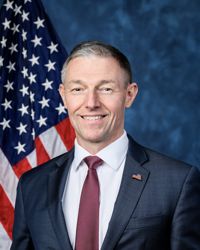
Mike Kennedy
RRepublicanUT-3 · Representative
57
/ 100
Average
Attendance98
Avg: 96
Independence7
Avg: 4
Bipartisan Tone21
Avg: 15
Ethics Record100
Avg: 99
Transparency48
Avg: 53
Accountability Score — composite of attendance, independence, bipartisan tone, ethics record & transparency.
Methodology25
Bills Sponsored
0
Enacted into Law
6
Passed a Chamber
19
In Committee
All Sponsored Bills
HR7831Passed House
License to Drill Act
License to Drill Act This bill extends through FY2037 the Bureau of Land Management’s (BLM’s) authority to collect oil and gas permit processing fees. For each new permit application, BLM collects a fee that is transferred to the BLM Permit Processing Improvement Fund. (Under current law, the fees are authorized through FY2026.)
HR8658Passed House
Indian Health Service Emergency Claims Parity Act
Indian Health Service Emergency Claims Parity Act This bill extends from 72 hours to not less than 15 days the time period to notify the Purchased/Referred Care (PRC) program of emergency medical care received from a non-Indian Health Service (IHS) medical provider or at a non-IHS medical facility. This bill does not apply to individuals who are elderly or disabled, who continue to have a 30-day notification requirement for emergency services. The IHS provides medical and dental services directly to American Indian and Alaska Native patients whenever possible. The PRC program pays for medical or dental care that is provided away from an IHS or tribal health care facility. The PRC program must be notified of requests for authorization of payment for health care services from a non-IHS provider. Currently in emergency cases, the patient, an individual on behalf of the patient, or the medical care provider must, within 72 hours after the beginning of treatment for the condition or after admission to a health care facility, notify a PRC authorizing official of the need for the emergency medical care. This bill instead allows the patient, other individual, or provider to notify PRC not less than 15 days of the treatment or admission.
HR9221In Committee
Outdoor Americans with Disabilities Act
The legislation would protect or guarantee public access to certain federal lands, allowing Americans to use these properties for activities like hiking, hunting, or recreation. The bill has been sent to two congressional committees that handle natural resources and agriculture matters to review which parts fall under each committee's responsibility.
HR9193In Committee
Powering the Future of American Space Dominance Act
The legislation would authorize NASA to develop and use nuclear-powered rockets and reactors to power spacecraft for missions far into space, such as trips to Mars and beyond. This would give NASA new technology options to travel faster and farther than traditional chemical rockets allow, potentially making deep space exploration more practical and efficient. The bill affects NASA's budget and operations, as well as companies that develop aerospace technology.
HR4684Passed House
Star-Spangled Summit Act of 2026
Star-Spangled Summit Act of 2026 This bill directs the Forest Service to issue a special use permit to maintain a flagpole bearing the American flag at Kyhv Peak Lookout Point in the Uinta National Forest, which is in Utah. The Forest Service must issue the special use permit for a 10-year period and renew the permit as required by the bill. The Forest Service may impose terms and conditions on a permit holder to ensure the proper care and maintenance of the flagpole. The bill prohibits the Forest Service from charging a land use fee for the special use permit. The bill also exempts such permit from environmental review requirements under the National Environmental Policy Act of 1969. As background, Scoutmaster Robert Collins and his scout troop raised the American flag at the point in 2000 and lowered it before winter. The flag was raised annually until the Forest Service cited policy that requires a permit for the construction or placement of any structure, including flagpoles, on National Forest lands. The bill directs the Forest Service to issue a special use permit so the flag may continue to be raised seasonally each year.
HR5638In Committee
Geothermal Royalty Reform Act
This bill would change how companies pay the government for the right to develop geothermal energy on public lands, likely increasing royalty rates and updating payment terms that haven't been significantly changed in decades. The changes would affect energy companies developing geothermal projects and could increase federal revenue from these renewable energy operations. The bill has been amended and is moving through the legislative process with support from committee members.
HR8335In Committee
PROTECT Act of 2026
This bill would change how the H-1B visa program works, which allows U.S. companies to hire skilled foreign workers for specialty jobs. The changes would likely make it harder for employers to use these visas, though the bill would create exceptions for certain critical professions like healthcare or other vital fields. The bill affects employers who rely on foreign talent, workers competing for these jobs, and the industries that depend on specialized skills.
HR5639In Committee
Co-Location Energy Act
The bill would allow energy companies to share infrastructure and equipment at the same physical location to reduce costs and environmental impact. This co-location arrangement could help renewable energy projects, power plants, and transmission facilities operate more efficiently by combining resources rather than building separate facilities. The change would primarily affect energy companies and developers looking to expand power generation or transmission capacity.
HR8051In Committee
TECH Act
The TECH Act would likely expand technology education and training programs to help students develop skills in computer science, engineering, and digital fields. The bill would probably affect schools, students, and potentially workers seeking to retrain for tech-related jobs. Without more specific details, the exact provisions remain unclear, but the focus appears to be on preparing people for careers in the technology industry.
HR6399In Committee
To direct the United States Postal Service to designate a single, unique ZIP Code for Highland City, Utah.
The bill would require the U.S. Postal Service to assign Highland City, Utah its own distinct ZIP Code instead of sharing one with another community. This change would give the town its own postal identity, which could improve mail delivery efficiency and help residents and businesses distinguish their location on addresses. The measure has passed its initial committee vote unanimously.
HR7794In Committee
Stop Child Care Funding Fraud Act of 2026
This bill would create new rules and oversight to prevent fraud and misuse of federal child care funding programs, protecting taxpayer money that supports families paying for child care services. It would likely require stricter tracking of how child care providers and programs use government subsidies and grants, and could establish penalties for providers who misuse these funds. The changes would affect child care centers, family child care providers, and families receiving child care assistance.
HR7578In Committee
TORCH Act
I don't have enough information to write an accurate summary. The bill's subjects aren't listed, and the title "TORCH Act" is too vague to determine its specific purpose without seeing the actual bill text. Based on its referral to the Agriculture and Natural Resources committees, it likely addresses farming, forestry, public lands, or environmental policy, but I cannot responsibly summarize what it would actually do without more details.
HR6491In Committee
Streamline Transit Projects Act
The proposal would speed up the approval process for public transportation projects like buses and trains by reducing the amount of time federal agencies have to review and approve them. This would help cities and transit agencies build new routes and expand existing systems faster, though it could mean less time for environmental and community impact reviews. Commuters, transit workers, and local governments would be the main groups affected by these changes.
HR1045Passed House
Utah Wildfire Research Institute Act of 2025
Utah Wildfire Research Institute Act of 2025 This bill requires the establishment of a Southwest Ecological Restoration Institute in Utah. Such institutes currently exist in Arizona, New Mexico, and Colorado and promote the use of adaptive ecosystem management to reduce the risk of wildfires and restore the health of forest and woodland ecosystems.
HR6447In Committee
CCP IP Act
This bill addresses intellectual property concerns related to China, likely aiming to protect American companies and inventors from unfair practices by Chinese competitors or the Chinese government. The legislation would probably establish new rules or enforcement mechanisms to prevent theft of American technology, trade secrets, or patents by Chinese entities. It affects American businesses, tech companies, and workers whose jobs depend on protecting innovation from foreign competition.
HR5637In Committee
No Work, No Pay Act of 2025
No Work, No Pay Act of 2025 This bill prohibits Members of Congress from being paid during a government shutdown, beginning with the 120th Congress. Under the bill, a government shutdown is in effect when there is a lapse in appropriations for any federal agency or department as a result of a failure to enact a regular appropriations bill or a continuing resolution.
HR5636In Committee
Protect Consumers from Reallocation Costs Act of 2025
The legislation would prevent energy companies from charging customers for the costs of relocating or reallocating their operations, such as moving infrastructure or equipment to different locations. This would protect consumers from unexpected fees on their energy bills while potentially limiting how companies can recover expenses from infrastructure changes. The bill has been sent to the House Committee on Energy and Commerce for review.
HRES700In Committee
Condemning the assassination of Charlie Kirk and honoring his life and legacy.
This resolution condemns the assassination of Charlie Kirk, extends condolences and sympathies to his family, and honors his commitment to civil discussion and debate.
HR3425Passed House
Personnel Oversight and Shift Tracking Act of 2025
Personnel Oversight and Shift Tracking Act of 2025 or the POST Act of 2025 The bill directs the Federal Protective Service (FPS) to improve the performance of security personnel contracted to protect federal buildings and to report on such efforts to Congress. Within one year after the bill's enactment, FPS must establish performance testing and improvement protocols for contract security personnel. Specifically, FPS shall (1) establish standards for the collection, maintenance, and analysis of covert testing data; (2) conduct quarterly analytical reviews of covert testing data to identify trends and opportunities for operational improvement; (3) establish a mandatory, cause-specific corrective training and performance improvement plan for any individual who fails a covert test; and (4) update security training guidance to address failed covert tests, emerging threats, and best practices. FPS must report to Congress about implementation upon completion and annually thereafter. Within 180 days after the bill’s enactment, FPS must assess whether to replace or upgrade its tracking system for managing and monitoring the deployment availability of contract security personnel. FPS must develop (1) an implementation plan that includes a timeline for the replacement or update; and (2) procedures to ensure timely and accurate communication to building tenants regarding contract security personnel absences or other gaps in coverage. FPS must report to Congress on the assessment within one year after the bill's enactment and annually for the next three years.
HR3451In Committee
To amend the National Trails System Act to direct the Secretary of the Interior to conduct a study on the feasibility of designating the Bonneville Shoreline Trail.
The federal government would study whether the Bonneville Shoreline Trail, a hiking path in Utah, should be officially added to the National Trails System, which recognizes and protects important walking routes across the country. This study would examine practical questions like land ownership, maintenance costs, and public support to determine if the trail meets the requirements for this official designation. The decision would affect hikers, local communities, and land managers in the region.
HR2681In Committee
Moab UMTRA Project Transition Act of 2025
This bill addresses the cleanup and management of the Moab uranium mill tailings site in Utah, which contains radioactive waste left over from uranium processing. The legislation likely transfers responsibility for the site's long-term environmental remediation from the federal government to another entity, potentially affecting how cleanup costs are handled and who oversees the project going forward. The change could impact local communities near the site, energy companies involved in uranium production, and federal budget priorities for environmental cleanup.
HR2445In Committee
Ensuring Medicaid Eligibility Act of 2025
Ensuring Medicaid Eligibility Act of 2025 This bill establishes additional requirements for state Medicaid programs with respect to verifying the eligibility of enrollees, particularly for noncitizens. It also prohibits federal Medicaid payment for services for certain noncitizens who are temporarily admitted into the United States. The bill prohibits implementation of the rule titled Medicaid Program; Streamlining the Medicaid, Children's Health Insurance Program, and Basic Health Program Application, Eligibility Determination, Enrollment, and Renewal Processes , which was issued by the Centers for Medicare & Medicaid Services on April 2, 2024. Specifically, the bill prohibits implementation of provisions that, among other changes, (1) allow state Medicaid programs to verify an individual’s U.S. citizenship and identity through certain systems without additional proof of identity; (2) align certain Medicaid enrollment processes for those whose eligibility is not based on income with those that are based on income; and (3) establish additional timelines for Medicaid eligibility terminations, including when there is a change in an individual’s circumstances. The bill also requires state Medicaid programs to (1) verify an individual's citizenship or immigration status prior to enrolling the individual in Medicaid; and (2) for individuals who qualify for Medicaid based on income, verify the individual's income on at least a quarterly basis while enrolled. Finally, the bill prohibits federal Medicaid payment for services provided to noncitizens granted parole, asylum, Temporary Protected Status, withholding of removal, or deferred action, including Deferred Action for Childhood Arrivals (DACA) recipients.
HR1318Passed House
United States Research Protection Act
United States Research Protection Act This bill clarifies the definition of a malign foreign talent recruitment program under the Research and Development, Competition, and Innovation Act. The Research and Development, Competition, and Innovation Act, which was included in the CHIPS and Science Act, prohibits researchers who receive federal funds from participating in malign foreign talent recruitment programs, in which foreign countries incentivize or compensate researchers for activities that present a conflict of interest for the researcher or that are otherwise unauthorized (e.g., sharing proprietary information without proper authorization). The bill clarifies that these restrictions apply to programs that are sponsored by a foreign country of concern, including China, Iran, North Korea, and Russia. The bill also clarifies that malign foreign talent recruitment programs may involve direct or indirect compensation or incentives from such countries.
HR1198In Committee
Let’s Get to Work Act of 2025
Let's Get to Work Act of 2025 This bill modifies and expands work requirements under the Supplemental Nutrition Assistance Program (SNAP) and certain housing programs of the Department of Housing and Urban Development (HUD). Specifically, the bill expands the applicability of the work requirements for SNAP recipients who are able-bodied adults without dependents (ABAWDs). As background, SNAP recipients who are ABAWDs have work-related requirements in addition to the general SNAP work registration and employment and training requirements. The bill applies the work requirements for ABAWDs to adults who are not over 60 years old, whereas these requirements currently apply to adults who are not over 55 years old. Further, the ABAWD exemption for a parent or household member with responsibility for a dependent child is restricted under the bill to a dependent child under the age of six. Currently, the child must be under the age of 18. The bill allows a member of a household with responsibility for a dependent child to participate in SNAP for up to 6 months (currently 3 months) over a 36-month period without meeting the ABAWD work requirements. The bill also includes an exception for an individual who (1) is responsible for a dependent individual, and (2) is married to and resides with an individual who complies with the SNAP work requirements. Additionally, the bill establishes work requirements for families residing in public housing by applying the SNAP work requirements for ABAWDs to the HUD public housing and tenant-based rental assistance (voucher) programs.
HR376In Committee
Historic Roadways Protection Act
Historic Roadways Protection Act This bill prohibits the Bureau for Land Management (BLM) from closing historical roads on public lands in certain areas of Utah until the Federal District Court for Utah makes a decision on each of the R.S. 2477 cases, which are cases brought by Utah and counties to keep historical roads on BLM land in Utah open for public use. By way of background, a provision of the Mining Law of 1866, commonly known as R.S. 2477, granted rights-of-way to states and counties across public lands for the construction of roads for public use in order to promote settlement of the American West. In 1976, Congress repealed R.S. 2477 when it enacted the Federal Land Policy and Management Act (FLPMA), but FLPMA preserved rights-of-way that had been established under R.S. 2477. After the BLM released travel management plans that closed some historical roads, Utah and 22 counties filed lawsuits about their rights-of-way across public lands for historical roads. Until the BLM certifies that those cases have been decided, the bill prohibits the BLM from obligating or expending federal funds to (1) finalize or implement a new travel management plan for certain travel management areas in Utah; or (2) implement, with respect to land within the boundary of Utah, the Indian Creek (Canyon Rims) Travel Management Plan, the San Rafael Desert Travel Management Plan, the San Rafael Swell Travel Management Plan, or the Labyrinth/Gemini Bridges Travel Management Plan.