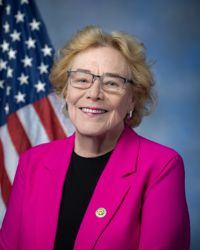
Zoe Lofgren
DDemocratCA-18 · Representative
54
/ 100
Average
Attendance98
Avg: 96
Independence2
Avg: 4
Bipartisan Tone25
Avg: 15
Ethics Record100
Avg: 99
Transparency28
Avg: 53
Accountability Score — composite of attendance, independence, bipartisan tone, ethics record & transparency.
Methodology18
Bills Sponsored
0
Enacted into Law
0
Passed a Chamber
17
In Committee
All Sponsored Bills
HR10575In Committee
Deterring Extraterritorial Foreign Exploitation of Networks Damaging Intellectual Property (DEFEND IP) Act of 2026
HR10574In Committee
American Leadership in Fusion Act
HR6207Reported
Chip EQUIP Act
Chip Equipment Quality, Usefulness, and Integrity Protection Act of 2025 or the Chip EQUIP Act This bill prohibits companies that receive certain federal funds from purchasing specified semiconductor manufacturing equipment made by foreign entities of concern (e.g., companies owned or controlled by China, Iran, North Korea, or Russia) or their subsidiaries for the federally funded project. The CHIPS Act of 2022, which became law in August 2022, appropriated funding for the Department of Commerce to carry out the CHIPS for America provisions enacted in the National Defense Authorization Act for Fiscal Year 2021. These provisions included appropriations for financial incentives to expand domestic manufacturing capacities across the semiconductor supply chain, as well as for research and development programs. Under the bill, Commerce must include in the terms of each agreement with a covered entity (e.g., companies receiving CHIPS funds) prohibitions with respect to a project relating to the procurement, installation, or use of the specified semiconductor manufacturing equipment. The prohibitions must be effective for 10 years beginning on the date on which the agreement is signed. The bill authorizes Commerce to waive these prohibitions under certain circumstances, such as if the specified semiconductor manufacturing equipment is not produced in the United States or an allied or partner country in sufficient and reasonably available quantities or of a satisfactory quality to support established or expected production capabilities.
HR9334In Committee
Workforce for AI Trust Act
Workforce for AI Trust Act This bill provides for various workforce development and research programs related to artificial intelligence (AI). For example, the bill authorizes the National Institute of Standards and Technology (NIST) to support education and workforce development activities to expand careers in the AI workforce. Further, the bill requires NIST to develop a common system for describing and classifying AI-related tasks, knowledge, and skills that can be used to develop job descriptions or competency areas (an AI workforce framework ). NIST must develop guidelines for using the framework and take other steps to support external use (e.g., through outreach and dissemination to AI education programs). Separately, the National Science Foundation (NSF) may make awards through eligible institutions of higher education to support graduate and postdoctoral research fellowships across disciplines (including in social science and humanities) related to trustworthy AI. NSF may also make awards to support institutional workshops to advance the development and training of trustworthy AI systems. NSF must encourage the use of AI to accelerate work across NSF-supported fields, including by supporting (1) training for undergraduate and graduate students and postdoctoral researchers, (2) workshops on the application of trustworthy AI to new uses, and (3) supplements to existing research awards for applying AI to ongoing research. Further, NSF must generally ensure that merit review panels convened to evaluate AI-related proposals incorporate perspectives from diverse research disciplines (e.g., social science, ethics, and linguistics).
HR9439In Committee
Voluntary Consumer AI Disclosure Pilot Act
The federal government would create a test program requiring private companies to voluntarily disclose how they use artificial intelligence systems and what risks those systems might pose. NIST, a scientific agency, would develop standards and guidelines to help companies be transparent about their AI use. This would affect tech companies, businesses using AI, and potentially consumers who interact with AI systems.
HR9259In Committee
Fair Day in Court for Kids Act of 2026
The bill would ensure that children have adequate legal representation and support when involved in court cases, making it easier for young people to understand and participate in the legal system that affects them. It aims to improve how courts handle cases involving minors by potentially requiring better access to lawyers, interpreters, and other resources that help kids navigate the justice system. The measure would affect children involved in various legal proceedings, including those in family court, juvenile justice cases, and other court matters.
HRES1348In Committee
A resolution expressing support for the James Lick Observatory celebrating their 150th anniversary on June 7, 2026, and recognizing its contributions to science and astronomy.
This resolution celebrates the James Lick Observatory's 150th anniversary in 2026 and recognizes the important role it has played in advancing astronomy and scientific research over the past century and a half. The resolution honors the observatory's contributions to our understanding of space and the universe while acknowledging its significance to the scientific community. This is a symbolic measure that expresses congressional support for the observatory's achievements and legacy.
HR8111In Committee
Bankruptcy Venue Reform Act
This bill would change the rules about where bankruptcy cases can be filed, likely making it harder for companies to shop around for bankruptcy courts they prefer. The changes would affect businesses filing for bankruptcy and potentially their creditors, employees, and other parties with financial claims, by limiting which courts have jurisdiction over these cases.
HJRES154In Committee
Providing for congressional disapproval under chapter 8 of title 5, United States Code, of the rule submitted by the Department of Labor relating to the Adverse Effect Wage Rate.
Congress is considering blocking a new Labor Department rule that sets wage requirements for certain temporary worker visa programs. The rule would increase the minimum wages that employers must pay foreign workers brought in through these programs, which supporters say protects American workers from wage competition but opponents argue raises costs for businesses. If approved, this resolution would prevent the new wage rule from taking effect.
HR8014In Committee
Online Privacy Act of 2026
This bill would establish new rules for how companies collect, use, and share personal information about people online, likely requiring websites and apps to be more transparent about what data they gather and giving users more control over their information. It would probably set standards for data security and allow people to request that companies delete their personal data or stop selling it to third parties. The rules would apply to tech companies, social media platforms, retailers, and other businesses that collect information from internet users.
HR7836In Committee
Real Courts, Rule of Law Act of 2026
This bill would likely establish or modify immigration court procedures and standards to address concerns about judicial consistency and legal processes in immigration cases. The legislation would affect immigrants facing deportation or seeking legal status, as well as immigration judges and court operations. The bill has been sent to the Judiciary and Budget committees for review.
HR6870In Committee
GRACE Act
HR5449In Committee
Redistricting Reform Act of 2025
Redistricting Reform Act of 2025 This bill sets forth requirements for congressional redistricting and generally prohibits mid-decade redistricting. Specifically, the bill requires that congressional redistricting be conducted in accordance with a plan developed by (1) a state-established independent commission; or (2) if such a commission does not enact a plan, a three-judge panel from a U.S. District Court. This requirement does not apply to a state that has a plan developed and approved by an independent redistricting commission that complies with specified requirements. The bill outlines the criteria for a redistricting plan, including that congressional districts must be drawn to (1) ensure the practical ability of a protected group to participate in the political process, nominate candidates, and elect representatives of choice; and (2) represent communities of interest and neighborhoods. Additionally, the bill prohibits the use of a redistricting plan that was drawn with the intent (or has the effect of) materially favoring or disfavoring any political party. Further, the bill establishes the requirements for appointing members to a state-established independent redistricting commission, including diversity requirements. The Government Accountability Office must report on the extent to which these commissions meet the diversity requirements. The bill includes a provision to prevent states from redistricting more than once following an apportionment (i.e., mid-decade redistricting). The bill also directs the Election Assistance Commission to make payments to states to carry out congressional redistricting.
HR4696In Committee
Renewing Immigration Provisions of the Immigration Act of 1929
This bill would extend or update certain immigration rules that have been in place since 1929, though the specific provisions being renewed are not detailed in the available information. The changes would likely affect how immigrants enter the country and what requirements they must meet, impacting both foreign nationals seeking to come to the United States and the government agencies that process immigration cases. Without more details about which particular rules are being renewed, the exact effects on immigration policy remain unclear.
HR3227In Committee
Farm Workforce Modernization Act of 2025
Farm Workforce Modernization Act of 2025 This bill establishes a new certified agricultural worker (CAW) visa status for foreign farmworkers, heightens requirements under the current H-2A temporary worker program, and provides for mandatory employment eligibility verification for the agricultural workforce. The Department of Homeland Security (DHS) may grant CAW status to an applying non-U.S. national ( alien under federal law) who meets certain requirements, such as hours worked in agricultural labor during a specified time period and having a continuous presence in the United States. The bill establishes a path to lawful permanent resident status for those with CAW status. CAW status shall be valid for 5.5 years and may be extended. The applicant's spouse or children may receive CAW dependent status. A CAW applicant may not be detained or removed by DHS and shall be authorized for employment until DHS makes a final decision on the application. The bill also modifies the H-2A visa program, which allows employers to hire foreign workers for temporary or seasonal agricultural work. The changes include (1) requiring H-2A employers to guarantee certain minimum work hours, and (2) making the program available for agricultural work that is not temporary or seasonal. DHS must also establish an electronic system patterned on the E-Verify Program for employers to verify an individual's identity and employment authorization. Employers hiring individuals for agricultural employment must use the system. The bill extends through FY2030 and codifies the Multifamily Housing Preservation and Revitalization program for rural and farmworker housing.
HR2729In Committee
Carnivals are Real Entertainment Act
I cannot write a meaningful summary for this bill. The title "Carnivals are Real Entertainment Act" does not clearly indicate what policy it would actually implement, and the only subject listed is immigration, which creates a disconnect that makes it impossible to determine what the bill would do in concrete terms. Without access to the bill's actual text or a clearer indication of its purpose, I cannot provide an accurate summary for a general audience.
HR2210In Committee
Saving NASA’s Workforce Act
Saving NASA’s Workforce Act This bill prohibits the National Aeronautics and Space Administration (NASA) from initiating or implementing any reduction in its workforce until FY2026 full-year appropriations for NASA have been enacted. During this period, NASA is also prohibited from conducting involuntary separations for employees in the competitive service, career employees in the excepted service, and career appointees in the Senior Executive Service, except in cases of misconduct, delinquency, or inefficiency. On January 20, 2025, President Donald Trump issued an executive order titled Ending Radical and Wasteful Government DEI Programs and Preferencing , which required executive branch agencies to terminate diversity, equity, and inclusion offices and positions. Further, on February 11, 2025, President Trump issued an executive order titled Implementing the President’s “Department of Government Efficiency” Workforce Optimization Initiative , which required executive branch agencies to initiate large-scale reductions in force. On March 10, 2025, NASA announced that it would close certain offices and lay off associated staff in compliance with these executive orders. NASA ultimately closed the Office of Technology, Policy, and Strategy; the Office of the Chief Scientist; and the Diversity, Equity, Inclusion, and Accessibility Branch of the Office of Diversity, Equity, and Inclusion.
HR4381In Committee
H-2B Program Reform Act of 2009
H-2B Program Reform Act of 2009 - Amends the Immigration and Nationality Act to make any alien seeking to enter the United States as an H-2B visa (nonagricultural temporary/seasonal worker) inadmissible unless the Secretary of Labor (Secretary) certifies to the Secretary of State and the Secretary of Homeland Security (DHS) that: (1) there are not sufficient U.S. workers to perform such temporary labor or services; and (2) such alien's employment will not adversely affect similarly-employed U.S. workers' wages and working conditions. Requires H-2B employers to file an application with the Secretary which shall include information regarding: (1) the numbers, occupational classifications, and employment locations of such nonimmigrants; (2) the recurring and temporary need for such labor and the inability to secure U.S. workers to meet such labor needs; and (3) instances of employment-related violations within the previous three years. Limits labor contracting and construction entities registration eligibility. Directs the Secretary to set the number of H-2B visas each employer would be approved to use. Requires an employer to pay a $100 application fee and a $100 per-worker fee. Sets forth: (1) labor certification application provisions; (2) H-2B and U.S. worker protections; and (3) penalties, including temporary program removal, for compliance failures. Establishes in the Treasury the Employment Certification Fee Account. States that forest, conservation, and logging workers shall be considered: (1) H-2A nonimmigrant agricultural workers for employment purposes; and (2) seasonal agricultural workers under the Migrant Seasonal Worker Protection Act.