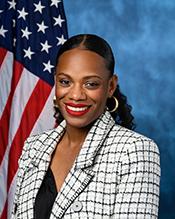
Summer L. Lee
DDemocratPA-12 · Representative
50
/ 100
Average
Attendance100
Avg: 96
Independence4
Avg: 4
Bipartisan Tone4
Avg: 15
Ethics Record100
Avg: 99
Transparency20
Avg: 53
Accountability Score — composite of attendance, independence, bipartisan tone, ethics record & transparency.
Methodology17
Bills Sponsored
0
Enacted into Law
0
Passed a Chamber
17
In Committee
All Sponsored Bills
HR10277In Committee
Access to School Supplies Act of 2026
Access to School Supplies Act of 2026 This bill directs the Department of Education to carry out a pilot program to make competitive grants for up to 10 qualified local educational agencies to purchase school supplies. School supplies refer to books, supplies, and supplementary materials used by students and instructional staff in the classroom.
HR9751In Committee
Consumer Appeal Rights Enforcement Act
The proposal would add new rules for how retirement and health insurance plans must handle when workers or beneficiaries file complaints or disagree with decisions about their benefits. These changes would likely give people more time and clearer procedures to challenge denied claims, making it easier for workers and retirees to get their benefits disputes resolved fairly.
HR9556In Committee
Support Our Miners Act
The legislation would provide support and protections for coal miners and their families, likely including measures related to healthcare, pension benefits, and job training programs. The bill aims to address challenges faced by mining communities, particularly in regions where coal mining has been a major source of employment. It has been sent to the House Committee on Education and Workforce for review and consideration.
HR9437In Committee
Right to Vote Act
The proposal would establish new rules and protections for voting in federal elections, including measures related to voter registration, voting access, and election administration. It would affect all Americans eligible to vote, election officials, and states responsible for running elections. The specific provisions are being reviewed by the House Judiciary Committee.
HR9029In Committee
Coal Cleanup Taxpayer Protection Act of 2026
The proposal would change how the federal government handles cleanup costs when coal mining companies abandon their operations or go bankrupt, shifting more financial responsibility onto the companies themselves rather than leaving taxpayers to foot the bill. This affects coal mining companies, workers in coal regions, and taxpayers who currently help pay for restoring mined land back to usable condition. The bill aims to ensure that companies set aside enough money upfront to cover reclamation costs instead of leaving the government responsible for expensive cleanup projects.
HR8484In Committee
Hazard Pay for Health Care Heroes Act
The proposal would give emergency funding to hospitals and health care facilities to help protect and support essential health care workers during public health crises. The money could be used for things like hazard pay, mental health services, childcare assistance, and equipment to keep workers safe. This would affect doctors, nurses, and other medical staff who continue working during emergencies like disease outbreaks.
HR8303In Committee
Revitalizing America’s Schoolyards Act of 2026
The federal government would provide money to schools to improve and upgrade their outdoor play areas and schoolyards, making them safer, more engaging, and better equipped for students to learn and exercise. Schools could use these grants to add new equipment, fix existing facilities, plant trees and gardens, or redesign spaces to encourage physical activity and outdoor learning. This would help schools across the country, particularly those with limited budgets, create better outdoor environments for their students.
HRES1119In Committee
Impeaching Pamela Bondi, Attorney General of the United States, for high crimes and misdemeanors.
This is a resolution to remove Pamela Bondi from her position as Attorney General by impeaching her in the House of Representatives and potentially trying her in the Senate, based on allegations of serious wrongdoing. The resolution has been sent to the House Judiciary Committee, which will investigate the charges and decide whether to recommend impeachment to the full House. If the House votes to impeach and the Senate convicts her, she would be removed from office.
HR7623In Committee
Freedom House Ambulance Service Congressional Gold Medal Act
This bill would award a Congressional Gold Medal to Freedom House Ambulance Service, a historic ambulance service that provided emergency medical care, in recognition of its contributions to public health and emergency services. The medal is a ceremonial honor that Congress grants to individuals or organizations for outstanding achievements or service to the nation. The bill has been referred to two House committees for review before any vote can take place.
HR7220In Committee
COINTELPRO Full Disclosure Act
This bill would require the federal government to fully release all remaining documents related to COINTELPRO, the FBI's controversial secret surveillance and disruption program that targeted civil rights leaders, political activists, and other groups during the Cold War era. The disclosure would give the public and researchers access to previously hidden information about how the government monitored and interfered with American citizens and organizations. The bill affects government transparency and accountability by ensuring that historical records of these operations become available to the American people.
HR7110In Committee
Eliminating Bias in Algorithmic Systems Act of 2026
This bill would require companies and government agencies to test their computer algorithms and artificial intelligence systems for bias and discrimination before using them to make decisions about hiring, lending, housing, or other important services. If algorithms are found to unfairly disadvantage people based on race, gender, or other protected characteristics, organizations would have to fix the problems or stop using them. The law would primarily affect tech companies, financial institutions, employers, and government agencies that rely on automated decision-making systems.
HRES990In Committee
Recognizing the 113th anniversary of Delta Sigma Theta Sorority, Incorporated.
This resolution recognizes the 113th anniversary of the founding of Delta Sigma Theta Sorority, Incorporated.
HR4693In Committee
College Athlete Right to Organize Act
College athletes would gain the legal right to form unions and collectively bargain with their schools over issues like compensation, working conditions, and benefits. This would allow student-athletes to negotiate as a group rather than individually, similar to how professional athletes and other workers can organize. The change would affect millions of college students across the country who compete in NCAA sports.
HR4337In Committee
Congressional Oversight Access Act
The proposal would give Congress greater access to information and documents held by federal agencies, making it easier for lawmakers to conduct investigations and oversight of the executive branch. This would affect how government agencies operate by requiring them to respond more quickly to congressional requests and potentially limiting their ability to withhold certain materials. The change is intended to strengthen Congress's ability to check the power of the president and executive departments.
HRES414In Committee
Recognizing that the United States has a moral and legal obligation to provide reparations for the crime of enslavement of Africans and its lasting harm on the lives of millions of Black people in the United States.
This resolution recognizes the responsibility of the federal government to provide reparations and encourages the passage and implementation of the Commission to Study and Develop Reparation Proposals for African Americans Act.
HR2352In Committee
Abolish Super PACs Act
This bill would eliminate Super PACs, which are political organizations that can raise and spend unlimited amounts of money to influence elections as long as they don't directly coordinate with candidates or parties. The change would affect political campaigns and fundraising by restricting how much money outside groups can pour into elections, potentially reducing the influence of wealthy donors and large corporations on politics. Supporters argue this would reduce corruption and the outsized influence of money in politics, while opponents contend it would limit free speech rights.
HRES35In Committee
Recognizing the 112th Anniversary of Delta Sigma Theta Sorority, Incorporated.
This resolution recognizes the 112th anniversary of the founding of Delta Sigma Theta Sorority, Incorporated.