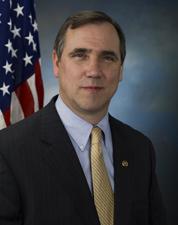
Jeff Merkley
DDemocratOR · Senator
65
/ 100
Above Average
Attendance99
Avg: 97
Independence15
Avg: 23
Bipartisan Tone13
Avg: 14
Ethics Record100
Avg: 100
Transparency100
Avg: 47
Accountability Score — composite of attendance, independence, bipartisan tone, ethics record & transparency.
Methodology112
Bills Sponsored
0
Enacted into Law
2
Passed a Chamber
103
In Committee
All Sponsored Bills
SJRES221In Committee
A joint resolution providing for congressional disapproval of the agreement for civilian nuclear cooperation between the United States and the Kingdom of Saudi Arabia pursuant to section 123 of the Atomic Energy Act of 1954.
S5624In Committee
Honoring Fallen Wildland Firefighters Act of 2026
S5670In Committee
A bill to ensure the prudent obligation of budget authority, and for other purposes.
S5606In Committee
Hong Konger Promise of Refuge Act
S5602Introduced
No Funds for Trump’s Illegal Arch Act
S5603Introduced
Protecting Presidential Memorials Act
S5673In Committee
Car Privacy Rights Act of 2026
S5592In Committee
American Promise Mortgage Act
S5575In Committee
Stop Corrupt Gratuities Act
S5568In Committee
Smaller Class Sizes for Students and Educators Act of 2026
Smaller Class Sizes for Students and Educators Act of 2026 This bill directs the Department of Education to award grants for local educational agencies to reduce class sizes in the early elementary grades (grades K-3) in targeted public elementary schools by recruiting, hiring, and supporting qualified teachers.
S5473In Committee
Homeownership Promise Act
SRES868In Committee
A resolution recognizing September 20, 2026, as "National LGBTQ+ Servicemembers and Veterans Day".
S5440In Committee
Grand Ronde Land Transfer Act of 2026
SRES856In Committee
A resolution supporting the designation of September 19, 2026, as "National Stillbirth Prevention and Awareness Day", recognizing tens of thousands of families in the United States that have endured a stillbirth, and seizing the opportunity to keep other families from experiencing the same tragedy.
SJRES214In Committee
A joint resolution proposing an amendment to the Constitution of the United States to prohibit the use of slavery and involuntary servitude as a punishment for a crime.
S5362In Committee
Assuring the Future of Tibet Act of 2026
S5357In Committee
TABOO Act
S5319In Committee
Nurse Overtime and Patient Safety Act
Nurse Overtime and Patient Safety Act This bill requires certain providers, as a condition of Medicare participation, to limit mandatory overtime for nurses. Specifically, the bill prohibits hospitals, ambulatory surgical centers, home health agencies, rural health clinics, federally qualified health centers, and other specified providers from requiring nurses to work (1) more than a previously scheduled shift, 48 hours in a workweek, or 12 consecutive hours in a 24-hour period; or (2) during the 10 hours immediately following the 12th hour worked in a shift during a 24-hour period. Qualifying work hours include time spent in training, on call, and on standby. The bill's provisions do not apply during declared emergencies or disasters, subject to specified conditions, and do not preclude voluntary overtime. The bill also establishes (1) certain protections for nurses who file complaints against providers, (2) documentation and notice requirements for providers, and (3) potential civil penalties for violations.
S5302In Committee
Truth in Labeling Act of 2026
S5318In Committee
Summer Meals and Learning Act of 2026
Summer Meals and Learning Act of 2026 This bill establishes a grant program to support summer early reading programs held at schools with a summer lunch site. Specifically, the Department of Education must use funds provided for the program to award competitive grants to state library administrative agencies to enable them to award subgrants to eligible local educational agencies for summer early reading programs held at schools with a summer lunch site. The program is open to local educational agencies that include schools where at least 50% of the students in prekindergarten through grade 3 are (1) reading below grade level at grade 3, or (2) at risk of reading below grade level at grade 3.
S5238In Committee
For Our Republic Act
S5235In Committee
Alan Reinstein Ban Asbestos Now Act of 2026
S5184In Committee
FORK Act of 2026
Feeding Our Rural Kids Act of 2026 or the FORK Act of 2026 This bill establishes a summer meal delivery vehicle pilot program as part of the Summer Food Service Program (SFSP). (The SFSP is a federally funded, state-administered program that reimburses providers that serve no-cost, healthy meals and snacks to children and teens at summer sites in low-income communities.) Under the bill, the Department of Agriculture (USDA) must award one-year grants of up to $100,000 for service institutions (e.g., school food authorities) to purchase, retrofit, or repair vehicles to facilitate noncongregate meal distribution. This is meal distribution outside of the typically required group, or congregate, setting (e.g., grab-and-go meal service). Among other things, USDA must give priority to service institutions located in an area in which poor economic conditions exist and that serve a high proportion of students from socially disadvantaged backgrounds. USDA must also ensure, to the maximum extent practicable, that service institutions receiving grants are located in different states.
S1874Reported
Title VIII Nursing Workforce Reauthorization Act of 2026
Title VIII Nursing Workforce Reauthorization Act of 2026 This bill reauthorizes through FY2031, revises, and establishes programs that support recruitment, education, retention, and advanced practices of nurses and nursing school faculty. Specifically, the bill reauthorizes programs within the Health Resources and Services Administration that provide grants to support increased enrollment in nursing education (including for individuals from disadvantaged backgrounds), advanced nursing education and specialized training, nurse retention, and enhanced patient care. The bill also reauthorizes programs that support student loan repayment and scholarships for nurses who agree to work at facilities with critical nursing shortages and nursing faculty who work at accredited schools of nursing. Also, the bill expands certain grants to include (1) training on the use of new technologies such as telehealth and virtual resources, and (2) care for survivors of sexual assault. Additionally, the bill temporarily establishes (1) grants to nursing schools for supplementing the salaries of eligible faculty for a period of up to three years to enhance faculty recruitment and retention, and (2) grants to state agencies, nonprofits, and nursing schools for establishing nursing workforce centers and collecting data regarding the nursing workforce.
S4259Reported
Blue Skies for Taiwan Act of 2026
This bill would likely strengthen U.S. support for Taiwan's aviation and aerospace capabilities, possibly through increased military cooperation, technology sharing, or defense partnerships. The measure would affect Taiwan's ability to develop or acquire aircraft and related defense systems, while also shaping the U.S. relationship with Taiwan on security matters. The bill is currently under review by the Senate Foreign Relations Committee.
S5106In Committee
Wildfire Insurance Affordability Act
The bill would create a federal grant program to help communities invest in wildfire prevention and resilience measures, such as forest management and building protections. It would also establish a pilot program to help reduce insurance premium costs for people and businesses in wildfire-prone areas. These programs aim to make it more affordable for property owners to protect themselves against wildfires while encouraging communities to take preventive steps.
S5071In Committee
Children's Safe Welcome Act of 2026
The legislation would establish new safeguards for children held in immigration detention facilities, likely including requirements for proper care, medical attention, and family communication. It would affect immigrant children in government custody and the agencies responsible for their detention and treatment. The bill is currently under review by the Senate Judiciary Committee.
S5087In Committee
Wildfire Reduction Market Expansion Act of 2026
The proposal would change how the government defines renewable biomass—materials like wood and agricultural waste that can be converted into fuel—under the renewable fuel standard, which requires fuel companies to blend renewable fuels into gasoline and diesel. These changes could affect which types of biomass qualify for use in renewable fuel production, potentially impacting farmers, forestry companies, and fuel producers who rely on these standards. The bill is currently under review by the Senate's environmental committee.
S5021In Committee
Protecting Students from Worthless Degrees Act
The bill would establish new protections for students as consumers, likely addressing issues like student loan practices, educational services, and marketplace transactions. It would give students stronger rights and remedies if they are deceived or treated unfairly by schools, lenders, or companies selling education-related products and services. The measure is currently under review by the Senate committee responsible for education and consumer protection matters.
SRES806In Committee
A resolution designating July 2026 as "Plastic Pollution Action Month".
This resolution would officially recognize July 2026 as "Plastic Pollution Action Month" to raise awareness about the environmental problems caused by plastic waste. The designation is meant to encourage individuals, businesses, and organizations to take action against plastic pollution during that month. It does not create any new laws or requirements, but rather serves as a symbolic statement from Congress about the importance of addressing plastic waste.
S5005In Committee
Epstein Files Transparency Act II
The bill would allow state attorneys general to enforce the Epstein Files Transparency Act, which deals with making certain documents related to Jeffrey Epstein publicly available. Currently, the law may only be enforceable by federal authorities, so this change would give state officials the power to pursue violations and ensure compliance. This would affect states' ability to independently hold parties accountable for failing to disclose relevant records.
S4990In Committee
McCarty and Heideman Air Safety Enhancement Act
The FAA would be required to review and update its rules, policies, and guidance for safety in low-altitude airspace, which is the airspace closer to the ground where small aircraft, drones, and helicopters operate. This review could lead to new or revised regulations to address potential safety issues in this airspace. The changes would affect drone operators, small aircraft pilots, and other users of low-altitude airspace.
SJRES196In Committee
A joint resolution providing for congressional disapproval under chapter 8 of title 5, United States Code, of the rule submitted by the Department of Education relating to "Reimagining and Improving Student Education-Federal Student Loan Program Final Regulations".
Congress would reject a new Department of Education rule that changes how the federal student loan program works, preventing the rule from taking effect. The rule, which the Education Department created to reshape student loan policies, would be blocked if Congress votes to disapprove it. This affects millions of student loan borrowers and could impact how they repay their loans and qualify for forgiveness programs.
S4937In Committee
Investor Choice Act of 2026
The bill would ban companies from forcing customers and employees to sign agreements that require them to settle disputes through private arbitration instead of going to court. This change would allow workers and consumers to pursue lawsuits against securities firms and other companies rather than being locked into private dispute resolution processes. The measure affects anyone who invests in securities or works in the financial industry.
S4942In Committee
SAFE Banking Act of 2026
Banks and other financial companies would be protected from federal penalties if they provide banking services to marijuana businesses that are legal under state law. Currently, many banks avoid working with legal marijuana companies because federal law still classifies marijuana as illegal, creating a conflict that puts financial institutions at legal risk. This bill would allow banks to safely serve these state-approved marijuana businesses and their suppliers without fear of federal prosecution or losing their banking licenses.
SRES782In Committee
A resolution recognizing the importance of pollinators to ecosystem health and agriculture in the United States by designating June 22 through June 28, 2026, as "National Pollinator Week".
This resolution sets aside June 22-28, 2026, as National Pollinator Week to highlight how important bees, butterflies, and other pollinators are to farming and natural ecosystems across the country. The designation aims to raise public awareness about pollinators and their role in producing food and maintaining healthy environments. The resolution has been sent to the Senate Committee on Environment and Public Works for consideration.
S4804In Committee
Manufactured Housing Lending Act
The government-sponsored mortgage companies Fannie Mae and Freddie Mac would be required to create test programs that help people buy manufactured homes (mobile homes) by offering loans for both the home and the land it sits on together. Currently, these companies typically don't offer this type of combined financing, making it harder for manufactured home buyers to get affordable loans. The pilot programs would test whether offering these loans is practical and could expand homeownership options for people looking to buy manufactured homes.
S4803In Committee
Home Equity Lending Integrity Act
The bill would expand consumer protection rules that currently apply to traditional home loans to also cover home equity investment loans, where companies buy a stake in a homeowner's future property value in exchange for cash. This change would require lenders offering these products to follow the same disclosure and lending standards as traditional mortgage lenders, giving homeowners more transparency about costs and terms. The measure affects both homeowners considering these alternative financing options and the companies that offer them.
S4774In Committee
Fraudulent Artificial Intelligence Regulations (FAIR) Elections Act of 2026
This bill would make it illegal to spread fake videos or images created by artificial intelligence that are designed to mislead voters about elections, and it would prevent election officials from removing people from voting rolls based on unverified databases that claim someone is ineligible to vote. The legislation aims to protect both the integrity of elections and voters' right to participate by cracking down on AI-generated disinformation and stopping potentially inaccurate voter purges.
S4772In Committee
Renewable Energy Choice Act
States and local governments would be prevented from blocking or restricting renewable energy projects based on the type of renewable source being used, meaning they couldn't reject solar, wind, geothermal, or other clean energy installations simply because of what kind of renewable energy is involved. This would affect state and local officials, renewable energy companies, and property owners who want to develop clean energy projects. The bill aims to remove barriers that could slow down the expansion of renewable energy infrastructure across the country.
S4732In Committee
Wildfire Smoke Emergency Declaration Act of 2026
The proposal would give the President the power to officially declare a smoke emergency when wildfire smoke or other smoke sources create serious public health threats across the country. During such a declared emergency, the federal government could coordinate response efforts and potentially provide additional resources to affected states and communities to protect people from dangerous air quality. The bill is currently under review by the Senate committee responsible for homeland security matters.
S4735In Committee
Protecting Americans from High Electricity Prices Act of 2026
The bill would create a formal process for federal agencies to evaluate whether projects and policies serve the public interest by considering their greenhouse gas emissions and climate impacts. This would affect companies planning major infrastructure projects, energy development, and other activities that require federal approval, as they would need to demonstrate how their plans account for climate concerns. The measure aims to give environmental considerations a structured role in how the government makes decisions about projects that emit significant amounts of greenhouse gases.
S4721In Committee
Restoring Renewable Energy Parity Act
This bill would block certain executive actions and eliminate specific executive orders or documents that have been previously issued. The exact impact depends on which executive actions and documents would be affected, as the bill's specific provisions aren't detailed in the available information. The measure is currently under review by the Senate Finance Committee.
S4720In Committee
Protecting U.S. Fishers from Illegal Foreign Flags Act of 2026
The bill would allow the U.S. Commerce Secretary to identify countries that use "open registry" ships (vessels registered in countries other than where they're owned) as nations involved in illegal fishing, giving the government more tools to crack down on fishing practices that violate international rules. This affects fishing companies and countries that operate large ocean-going fleets, as they could face trade penalties or other consequences if identified as supporting illegal fishing. The change targets a loophole where ships can hide their true ownership and avoid responsibility for breaking fishing laws.
S4618In Committee
Elementary and Secondary School Counseling Act
The bill would provide funding and support to hire more mental health professionals like counselors and psychologists in public schools that serve low-income or underserved communities. This would help students get access to mental health services at school, addressing issues like anxiety, depression, and trauma that can affect learning and wellbeing. The measure aims to reduce the shortage of mental health staff in schools that need these services most.
S4597In Committee
Early Childhood Workforce Advancement Act of 2026
The federal government would provide competitive grants to partnerships of schools, colleges, and organizations to create or expand training programs that prepare students for careers working with young children in early childhood education settings. These programs would teach students the skills needed for jobs like preschool teachers, childcare workers, and early childhood specialists. The Education and Health departments would work together to distribute the grants to communities that need more trained workers in this field.
S4568In Committee
Nursing is a Professional Degree Act
The bill would change how the federal government defines "professional student" under higher education law, which affects which students qualify for federal financial aid, loans, and other education benefits. The specific changes would determine whether certain graduate and professional degree programs—such as those in medicine, law, or other specialized fields—meet the requirements for federal student aid eligibility. This could expand or restrict access to federal education funding for students pursuing advanced professional degrees.
SJRES163In Committee
A joint resolution to direct the removal of United States Armed Forces from hostilities within or against the Islamic Republic of Iran that have not been authorized by Congress.
This joint resolution directs the President to remove U.S. Armed Forces from hostilities within or against Iran unless a declaration of war or authorization to use military force for such purpose has been enacted. The resolution specifies that it shall not be construed to prevent the United States from defending against an attack on the United States or its personnel or facilities in other nations.
SJRES156In Committee
A joint resolution providing for congressional disapproval under chapter 8 of title 5, United States Code, of the rule submitted by the Bureau of Consumer Financial Protection relating to the withdrawal of the rule relating to "Truth in Lending (Regulation Z); Consumer Credit Offered to Borrowers in Advance of Expected Receipt of Compensation for Work".
Congress is considering blocking a decision by the Consumer Financial Protection Bureau to cancel a rule that was supposed to protect workers who borrow money against their future paychecks. If approved, this resolution would force the agency to keep the paycheck advance lending rule in place rather than allow it to be withdrawn. The vote would affect payday lenders and the workers who use these high-cost loans.
SRES709In Committee
A resolution supporting the goals and ideals of National Nurses Week, to be observed from May 6 through May 12, 2026.
Congress is expressing support for National Nurses Week, a yearly observance from May 6-12 that recognizes the contributions and hard work of nurses across the country. The resolution celebrates nurses' roles in patient care, public health, and the healthcare system while highlighting the importance of their profession. This symbolic measure affirms Congress's appreciation for nurses without creating new laws or programs.
S4325In Committee
6PPD Task Force Act
A chemical called 6PPD, used in tire manufacturing, breaks down into a toxic substance called 6PPD-Q that is killing coho salmon in rivers and streams. This bill would create a task force to study the problem and fund research into safer alternatives to 6PPD, affecting tire manufacturers, environmental agencies, and communities that depend on healthy salmon populations.
SRES666Introduced
A resolution designating the first week of April as "National Asbestos Awareness Week".
This resolution designates the first week of April as National Asbestos Awareness Week. It also urges the Office of the Surgeon General to warn and educate people about asbestos exposure, which may be hazardous to their health.
S4222In Committee
End Polluter Welfare for Enhanced Oil Recovery Act of 2026
This bill would eliminate tax breaks and subsidies that currently help oil companies pay for enhanced oil recovery projects, where they inject liquids or gases into oil fields to extract more oil. By removing these financial incentives, the government would reduce the amount of taxpayer money supporting oil production while potentially increasing federal revenue. The change would primarily affect large oil and gas companies that use these recovery techniques.
S4226In Committee
STOP Corrupt Bets Act of 2026
The bill would restrict certain types of financial bets and derivatives that regulators believe are used to manipulate markets or hide corrupt dealings, targeting practices in the finance industry that can harm regular investors and the broader economy. It likely aims to increase oversight of complex financial instruments and close loopholes that allow traders to place bets that don't serve legitimate business purposes but instead enable fraud or market manipulation. Banks, hedge funds, and other financial firms would face new rules about what kinds of bets they can make and would need to report more information about their trading activities.
S1092Passed Senate
WIPPES Act
Wastewater Infrastructure Pollution Prevention and Environmental Safety Act or the WIPPES Act This bill requires entities responsible for the labeling or retail packaging of certain premoistened, nonwoven wipes (e.g., baby wipes, cleaning wipes, or personal care wipes) to label such products clearly and conspicuously with the phrase Do Not Flush and accompanying symbol as depicted under specified industry guidelines. The Federal Trade Commission must enforce these requirements and may issue regulations to implement the bill.
S3588In Committee
School Access to Naloxone Act of 2026
School Access to Naloxone Act of 2026 This bill authorizes grants for expanding access to drugs or devices to treat opioid overdoses (e.g., naloxone) in elementary and secondary schools. The Department of Health and Human Services may award the grants to states, Indian tribes, and localities. To receive a grant, recipients must certify that schools in their jurisdictions will stock the drugs and devices and have trained staff on premises during operating hours to administer them. Additionally, the attorney general of the recipient's state must certify that trained staff are covered by state civil liability protections for individuals who administer aid in an emergency (commonly known as Good Samaritan laws).
S3812In Committee
WORK to Save Lives Act
The bill would require employers to provide paid leave to workers who need time off for medical treatment, recovery, or caregiving responsibilities, with the goal of helping people stay healthy without losing income. It aims to address situations where workers might skip necessary medical care or lose their jobs because they cannot afford unpaid time away from work. The measure would affect both employers and their employees across various industries.
S880In Committee
Fair College Admissions for Students Act
Fair College Admissions for Students Act This bill prohibits an institution of higher education (IHE) that participates in federal student aid programs from giving preferential treatment in the admissions process to applicants based on their relationships to donors or alumni of the IHE.
S4135In Committee
FLAP Reauthorization Act
The bill would reauthorize the Federal Lands Access Program, which provides federal funding to states and tribes for maintaining and improving roads that provide access to federal lands like national forests and parks. This funding helps keep these transportation routes in good condition for both public recreation and resource management, benefiting rural communities, outdoor enthusiasts, and local governments that rely on these roads.
S4017In Committee
End Prediction Market Corruption Act
This bill would regulate prediction markets—platforms where people bet on the outcomes of future events like elections or sports—to prevent fraud and insider trading. It likely aims to establish rules that keep people with special knowledge from unfairly profiting on these markets and protect regular bettors from being cheated. The legislation would affect prediction market operators, traders, and potentially the broader financial industry that oversees these platforms.
S3930In Committee
HOPE (Humans over Private Equity) for Homeownership Act
This bill would likely change how private equity firms and other large investors are taxed when they buy up residential properties, with the goal of making it easier for individual families to purchase homes rather than having corporations buy them up as investments. The measure would probably increase taxes or add restrictions on these large-scale property purchases to discourage institutional investors from competing with regular homebuyers in the housing market. The changes would affect private equity companies, real estate investors, and potentially homebuyers looking to purchase properties in competitive markets.
S3820In Committee
Soil CARE Act of 2026
Soil Conservation And Regeneration Education Act of 2026 or the Soil CARE Act of 2026 This bill directs the Department of Agriculture (USDA) to establish a training program for soil health management in Natural Resources Conservation Service (NRCS) programs. Under the bill, soil health management means land management methods used to increase and balance soil health, such as microbial biomass and macrofauna, for the purpose of improving biological functions, including forming and stabilizing soil structure, cycling nutrients, controlling pests and disease, and degrading or detoxifying contaminants. The training program must (1) provide education, resources, and technical support to NRCS personnel and third-party providers on the rapidly evolving methodologies, science, and practices for improving soil health; and (2) assist NRCS personnel and third-party providers in supporting agricultural producers in understanding and implementing soil health management systems that regenerate farmland. The training program must be available twice every two years in each NRCS region and include both an online curriculum and in-person training workshops. The training program must be developed and delivered through cooperative agreements with entities with soil health management systems expertise and experience working with and training producers. The bill includes minimum curriculum requirements for the training program, including specific units on soil health and diversified production systems. USDA must review and update the training program curriculum and materials every two years.
S3735In Committee
Prohibit Partisan Park Passes Act
This bill would prevent the federal government from creating or offering special park passes or discounts based on political party affiliation or voting status. The legislation aims to ensure that access to national parks and public lands remains equal for all Americans regardless of their political beliefs or registration.
S3745In Committee
ICE and CBP Constitutional Accountability Act
This bill would create new legal accountability measures for Immigration and Customs Enforcement (ICE) and Customs and Border Protection (CBP) agents, likely allowing people to sue these agencies for constitutional violations and establishing oversight mechanisms for their operations. The legislation aims to address concerns about civil rights abuses by immigration enforcement officials and would affect both immigrants and citizens who interact with these agencies. By making it easier to hold federal agents accountable in court, the bill seeks to ensure these agencies follow constitutional protections during enforcement actions.
S3673In Committee
Roadside Pollinator Program Amendments Act
This bill would modify how the federal government manages plants and flowers along highways and roadsides to better support pollinators like bees and butterflies. Instead of just mowing grass for safety and appearance, the program would allow for planting native wildflowers and other vegetation that provides food and habitat for these insects, which are important for agriculture and ecosystems. The changes would affect how the Department of Transportation and state highway departments maintain roadside areas across the country.
S3655In Committee
Hong Kong Economic and Trade Office (HKETO) Certification Act
This bill would require the U.S. government to officially recognize and certify Hong Kong's economic and trade offices operating in America as legitimate representatives of Hong Kong's interests, rather than treating them as agents of the Chinese government. The certification would allow these offices to conduct trade and economic activities more freely, affecting businesses that rely on Hong Kong trade relationships and commerce between the two regions. The bill reflects ongoing debate about Hong Kong's political status and how much independence it should have in conducting its own international economic affairs.
SRES321In Committee
A resolution commemorating 30 years of diplomatic relations between the United States and Vietnam on July 11, 2025.
This resolution marks the 30th anniversary of restored diplomatic relations between the United States and Vietnam, which were formally established on July 11, 1995. The resolution honors this milestone in U.S.-Vietnam relations and recognizes the progress both countries have made in trade, cultural exchange, and cooperation over the past three decades. The Senate has already approved the resolution with amendments.
SRES548In Committee
A resolution denouncing the horrors of authoritarianism.
S1926In Committee
Reducing Waste in National Parks Act
The proposal would require the National Park Service to develop and implement plans to reduce waste at national parks, likely including measures like reducing single-use plastics, improving recycling programs, and encouraging visitors to minimize their environmental impact. The bill aims to make parks cleaner and more sustainable while protecting natural resources for future visitors. Park officials, visitors, and environmental groups would all be affected by any new waste reduction requirements.
S945In Committee
Smith River National Recreation Area Expansion Act
This bill would expand the Smith River National Recreation Area, likely adding more land to the protected area for outdoor recreation and conservation purposes. The expansion would affect how the added land can be used—generally restricting commercial development and logging while keeping it open for activities like hiking, fishing, and camping. Local communities, outdoor enthusiasts, and environmental groups would be most directly impacted by the changes to land management in the region.
S2110Passed Senate
REUSE Act of 2025
The REUSE Act of 2025 aims to encourage the reuse and recycling of materials to reduce waste and environmental harm, likely by creating incentives or requirements for businesses and consumers to reuse products instead of throwing them away. The bill would affect manufacturers, retailers, and everyday people by potentially changing how products are designed, packaged, and disposed of. By promoting reuse over disposal, the legislation seeks to lower the amount of trash going to landfills and reduce the environmental impact of producing new goods.
S2684Reported
United States - Taiwan Partnership in the Americas Act
The bill would strengthen cooperation between the United States and Taiwan in Latin America and the Caribbean by allowing them to work together on development projects, trade initiatives, and diplomatic efforts in the region. It aims to increase Taiwan's participation in regional organizations and activities where it currently has limited involvement, while also supporting U.S. interests in the Western Hemisphere. The measure affects diplomatic relations, international development organizations, and countries throughout Latin America and the Caribbean.
SRES424In Committee
A resolution affirming the unwavering commitment of the Senate to the First Amendment and to freedom of speech and of the press as foundations of the democratic republic of the United States.
SRES408In Committee
A resolution recognizing September 20, 2025, as "National LGBTQ+ Servicemembers and Veterans Day".
This resolution recognizes September 20, 2025, as National LGBTQ+ Servicemembers and Veterans Day and celebrates the contributions of lesbian, gay, bisexual, transgender, and queer servicemembers and veterans who have served in the Armed Forces. Additionally, the resolution (1) regrets the harm done to such servicemembers and veterans under policies that discriminate based on sexual orientation and gender identity, and (2) urges the Department of Veterans Affairs and Department of Defense to ensure transgender veterans and servicemembers and their families have access to a full range of health care.
SRES401In Committee
A resolution supporting the designation of September 19, 2025, as "National Stillbirth Prevention and Awareness Day", recognizing tens of thousands of families in the United States that have endured a stillbirth, and seizing the opportunity to keep other families from experiencing the same tragedy.
S2836In Committee
POP Act
S2811In Committee
Alan Reinstein Ban Asbestos Now Act of 2025
Alan Reinstein Ban Asbestos Now Act of 2025 This bill generally prohibits the manufacture, process, use, and distribution in commerce of commercial asbestos or any mixture or article containing commercial asbestos. The President may, on application, grant exemptions from the prohibition in situations where it is necessary to protect national security interests.
S2653In Committee
RECHARGE Act
S2557In Committee
Epstein Files Transparency Act
This bill would require the government to release documents and records related to Jeffrey Epstein's criminal case, making previously sealed or confidential files available to the public. The legislation aims to increase transparency around the investigation and prosecution of Epstein's crimes, potentially allowing journalists, researchers, and the public to better understand what happened and who may have been involved.
S2502In Committee
Preventing the Forced Return of Uyghurs Act of 2025
S2519In Committee
Medical Debt Relief Act of 2025
The proposal would help people struggling with medical bills by allowing them to remove unpaid medical debt from their credit reports and limiting how much debt collectors can pursue them for healthcare costs. This would make it easier for patients to get loans, rent apartments, or access other financial services that depend on credit scores, while reducing the aggressive collection practices that often follow hospital visits and medical procedures. The measure primarily affects individuals with outstanding medical bills and the debt collection industry.
S2525In Committee
Transnational Repression Policy Act
This bill would create new policies and tools to combat transnational repression—when foreign governments target their own citizens or dissidents living in the United States through harassment, threats, or violence. The legislation likely aims to protect vulnerable populations like political refugees and activists by increasing law enforcement coordination, imposing consequences on foreign governments that engage in such activities, and strengthening support for victims. It would affect both U.S. foreign policy and the safety of immigrants and international activists living in America.
S2435In Committee
Fighting Fibers Act of 2025
S2415In Committee
Columbia River Clean-Up Act of 2025
S2386In Committee
Preventing Authoritarian Policing Tactics on America’s Streets Act
SCONRES18In Committee
A concurrent resolution recognizing a health and safety emergency disproportionately affecting the fundamental rights of children due to the Trump administration's directives that unleash fossil fuels and greenhouse gas emissions that contribute to climate change, while suppressing climate change science.
This resolution expresses Congress's view that certain Trump administration policies on fossil fuels and climate science pose a health and safety emergency for children. The resolution argues that these policies increase greenhouse gas emissions and limit climate change research, which the sponsors believe threatens children's fundamental rights and wellbeing. As a concurrent resolution, it is a statement of congressional opinion rather than a law that would require action or create new regulations.
SRES320In Committee
A resolution designating July 2025 as "Plastic Pollution Action Month".
This resolution designates July 2025 as Plastic Pollution Action Month.
SRES283In Committee
A resolution commemorating the 90th birthday of His Holiness the 14th Dalai Lama on July 6, 2025, as "A Day of Compassion" and expressing support for the human rights and distinct religious, cultural, linguistic, and historical identity of the Tibetan people.
Congress is officially recognizing the 90th birthday of the Dalai Lama on July 6, 2025, as "A Day of Compassion" and expressing support for Tibetan human rights, religious freedom, and cultural preservation. The resolution affirms Congress's backing for the Tibetan people's distinct identity and traditions. This is a symbolic gesture that passed the Senate unanimously and does not create any new laws or government programs.
S2221In Committee
SAWMILL Act
This bill would likely make changes to how timber is harvested and managed on federal public lands, possibly by adjusting regulations around sawmill operations or wood processing. The legislation would affect timber companies, sawmill workers, and potentially local communities that depend on forestry jobs, while also influencing how the government manages forests for environmental and economic purposes.
S2179In Committee
Canyon’s Law
The proposal would protect certain canyon lands and natural areas from development and resource extraction, preserving them for conservation and public recreation. It affects landowners, energy companies, and outdoor enthusiasts by restricting how federal and private lands in canyon regions can be used. The bill aims to balance environmental protection with existing land management practices in these sensitive geological areas.
SRES289In Committee
A resolution recognizing the importance of pollinators to ecosystem health and agriculture in the United States by designating June 15 through June 22, 2025, as "National Pollinator Week".
This resolution supports the designation of June 15-June 22, 2025, as National Pollinator Week.
S2128In Committee
MONARCH Act of 2025
Monarch Action, Recovery, and Conservation of Habitat Act of 2025 or the MONARCH Act of 2025 This bill provides support for the conservation of western monarch butterflies (the monarch butterfly population that overwinters along the coast of California and breeds across California, Arizona, Nevada, Washington, Oregon, Idaho, and Utah). Specifically, the bill establishes the Western Monarch Butterfly Rescue Fund. The Department of the Interior must use amounts in the fund to provide grants for the conservation of such butterflies and other pollinators within the range of western monarch butterflies. In addition, Interior must enter into an agreement with the National Fish and Wildlife Foundation to facilitate updating and implementing the Western Monarch Butterfly Conservation Plan, which was prepared by the Western Association of Fish and Wildlife Agencies.
SRES248In Committee
A resolution expressing the need for the Federal Government to establish a national biodiversity strategy for protecting biodiversity for current and future generations.
S1753In Committee
End Price Gouging for Medications Act
The proposal would allow the federal government to investigate and take action against pharmaceutical companies that dramatically raise drug prices without justification, particularly during emergencies or public health crises. It would give regulators tools to prevent sudden, extreme price increases on existing medications that patients depend on, affecting both individual consumers and insurance companies that pay for prescriptions. The measure aims to make essential medicines more affordable while still allowing companies to profit from their products.
S1691In Committee
Traveler Privacy Protection Act of 2025
Traveler Privacy Protection Act of 2025 This bill limits the use of facial recognition or matching technology (e.g., matching and identification software) in airports for passenger screening. In general, the bill restricts the Transportation Security Administration’s (TSA’s) use of the technology to performing passenger identity verification at airport screening locations. The TSA must notify passengers prior to each use of the technology and receive affirmative express consent. If a passenger opts out of the use of the technology, then the TSA must perform identity verification using an approved identification document (e.g., a state driver's license) without collecting biometric information (e.g., fingerprints). For a passenger using a trusted traveler program (e.g., Global Entry), the TSA must provide notice on the use of the technology at the time of program enrollment and renewal and as the passenger approaches the point of identity verification. The passenger must have the option to opt out. The bill prohibits the TSA from (1) subjecting a passenger who opts out of the screening to discriminatory treatment or less favorable screening conditions; (2) using the technology to track or identify passengers outside of the screening location or to enable systemic, indiscriminate, or wide-scale monitoring, surveillance, or tracking; and (3) sharing biometric information collected through the use of the technology. The bill also limits the amount of time that the TSA may store the information collected. Further, these restrictions and requirements apply to the TSA's use of the technology in other specified circumstances (e.g., employee screenings).
SRES206In Committee
A resolution supporting the goals and ideals of National Nurses Week, to be observed from May 6 through May 12, 2025.
This resolution expresses support for the goals and ideals of National Nurses Week.
S1503In Committee
Equality Act
The legislation would expand federal civil rights protections to explicitly include sexual orientation and gender identity in areas like employment, housing, public accommodations, education, and federally funded programs. This means LGBTQ+ individuals would have the same legal protections against discrimination that currently exist for people based on race, religion, or sex. The bill would affect businesses, schools, landlords, and other organizations that serve the public or receive federal funding.
S1445In Committee
Stop Arctic Ocean Drilling Act of 2025
This bill would ban oil and gas drilling in the Arctic Ocean, preventing companies from exploring or extracting fossil fuels in federal waters off Alaska's coast. The measure would affect energy companies' ability to develop new oil and gas resources in the Arctic region while potentially reducing environmental risks to the sensitive Arctic ecosystem.
S1274In Committee
Protecting American Households From Rising Energy Costs Act of 2025
S1220In Committee
Savings Opportunity and Affordable Repayment Act
Savings Opportunity and Affordable Repayment Act This bill creates a new income-driven repayment plan for student loans called the Savings Opportunity and Affordable Repayment (SOAR) plan. The SOAR plan has similar provisions to, but further expands on, the Department of Education's (ED's) final rule published on July 10, 2023, that created the Saving on a Valuable Education (SAVE) plan. The SAVE plan was blocked by federal courts. The bill directs ED to carry out a SOAR plan program that complies with specified requirements. The bill allows all federal student loan types to be eligible for repayment under the SOAR plan, including Parent PLUS Loans and Federal Family Education Loans. Under the SOAR plan, a federal student loan borrower whose income is at or below 250% of the federal poverty level (FPL) has $0 monthly payments. A borrower whose income is over 250% of the FPL pays 5% of their discretionary income on loans obtained for undergraduate study and 10% of their discretionary income for all other outstanding loans (e.g., loans obtained for graduate study). Additionally, under the SOAR plan, holders of eligible federal student loans (e.g., ED or private lenders) must apply 50% of the borrower's monthly payment toward outstanding principal. The other 50% must be applied in the following order: (1) accrued charges and collection costs on the loan, (2) outstanding interest, and (3) outstanding principal. ED must forgive any loan balance that remains outstanding after a specified maximum repayment period (e.g., 10 years or 15 years).
S1200In Committee
Deschutes River Conservancy Reauthorization Act of 2025
This bill would renew the legal authority and funding for the Deschutes River Conservancy, an organization that works to protect and restore the Deschutes River in Oregon through land conservation and water management projects. The reauthorization would allow the conservancy to continue its work protecting fish habitat, maintaining water quality, and preserving natural areas along the river for public use. The bill affects Oregon communities, outdoor enthusiasts, and local ecosystems that depend on the river's health.
SRES140Introduced
A resolution designating the first week of April 2025 as "National Asbestos Awareness Week".
This resolution designates the first week of April 2025 as National Asbestos Awareness Week.
S1094In Committee
Mass Timber Federal Buildings Act of 2025
The federal government would be required to consider using mass timber (engineered wood products made from smaller trees) in new federal building construction projects, with the goal of reducing carbon emissions and supporting the timber industry. This would affect federal agencies responsible for building and maintaining government facilities, as well as timber companies and construction firms that would compete to supply these materials. The change aims to make federal buildings more environmentally friendly while creating economic opportunities in forestry and construction sectors.
SCONRES10In Committee
A concurrent resolution recognizing the essential work of the League of Oregon Cities.
S575In Committee
I CAN Act
Improving Care and Access to Nurses Act or the I CAN Act This bill allows other health care providers besides physicians (e.g., nurses) to provide certain services under Medicare and Medicaid. Among other changes, the bill (1) allows a nurse practitioner or physician assistant to fulfill documentation requirements for Medicare coverage of special shoes for diabetic individuals; (2) expedites the ability of physician assistants, nurse practitioners, and clinical nurse specialists to supervise Medicare cardiac, intensive cardiac, and pulmonary rehabilitation programs; and (3) allows nurse practitioners to certify the need for inpatient hospital services under Medicare and Medicaid.
S513In Committee
Help Our Kelp Act of 2025
This bill would likely establish or expand programs to support kelp farming and harvesting in U.S. waters, potentially providing funding, research, or regulatory support for the kelp industry. Kelp farming could help coastal communities economically while also providing environmental benefits like carbon sequestration and improved water quality. The bill affects fishing communities, environmental organizations, and coastal states interested in sustainable ocean resources.
S341In Committee
Smoke and Heat Ready Communities Act of 2025
Smoke and Heat Ready Communities Act of 2025 This bill authorizes the Environmental Protection Agency (EPA) to make grants to air pollution control agencies to support the development and implementation of programs that support local communities in detecting, preparing for, communicating with the public about, or mitigating the environmental and public health aspects of wildfire smoke and extreme heat. The EPA must establish a formula to distribute the grants among air pollution control agencies. The bill requires the EPA to establish four Centers of Excellence for Wildfire Smoke and Extreme Heat at institutions of higher education to research (1) the effects of smoke emissions from wildland fires and extreme heat on public health, and (2) the means by which communities can better respond to impacts from such conditions. Additionally, the EPA must begin to carry out research to study the health effects of smoke emissions from wildland fires and extreme heat; develop and disseminate personal and community-based interventions to reduce exposure to, and health effects of, wildland fire smoke emissions and extreme heat; increase the quality of smoke and extreme heat monitoring and prediction tools and techniques; and develop implementation and communication strategies. The EPA must also establish a competitive grant program to assist certain entities (e.g., a state) in developing and implementing collaborative community plans for mitigating the impacts of smoke emissions from wildland fires and extreme heat.
S288In Committee
Southern Mongolian Human Rights Policy Act
This bill would establish U.S. policy toward Inner Mongolia, a region in China, by calling for greater protections of human rights and cultural freedoms for Mongolian people living there. The legislation would likely direct the State Department to monitor conditions, support advocacy groups, and potentially impose consequences on Chinese officials responsible for human rights violations in the region. It affects U.S. foreign relations with China and could influence how the U.S. government addresses concerns about ethnic minorities and cultural preservation in that area.
S3079In Committee
Building Star Energy Efficiency Act of 2010
Building Star Energy Efficiency Act of 2010 - Establishes in the Department of Energy (DOE) the Building Star Energy Efficiency Rebate Program of 2010. Directs the Secretary of Energy to issue rebates to building owners to offset a portion of the cost of purchasing and installing qualifying equipment or materials or undertaking qualifying services to enhance the energy efficiency of existing commercial buildings and multifamily residential buildings. Prescribes rebates for the purchase and installation of qualifying: (1) insulation, windows, and qualified high-efficiency window films and screens; (2) new energy efficient equipment, such as boilers, furnaces, and water heaters; (3) unitary air conditioners and unitary heat pumps; (4) variable speed drives for motors; and (5) interior lighting. Prescribes calculations for reductions in: (1) installed lighting power resulting from installation of qualified interior lighting; and (2) annual energy usage resulting from installation of qualified exterior lighting. Prescribes calculations also for rebates for qualified: (1) replacement chillers; (2) qualifying services to enhance the energy efficiency of buildings; (3) energy-efficient building operation and maintenance training; (4) service on space heating equipment and cooling systems, (5) energy monitoring and management systems with analog controls; and (6) HVAC testing, balancing, and duct sealing. Directs the Secretary to: (1) establish a Building Star Energy Efficiency Loan Program to make grants to states to support financial assistance provided by qualified program delivery entities for making energy efficiency and renewable energy improvements to existing buildings that qualify under the Building Star energy retrofit program. Amends the Energy Policy Act of 2005 to: (1) direct the Secretary to make guarantees for energy efficiency projects, including projects to retrofit residential, commercial, and industrial buildings, facilities, and equipment; and (2) authorize the Secretary, in the case of programs that finance such retrofitting, to offer loan guarantees for portfolios of debt obligations, and to purchase or make commitments to purchase portfolios of debt obligations.
S2791In Committee
Forest Harvest Opportunity Act
Forest Harvest Opportunity Act - Directs the Secretary of the Interior, within 30 days of a timber purchaser requesting an economy-related contract extension of a qualifying contract for the sale of timber from land administered by the Bureau of Land Management (BLM) between the Secretary and the purchaser, to modify the contract to add three years to such contract's expiration date. Defines qualifying contract as a contract, executed on or before December 31, 2008, for the sale of timber from BLM lands: (1) for which there is unharvested volume remaining; (2) for which, within 90 days of enactment of this Act, a timber purchaser makes a written request to the Secretary for an economic related contract extension; and (3) that has not been terminated prior to the request for an extension. Requires the timber purchaser to waive any and all claims its has against the United States involving the qualifying contract that exist on the date such contract is modified. Prohibits anything in this Act from affecting any claim by the United States against any timber purchaser, including those claims that arose under a qualifying contract before the date on which its expiration date was extended.
S1574In Committee
Clean Energy for Homes and Buildings Act of 2009
Clean Energy for Homes and Buildings Act of 2009 - Directs the Secretary of Energy to develop and publish for review and comment near-, medium-, and long-term goals for: (1) a minimum number of homes and other buildings to be retrofitted through energy efficiency measures or to have on-site renewable energy systems added; (2) the number of on-site solar energy, wind energy, and geothermal heat pump systems to be installed; (3) the quantities by which use of grid-supplied electricity, natural gas, home heating oil, and other fuels, total fossil fuel dependence in the buildings sector, and greenhouse gas emissions will be reduced; (4) the number of jobs that will be created; and (5) the estimated total energy cost savings for building owners. Establishes in the Department of Energy (DOE) the Clean Energy for Homes and Buildings Program. Directs the Secretary to: (1) establish eligibility criteria for applicants for financial assistance (including credit enhancements, debt instruments, or other financial products); and (2) select a portfolio of investments that reaches a diversity of building owners. Authorizes the Secretary to provide financial assistance to eligible applicants to promote the widespread deployment of, and mobilize private sector support of credit and investment institutions for, energy efficiency measures and on-site renewable energy generation systems in buildings.
S901In Committee
Sustainable Revenue for Oregon Counties Act of 2009
Sustainable Revenue for Oregon Counties Act of 2009 - Establishes the Oregon Task Force on Sustainable Revenue for Counties to consider and review concepts for the establishment of a long-term revenue source for counties in Oregon that have historically received federal funds. Directs the Task Force, in conducting the consideration and review, to consider: (1) revenue sources proposed by relevant legislation or administrative actions; (2) payments based on timber harvests, including thinning to restore forest health, carried out at sustainable levels; (3) payments based on the revenues each county could have received through property taxation if the land owned by the federal government was privately held and subject to a property tax; (4) revenue based on a portion of the proceeds from sales of material collected from public land in Oregon for the production of biomass electricity or cellulosic liquid transportation fuels, user fees for recreational activities on such land, payments for increases in carbon sequestration, and land exchanges or transfers that could provide compensation for nontaxable federal land in the counties; (5) local revenue sources that could be used to reduce or eliminate reliance of the counties on federal funds; (6) federal payments made by the government to the counties, including specified guaranteed payments; and (7) any other revenue source appropriate for review. Requires the Task Force to hold hearings on the establishment of a sustainable, long-term revenue source for the counties.