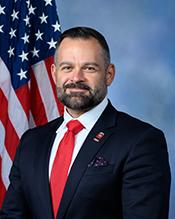
Cory Mills
RRepublicanFL-7 · Representative
41
/ 100
Below Average
Attendance93
Avg: 96
Independence7
Avg: 4
Bipartisan Tone40
Avg: 15
Ethics Record40
Avg: 99
Transparency4
Avg: 53
Accountability Score — composite of attendance, independence, bipartisan tone, ethics record & transparency.
Methodology13
Bills Sponsored
0
Enacted into Law
0
Passed a Chamber
13
In Committee
All Sponsored Bills
HRES1407In Committee
Expressing the sense of the House of Representatives that the current design concept for the National Global War on Terrorism Memorial fails to adequately honor the profound sacrifice of members of the United States Armed Forces, and demanding a redesigned monument that clearly and unmistakably honors the valor, combat reality, and distinct sacrifice of post-9/11 veterans.
The House is expressing its view that the current design for a planned National Global War on Terrorism Memorial doesn't properly honor the sacrifices of military members who served after 9/11, and is calling for the memorial to be redesigned to better reflect the valor and experiences of post-9/11 veterans. This resolution doesn't create or fund the memorial itself, but rather states the House's position that the existing design concept should be changed to more clearly and unmistakably recognize the distinct sacrifices of those who served in the wars following the September 11 attacks.
HR8983In Committee
PETS Act
Veterinarians would be required to check a national database of controlled drug prescriptions before dispensing pain medications and other regulated drugs to animals, similar to what human doctors already do. This aims to prevent drug abuse and ensure veterinarians are aware of animals' medication histories to avoid dangerous drug interactions. The requirement would apply to all veterinarians who prescribe or dispense controlled substances.
HR8855In Committee
To amend title 18, United States Code, to establish nationwide concealed carry reciprocity for certain members of the Armed Forces, and for other purposes.
The proposal would allow active-duty military members and certain veterans to carry concealed firearms across state lines without needing separate permits in each state, even though state gun laws currently vary widely. Currently, someone with a concealed carry permit from one state may not be legally allowed to carry in another state, but this bill would create a federal exception for military personnel. The change would affect service members and veterans who want to carry guns for personal protection while traveling between states.
HRES1197In Committee
Providing for the expulsion of Representative Nancy Mace from the United States House of Representatives.
This resolution would remove Representative Nancy Mace from the House of Representatives, which requires a two-thirds majority vote from all members present. The measure has been sent to the House Ethics Committee for review, which typically investigates allegations of misconduct before such expulsion votes proceed. Expulsions from Congress are extremely rare and historically reserved for the most serious violations of House rules or criminal conduct.
HRES1160In Committee
Praising the efforts of United States Combat Search and Rescue teams in the recovery of two United States Air Force Airmen who ejected over Iran.
This resolution honors and recognizes the work of U.S. Combat Search and Rescue teams who successfully recovered two Air Force pilots after they ejected over Iran. The measure celebrates the military personnel involved in this dangerous rescue operation and acknowledges their bravery and skill in completing the mission.
HR8058In Committee
United States Secret Service Reserve Fund Act of 2026
United States Secret Service Reserve Fund Act of 2026 This bill establishes the United States Secret Service Reserve Fund for the payment of expenses related to the protection of Presidents, their families, and other individuals designated under current law (including the salaries of employees who directly provide such protection) during a lapse in appropriations for the U.S. Secret Service (USSS). The bill also provides appropriations for the fund. The fund may only be used during the period that (1) begins on the date of a lapse in appropriations for the USSS, and (2) ends on the earlier of the date on which the lapse in appropriations ends or the date that is 30 days after the lapse began. Under the bill, any amounts that remain in the fund and have not been used as of December 31, 2026, must be transferred to the Department of the Treasury and rescinded. The unused funds must be transferred by January 31, 2027. The bill also requires the USSS to report to Congress on the uses of, and the transactions relating to, the reserve fund.
HR7838In Committee
Veteran Artists Healing Act
This bill would support military veterans by providing funding and resources for art-based healing programs, recognizing that creative activities like painting, music, and theater can help veterans recover from physical injuries and mental health challenges like PTSD. The legislation likely aims to expand access to these therapeutic art programs through VA facilities or partnerships with arts organizations. Veterans and mental health advocates would be the primary beneficiaries of these new or expanded services.
HR7551In Committee
HILTON Act
I don't have enough specific information about what the HILTON Act would actually do based on the title and subjects alone. The title appears to be an acronym, but without knowing what it stands for or seeing the bill's actual provisions, I cannot write an accurate summary of its concrete effects. To provide a meaningful explanation, I would need details about the bill's specific proposals, which agencies or programs it affects, and what changes it would make to government operations.
HR7369In Committee
United States Capitol Police Reserve Fund Act of 2026
This bill would create a reserve fund for the U.S. Capitol Police to help them manage unexpected expenses and emergencies without having to request emergency funding from Congress each time. The fund would give the Capitol Police more financial flexibility to respond quickly to security threats or operational needs at the Capitol building and surrounding areas. This affects Capitol Police officers and operations, as well as Congress's budget management.
HRES1006In Committee
Removing the Director of the Congressional Budget Office.
This resolution removes Congressional Budget Office (CBO) Director Phillip Swagel from his position. (Under current law, either chamber of Congress may remove the CBO director with a resolution.)
HR7113In Committee
To redesignate the Congressional Budget Office as the "China Budget Office".
This bill would change the name of the Congressional Budget Office, the independent agency that analyzes the costs and effects of proposed legislation for Congress, to the "China Budget Office." The bill appears designed to refocus the agency's work on budgetary issues related to China, though the practical effects of a name change alone would be limited unless accompanied by changes to the agency's actual responsibilities and funding.
HR6692In Committee
FUBAR Act
HRES46In Committee
Amending the Rules of the House of Representatives to exclude employees of the offices of Members who serve on certain committees of the House from the allotment of the number of employees of the office who may hold security clearances processed by the Office of House Security if such employees are members of the armed forces who hold a security clearance issued by the Department of Defense, and for other purposes.
This resolution creates an exception to the House limit on the number of employees who may hold security clearances within certain Member offices. Specifically, any member of the Armed Forces who holds a security clearance issued by the Department of Defense does not count toward the number of employees of a Member who may hold security clearances issued by the Office of House Security. The exception applies to employees of Members on the Committees on Armed Services, Foreign Affairs, or Homeland Security; the Permanent Select Committee on Intelligence; or specified subcommittees of the Committee on Appropriations.